
How Can I Verify That Enriched Email Addresses Are Deliverable in 2026?
Enriched email addresses are not automatically deliverable. An address can pass SMTP validation, appear in your CRM, and still land in spam, bounce silently, or never reach an inbox.
For SDRs and RevOps teams running outbound sequences, the difference between "delivered" and "inbox-placed" can mean the difference between a booked meeting and a damaged sender reputation.
The verification question has also gotten harder. Verifying email addresses for B2B sales now requires a multi-layer workflow, not a single SMTP check. This guide gives you a practical, provider-segmented framework to de-risk enriched-email campaigns from pre-send validation through post-send governance.

Research Less, Pipeline More With Apollo
Tired of your reps burning hours hunting for contact info instead of closing deals? Apollo surfaces verified contacts instantly so your team sells more and researches less. Join 600K+ companies building pipeline at speed.
Start Free with Apollo →Key Takeaways
- "Delivered" and "inbox-placed" are different metrics. A high delivery rate can mask serious inbox placement and spam problems.
- Pre-send verification (syntax, SMTP, catch-all detection, domain health) is the first gate, not the only gate.
- Microsoft and Gmail have different enforcement thresholds. Segment your lists by provider and apply distinct send controls.
- Google requires senders to keep spam complaint rates below 0.1%, with enforcement triggered at 0.3% or higher.
- Verification is now a continuous cadence, not a one-time check. Enriched B2B emails decay quickly due to job changes and domain shifts.
Why Does "Delivered" Not Mean "Inbox-Placed"?
"Delivered" means the receiving server accepted the message. "Inbox-placed" means the message reached the primary inbox, not spam or a filtered folder. These are distinct outcomes, and the gap between them is significant.
According to Insight Mark Research, the overall B2B email delivery rate in 2025 is approximately 98.16%, yet effective inbox placement can be materially lower. Research from email-check.app shows the average B2B inbox placement rate dropped to around 57% in 2025, down from 78% in 2023. That gap, between delivery and placement, is where enriched address quality is tested.
For SDRs sending high-volume cold outbound, this means a sequence that looks "delivered" in your ESP can still be failing at inbox. Tracking only bounce rates will not surface this problem.
What Is the End-to-End Verification Framework?
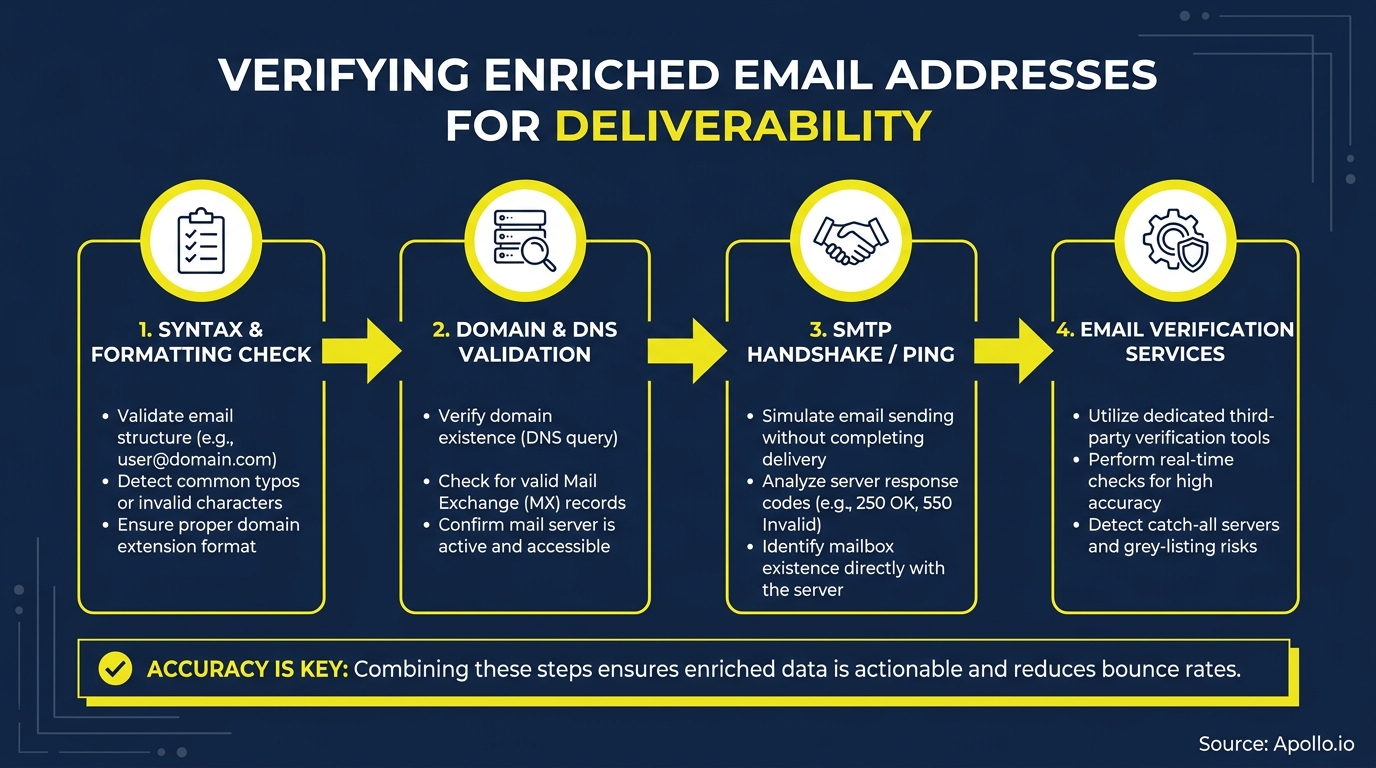
Verifying enriched email deliverability requires three sequential stages: pre-send validation, authentication alignment, and post-send monitoring.
Stage 1: Pre-Send Validation
- Syntax check: Confirm format validity (no typos, valid domain structure).
- MX record lookup: Confirm the domain has a mail exchange server configured.
- SMTP verification: Ping the mailbox without sending a message to check if it accepts mail.
- Catch-all detection: Flag domains that accept all addresses regardless of existence. Catch-all addresses pass SMTP checks but can bounce or silently filter after delivery.
- Role-account flags: Suppress addresses like info@, support@, or admin@. These generate complaint rates, not replies.
- Spam-trap risk scoring: Cross-check against known honeypot address patterns.
According to Gamalogic, email verification typically sees bounce rates drop from 15-20% down to under 6%. That improvement is only achievable when catch-all and role-account filtering is part of the pre-send workflow, not just SMTP pinging.
Tired of bounce-heavy sequences? Apollo's contact enrichment platform includes built-in email verification with 97% accuracy, so your outbound starts with data that's already been validated.
Stage 2: Authentication Alignment
- Confirm SPF, DKIM, and DMARC records are published and passing for your sending domain.
- Align your "From" domain with your authentication records. Misalignment causes deferrals that look like bad data.
- Use a subdomain for cold outbound to protect your primary domain reputation.
Authentication failures are a hidden cause of apparent deliverability problems with enriched data. An address can be valid while your domain configuration causes the rejection.
What Is the Deliverability Scorecard for Enriched Campaigns?
A deliverability scorecard separates four metrics that are often conflated. Use this table as your campaign go/no-go framework before scaling sends.
| Metric | Definition | Target Threshold | Warning Threshold |
|---|---|---|---|
| Delivery Rate | Server accepted the message | >97% | <95% |
| Inbox Placement Rate | Message reached primary inbox | >85% | <75% |
| Spam Placement Rate | Message routed to spam folder | <5% | >8% |
| Spam Complaint Rate | User-reported spam (Postmaster Tools) | <0.1% | >0.3% |
The spam complaint thresholds above are not arbitrary. Google's bulk sender guidelines require senders to keep spam rates below 0.1% and explicitly state that rates reaching 0.3% or higher remove sender eligibility for mitigations. This became enforced policy in June 2024.

How Do Microsoft and Gmail Require Different Approaches?
Provider-specific segmentation is required because Microsoft and Gmail enforce deliverability rules differently, and mixing them into a single send strategy creates blind spots.
| Provider | Key Characteristic | Specific Action |
|---|---|---|
| Gmail / Google Workspace | Spam complaint rate enforcement via Postmaster Tools | Monitor complaint rates daily. Keep below 0.1%. Suppress unengaged contacts before rate hits 0.3%. |
| Microsoft / Outlook / Hotmail | Stricter DMARC alignment; toughest inbox placement of major providers | Enforce strict DMARC alignment. Throttle volume on Outlook-heavy lists. Segment and test separately. |
Microsoft has tightened high-volume sender requirements, including stricter DMARC alignment expectations for senders sending at scale. For RevOps teams managing sending infrastructure, this means enriched addresses at Outlook or Hotmail domains require their own deliverability controls, not a one-size-fits-all send policy.
Turn Funnel Gaps Into Pipeline Wins
Pipeline forecasting a guessing game because quality leads never make it past the top? Apollo surfaces in-market buyers at exactly the right moment, turning weak lead flow into real opportunities. 600K+ companies stopped guessing and started closing.
Start Free with Apollo →How Should SDRs and RevOps Teams Set a Re-Verification Cadence?
Re-verification cadence should be tied to list decay rate, not a fixed calendar schedule. B2B contact data degrades continuously as contacts change roles, leave companies, or have their domains reconfigured.
A practical cadence framework:
- At enrichment: Run full pre-send validation on all newly enriched contacts before adding to sequences.
- Every 60-90 days: Re-verify contacts in active sequences who have not engaged (no opens, clicks, or replies).
- After hard bounces: Suppress immediately and flag the domain for catch-all review.
- After complaint spikes: Pause the sequence, audit the list segment, and remove risky addresses before resuming.
- At ICP job-change signals: Re-verify when enrichment data flags a contact's title or company has changed.
Around 61% of email marketers reported that inbox placement became more difficult from 2023 to 2024, according to UseBouncer. The teams closing that gap are those treating verification as a continuous operation, not a one-time list clean.
Spending too much time managing list hygiene manually? Apollo's sales engagement platform integrates verified contact data with automated sequences, so your outreach runs on clean data from day one without managing five separate tools.
What Tools Do You Need for Post-Send Monitoring?
Post-send monitoring requires tooling beyond your ESP's delivery dashboard. These are the core instruments:
- Google Postmaster Tools: Free. Tracks spam complaint rate and domain reputation for Gmail recipients. Required for any team sending cold outbound to Google Workspace or Gmail addresses.
- Microsoft SNDS (Smart Network Data Services): Free. Monitors IP reputation and complaint data for Outlook/Hotmail recipients.
- Seed testing: Place test addresses across Gmail, Outlook, and other providers in your list. After sending, check where seed messages landed to measure actual inbox placement by provider.
- Bounce classification: Separate hard bounces (permanent failures) from soft bounces (temporary). Hard bounces from enriched addresses signal bad data. Suppress immediately.
For AEs and sales leaders reviewing campaign health, the actionable signal is not overall delivery rate. It's the inbox placement rate per provider segment and the spam complaint rate trend over time. A rising complaint rate on Gmail-heavy lists is an early warning that enriched address quality or message relevance needs attention. Read more in our guide on email deliverability and how to reach inboxes while avoiding spam filters.
How Can You Build a Pre-Send Verification Checklist?
Use this checklist before launching any sequence built on enriched contact data.
- Run syntax validation on the full list. Remove malformed addresses.
- Verify MX records exist for all domains in the list.
- SMTP-verify all addresses. Flag and quarantine catch-all results.
- Suppress role-based accounts (info@, hello@, support@, etc.).
- Check sending domain SPF, DKIM, and DMARC alignment.
- Confirm sending subdomain is warmed and has a positive reputation baseline.
- Segment the list by recipient domain provider (Gmail, Outlook, other).
- Set provider-specific daily send volume limits before launching.
- Confirm Google Postmaster Tools and Microsoft SNDS are connected and monitored.
This checklist applies equally to SDRs launching a new sequence and to improving deliverability across existing email sequences. The pre-send gate is the most cost-effective point to catch deliverability risk before it damages your sender reputation.

Start Outbound With Data You Can Trust
Verifying enriched email deliverability is a three-layer discipline: pre-send validation that goes beyond SMTP checks, authentication alignment that stops domain-level failures from masking data quality, and continuous post-send monitoring segmented by provider.
The teams that outperform on inbox placement are those treating verification as an ongoing operation, not a checkbox at list import. For B2B GTM teams that need to consolidate their data, engagement, and monitoring workflow into one system, Apollo brings enrichment, verification, and sequencing together. "Having everything in one system was a game changer," as Cyera's team put it.
Ready to start outbound with verified, deliverable contact data? Try Apollo free and access 230M+ business contacts with 97% email accuracy, built-in verification, and multi-channel sequencing in one platform.
Prove Pipeline ROI With Apollo
ROI pressure killing your tool budget? Apollo delivers measurable pipeline impact from day one — not months later. Leadium 3x'd annual revenue. Your CFO will thank you.
Start Free with Apollo →Don't miss these
Sales
Inbound vs Outbound Marketing: Which Strategy Wins?
Sales
What Is a Sales Funnel? The Non-Linear Revenue Framework for 2026
Sales
What Is a Go-to-Market Strategy? The 2026 GTM Playbook
See Apollo in action
We'd love to show how Apollo can help you sell better.
By submitting this form, you will receive information, tips, and promotions from Apollo. To learn more, see our Privacy Statement.
4.7/5 based on 9,690 reviews
