
How to Use Lead Tagging to Organize Your Prospect Lists in 2026
Most prospect lists fail not because of bad data, but because of no structure. When every lead looks the same, reps waste time on the wrong contacts, sequences miss the mark, and deals stall before they start. Building a sales prospecting list that converts requires more than names and emails — it requires a tagging system that tells your team who each contact is, where they are in the buying process, and what they need next.
Lead tagging solves this by turning a flat list into a segmented, actionable database. This guide covers the exact frameworks SDRs, RevOps teams, and sales leaders need to build an AI-ready tagging system in 2026.

Build Pipeline Without the Manual Grind
Tired of your reps burning hours on research instead of selling? Apollo delivers verified contacts and AI-powered prospecting so your team scales without the busywork. Join 600K+ companies building predictable pipeline.
Start Free with Apollo →Key Takeaways
- Lead tagging organizes prospect lists by role, intent, buying stage, and channel preference — making outreach faster and more relevant.
- Modern B2B deals involve multiple stakeholders, so tagging must map entire buying groups, not just individual contacts.
- Inconsistent or free-form tags degrade AI segmentation and automation — governed taxonomies are now a competitive necessity.
- Content engagement signals (asset downloads, topic interest) are highly taggable and convert directly into reusable intent-based prospect lists.
- Apollo's unified platform lets GTM teams build, tag, segment, and activate prospect lists without juggling multiple tools.
What Is Lead Tagging and Why Does It Matter in 2026?
Lead tagging is the practice of applying structured labels to contacts in your CRM or sales platform to categorize them by attributes like buying role, intent level, industry, deal stage, or channel preference. Tags transform static contact records into dynamic, filterable segments your team can act on immediately.
According to Lead Forensics, companies using CRM report a 17% increase in lead conversion, a 15% uplift in customer retention, and sales representatives who are 21% more productive. Tagging is the layer that makes CRM data usable at scale.
In 2026, tagging has become essential for a second reason: AI. Salesforce's State of Sales report found 84% of sales teams with AI are prioritizing data hygiene to support it.
Inconsistent tags — free-text labels, duplicates, undefined values — reduce the quality of AI-driven routing, scoring, and personalization. Clean tags are clean inputs for every automated workflow downstream.
How Do You Build a Buying-Group Tagging Taxonomy?
A buying-group tagging taxonomy assigns structured labels to every stakeholder within a target account, not just the primary contact. This is the foundation of account-based prospecting.
Forrester's Buyers' Journey Survey (2025) found 73% of B2B purchases involve 3+ departments, with an average of 13 internal stakeholders. A single-contact approach leaves most of the buying group untagged and unengaged.
Start with this minimal viable tag set:
| Tag Category | Example Values | Purpose |
|---|---|---|
| Buying Role | Champion, Blocker, Influencer, Exec Sponsor, Finance, Security | Sequence and content routing by role |
| Deal Stage | Awareness, Evaluation, Decision, Stalled, Closed-Lost | Pipeline stage targeting |
| Stall Reason | Budget-Hold, Security-Review, Implementation-Concern, Competitor-Eval | Unblocking stalled deals with relevant assets |
| Intent Signal | High-Intent, Topic-AI, Topic-Compliance, Asset-Downloaded | Content personalization and prioritization |
| Channel Preference | Rep-Led, Digital-First, Self-Serve, Email-Only | Outreach channel matching |
| Consent/Eligibility | OK-to-Email, Region-EU, Opt-Out | Compliance and activation gating |
Struggling to find and segment the right contacts for your accounts? Search Apollo's 230M+ contacts with 65+ filters to build tagged prospect lists instantly.

How Do SDRs and RevOps Teams Use Tags to Prevent Stalled Deals?
SDRs and RevOps teams use stall-reason tags to trigger the right content or follow-up action for each blocked deal, rather than sending generic nurture sequences that don't address the actual friction.
Forrester's State of Business Buying (2024) found 86% of B2B purchases stall during the buying process. The fix is mapping stall reasons directly to content assets. Use this framework:
- Tag: Budget-Hold — Send ROI calculators, TCO comparisons, and phased implementation proposals.
- Tag: Security-Review — Route security FAQs, compliance documentation, and IT-specific case studies to the security stakeholder.
- Tag: Implementation-Concern — Share onboarding timelines, customer success stories, and technical specs.
- Tag: Competitor-Eval — Trigger comparison content and champion enablement materials.
For AEs managing active opportunities, stall-reason tags eliminate guesswork. Instead of asking "why is this deal stuck?" the tag already has the answer — and the sequence fires automatically. Pair this with proven prospect nurturing strategies to keep hesitant leads moving forward.
Turn Funnel Chaos Into Qualified Pipeline
Tired of watching marketing leads stall before they ever reach your reps? Apollo's AI pinpoints in-market buyers and routes the right prospects at right moment. Over 600K companies build predictable pipeline with Apollo.
Start Free with Apollo →What Makes a Tagging System AI-Ready?
An AI-ready tagging system uses controlled vocabularies, enforced naming conventions, and ownership rules — so that automated segmentation, routing, and personalization have clean, consistent inputs to work with.
Free-form tags break AI workflows. When one rep tags a lead "hot" and another tags them "High Priority - Hot Lead Q2," those are two different tags in the system — and neither feeds reliably into automated segments or scoring models. Research from Anteriad's 2024 B2B Marketing Data Report found 60% of marketers reported improving data quality as a top challenge, while 66% identified it as a top priority. Tagging governance is where data quality begins.
AI-ready governance rules to implement now:
- Controlled vocabulary: Use a predefined list of allowed tag values. No free-text tags.
- Tag ownership: Assign each tag category to Sales Ops or Marketing Ops — not both.
- Tag inheritance: When an account tag updates (e.g., deal stage), child contact tags update automatically.
- Quarterly audits: Review unused tags, consolidate duplicates, and retire outdated labels.
- Eligibility tags: Bake consent and channel permissions into the tag set (e.g., "OK-to-Email," "Region-EU") to prevent reps from working leads that can't be activated.
How Do You Convert Content Signals Into Tagged Prospect Lists?
Content engagement signals become tags when you map each asset to a topic, intent level, and buying stage — then apply those tags automatically when a prospect engages with that content.
This creates reusable, intent-based prospect lists from first-party data. The Insight Collective reports that optimizing data value is the principal concern for 74% of marketing operations professionals. Content signal tagging is one of the highest-ROI ways to do it.
A practical content-to-tag mapping looks like this:
- Downloaded: "AI Implementation Checklist"→ Tags: Topic-AI, Intent-High, Asset-Downloaded
- Attended: Security Webinar→ Tags: Topic-Compliance, Buying-Role-Security, Intent-Active
- Viewed: Pricing Page 3+ times → Tags: Intent-High, Channel-Digital-First, Deal-Stage-Evaluation
Once tagged, these contacts auto-populate dynamic lists that feed directly into sequences, ads, or rep queues. Tags shift from organization labels to revenue metadata. For more on building lists from intent signals, see lead lists that actually convert.
How Should Tags Reflect Digital-First Buying Behavior?
Tags should reflect how prospects actually buy — and a growing share of B2B revenue now flows through digital channels. McKinsey's 2024 B2B Pulse Survey found online sales account for 34% of B2B revenue, with 71% of respondents offering some form of e-commerce.
Build channel-preference tags that match your outreach to how each buyer wants to transact:
- Self-Serve: Prospects who trial, explore docs, or use free tools without rep contact.
- Digital-First: Buyers who research, evaluate, and prefer async communication before talking to sales.
- Rep-Led: High-complexity deals where stakeholders prefer guided discovery calls.
- Commerce-Ready: Accounts with confirmed budget and authority who are ready to transact.
Spending too much time manually sorting leads by channel behavior? Automate multi-channel sequences in Apollo and route leads based on tag-driven rules.
What Does a Lead Tagging Implementation Checklist Look Like?
A lead tagging implementation checklist defines your taxonomy, assigns ownership, sets automation rules, and establishes KPIs — all before a single tag goes live.
Use this checklist to launch or audit your tagging system:
- Define tag categories: Buying Role, Deal Stage, Stall Reason, Intent Signal, Channel Preference, Eligibility.
- Build controlled vocabulary: Document all allowed values per category. Share with both Sales and Marketing Ops.
- Assign ownership: One team owns each tag category. No overlapping jurisdictions.
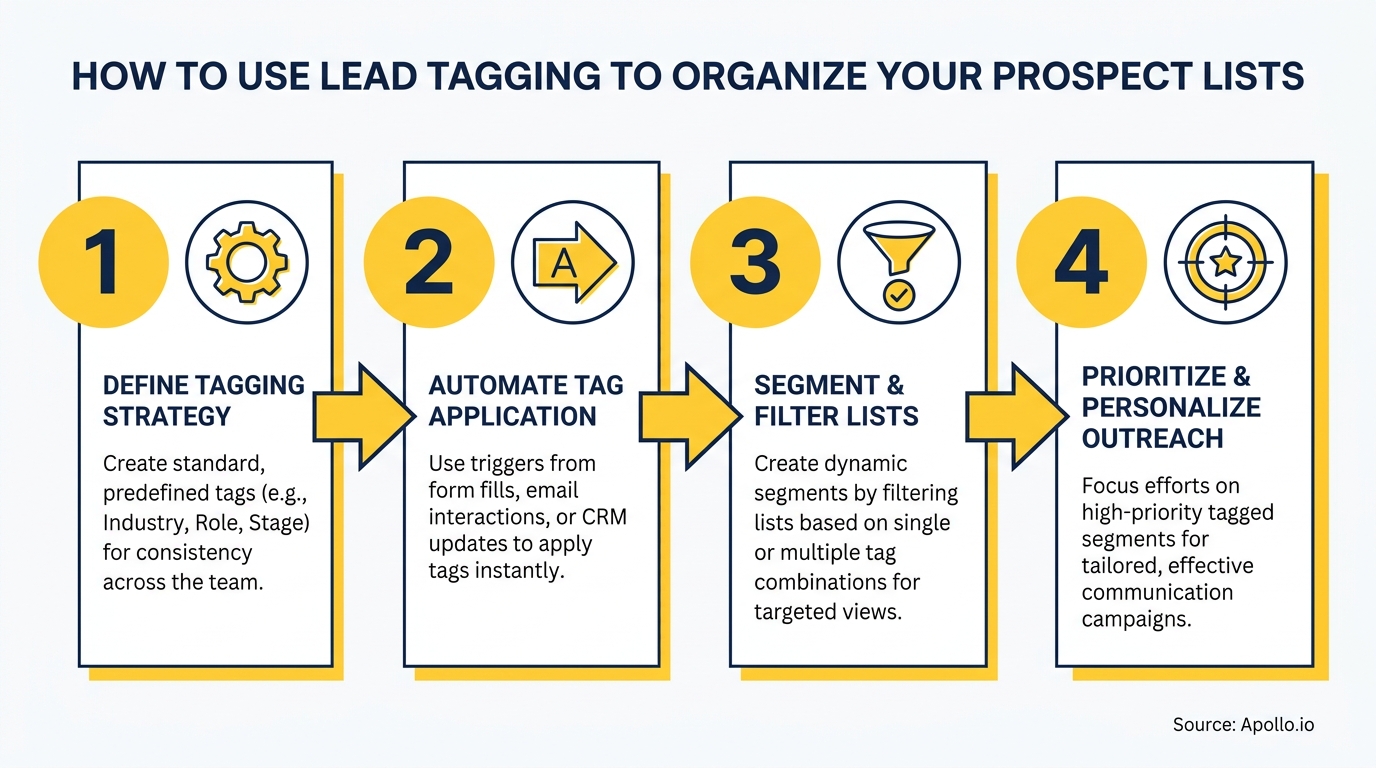
- Automate tag application: Use CRM workflows or your sales platform to apply tags based on actions (form fill, page visit, email click, stage change).
- Connect tags to sequences: Each tag combination should trigger a corresponding outreach sequence or content send.
- Set audit cadence: Quarterly review of unused, duplicate, and outdated tags.
- Track tag-level KPIs: Conversion rate by tag, sequence reply rate by buying role, pipeline velocity by stall-reason tag.
For SDRs starting from scratch on list building, pair this checklist with a structured outbound prospecting approach that feeds clean contacts into your tagging system from day one.

Start Tagging Smarter with Apollo
Lead tagging works best when your data, sequences, and workflows live in one place. Fragmented stacks mean tags don't sync, segments go stale, and reps work from different versions of the truth.
Apollo gives B2B GTM teams — from SDRs to RevOps leaders — a unified platform to find contacts, apply tags, build segments, and launch sequences without switching tools. As Cyera put it: "Having everything in one system was a game changer."
Trusted by nearly 100K paying customers including Anthropic, Redis, and Smartling, Apollo consolidates your sales tech stack so your tagging system actually drives pipeline — not just organization.
Get Leads Now — build your first tagged prospect list in Apollo for free.
Prove Pipeline ROI Before Next QBR
ROI pressure killing your tool budget? Apollo delivers measurable pipeline impact your leadership can see — fast. Leadium 3x'd annual revenue. Start your free trial and show results before the next renewal conversation.
Start Your Free Trial →Don't miss these
Sales
Inbound vs Outbound Marketing: Which Strategy Wins?
Sales
What Is a Sales Funnel? The Non-Linear Revenue Framework for 2026
Sales
What Is a Go-to-Market Strategy? The 2026 GTM Playbook
See Apollo in action
We'd love to show how Apollo can help you sell better.
By submitting this form, you will receive information, tips, and promotions from Apollo. To learn more, see our Privacy Statement.
4.7/5 based on 9,690 reviews
