
How Can I Use Firmographic Data to Prioritize My Prospect List in 2026?
Most prospect lists aren't bad because of missing contacts. They're bad because every account gets treated the same. Firmographic data fixes that by giving you a scalable, objective way to sort who deserves your attention first, what motion to use, and which accounts to suppress entirely. If you want to build a sales prospecting list that converts, firmographic segmentation is where it starts.

Research Less, Pipeline More With Apollo
Tired of your reps burning hours on manual lead research instead of selling? Apollo surfaces verified contacts and ICP-fit accounts instantly. Join 600K+ companies building predictable pipeline from day one.
Start Free with Apollo →Key Takeaways
- Firmographic data works best as a binary pass/fail filter first, then a ranking layer second. Use it to remove poor-fit accounts before SDRs burn a single touch.
- A 2025 Gartner survey of 632 B2B buyers found 73% actively avoid suppliers that send irrelevant outreach. Firmographic suppression is your first line of defense.
- Firmographics should map to channel motion: enterprise accounts route to ABM and buying-group content; SMB routes to product-led or self-serve paths.
- Data decay makes scoring drift. Contact data goes stale at 22-30% annually, so enrichment governance isn't optional.
- Apollo consolidates firmographic filtering, enrichment, and outreach sequencing in one platform, replacing the need for multiple point solutions.
What Is Firmographic Data and Why Does It Drive Prioritization?
Firmographic data is the set of company-level attributes used to classify and segment B2B accounts: industry, employee count, revenue range, geography, funding stage, tech stack, and business model. It answers the question "does this company fit our ICP?" before any human time is spent.
A Reddit user shared a firsthand perspectivethat cuts to the core of how many teams misuse this data: "Company size, industry, job title — that's a list. An ICP tells you why a specific type of company has the problem you solve, badly enough to pay for it. Those are different things and they produce very different targeting logic." Firmographics are the filter. Your ICP hypothesis is the logic behind the filter.
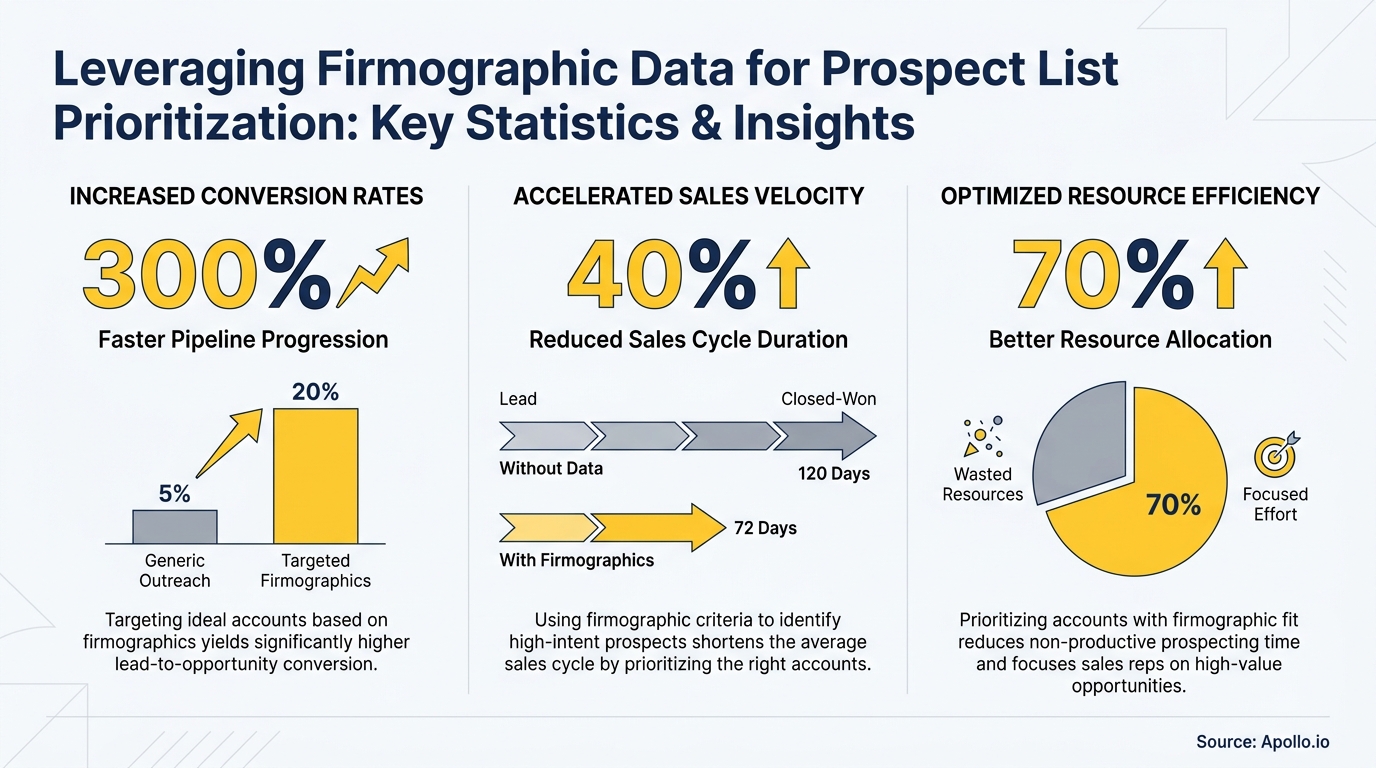
According to Forage.ai, companies using detailed firmographic data for account targeting achieve 73% larger deal sizes. That gap comes from routing effort toward accounts that actually fit, not from working harder on everything.
How Do You Build a Firmographic Scoring Model?
A firmographic scoring model assigns point values to company attributes so accounts can be ranked and tiered automatically. Start with your highest-value closed-won accounts and identify the attributes they share.
The core fields to weight are:
- Industry / NAICS code: Which verticals close fastest and at highest ACV?
- Employee band: What headcount range aligns with your product's value proposition?
- Revenue range: Does your pricing fit their budget reality?
- Geography / HQ region: Any regulatory, language, or go-to-market constraints?
- Funding stage / growth signal: Recent Series B funding often signals budget availability and urgency.
- Tech stack: Integrations or competitive indicators that affect fit.
Assign scores (e.g., 0, 5, or 10 per field) and set a threshold. Accounts below the threshold are suppressed from active sequences entirely.
Those above it get tiered. This is the shift from "scoring" to "gating" that leading GTM teams now treat as standard practice.
Research from My-Outreach confirms that firmographic data is considered the core of B2B lead scoring, allowing teams to prioritize prospects by adding firmographic variables to lead scoring models that fit their ICP. Pair that with intent data signals to rank which in-fit accounts are actively in-market right now.
Struggling to find qualified leads at scale? Search Apollo's 230M+ contacts with 65+ firmographic and technographic filters to build your scored prospect list in minutes.

How Should SDRs and RevOps Use Account Tiers to Route Outreach?
SDRs and RevOps teams should map each firmographic tier to a distinct channel motion and cadence, not just a priority label. The tier determines the sequence type, the number of touches, and who owns the account.
A sales professional wrote on Redditwith a practical framework that applies directly: "Segment the accounts according to company sizes and industries. Tier 1 should be your must-win accounts — no bigger than 10. Tier 2 gets industry-specific, persona-specific outreach. Tier 3 gets monthly mass email. Tier 4 gets a quarterly touch." The firmographic data powers each of those decisions.
| Tier | Firmographic Profile | Channel Motion | Cadence Owner |
|---|---|---|---|
| Tier 1 | Enterprise, high ACV industry, funded, tech-stack match | ABM + buying-group content + direct outbound | AE + SDR paired |
| Tier 2 | Mid-market, strong industry fit, moderate headcount | Personalized multi-channel sequence | SDR |
| Tier 3 | SMB, ICP industry, limited budget signals | Product-led / self-serve + monthly email | Marketing automation |
| Suppressed | Wrong industry, wrong size, wrong region | No outreach | N/A |
McKinsey's 2024 B2B Pulse found B2B customers now use an average of 10 interaction channels in a buying journey. That complexity makes firmographic-based channel routing essential.
Without it, reps default to the same motion for every account, wasting high-effort touches on self-serve accounts and under-investing in enterprise ones.
For Account Executives managing Tier 1 accounts, firmographic data also tells you how large and complex the buying group is likely to be. Gartner's May 2025 research found buying groups range from five to 16 people across up to four functions.
A larger, regulated-industry account needs consensus-building assets and multi-stakeholder sequencing from the first touch.
Turn Funnel Guesswork Into Real Pipeline
Tired of watching marketing leads stall before they ever reach sales? Apollo surfaces ICP-fit buyers with intent signals so your team acts first. 600K+ companies stopped guessing and started closing.
Start Free with Apollo →How Does Firmographic Data Improve Buying-Group Alignment?
Firmographic data improves buying-group alignment by giving you the account-level context needed to message all stakeholders consistently, not just the primary contact. A Gartner survey published in May 2025 found that buying groups reaching consensus are 2.5x more likely to report their deal was high-quality, and that buying-group relevance increases consensus by 20%.
The practical implication: when you know an account's industry, size, and regulatory environment, you can map which functions are likely involved (IT, Finance, Legal, Operations) and tailor outreach for each. A fintech SaaS selling to a 500-person financial services firm requires different messaging for the CISO than for the VP of Revenue, but the firmographic profile predicts both are in the room.
Companies with aligned ABM strategies built on solid firmographic foundations have seen a 208% increase in business revenue, according to AI-Ark. That result requires messaging coherence across the buying group, which starts with account-level firmographic context.
Why Does Data Freshness Govern Firmographic Prioritization Quality?
Data freshness governs prioritization quality because stale firmographic fields silently break your scoring model, routing logic, and sequence triggers. A tier assignment based on 18-month-old employee data or an outdated industry code will send enterprise-level sequences to a company that has since contracted, or suppress a recently funded prospect that now fits your ICP.
SalesMotionreports that B2B data decays at an alarming rate, with contact data going stale at 22-30% annually. Company-level attributes shift too: headcount changes with hiring and layoffs, funding status updates with new rounds, and tech stack evolves with new purchases.
A practical data enrichment strategyshould include:
- Automated enrichment on new records: Fill firmographic fields at point of entry, not retroactively.
- Quarterly refresh cycles: Re-enrich existing CRM accounts on a schedule.
- Field completeness thresholds: Suppress records from scoring if critical fields (industry, headcount band) are missing.
- Change alerts: Trigger re-scoring when funding stage, employee count, or tech stack changes.
Tired of working from incomplete or outdated account data? Apollo's data enrichment keeps your CRM records accurate with 65+ verified firmographic attributes, so your scoring and routing stay reliable.
RevOps leaders should also define SLAs: how quickly a new inbound lead gets firmographically enriched before entering a sequence, and how long an account can sit with missing fields before it's flagged for review. Learn more about how contact data enrichment drives ROI when governance is built in from the start.
What Firmographic Fields Matter Most for Prioritization?
The highest-signal firmographic fields for prospect prioritization are industry, employee count, revenue range, funding stage, geography, and technology stack. These six attributes collectively predict deal size, sales cycle length, budget availability, and stakeholder complexity.
- Industry: Most predictive of whether your solution solves a real problem at this account type.
- Employee count: Proxy for organizational complexity, budget, and likely buying group size.
- Revenue range: Determines whether your pricing fits their spend capacity.
- Funding stage: Recent funding correlates with active investment and urgency to build.
- Geography: Determines legal, language, and competitive considerations.
- Tech stack: Reveals integrations they need, competitors already in the account, and technical sophistication.
Not all fields deserve equal weight. Score industry and employee count most heavily because they determine fit at the most fundamental level.
Funding stage and tech stack are strong secondary signals. Geography is often a binary pass/fail, not a gradient score.
For teams building or refining their ICP, data-driven prospecting strategies can help identify which firmographic patterns appear in your best closed-won accounts versus churned customers.
How to Start Using Firmographic Data in 2026
Start by auditing your CRM for firmographic field completeness, then score your existing accounts before building new lists. Most teams discover their scoring model is broken not because the logic is wrong, but because the data fields it relies on are blank or outdated.
A practical implementation sequence:
- Pull your top 20 closed-won deals. Identify the firmographic attributes they share.
- Define pass/fail thresholds for each attribute (e.g., 50-500 employees, SaaS or financial services, US or UK HQ).
- Enrich your full CRM against those fields using a sales intelligence and lead database.
- Apply your scoring model and assign tier labels in CRM.
- Map each tier to a channel motion and sequence type.
- Set a quarterly enrichment refresh to prevent score drift.
Companies using lead scoring see a 77% higher ROI from lead generation. The firms achieving that result have systematized their firmographic inputs, not just their scoring logic. "Having everything in one system was a game changer," noted Cyera — a sentiment that reflects what happens when enrichment, scoring, and sequencing live in one unified platform rather than three separate tools.
Apollo brings firmographic filtering, automated enrichment, and multi-channel sequencing into one workspace, so SDRs, AEs, and RevOps teams work from the same scored, verified account data without stitching together multiple vendors.

Start Prioritizing Smarter Prospects Today
Firmographic data transforms a flat contact list into a prioritized, tiered pipeline where every rep knows exactly where to focus, what motion to use, and which accounts to skip. The teams winning in 2026 treat firmographic fit as a gate, not just a signal, and they back it with governed enrichment so their scoring never drifts.
Whether you're an SDR building your first territory plan or a RevOps leader systematizing prioritization across a full team, the framework is the same: define fit, score it, tier it, and keep the data fresh. Apollo gives you the database, enrichment engine, and sequencing tools to execute all of it without a fragmented tech stack.
Get Leads Now and start building a firmographic-first prospect list with Apollo's 230M+ verified contacts and 65+ search filters.
Prove Pipeline ROI With Apollo
ROI pressure killing your tool budget? Apollo delivers measurable pipeline impact from day one — so you walk into every budget review with numbers, not guesses. Leadium 3x'd their revenue. You're next.
Start Free with Apollo →Don't miss these
Sales
Inbound vs Outbound Marketing: Which Strategy Wins?
Sales
What Is a Sales Funnel? The Non-Linear Revenue Framework for 2026
Sales
What Is a Go-to-Market Strategy? The 2026 GTM Playbook
See Apollo in action
We'd love to show how Apollo can help you sell better.
By submitting this form, you will receive information, tips, and promotions from Apollo. To learn more, see our Privacy Statement.
4.7/5 based on 9,690 reviews
