
How to Track Email Open Rates and Reply Rates for Your Campaigns in 2026
Open rates are lying to you. Apple's Mail Privacy Protection pre-loads tracking pixels, bot scanners fire clicks in milliseconds, and inbox providers now penalize senders who exceed a 0.3% spam complaint threshold. If you're still reporting opens as your primary success metric, you're optimizing for a signal that no longer reflects human engagement. This guide gives you a deliverability-first measurement framework that ties every email metric back to pipeline outcomes. For the foundational work of writing emails that earn replies, start with how to write sales emails that get responses.

Research Less, Close More With Apollo
Tired of burning hours verifying contacts before a single email goes out? Apollo surfaces accurate business contacts instantly so your team spends time selling, not searching. Nearly 100K paying customers have already made the switch.
Start Free with Apollo →Key Takeaways
- Open rates are a diagnostic signal, not a primary KPI. Privacy protections inflate them and bot activity corrupts them.
- Your measurement stack should flow from deliverability to engagement to pipeline: delivered, inboxed, clicked, replied, booked, revenue influenced.
- Positive reply rate (interested responses only) is a more actionable metric than total reply rate.
- Authentication gaps (SPF, DKIM, DMARC) suppress inbox placement, which makes all downstream metrics unreliable.
- SDRs and RevOps teams that connect reply tracking to CRM pipeline data can prove email ROI where most teams cannot.
Why Are Open Rates Unreliable in 2026?
Open rates are unreliable because privacy tools and security scanners fire tracking pixels without a human ever reading the email. As noted by Martal, Apple's Mail Privacy Protection (MPP) has inflated reported open rates since 2022 by pre-loading tracking pixels automatically. This means a 50% open rate could reflect machine activity as much as genuine prospect interest.
The downstream consequence: open-rate-based decisions lead to false confidence in subject lines, send times, and list quality. Teams optimize the wrong variable and miss the metrics that actually predict revenue.
Use opens as a directional, segment-level filter only, not as a campaign success measure.
What Is the Right Email Measurement Stack?
The right measurement stack flows from deliverability to engagement to revenue, in that order. Every engagement metric is meaningless if your emails don't reach the inbox. Here is the full hierarchy:
| Layer | Metric | Why It Matters |
|---|---|---|
| Deliverability | Bounce rate, spam complaint rate, inbox placement rate | Determines whether engagement is even measurable |
| Authentication | SPF/DKIM/DMARC alignment | Missing auth depresses inbox placement regardless of content quality |
| Engagement | Click rate, reply rate, positive reply rate | Reliable human-intent signals post-MPP |
| Pipeline | Meetings booked, opportunities created, revenue influenced | Ties email activity to business outcomes |
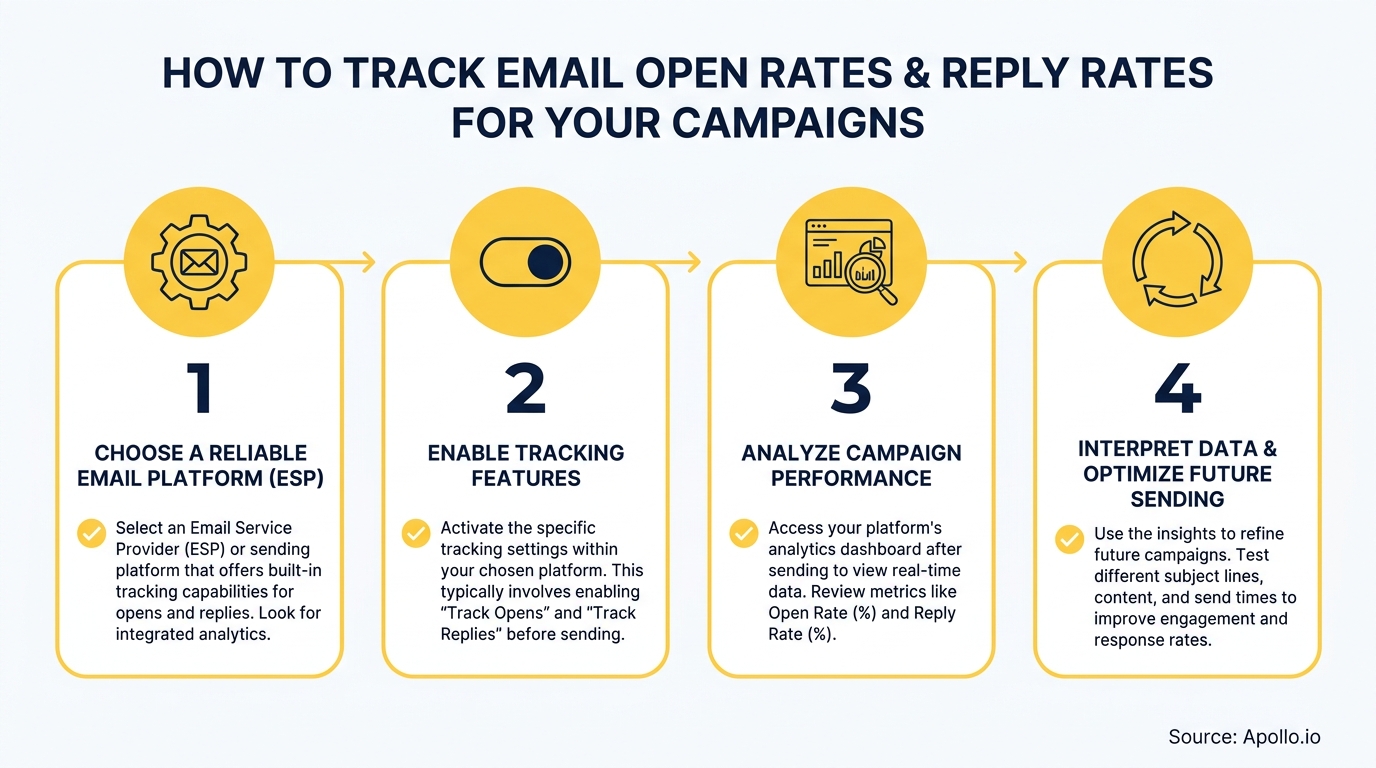
According to Campaign Monitor, many ESPs and CRM platforms offer built-in dashboards to monitor open rates, click-through rates, and other key metrics for individual and overall campaigns. Start there, then layer in deliverability monitoring and CRM attribution to complete the picture. Good email deliverability practices are the foundation before any metric tracking matters.
How Do You Calculate and Track Reply Rate Accurately?
Reply rate is calculated by dividing the number of unique human replies by the number of delivered emails, then multiplying by 100. As Count.co confirms, the key word is "unique human replies" — auto-replies, out-of-office messages, and bounce notifications must be excluded from the numerator.
For B2B outreach campaigns, track reply rate at three levels:
- Total reply rate: All responses including OOO, unsubscribes, and negative replies
- Positive reply rate: Interested or meeting-request responses only
- Conversation depth: Multi-turn replies that indicate genuine engagement
Positive reply rate is the metric that predicts pipeline. A campaign with a 10% total reply rate but only 1% positive reply rate is underperforming. Categorize every reply as: Interested, Not Interested, OOO, Unsubscribe, or Other. Feed those categories into your CRM so RevOps can attribute replies to opportunities. Pairing strong reply tracking with email personalization strategies consistently improves positive reply rates.
Spending hours manually sorting replies and updating CRM records? Apollo's sales engagement platform automates sequence tracking and reply categorization in one unified workspace.
Turn Funnel Guesswork Into Closed Deals
Pipeline forecasting a guessing game because leads stall before they ever reach your AEs? Apollo surfaces high-intent prospects and keeps your funnel moving with verified contacts that convert. Nearly 100K paying customers stopped guessing and started closing.
Start Free with Apollo →How Do SDRs and RevOps Teams Connect Email Metrics to Pipeline?
SDRs and RevOps teams connect email metrics to pipeline by syncing engagement events from their outreach platform directly into CRM deal records. Without this connection, email performance lives in a reporting silo and can't prove ROI.
Practical steps for RevOps teams:
- Map sequence steps to CRM stages so a positive reply auto-advances a contact to "Meeting Requested"
- Tag opportunities with the campaign and sequence that generated the first reply
- Build a dashboard showing: emails sent → replies → positive replies → meetings booked → opportunities created → revenue influenced
- Monitor spam complaint rate alongside reply rate. Google's bulk sender guidelines state that senders exceeding a 0.3% spam complaint rate become ineligible for mitigation support, meaning your deliverability can degrade suddenly and suppress all downstream metrics.
For AEs managing active deals, reply tracking in a unified platform also surfaces re-engagement signals when prospects respond to nurture sequences. This keeps deal context in one place rather than scattered across inboxes and spreadsheets. Check out how to improve email deliverability in 5 steps to ensure your tracking data reflects true inbox performance.

What Authentication and Deliverability Checks Protect Your Metrics?
Authentication gaps are a hidden cause of poor engagement metrics. If your emails land in spam, your reply rate measures the performance of your spam folder, not your copy.
SPF, DKIM, and DMARC alignment ensure inbox providers recognize your sending domain as legitimate.
Key checks to run before analyzing any campaign data:
- SPF record: Authorizes your sending IP
- DKIM signature: Cryptographically signs your emails
- DMARC policy: Instructs providers what to do with unauthenticated mail
- Postmaster Tools (Google/Yahoo): Monitor domain reputation and complaint rates directly from providers
- Bounce classification: Separate hard bounces (invalid addresses) from soft bounces (temporary delivery failures) and remove hard-bounce addresses immediately
Maintaining a clean, verified contact list is the first line of defense. Learn how to verify email addresses for B2B sales to reduce bounce rates before they damage your sender reputation.
How Can Open Rate Data Still Be Used Without Being Misleading?
Open rate data remains useful as a filtered diagnostic signal when you account for its distortions. The approach: segment your open data by email client, filter out Apple Mail users where MPP is active, and look for relative trends rather than absolute numbers.
Practical uses for filtered open rate data:
- Subject line A/B testing: Compare variants within the same send, same audience. Relative differences are directional even if absolute numbers are inflated. Data from Forbes shows personalized subject lines can increase open rates by 20-26%, making subject line testing still worth running as a relative comparison tool.
- Send-time optimization: Use open timing data (filtered for machine-speed opens) to identify when human engagement peaks. Pair this with guidance on the best time to email and call prospects.
- List health monitoring: A sustained drop in filtered open rate signals list decay or deliverability degradation, prompting a re-verification pass.
Struggling to get replies even when opens look healthy? Apollo's AI-powered messaging tools generate personalized email content that drives measurable reply-rate improvements, with teams reporting a 35% increase in bookings with AI-powered messaging.

Start Tracking the Metrics That Actually Drive Revenue
The shift from open-rate reporting to a deliverability-first KPI stack is not optional in 2026. Privacy protections, bulk-sender enforcement, and authentication requirements have fundamentally changed what email metrics mean.
The teams winning in B2B outreach track positive reply rate, meetings booked, and pipeline influenced, backed by authentication hygiene and real-time deliverability monitoring.
Apollo gives SDRs, AEs, and RevOps teams a unified platform to run sequences, track replies, categorize engagement, and connect it all to pipeline, without stitching together five separate tools. As Census put it: "We cut our costs in half." And Cyera: "Having everything in one system was a game changer."
Ready to build a measurement stack that proves email ROI? Schedule a demo with Apollo and see how the platform consolidates prospecting, sequencing, and analytics in one workspace.
Prove Pipeline ROI From Day One
ROI pressure killing your next budget approval? Apollo delivers measurable pipeline impact fast — with 35% more bookings from AI-powered outreach. Nearly 100K paying customers got their proof.
Start Free with Apollo →Don't miss these
Sales
Inbound vs Outbound Marketing: Which Strategy Wins?
Sales
What Is a Sales Funnel? The Non-Linear Revenue Framework for 2026
Sales
What Is a Go-to-Market Strategy? The 2026 GTM Playbook
See Apollo in action
We'd love to show how Apollo can help you sell better.
By submitting this form, you will receive information, tips, and promotions from Apollo. To learn more, see our Privacy Statement.
4.7/5 based on 9,690 reviews
