
How to Perform A/B Testing on Email Copy and Subject Lines
Most B2B teams treat A/B testing email copy and subject lines as a minor optimization task. It is not. According to Insight Mark Research, marketers who frequently A/B test see an 86% higher email ROI (approximately 42:1) compared to those who never test (23:1). That gap is a revenue problem, not a marketing detail.
The catch: most how-to guides stop at "write two subject lines and pick a winner." This guide goes further, covering the full workflow from segment setup through deliverability gating to a B2B KPI ladder that ties email tests to meetings booked, pipeline, and revenue. If you want to learn what makes cold email subject lines work before you test them, start there first.

Let Apollo Find Your Next Buyer
Tired of burning hours on manual research just to hit dead ends? Apollo surfaces verified contacts instantly so your reps spend time selling, not searching. Join 600K+ companies building pipeline faster.
Start Free with Apollo →Key Takeaways
- A/B testing email copy and subject lines is a revenue discipline: regular testers achieve substantially higher ROI than non-testers.
- Segment your list before you test. Testing one message across mixed audiences produces misleading winners.
- Open rates alone are an unreliable metric in 2026. Measure replies, meetings booked, and pipeline instead.
- Deliverability gates your results. A subject-line "winner" means nothing if one variant landed in spam.
- Test one variable at a time, use at least 1,000 contacts per variant, and run each test for a full send cycle before declaring a winner.
What Is A/B Testing for Email, and Why Does It Matter for B2B?
A/B testing (also called split testing) sends two versions of an email to separate, randomly selected audience segments to determine which version drives better results. In B2B, the goal is not just higher open rates but downstream outcomes: replies, meetings, MQLs, and pipeline.
Research from BookYourData shows businesses that employ A/B testing see a 37% higher ROI than those that do not. For SDRs and BDRs under quota pressure, that difference shows up as more booked meetings per sequence. For RevOps leaders, it shows up as more predictable pipeline from email channels.
How Do SDRs and BDRs Set Up A/B Tests That Actually Move Pipeline?
SDRs get the most from A/B testing when they follow a structured pre-work process rather than guessing at variables. The three steps before you write a single variant:
- Define your segment: Test within one audience cohort (e.g., VP Engineering at Series B SaaS companies). Mixed-persona sends create noise, not signal.
- Write a hypothesis: "Changing the subject line from a question to a pain-point statement will increase reply rate among [segment] because [reason]." Log it before you send.
- Pick one variable: Subject line, opening sentence, CTA, value proposition framing, or sender name. Never test two variables simultaneously in a standard A/B test.
For copy testing specifically, check the guide to writing sales copy that gets replies to identify which copy elements are worth testing first in your sequences.
Struggling to build a clean, segmented list to run tests against? Search Apollo's 230M+ contacts with 65+ filters to build precise segments by role, industry, funding stage, and more.
How Do You Design a Valid Email A/B Test?
A valid A/B test requires sufficient sample size, a single variable, and a predetermined success metric. Here is the core design framework:
| Design Element | Recommended Standard | Why It Matters |
|---|---|---|
| Minimum contacts per variant | 1,000+ | Reaches statistical significance; smaller samples produce unreliable winners |
| Variables per test | 1 only | Isolates cause; multiple variables make results uninterpretable |
| Test duration | Full send cycle (min. 3-5 business days for B2B) | Accounts for day-of-week and time-zone variation |
| Holdout group | 10-20% of list | Measures baseline and prevents list fatigue during tests |
| Winning metric | Defined before send | Prevents cherry-picking post-hoc metrics |
Variables worth testing in order of B2B impact: subject line length and format, opening sentence, value proposition framing, CTA (link vs. question vs. calendar link), sender name, and preview text. According to DemandScience, preview text (preheader) can significantly influence open rates and should complement the subject line without repeating it. Test them as a pair, not in isolation.
For subject line ideas to populate your test variants, see 40+ sales email subject lines that get clicks and replies.
Turn Funnel Guesswork Into Real Pipeline
Pipeline forecasting a guessing game because leads stall before they ever reach your AEs? Apollo surfaces high-intent prospects and moves them faster from contact to conversation. Nearly 100K paying customers stopped guessing and started closing.
Start Free with Apollo →Why Is Deliverability a Prerequisite for Accurate A/B Test Results?
Deliverability is a gating factor: if Variant A lands in the inbox and Variant B lands in spam, your test result measures inbox placement, not copy quality. Validate deliverability before declaring any winner.
Deliverability worsened for B2B senders in 2025. The Validity 2026 Email Deliverability Benchmark Report found inbox placement declined at both hosting platforms and filtering companies, creating compounding challenges for B2B email programs. Minimum safeguards before running any A/B test:
- Confirm SPF, DKIM, and DMARC records are configured correctly.
- Keep spam complaint rates below 0.30% (Google's threshold for bulk senders).
- Ensure one-click unsubscribe is active and functional.
- Suppress bounced and unengaged contacts before splitting your list.
- Run a seed test or inbox placement check on both variants before the full send.
For a full deliverability checklist, see Email Deliverability: Reach Inboxes, Dodge Spam Filters and How to Improve Email Deliverability in 5 Easy Steps.

What KPIs Should You Use to Evaluate Email A/B Test Results?
Open rate alone is an unreliable B2B testing metric in 2026. Apple Mail Privacy Protection inflates open rates for a significant portion of recipients, making opens a poor signal for declaring a winner.
Use this KPI ladder instead, measuring from delivery through revenue:
| KPI Level | Metric | What It Tells You |
|---|---|---|
| 1. Delivery | Delivery rate, inbox placement rate | Whether your email reached the inbox at all |
| 2. Engagement | Click rate, reply rate | Whether the message prompted action (more reliable than opens) |
| 3. Conversion | Meetings booked, demo requests | Whether engagement turned into pipeline activity |
| 4. Pipeline | MQL/SQL created, opportunities opened | Whether the test winner produces qualified pipeline |
| 5. Revenue | Closed-won attributed to sequence | The true business impact of the winning variant |
For AEs and revenue leaders, the meeting-booking rate is the most actionable short-cycle metric. A subject line that drives more replies but fewer meetings is not a winner for pipeline.
Track through to Level 3 at minimum before scaling a variant across your sequences.
Want to connect your email test results directly to pipeline? Apollo's sales engagement platform lets you run sequence-level A/B tests and track outcomes from email send through meeting booked in one unified workspace.
What Are the Most Impactful Variables to Test in B2B Email Copy?
The highest-impact variables to test in B2B email copy are the ones that change the perceived relevance and intent of the message. Start here:
- Subject line format: Question vs. statement vs. number-led (e.g., "Quick question" vs. "3 ways [Company] reduces churn" vs. "[First Name], saw your post on...")
- Opening sentence: Personalized trigger (job change, funding round) vs. pain-point statement vs. social proof reference
- Value proposition framing: Outcome-led ("Book 20% more meetings") vs. problem-led ("Tired of low reply rates?")
- CTA type: Direct ask ("15 minutes this week?") vs. soft ask ("Worth a quick look?") vs. embedded link
- Personalization depth: First name only vs. company-specific detail vs. intent signal reference
Gartner's research found customers are significantly more likely to buy when experiences feel personalized, but nearly half of personalized digital communications are perceived as irrelevant or intrusive. That finding makes personalization depth a high-value variable to test, not just subject line wording. For more on personalization tactics, see Email Personalization for Sales: Boost Replies with Smart Content.

Start A/B Testing Email Copy and Subject Lines with a Repeatable System
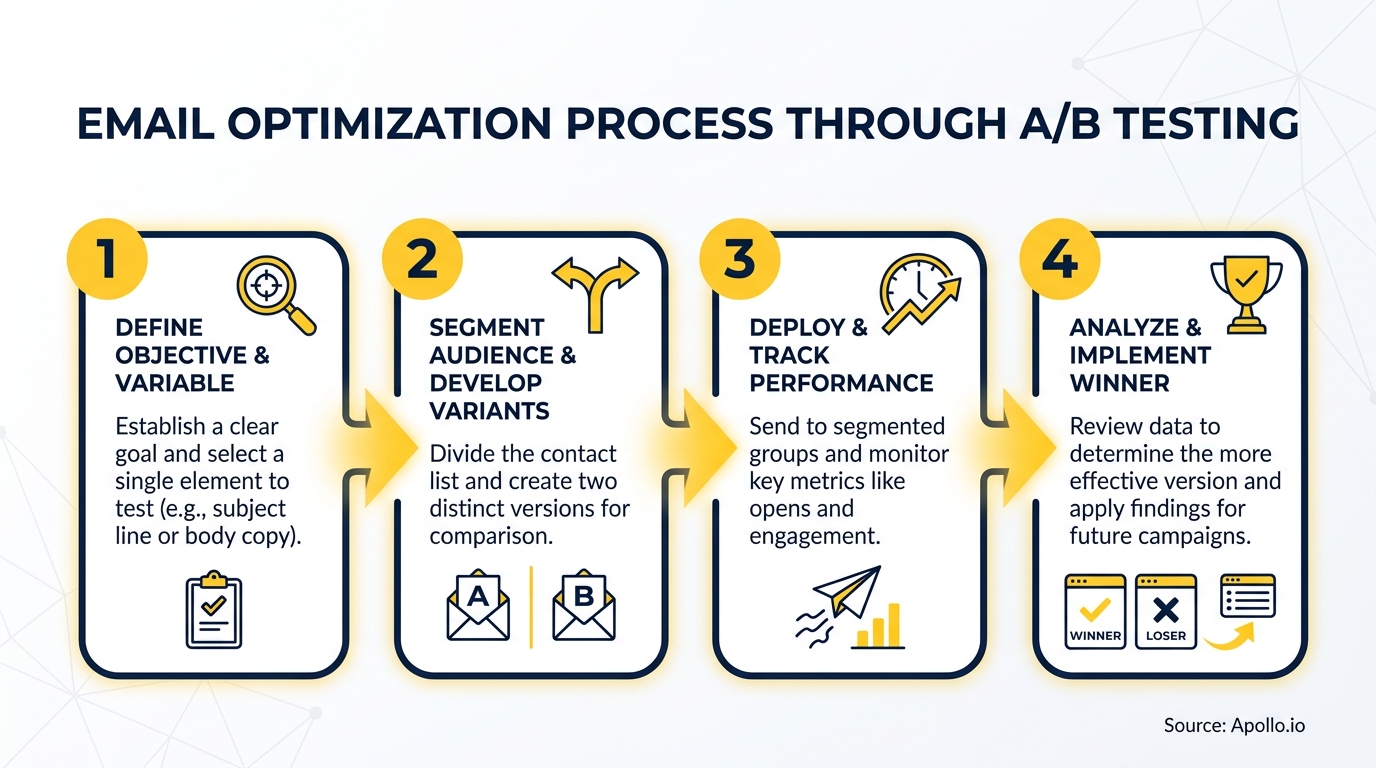
A/B testing email copy and subject lines produces compounding returns when it is a system, not a one-time experiment. The workflow is: define your segment, write a hypothesis, isolate one variable, confirm deliverability, send to 1,000+ contacts per variant, measure through the KPI ladder (not just opens), and document the result for your team's experiment log.
The Sinch Mailgun 2026 Email Impact Report, based on 400 billion emails sent in 2025, found that most teams use AI for basic content generation while higher-impact uses like optimization, segmentation, and deliverability remain underused. The teams that build structured testing habits are the ones that create a durable edge in email performance.
Apollo consolidates prospecting, sequencing, A/B testing, and pipeline tracking in one platform, so your test results connect directly to revenue outcomes without stitching together multiple tools. As Cyera put it, "Having everything in one system was a game changer."
Try Apollo Free and run your first structured email A/B test inside the same platform where you build your sequences and track your pipeline.
Prove Pipeline ROI Before Next Quarter
ROI pressure killing your tool budget? Apollo delivers measurable pipeline impact from day one — so you can show results, not just activity. Leadium 3x'd their revenue. Your number's next.
Start Free with Apollo →Don't miss these
Sales
Inbound vs Outbound Marketing: Which Strategy Wins?
Sales
What Is a Sales Funnel? The Non-Linear Revenue Framework for 2026
Sales
What Is a Go-to-Market Strategy? The 2026 GTM Playbook
See Apollo in action
We'd love to show how Apollo can help you sell better.
By submitting this form, you will receive information, tips, and promotions from Apollo. To learn more, see our Privacy Statement.
4.7/5 based on 9,690 reviews
