
How Can I Merge Duplicate Records in My Database? A 2026 RevOps Playbook
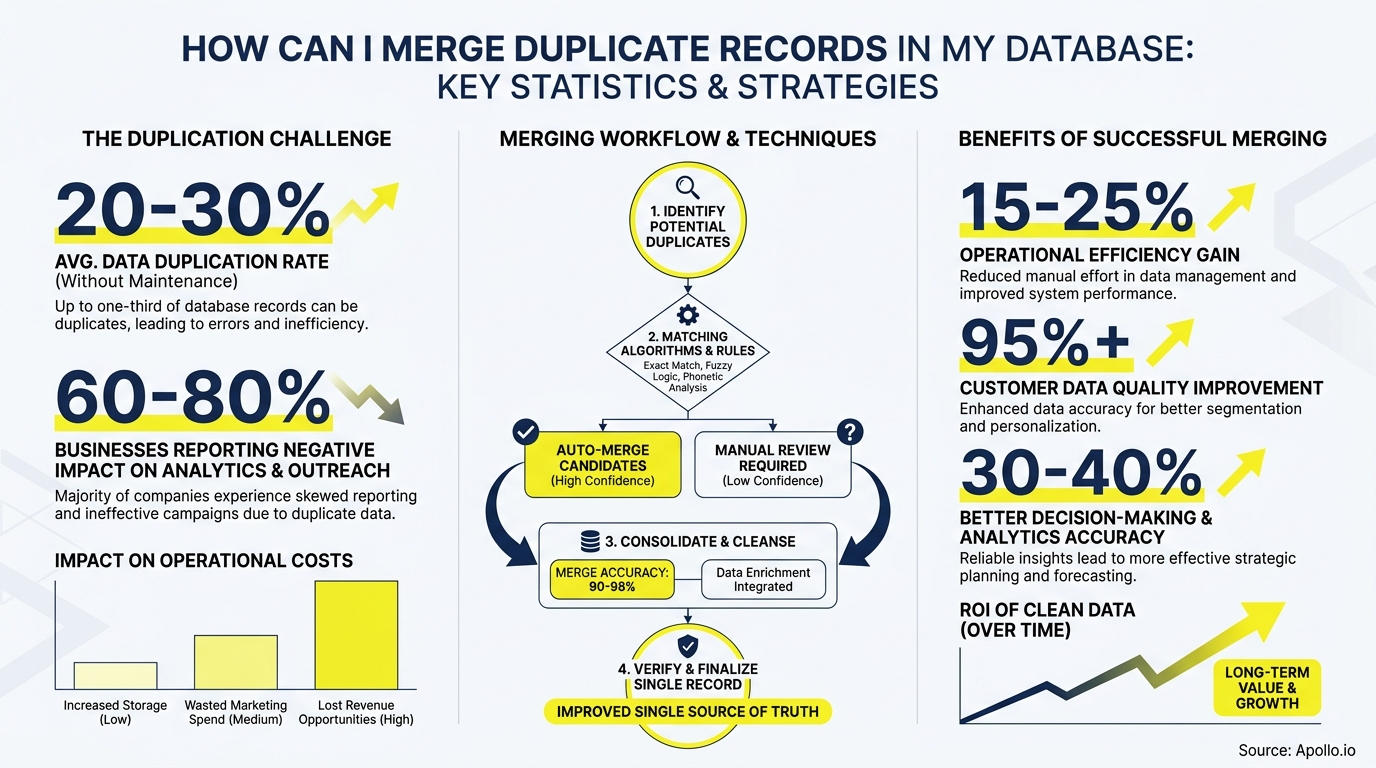
Duplicate records are not a minor annoyance. They silently inflate funnel metrics, trigger double-sends to prospects, break attribution, and erode trust in every report your team produces. According to RevOps Coop's 2025 State of RevOps Survey, 99% of respondents struggle with technical data issues including duplicates and floating lead records. If you're asking how to merge duplicate records in your database, this playbook gives you a governance-backed, step-by-step answer. It also covers how to build a prevention-first operating model so duplicates stop returning after each cleanup. For RevOps leaders looking to improve overall sales efficiency, clean data is the foundation everything else is built on.

Clean Data. Real Contacts. More Pipeline.
Tired of bounced emails and dead-end dials eating your day? Apollo delivers 97% email accuracy across 230M+ verified contacts so your team reaches real buyers, not voicemail. Start building pipeline that actually converts.
Start Free with Apollo →Key Takeaways
- Duplicate records affect nearly every B2B database and create compounding revenue and productivity losses.
- A staged merge process (identify, match, apply survivorship rules, reconcile IDs) prevents data loss and audit failures.
- Prevention at entry points (forms, imports, enrichment) eliminates far more duplicates than periodic cleanups.
- AI-assisted matching significantly outperforms rules-only approaches, but human review remains essential for conflict resolution.
- RevOps teams that treat deduplication as a weekly operating rhythm, not a one-off project, sustain measurably better pipeline quality.
Why Do Duplicate Records Cost So Much?
Duplicate records cost organizations revenue, productivity, and credibility at every layer of the GTM stack. A study cited by extu.com found that duplicate data is a major issue for 91% of B2B companies. The downstream effects compound quickly.
- Sales productivity: Sales teams lose an estimated 550 hours annually due to inaccurate CRM data, per Landbase.
- Rep trust: Only 35% of sales professionals fully trust their CRM data's accuracy, according to Kondo's B2B Sales 2025 Report.
- Marketing waste: Duplicate contacts mean duplicate sends, which wastes budget and damages sender reputation.
- Reporting breakage: Inflated contact counts, double-attributed conversions, and broken sequences all trace back to unresolved duplicates.
For RevOps leaders, this is also an AI readiness issue. Duplicate and inconsistent records degrade the quality of any AI model or scoring system trained on your CRM data.
Clean data is a prerequisite for reliable AI output, not an optional hygiene task.
How Do You Identify Duplicate Records Before Merging?
Identification is the first step: locate all records that represent the same real-world entity before touching a single field. Rushing to merge without a structured identification phase creates irreversible data loss.
What Matching Methods Work Best?
Use a combination of exact and fuzzy matching to surface candidates:
| Method | Best For | Limitation |
|---|---|---|
| Exact match (email, phone) | High-confidence duplicates | Misses typos and format variations |
| Fuzzy match (name, company) | Catching near-matches | Higher false-positive rate |
| Token-based normalization | Standardizing before matching | Requires pre-processing step |
| AI/LLM entity matching | Complex, ambiguous records | Requires human review on low-confidence pairs |
A Reddit user shared a firsthand perspectiveon merging databases safely: create a staging table that preserves original IDs in an OldID field, tag each record with its source database, assign new auto-generated IDs, and only then run consolidation queries. This staged approach protects referential integrity while giving you a full audit trail.
What Are Survivorship Rules and Why Do They Matter?
Survivorship rules determine which field values survive when two duplicate records are merged into one. Without them, automated merges silently overwrite correct data with stale or blank values.
A commenter added in a Reddit discussion that without a date_updated field or field-level change tracking, no algorithm can reliably determine which version of a conflicting value is correct. This insight underscores why survivorship rules must be explicit and documented before any merge runs.
Common survivorship rule patterns:
- Most recent wins: Use the field value from the record with the latest
updated_attimestamp. - Most complete wins: Retain the non-null value when one record has a blank field.
- Source priority wins: Designate a trusted source system (e.g., CRM over import CSV) whose values take precedence.
- Concatenate: For notes or tags, merge both values rather than choosing one.
- Human review: Flag high-value records or conflicting critical fields (revenue, stage) for manual resolution.
Document your survivorship rules in a shared SOP before running any bulk merge. This makes the process auditable and repeatable.

How Do RevOps Teams Build a Repeatable Dedupe Operating Model?
RevOps leaders who treat deduplication as a recurring operating rhythm, not a one-time project, maintain consistently higher data quality. The model has four components: cadence, roles, escalation, and metrics.
What Roles and Cadence Should a Dedupe Operating Model Include?
| Component | Detail |
|---|---|
| Weekly triage | RevOps or CRM admin reviews auto-flagged duplicate candidates from the prior week |
| Monthly bulk merge | High-confidence batches merged automatically; low-confidence batches reviewed manually |
| Quarterly audit | Full duplicate rate measurement, survivorship rule review, and SLA check |
| Escalation path | Sales or marketing ops escalates contested merges (e.g., active deal records) to a designated data owner |
| Key metric | Track duplicate rate as a percentage of total records; set a target threshold and alert when exceeded |
According to MarketingOps.com, 75% of RevOps professionals cite data inconsistencies including duplicate records as the most frustrating part of their tech stack, directly limiting confidence in performance metrics. A structured operating model converts that frustration into a managed, measurable process. For teams pursuing broader sales transformation, operationalizing data hygiene is one of the highest-leverage investments RevOps can make.
Tired of dirty data hurting your pipeline? Apollo's CRM enrichment tools continuously verify and update your contact records so duplicates don't accumulate in the first place.
Turn Funnel Guesswork Into Real Pipeline
Tired of watching quality leads stall before they ever reach your pipeline? Apollo surfaces in-market buyers the moment they're ready, so your team stops chasing and starts closing. 600K+ companies trust Apollo to forecast with confidence.
Start Free with Apollo →How Can You Prevent Duplicate Records From Entering Your Database?
Prevention at entry points eliminates far more duplicates than any cleanup process. Every inbound data channel is a potential source of duplicates: web forms, CSV imports, enrichment providers, and CRM integrations.
- Web forms: Run real-time email deduplication checks on form submit. Match against existing records before creating a new one.
- CSV imports: Pre-validate imports with a staging table. Flag matches above a configurable similarity threshold before writing to production.
- Enrichment providers: Use match-and-update logic rather than create-on-no-match. Map incoming records to existing contacts by email or domain first.
- Multi-system integrations: Assign a canonical record ID in your master system and propagate it across all connected tools to prevent cross-system phantom duplicates.
- Field standardization: Normalize phone, company name, and address formats at the point of entry to improve downstream match rates.
Understanding the structure of your marketing database is essential for knowing where duplicates enter. Most originate at integration seams, not from manual data entry.
How Does AI-Assisted Deduplication Work in 2026?
AI-assisted deduplication uses machine learning and language model-based entity matching to identify duplicate pairs that rules-based systems miss. In 2026, this approach is moving from experimental to standard practice in RevOps and data engineering teams.
The key operational shift is that AI-assisted dedupe works best with a human-in-the-loop review step for low-confidence matches. This is not a fully automated replacement for human judgment; it is an acceleration layer that reduces the manual review burden on high-confidence pairs while surfacing ambiguous cases for human decision.
Practical guardrails for AI-assisted dedupe:
- Set a confidence threshold (e.g., 0.85+) for auto-merge; route everything below to a review queue.
- Log every AI-assisted merge decision with the confidence score and matched fields for auditability.
- Review false positives and false negatives monthly to refine matching rules.
- Never auto-merge records with active open opportunities or sequences without a human approval step.
For B2B GTM teams, AI-assisted matching also connects to broader sales automation strategies. Clean, de-duplicated data is what makes automated sequences run reliably without embarrassing double-sends to the same contact.
Spending too much time chasing bad data instead of building pipeline? Apollo's data enrichment keeps your CRM accurate with 230M+ verified business contacts so your team works from a single source of truth.
What Is the Step-by-Step Process to Merge Duplicate Records Safely?
Merging duplicate records safely requires a six-step process that protects data integrity, preserves relationship history, and maintains a full audit trail.
- Identify candidates: Run matching queries using email, phone, name, and company. Export results to a staging environment, not production.
- Classify confidence: Label each pair as high, medium, or low confidence based on match score. Auto-approve high-confidence pairs; queue the rest for review.
- Apply survivorship rules: Use your documented rules to determine the winning field values for each pair. Log every decision.
- Preserve original IDs: Store the losing record's ID in an
OldIDorlegacy_idfield on the surviving record. This prevents broken foreign key references across related tables. - Migrate related records: Update all child records (activities, opportunities, emails, tasks) to reference the surviving record's ID before deleting the duplicate.
- Archive, do not delete: Soft-delete the losing record and retain it in an archive table for a defined retention period. This preserves the audit trail and enables rollback if needed.
This process applies whether you are working in SQL, a CRM platform, or a custom database. The logic is consistent: stage first, apply rules, migrate dependencies, then archive. For teams managing a modern sales tech stack, this same discipline should be applied across every connected system, not just the primary CRM.
How Do You Sustain Data Quality After Merging Duplicates?
Sustaining data quality after a merge requires governance artifacts that make the process repeatable and accountable. A one-time cleanup without governance infrastructure will result in the same duplicate accumulation within months.
Minimum governance artifacts to put in place:
- RACI matrix: Define who is Responsible, Accountable, Consulted, and Informed for each step of the dedupe operating model.
- Data quality SLA: Set a maximum acceptable duplicate rate (e.g., under 2% of total records) and a response SLA when the threshold is breached.
- Merge audit log:A append-only log recording every merge: timestamp, matched fields, confidence score, survivorship decisions, and the approving user or system.
- Dashboard: Track duplicate rate trend, merge volume by week, review queue depth, and false positive rate. Review in your weekly RevOps standup.
Teams that embed these artifacts into their marketing analytics and RevOps workflows report sustained improvement in funnel accuracy and pipeline predictability. The goal is a living system, not a one-time project.

Start With Clean Data and Stay Clean
Merging duplicate records is a solvable problem, but only if you treat it as an ongoing operating discipline rather than a cleanup sprint. The playbook is clear: stage before you merge, define survivorship rules before you touch data, preserve original IDs, migrate child records, and archive instead of delete.
Then build prevention into every data entry point so duplicates stop accumulating.
For B2B GTM teams, the stakes extend beyond data hygiene. Duplicates directly corrupt the pipeline metrics, sequence reliability, and AI model inputs that revenue leaders depend on.
Clean data is the infrastructure that makes every other sales and marketing investment work.
Apollo helps GTM teams stay clean from the start. With 230M+ verified business contacts, Apollo's enrichment tools keep your CRM records accurate and current, reducing the duplicate accumulation that comes from stale or incomplete data. Schedule a Demo to see how Apollo consolidates your GTM data, enrichment, and engagement in one unified platform.
Prove Pipeline ROI With Apollo
ROI pressure killing your tool budget? Apollo delivers measurable pipeline impact from day one — no guesswork, no slow ramp. Leadium 3x'd annual revenue. See your return before the next renewal conversation.
Start Free with Apollo →Don't miss these
Sales
Inbound vs Outbound Marketing: Which Strategy Wins?
Sales
What Is a Sales Funnel? The Non-Linear Revenue Framework for 2026
Sales
What Is a Go-to-Market Strategy? The 2026 GTM Playbook
See Apollo in action
We'd love to show how Apollo can help you sell better.
By submitting this form, you will receive information, tips, and promotions from Apollo. To learn more, see our Privacy Statement.
4.7/5 based on 9,690 reviews
