
How to Maintain Personalization at Scale Without Excessive Manual Effort
Buyers now expect tailored experiences at every touchpoint, but most B2B teams are drowning in manual research, one-off message edits, and disconnected tools. According to Instapage, 83% of B2B marketers report improved lead generation from personalization, yet the manual effort required to deliver it consistently is unsustainable at scale. The good news: maintaining personalization without excessive manual effort is achievable when you build the right system, not just adopt the right tools.
This guide covers a governance-first approach to email personalization for sales and outreach that scales across your entire GTM team, without burning out your reps or your budget.

Build Pipeline Faster With Apollo
Tired of hours lost to manual research and dead-end contact data? Apollo surfaces verified prospects and scales your outreach automatically. Join 600K+ companies generating predictable pipeline.
Start Free with Apollo →Key Takeaways
- Personalization at scale requires a system (modular content + automation + governance), not just AI writing tools.
- Superficial personalization (inserting industry or role tokens) can backfire; decision-support personalization drives confident purchase decisions.
- SDRs and BDRs need account context and signal-based triggers, not higher outreach volume.
- Marketing automation reduces operational costs and frees reps to focus on high-value interactions.
- A "personalize vs. suppress" decision framework prevents buyer overwhelm and protects pipeline quality.
Why Does Personalization Without Manual Effort Feel Impossible?
Most B2B teams lack a scalable personalization infrastructure, not personalization intent. Research from Martal shows AI-driven personalization can boost conversions by up to 57% in B2B contexts, but realizing that lift requires clean data, modular content, and automated workflows working together.
The three root causes of manual overload are:
- No modular content library: Reps write from scratch for every persona, industry, or pain point.
- Disconnected data: Account research lives in tabs, not in the workflow where outreach happens.
- No routing or governance: Every message requires human review because there are no quality gates or suppression rules.
McKinsey's May 2026 Global B2B Pulse Survey found market leaders are 4x more likely than peers to deploy true one-to-one personalization, and 2x more likely to adopt generative AI to support it. The gap is not ambition; it is operating model design.
When Should You Personalize (and When Should You Suppress It)?
Not every interaction warrants personalization, and over-personalizing is a real risk. A Gartner 2025 survey found personalized marketing created negative experiences for 53% of customers, making them 3.2x more likely to regret a purchase.
The fix is a clear decision framework.
| Scenario | Action | Reason |
|---|---|---|
| High-intent signal (visited pricing page, downloaded content) | Personalize with decision-support context | Buyer is in active research mode |
| Cold outreach to a new ICP account | Personalize at the segment level (industry + role) | Sufficient relevance without over-investment |
| Re-engagement after 90+ days of silence | Use a neutral, low-pressure template | Heavy personalization feels intrusive after a gap |
| Existing customer upsell | Personalize with usage data and specific outcomes | Context-rich data justifies deep personalization |
| Unverified or incomplete contact data | Suppress personalization; send generic value message | Wrong personalization is worse than none |
Gartner also found that active, decision-support personalization (helping buyers weigh trade-offs and next steps) made customers 2.3x more likely to complete purchase decisions confidently. Aim for guidance, not just relevance tokens.
What Is a Modular Content System and How Does It Eliminate Manual Work?
A modular content system breaks outreach into reusable building blocks that snap together based on audience signals, eliminating the need to write from scratch. Instead of one SDR crafting a unique email for every account, your team assembles pre-approved modules triggered by CRM data, intent signals, or buying stage.
Core modules to build:
- Opening hook variants: By industry, company size, trigger event (funding, hiring surge, product launch)
- Pain point blocks: Mapped to persona (SDR, RevOps, VP Sales) and known challenges
- Social proof snippets: Customer outcomes by vertical, organized for easy insertion
- CTA options: Meeting request, resource offer, referral ask, depending on funnel stage
Combine this with sales automation to trigger the right module combination based on account data automatically. Salesgenie reports that marketing automation is identified by 49% of companies as saving time on repetitive tasks while enabling personalized communications at scale.
Spending hours researching accounts before writing a single message? Apollo's AI sales automation surfaces account context and drafts personalized outreach in your workflow, so reps spend time selling, not researching.

How Do SDRs and BDRs Scale Personalization Without Burning Out?
SDRs and BDRs scale personalization by shifting from volume-based outreach to signal-based prioritization. The 6sense 2026 State of the BDR Report found that 99% of BDRs now use AI, yet outreach volume nearly doubled to roughly 33 touches per contact with no reliable improvement in quota attainment.
More messages is not the answer; better context is.
A practical SDR personalization workflow:
- Pull intent signals from your platform (job postings, web activity, technographic changes) to identify warm accounts.
- Map the buying group for each target account (champion, economic buyer, technical evaluator) and assign persona-specific modules.
- Let automation sequence the right modules based on persona and stage, with AI filling in account-specific details.
- Reserve human writing time for top-tier accounts or unusual contexts only.
For RevOps leaders, the operational lever is connecting intent data to your sequencing platform so triggers fire automatically without rep intervention. This is what separates teams doing personalization from teams scaling it. You can also learn more about improving sales efficiency with RevOps to build the operational foundation these workflows require.
Turn Weak Funnels Into Qualified Pipeline
Tired of watching marketing leads stall before they ever reach sales? Apollo surfaces verified, in-market prospects so your team works the right opportunities at right time. Nearly 100K paying customers stopped guessing and started closing.
Start Free with Apollo →What Governance Rules Prevent AI Personalization from Going Wrong?
Personalization governance means establishing quality gates, approval rules, and suppression logic before automation runs at scale. Forrester's 2026 B2B predictions warn that ungoverned generative AI could cost B2B companies significant losses, with 19% of AI-using buyers already feeling less confident due to inaccurate or unreliable AI-generated information.
Minimum governance checklist for B2B teams:
- Data quality gate: Only personalize contacts with verified business email and company firmographics confirmed.
- Brand-safe content review: All AI-drafted modules reviewed and approved by marketing before entering the library.
- Suppression rules: Exclude active opportunities, current customers (unless upsell sequence), and contacts who have opted out or unsubscribed.
- Frequency caps: Set maximum touches per contact per week to prevent overwhelm.
- Audit trail: Log which module version was sent to which contact for performance analysis and compliance.
For teams operating globally, note that most EU AI Act rules apply from August 2, 2026, requiring disclosure and auditability for AI-generated communications. Build those controls into your system now.
How Does Apollo Help GTM Teams Personalize at Scale?
Apollo consolidates prospecting, enrichment, sequencing, and AI-assisted messaging into one platform, eliminating the manual handoffs between disconnected tools that create personalization bottlenecks. As Cyera put it: "Having everything in one system was a game changer."
Key capabilities for scaling personalization without manual effort:
- 230M+ verified contacts with 65+ firmographic and technographic filters to build precise ICP segments automatically.
- AI Research Agent that surfaces account context and drafts personalized outreach, with teams seeing 46% more meetings booked.
- Multi-channel sequences (email, phone, social) triggered by intent signals and buying-stage data, not manual rep action.
- Workflow engine that routes contacts to the right sequence automatically based on CRM field changes or behavioral triggers.
Struggling to keep outreach relevant without spending hours on research? Apollo's sales engagement platform automates personalized multi-channel sequences so your reps focus on conversations, not copy-pasting. For AEs managing active deals, Apollo's deal management and data synchronization keep account context current across every touchpoint without manual CRM updates.
How Do You Build a Scalable B2B Personalization System in 2026?
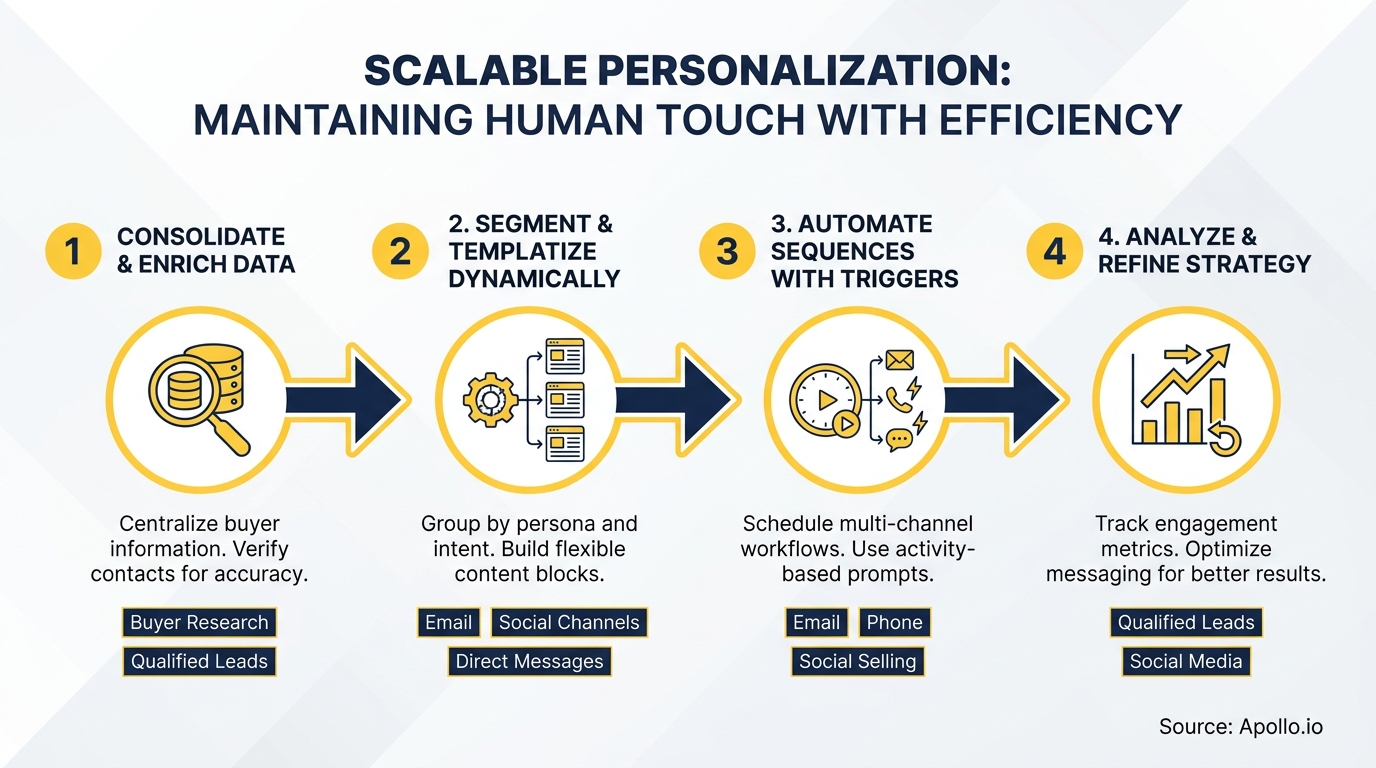
A scalable personalization system in 2026 combines clean data, modular content, automation triggers, and governance rules into a repeatable operating model. Build it in four stages:
- Audit your data foundation. Adobe's 2026 B2B research found only 41% of B2B organizations have a unified customer data foundation. Fix CRM hygiene, enrich missing fields, and connect intent signals before building personalization on top.
- Build your modular content library. Map modules to persona, industry, buying stage, and trigger event. Keep each block under 50 words for flexible assembly.
- Automate triggers and routing. Define which signals fire which sequence for which segment. Remove rep decision-making from routine touches.
- Establish governance and review cadence. Set suppression rules, frequency caps, and a monthly content library review to keep modules accurate and brand-safe.
This operating model is what separates teams generating generic AI copy from teams running personalization that moves pipeline. Explore how a well-structured B2B marketing funnel integrates with this approach to ensure personalization drives measurable conversion at every stage. For teams building their full sales tech stack, consolidating these capabilities into fewer tools reduces the integration debt that makes personalization governance difficult.

Start Personalizing at Scale Without the Manual Grind
Maintaining personalization without excessive manual effort comes down to one principle: build a system, not a habit. Modular content, signal-based automation, and clear governance rules let your team deliver relevant, decision-support experiences to every account without writing from scratch or reviewing every message manually.
Apollo gives SDRs, AEs, RevOps teams, and marketing leaders one unified platform to find the right contacts, enrich them with account context, and run personalized sequences automatically. Whether you're a founder building your first outbound motion or an enterprise GTM leader standardizing personalization across regions, Apollo consolidates the tools you need into one workspace.
Get Leads Now and see how Apollo helps your team personalize at scale without the manual effort holding you back.
Prove Pipeline ROI With Apollo
ROI pressure killing your tool budget? Apollo delivers measurable pipeline impact from day one — no guesswork, no waiting. Leadium 3x'd their annual revenue. Start yours free today.
Start Free with Apollo →Don't miss these
Sales
Inbound vs Outbound Marketing: Which Strategy Wins?
Sales
What Is a Sales Funnel? The Non-Linear Revenue Framework for 2026
Sales
What Is a Go-to-Market Strategy? The 2026 GTM Playbook
See Apollo in action
We'd love to show how Apollo can help you sell better.
By submitting this form, you will receive information, tips, and promotions from Apollo. To learn more, see our Privacy Statement.
4.7/5 based on 9,690 reviews
