
How Can I Ensure My Prospect Data Is Up-to-Date in 2026?
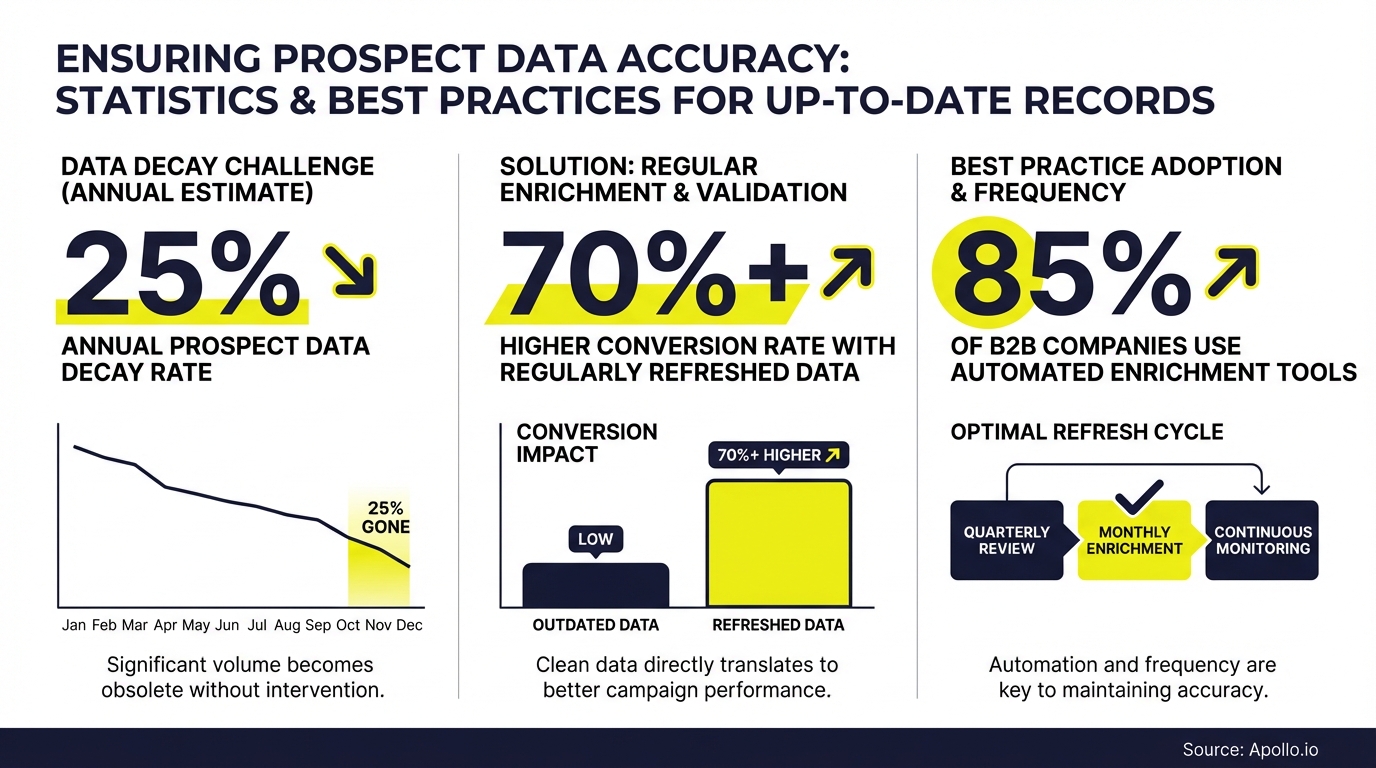
Stale prospect data is a silent pipeline killer. According to Landbase, B2B contact data decays at a rate between 22.5% and 70.3% annually, meaning a database you built last year could already be unreliable. For SDRs, AEs, and RevOps teams relying on that data to generate revenue, the consequences are missed meetings, bounced emails, and delayed campaigns. The good news: a proactive data enrichment strategy can shift your team from reactive cleanup to continuous data freshness.

Research Less, Pipeline More With Apollo
Tired of burning hours verifying contacts and chasing dead-end leads? Apollo delivers 230M+ verified contacts so your reps spend time selling, not searching. Join 600K+ companies building predictable pipeline.
Start Free with Apollo →Key Takeaways
- B2B contact data decays significantly every year, making continuous verification more effective than periodic list cleaning.
- Poor data quality is an initiative blocker, not just an ops inconvenience, directly delaying GTM execution.
- A data freshness SLA defines how often each field type gets verified, reducing guesswork for RevOps teams.
- Automation at capture, before send, and on job-change signals replaces slow manual cleanup workflows.
- Platforms like Apollo consolidate data enrichment, verification, and outreach into one workspace, reducing tech stack complexity.
Why Does Prospect Data Go Stale So Quickly?
Prospect data decays because people change jobs, companies restructure, and contact details shift constantly. Research from IndustrySelect found that 70.8% of business cards had one or more changes within just 12 months. Job titles, direct dials, and email addresses are the most volatile fields, invalidated every time someone quits, gets promoted, or changes employers.
The financial impact is severe. A Forbes Communications Council report found that individual organizations lose an average of $12.9 million to $15 million per year due to wasted marketing spend, lost sales opportunities, and operational inefficiencies tied to bad data.
What Is a Data Freshness SLA and Why Do You Need One?
A Data Freshness SLA is a defined policy specifying how often each field type in your CRM must be verified or re-enriched. Without one, teams default to manual, inconsistent cleanup, and 57% of CRM professionals currently rely on those slow manual processes to handle decay.
A practical SLA framework looks like this:
| Field Type | Verification Cadence | Priority Tier |
|---|---|---|
| Business email address | Monthly | Critical |
| Job title / seniority | Quarterly | High |
| Direct phone number | Quarterly | High |
| Company headcount / revenue | Semi-annually | Medium |
| Mailing / office address | Annually | Standard |
High-value accounts should sit in a tighter cadence across all field types. Tier your SLA by deal size or segment to focus enrichment resources where pipeline impact is greatest.
How Do RevOps Teams Build an Automation-First Data Hygiene Model?
RevOps leaders eliminate manual cleanup by embedding verification at three trigger points: capture time, pre-send, and on job-change signals. This continuous verification model, now replacing quarterly batch cleaning as the leading practice, catches decay before it affects outreach rather than after.
The automation blueprint has four layers:
- Capture-time validation: Validate email format, domain, and duplicates the moment a record enters your CRM or form.
- Pre-send verification: Re-check deliverability and contact status before each sequence activates.
- Job-change alerts: Trigger automatic re-enrichment when a contact changes roles or companies. Apollo's job change alerts and data enrichment feature does this automatically, keeping your records current without manual monitoring.
- Exception queues: Route bounced emails and undeliverable records into a remediation workflow rather than leaving them as dead weight in your CRM.
Tired of manually chasing stale contacts? Automate your CRM enrichment with Apollo's continuous verification tools and stop losing pipeline to bad data.

How Can SDRs and AEs Protect Their Pipeline From Data Decay?
SDRs and AEs lose quota-attainment time when they reach out to contacts who have moved on, changed titles, or left companies entirely. The fix is sourcing contact data from a verified, continuously refreshed database rather than relying solely on static CRM exports.
For SDRs building outbound sequences, this means:
- Pulling contacts from a live database with verified emails, not a stale list export.
- Checking job tenure signals before prioritizing outreach to a contact.
- Using data enrichment to fill gaps in title, seniority, and company context before personalizing a message.
For AEs managing active opportunities, keeping account-level firmographic data fresh, headcount, funding stage, technology stack, ensures discovery and follow-up conversations stay relevant. Contact data enrichment directly improves conversion rates by ensuring outreach lands with accurate context.
Turn Funnel Guesswork Into Real Pipeline
Pipeline forecasting a guessing game because leads stall before they ever reach your reps? Apollo surfaces high-intent prospects and moves them faster from first touch to opportunity. Nearly 100K paying customers stopped guessing and started closing.
Schedule a Demo →What Governance and Ownership Model Keeps Data Accurate at Scale?
Data governance for prospect data means assigning clear ownership of data quality across GTM, RevOps, and (increasingly) legal teams. Among organizations that updated governance in response to new privacy laws, 67% report that their legal department gained a more prominent role in CRM data management.
A lightweight governance structure includes:
- Data Owner (RevOps): Defines SLAs, monitors quality scores, and manages enrichment vendor relationships.
- Data Stewards (Sales and Marketing Ops): Enforce capture standards, manage deduplication rules, and escalate exceptions.
- Legal/Compliance: Maintains suppression lists, do-not-contact flags, and consent documentation, ensuring "up-to-date" includes removals and preference changes, not just new records.
Suppression sync across CRM, marketing automation, and outreach tools is non-negotiable. A contact opting out in one system must propagate everywhere, automatically.
How Do You Evaluate a Data Enrichment Vendor for Freshness and Accuracy?
Choosing the right enrichment source directly determines how fresh your prospect data stays. The key evaluation criteria go beyond record count.
| Evaluation Criterion | What to Ask |
|---|---|
| Data provenance | What are the source types? How is refresh frequency documented? |
| Email verification accuracy | What is the verified accuracy rate? How are bounces handled? |
| Job-change detection | Does the platform alert on role changes automatically? |
| CRM integration depth | Does enrichment sync back to your CRM in real time or batch? |
| Compliance posture | How does the vendor handle suppression and consent documentation? |
Apollo's database of 230M+ people and 30M+ companies maintains 97% email accuracy, with native CRM integrations and automatic job-change enrichment. Explore which data enrichment tools drive revenue in 2026 for a fuller comparison of the vendor landscape.
Working with fragmented tools for prospecting, enrichment, and outreach? Search Apollo's 230M+ verified contacts with 65+ filters and consolidate your stack into one platform. As Cyera put it, "Having everything in one system was a game changer."

How Do You Measure the ROI of Keeping Prospect Data Current?
The ROI of data freshness shows up in pipeline velocity, email deliverability, and campaign execution speed. Teams with clean data launch initiatives faster and avoid the delays that cost real revenue. According to Datamaticsbpm, 77% of businesses admit that inaccurate data affects their adaptability to change, meaning data quality is directly tied to competitive responsiveness.
Track these KPIs to quantify your data freshness program:
- Email bounce rate: Target under 2% for outbound sequences.
- CRM record completeness score: Percentage of records with all critical fields populated.
- Enrichment coverage rate: Share of active prospects with verified title, email, and phone.
- GTM initiative delay rate: Number of campaigns delayed due to data quality issues per quarter.
- Pipeline-to-close velocity: Tracks whether clean data accelerates deal progression.
Connect these metrics to revenue outcomes quarterly. When bounce rates drop and enrichment coverage rises, the pipeline impact becomes visible and defensible to leadership. For a deeper look at structuring this, see how customer data enrichment works and the downstream revenue effects it produces.
Start Keeping Your Prospect Data Fresh With Apollo
Ensuring prospect data stays current requires moving from periodic manual cleanup to a continuous, automated, governance-backed system. Define your data freshness SLAs, automate enrichment at every trigger point, assign clear ownership, and measure the pipeline impact consistently.
Apollo gives B2B GTM teams, from SDRs to RevOps to enterprise sales leaders, a unified platform to find, verify, enrich, and engage prospects without juggling multiple tools. With 97% email accuracy, automatic job-change alerts, and deep CRM integrations, Apollo replaces the patchwork of data vendors and engagement tools your team currently manages separately.
Start Free with Apollo and ensure every prospect record your team touches is accurate, complete, and ready to convert.
Prove Pipeline ROI With Apollo
ROI pressure killing your tool budget before renewal? Apollo delivers measurable pipeline impact from day one. Leadium 3x'd their annual revenue — your CFO conversation just got a lot easier.
Start Free with Apollo →Don't miss these
Sales
Inbound vs Outbound Marketing: Which Strategy Wins?
Sales
What Is a Sales Funnel? The Non-Linear Revenue Framework for 2026
Sales
What Is a Go-to-Market Strategy? The 2026 GTM Playbook
See Apollo in action
We'd love to show how Apollo can help you sell better.
By submitting this form, you will receive information, tips, and promotions from Apollo. To learn more, see our Privacy Statement.
4.7/5 based on 9,690 reviews
