
How to Automate Lead Scoring and Focus on Your Best Prospects
Most B2B teams treat lead scoring as a gut-feel exercise disguised as a process. SDRs work through queues based on arbitrary point totals, AEs chase contacts who will never buy, and RevOps watches pipeline accuracy erode. According to Digital Applied, 61% of B2B teams now use AI for lead scoring as of Q1 2026, up from 23% in 2024. The gap between teams that automate intelligently and those still scoring manually is widening fast. If you want to focus your reps on the best prospects, automated lead scoring is no longer optional.

Scale Smarter With Apollo's AI Engine
Tired of your reps burning hours on manual research instead of selling? Apollo surfaces verified contacts and automates outreach so your team scales without the chaos. Join 600K+ companies building predictable pipeline.
Start Free with Apollo →Key Takeaways
- Automated lead scoring removes subjective guesswork and routes the highest-fit, highest-intent prospects to your reps first.
- AI-powered scoring consistently outperforms rule-based models on conversion rate and cost per acquisition.
- Data quality and governance are prerequisites, not afterthoughts, for scoring accuracy you can trust.
- Buying-group scoring is replacing single-contact MQL models in 2026, shifting focus to account-level committee signals.
- A phased pilot-to-production approach reduces implementation risk and builds sales team trust in the model.
What Is Automated Lead Scoring and Why Does It Matter in 2026?
Automated lead scoring assigns a numeric or tiered rank to each prospect based on behavioral, firmographic, and intent signals, without requiring manual input from marketing or sales. The system continuously recalculates scores as new data arrives, so your pipeline always reflects current reality. Landbase reports that companies implementing lead scoring achieve a 138% ROI on lead generation, compared to 78% for companies without such systems.
The stakes are higher now because buying committees have expanded and individual MQL scores often mislead. Scoring a single contact as "hot" while missing four other stakeholders wastes SDR cycles.
Modern automation addresses this by detecting committee formation and role coverage at the account level, not just individual activity.
How Does AI-Powered Lead Scoring Work?
AI lead scoring trains on historical closed-won and closed-lost data to identify the firmographic, behavioral, and intent patterns that predict conversion. The model weighs signals like job title, company size, technology stack, website visits, email engagement, and third-party intent data, then outputs a score with reason codes explaining why each prospect ranked high or low.
| Signal Type | Examples | Weight Category |
|---|---|---|
| Firmographic fit | Industry, headcount, revenue, tech stack | High |
| Behavioral engagement | Demo requests, pricing page visits, email clicks | High |
| Intent data | Third-party topic research, competitor comparisons | Medium-High |
| Recency signals | Recent hiring surge, funding announcement, leadership change | Medium |
| Negative signals | Wrong industry, too small, email unsubscribe | Score reducer |
Research from SuperAGI shows companies using AI-powered lead scoring have seen up to a 45% increase in conversion rates and a 30% reduction in cost per acquisition. The key differentiator versus rule-based scoring is adaptability: AI models update as market conditions and buyer behavior shift, rather than requiring manual reconfiguration.
Struggling to identify which prospects match your ICP before scoring even begins? Search Apollo's 230M+ contacts with 65+ filters to build a precise prospect universe.
Turn Funnel Guesswork Into Pipeline Clarity
Tired of watching marketing leads stall before they ever reach your pipeline? Apollo surfaces high-intent buyers and arms your team with real-time signals. Nearly 100K paying customers stopped guessing and started closing.
Schedule a Demo →How Do SDRs and RevOps Teams Implement Automated Lead Scoring?
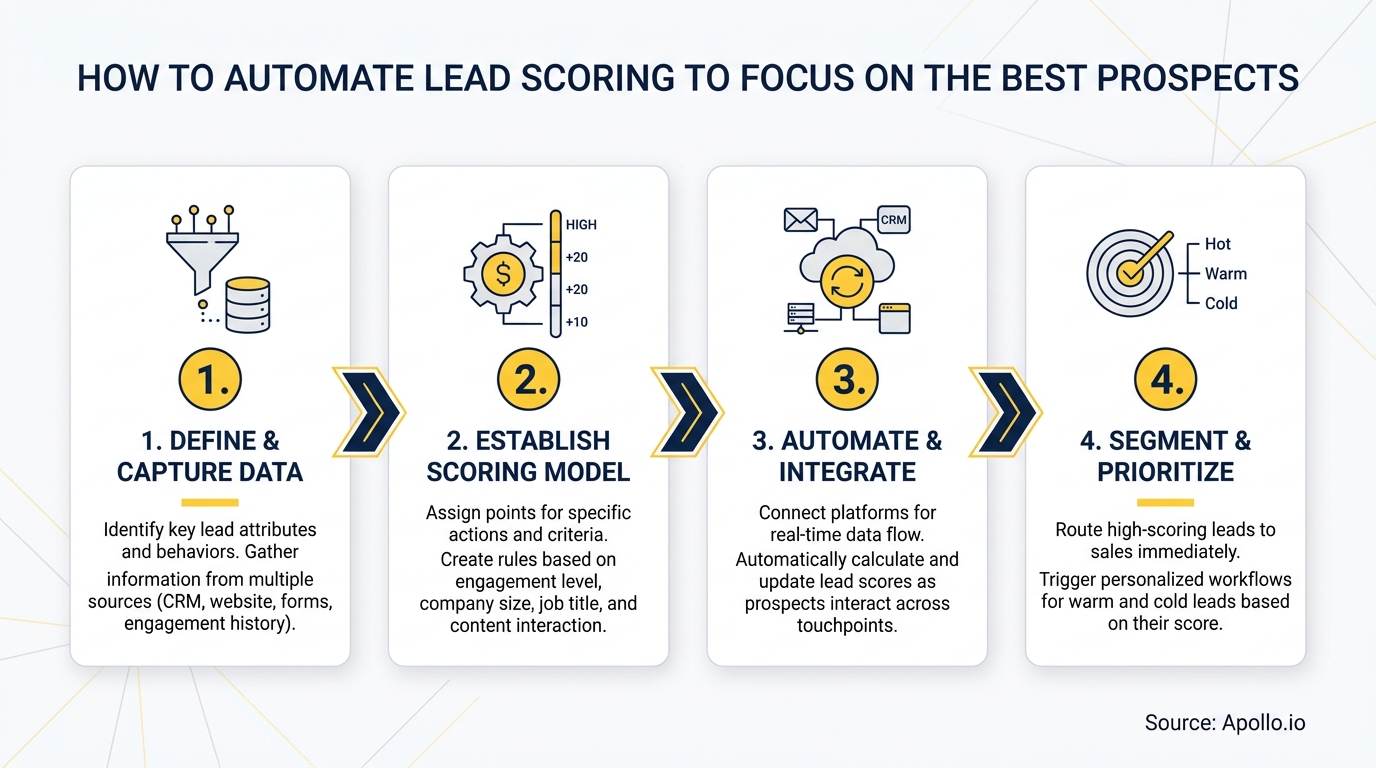
SDRs and RevOps teams implement automated lead scoring through a phased pilot-to-production approach that starts with data readiness and ends with a monitored, feedback-informed model in production.
What Does a Pilot-to-Production Playbook Look Like?
- Days 1-30 (Data Readiness): Audit CRM completeness. Identify your last 12 months of closed-won and closed-lost deals. Enrich missing firmographic fields. Define your ICP using firmographic and technographic criteria.
- Days 31-60 (Model Build and Labeling): Label historical records as high/medium/low fit. Select your scoring model type (rule-based to start, predictive for scale). Define reason-code categories so reps understand why a lead scored high.
- Days 61-90 (Pilot and Monitoring): Run the model in parallel with your current process. Compare predicted scores against actual outcomes weekly. Collect rep feedback on score accuracy. Adjust weights before full rollout.
RevOps leaders find the feedback loop in days 61-90 is the most critical step. Without it, scoring models drift and sales trust erodes.
Build a weekly review cadence where AEs flag mismatch between score and actual deal quality.
Why Is Data Quality the Foundation of Trustworthy Lead Scoring?
Trustworthy lead scoring requires clean, complete, and current data at every input stage. A model built on stale or incomplete CRM records produces scores that reps ignore, and ignored scores are worse than no scores at all.
The measurement trust problem is real: a 2024 Forrester survey found that 64% of B2B marketing leaders do not trust their organization's marketing measurement for decision-making. That distrust extends directly to automated scoring outputs when the underlying data is unreliable.
Enriching your contact and account records before scoring is not optional preprocessing; it is the prerequisite for any model that sales will actually use.
Apollo's data enrichment tools keep your CRM records verified and current across 65+ firmographic and contact attributes, giving your scoring model accurate inputs from the start.

What Are the Key Signals to Include in Your Lead Scoring Model?
Effective lead scoring combines fit signals (who the prospect is) with intent signals (what they are actively doing). Neither alone is sufficient: high-fit prospects who show no buying intent are not ready, and high-intent prospects who fall outside your ICP rarely convert.
In 2026, the shift from single-contact scoring to buying-group scoring is the most important structural change for B2B teams. Instead of scoring one contact, you score the account by mapping which roles have engaged, which are missing, and whether the committee is forming.
This approach directly addresses the problem of SDRs working a champion who lacks internal budget authority.
Key signal categories to weight in your model:
- ICP fit: Industry, headcount range, revenue band, geography, technology stack
- Engagement depth: Pricing page visits, demo requests, content downloads, email reply rates
- Intent signals: Third-party research topics, competitor review activity, job postings indicating budget
- Timing signals: Recent funding, leadership hire, expansion announcement, fiscal quarter start
- Buying-group coverage: Number of stakeholders engaged, seniority of contacts, economic buyer identified
For a deeper breakdown of how to structure your model, see Apollo's guide to lead scoring models and compare approaches by team size and sales motion.
How Do You Measure Whether Your Automated Lead Scoring Is Working?
Automated lead scoring is working when high-score leads convert to pipeline and closed deals at a materially higher rate than low-score leads. Track these KPIs weekly after launch:
| KPI | What It Measures | Healthy Signal |
|---|---|---|
| MQL-to-SQL conversion rate by score tier | Score accuracy | High-tier converts 2x+ low-tier |
| Win rate by score tier | Predictive validity | Top-tier win rate beats average |
| Time-to-first-touch for high-score leads | Routing efficiency | Under 5 minutes for tier-1 |
| Rep override rate | Sales trust in model | Declining over time |
| Pipeline sourced from scored leads | Business impact | Growing quarter-over-quarter |
According to Dring.ai, businesses using explainable AI for lead prioritization experienced an 8% increase in renewal bookings and a 20% reduction in wasted sales efforts. Explainability, meaning reps can see why a lead scored the way it did, is what drives those efficiency gains. Reason codes like "attended webinar + visited pricing page + matches ICP headcount" give reps context that a raw number never provides.
Pair your scoring dashboard with an automated lead generation system so high-scoring prospects flow directly into sequences without manual handoffs.

How to Automate Lead Scoring: Start Here
Automating lead scoring to focus on the best prospects comes down to three durable principles: clean data in, explainable model out, and closed-loop feedback between sales and marketing. Teams that shortcut any of these end up with scores that reps distrust and ignore.
Apollo brings lead intelligence, contact enrichment, scoring, and outreach into one unified platform, so your scoring model feeds directly into sequenced outreach without switching tools. As Cyera put it, "Having everything in one system was a game changer." For teams that have been stitching together separate data, scoring, and engagement tools, consolidation alone delivers measurable efficiency gains.
Ready to put your best prospects at the top of every rep's queue? Start free with Apollo and see how unified scoring and engagement changes pipeline quality from day one.
Prove Pipeline ROI Before Next QBR
ROI pressure killing your tool adoption? Apollo delivers measurable pipeline impact fast — with 35% more bookings from AI-powered messaging. Nearly 100K paying customers made the business case stick.
Schedule a Demo →Don't miss these
Sales
Inbound vs Outbound Marketing: Which Strategy Wins?
Sales
What Is a Sales Funnel? The Non-Linear Revenue Framework for 2026
Sales
What Is a Go-to-Market Strategy? The 2026 GTM Playbook
See Apollo in action
We'd love to show how Apollo can help you sell better.
By submitting this form, you will receive information, tips, and promotions from Apollo. To learn more, see our Privacy Statement.
4.7/5 based on 9,690 reviews
