
How Can Enterprises Selling to Other Enterprises Optimize Their Outreach in 2026?
Enterprise B2B outreach has a relevance problem. A Gartner survey in 2025 found 73% of B2B buyers actively avoid suppliers that send irrelevant outreach, and 61% prefer a rep-free buying experience altogether. More volume, faster sequences, and AI-generated emails won't fix a fundamentally misaligned message. The fix is a smarter system: account intelligence, buying-committee enablement, content consistency, and outreach structured for the way buyers actually research in 2026. This article shows enterprise GTM teams exactly how to build it. For a strong foundation, start by defining your unique selling proposition before scaling any outbound motion.

Research Less, Pipeline More With Apollo
Tired of your reps burning hours verifying contact info instead of selling? Apollo surfaces accurate, ready-to-engage prospects so your team spends time closing. Over 600K companies have already made the switch.
Start Free with Apollo →Key Takeaways
- Irrelevant outreach is now a deal-risk: nearly three-quarters of B2B buyers will actively avoid your brand if your messages don't match their context or buying stage.
- Enterprise buying decisions involve an average of 13 stakeholders across multiple departments, so single-threaded outreach almost always stalls.
- Personalization drives measurable pipeline impact: 80% of B2B buyers are more likely to purchase after a highly personalized experience.
- Sales-marketing content inconsistency is a conversion leak: when your website says one thing and your reps say another, buyers lose confidence.
- AI adoption is nearly universal among B2B buyers, meaning your outreach assets need to be structured, comparable, and sourceable, not just inbox-friendly.
What Is the 'Relevance First' Framework for Enterprise Outreach?
The Relevance First framework means qualifying message fit before sending volume. Instead of launching sequences at every contact in a target account, enterprise GTM teams should apply three filters: account signal, role relevance, and stage alignment.
- Account signal: Is there an active trigger (hiring surge, funding round, tech stack change, or intent data spike) that makes this account likely to be in-market? Use intent data to prioritize accounts showing buying behavior now.
- Role relevance: Does this specific contact's job function connect to the problem you solve? SDRs waste cycles chasing titles with no budget authority or influence over the decision.
- Stage alignment: Is your message appropriate for where the account sits in the buying journey? Problem-aware buyers need different content than accounts already evaluating vendors.
Add a stop-rule: if an account has received three touches with zero engagement and no active signal, pause outreach and wait for a new trigger before resuming. This protects sender reputation and preserves the relationship for when timing improves.
Struggling to identify which accounts are actually in-market? Search Apollo's 230M+ contacts with 65+ filters to surface accounts by intent signal, technographic, and buying-stage indicators.
How Should Enterprise Teams Enable the Entire Buying Committee?
Enterprise buying committees require multi-threaded outreach mapped to each stakeholder's role in the decision. Forrester's 2024 research found the average B2B purchase involves 13 people and 89% span two or more departments.
Single-threaded outreach to one champion almost always stalls at the consensus phase.
Use this matrix to align outreach assets to roles and buying stages:
| Buying Stage | Economic Buyer | Technical Validator | Champion/End User | Procurement/Legal |
|---|---|---|---|---|
| Problem Identification | Executive briefing, industry trend data | Technical pain-point explainer | Use-case video, demo offer | Not yet engaged |
| Requirements & Validation | ROI calculator, peer case study | Security/compliance doc, integration specs | Trial access, feature comparison | Not yet engaged |
| Vendor Selection | Board-ready business case | Architecture review, SLA details | Customer reference call | MSA template, DPA, vendor questionnaire |
For Account Executives managing complex deals, champion reactivation deserves a dedicated play. Many enterprise deals stall not because of fit, but because the internal champion lost momentum. A well-timed, role-specific asset (a new case study, a relevant product update, or a direct ROI summary) can restart a stalled consensus process without a full re-qualification cycle. Learn how RevOps-led sales transformation creates the operational structure to support multi-threaded account coverage at scale.
Turn Funnel Guesswork Into Pipeline Wins
Tired of watching marketing leads stall before they ever reach your pipeline? Apollo surfaces high-intent prospects and keeps your funnel moving with real buying signals. Nearly 100K paying customers stopped forecasting blind.
Schedule a Demo →Why Does Sales-Marketing Content Consistency Matter for Outreach?
Content inconsistency between your website and your sales conversations is a conversion leak. Gartner found 69% of B2B buyers report inconsistencies between information on a supplier's website and what sellers provide, and that gap directly erodes trust at the moment buyers are evaluating vendors.
Run this consistency audit across your core outreach assets quarterly:
- Website vs. sales deck: Do your positioning, differentiators, and pricing language match exactly?
- Sales scripts vs. objection library: Are reps using approved messaging, or improvising responses that contradict published content?
- Case studies vs. verbal references: Do the outcomes reps cite in calls match the numbers published in case studies?
- Pricing pages vs. proposal templates: Are the tiers, terms, and value framing consistent across every buyer touchpoint?
RevOps leaders should own this audit. Assign a single content owner per product line to maintain a "message source of truth" that both marketing and sales pull from. Pair this with marketing analytics to track which assets actually move deals forward, and cut anything that creates confusion.

How Do SDRs and AEs Personalize Outreach at Enterprise Scale?
Personalization at enterprise scale means using structured data to customize messages by role, industry, and signal, not writing every email from scratch. Research from Coalition Technologies shows 80% of B2B buyers are more likely to purchase after engaging with a highly personalized experience. Yet data from Landbase shows 86-90% of sales emails currently contain no personalization elements at all. That gap is an immediate competitive advantage for teams willing to close it.
For SDRs handling high-volume prospecting, the most scalable approach is tiered personalization:
- Tier 1 (top 20 accounts): Fully researched, role-specific messaging with custom insights, relevant proof, and a specific hypothesis about their problem.
- Tier 2 (next 80 accounts): Persona-level templates with dynamic fields for industry, trigger event, and relevant use case.
- Tier 3 (broader ICP): Segment-level sequences with intent-signal triggers to determine timing.
Multi-channel coverage matters equally. According to S2M Group, modern B2B outreach often requires 8-12 touchpoints across 4-6 channels over 3-4 weeks to build familiarity and break through. Pair personalized email content with phone, social outreach, and direct mail for Tier 1 accounts to maximize contact rates. Spending too much time building sequences manually? Automate multi-channel sequences with Apollo's sales engagement platform and focus rep time on the conversations that matter.
How Should Enterprise Outreach Assets Be Structured for AI-Assisted Buyers?
Enterprise outreach assets should be structured for AI-assisted evaluation because your buyers are increasingly using generative AI to research, compare, and shortlist vendors before contacting sales. Forrester found 89% of B2B buyers adopted generative AI in less than two years, and nearly 95% expected to use it in purchasing decisions going forward.
Assets that perform well in AI-mediated research share these traits:
- Comparison pages: Structured, factual comparisons against alternatives that AI can extract and cite.
- Objection libraries: Clear Q&A format addressing security, integration, ROI, and implementation concerns.
- Proof assets: Named customer case studies with specific, attributed outcomes that AI tools can surface as evidence.
- Pricing/ROI explainers: Transparent value framing that helps buyers build an internal business case without needing a sales call first.
This is not just an SEO play. When a procurement team uses AI to evaluate your solution, the quality of your structured content determines whether you appear in the shortlist. Pair this with strong sales automation workflows that trigger the right asset to the right contact based on engagement signals, so follow-up feels timely, not generic. For teams tracking pipeline impact, connect these assets to your B2B marketing funnel to measure which proof assets actually accelerate deal velocity.

How Can Enterprise GTM Teams Put This Into Practice?
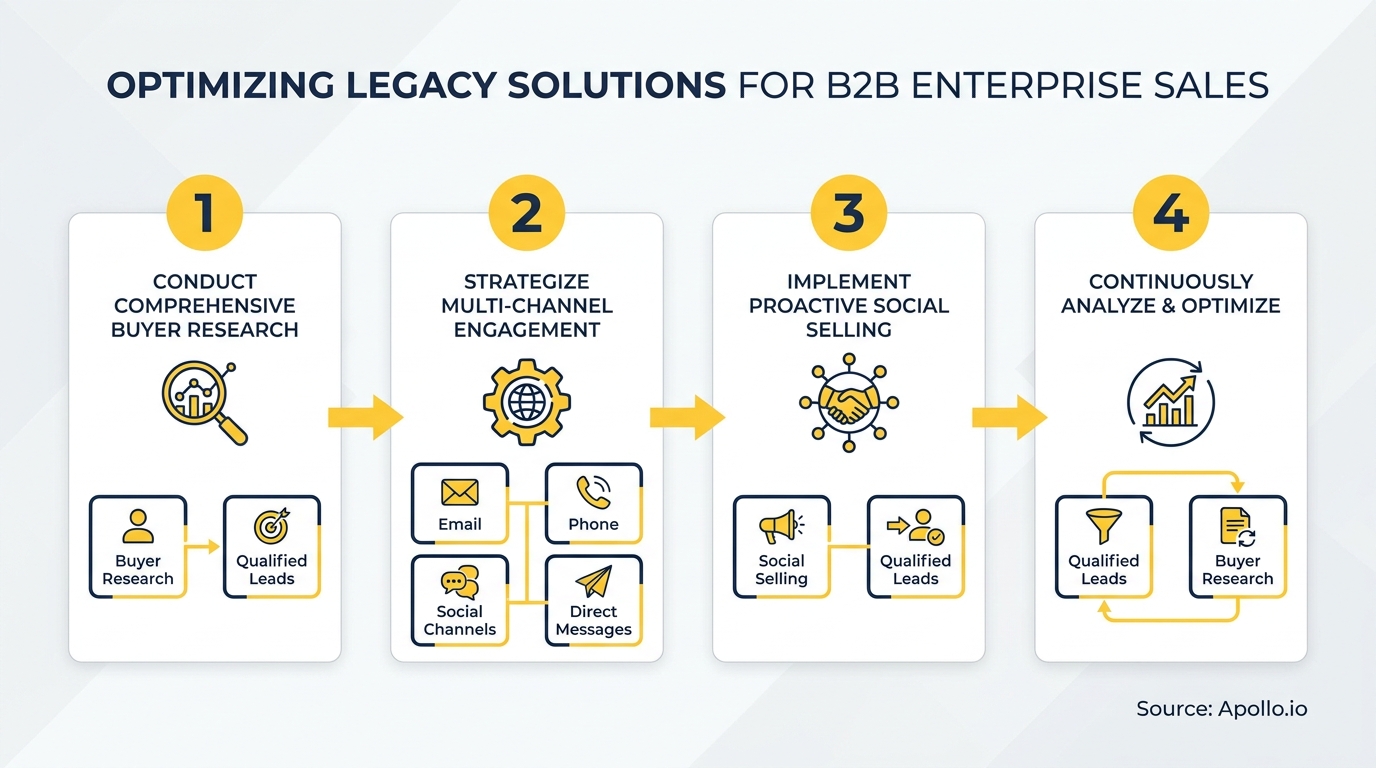
Optimizing enterprise B2B outreach in 2026 comes down to four execution priorities: signal-driven targeting, buying-committee coverage, consistent messaging governance, and AI-readable proof assets. Each element addresses a specific failure mode that causes deals to stall or buyers to disengage.
The teams that outperform are not necessarily the ones sending the most outreach. They are the ones sending the most relevant outreach, to the right roles, at the right stage, backed by content that works equally well in a rep-led conversation and an AI-assisted evaluation.
As Cyera's team put it, "Having everything in one system was a game changer" when consolidating their GTM motion.
Apollo gives enterprise GTM teams a unified platform to execute all of this: 230M+ verified contacts with 65+ filters for precise targeting, multi-channel sequences for buying-committee coverage, AI-powered research and personalization, and CRM integrations that keep data clean across every touchpoint. Trusted by nearly 100K paying customers including Anthropic, DocuSign, and Autodesk.
Start Your Free Trial and see how Apollo consolidates your sales tech stack into one workspace for prospecting, engagement, and pipeline management.
Prove Pipeline ROI Before Next Quarter
ROI pressure killing your tool budget before it even starts? Apollo delivers measurable pipeline impact fast — 46% more meetings with AI, so your next budget conversation writes itself. Start free today.
Start Free with Apollo →Don't miss these
Sales
Inbound vs Outbound Marketing: Which Strategy Wins?
Sales
What Is a Sales Funnel? The Non-Linear Revenue Framework for 2026
Sales
What Is a Go-to-Market Strategy? The 2026 GTM Playbook
See Apollo in action
We'd love to show how Apollo can help you sell better.
By submitting this form, you will receive information, tips, and promotions from Apollo. To learn more, see our Privacy Statement.
4.7/5 based on 9,690 reviews
