
How Automation Triggers Actions Based on Lead Engagement
Your buyer has already visited your pricing page, watched a demo video, and compared you against competitors — before your SDR sends a single email. According to 6sense's 2025 Buyer Experience Report, 94% of buyers rank preferred vendors before speaking with sales. If your automation isn't detecting those early signals and triggering the right actions, you're already behind. Learning how to build an automated lead generation system that responds to real engagement is now a baseline requirement for any B2B GTM team.

Build Pipeline Faster With Apollo
Tired of burning hours on manual research while your pipeline stays empty? Apollo surfaces verified contacts and automates outreach so your team spends time selling, not searching. Join 600K+ companies generating predictable pipeline.
Start Free with Apollo →Key Takeaways
- Engagement signals vary in strength — low, medium, and high — and each level should trigger a different automated action, from nurture content to direct sales outreach.
- Omnichannel signals (email, web, webinar, chat, social) must feed a single scoring model; single-channel triggers miss the majority of buyer intent.
- Negative triggers and cooldown rules are just as critical as positive triggers — irrelevant automation actively damages pipeline.
- CRM data quality is the foundation: without clean fields, scoring rules, and decay logic, trigger automation produces noise, not revenue.
- Pipeline measurement should go beyond MQL volume to track SQL creation, cycle velocity, and revenue influence per trigger type.
What Are Lead Engagement Signals and How Do They Differ by Strength?
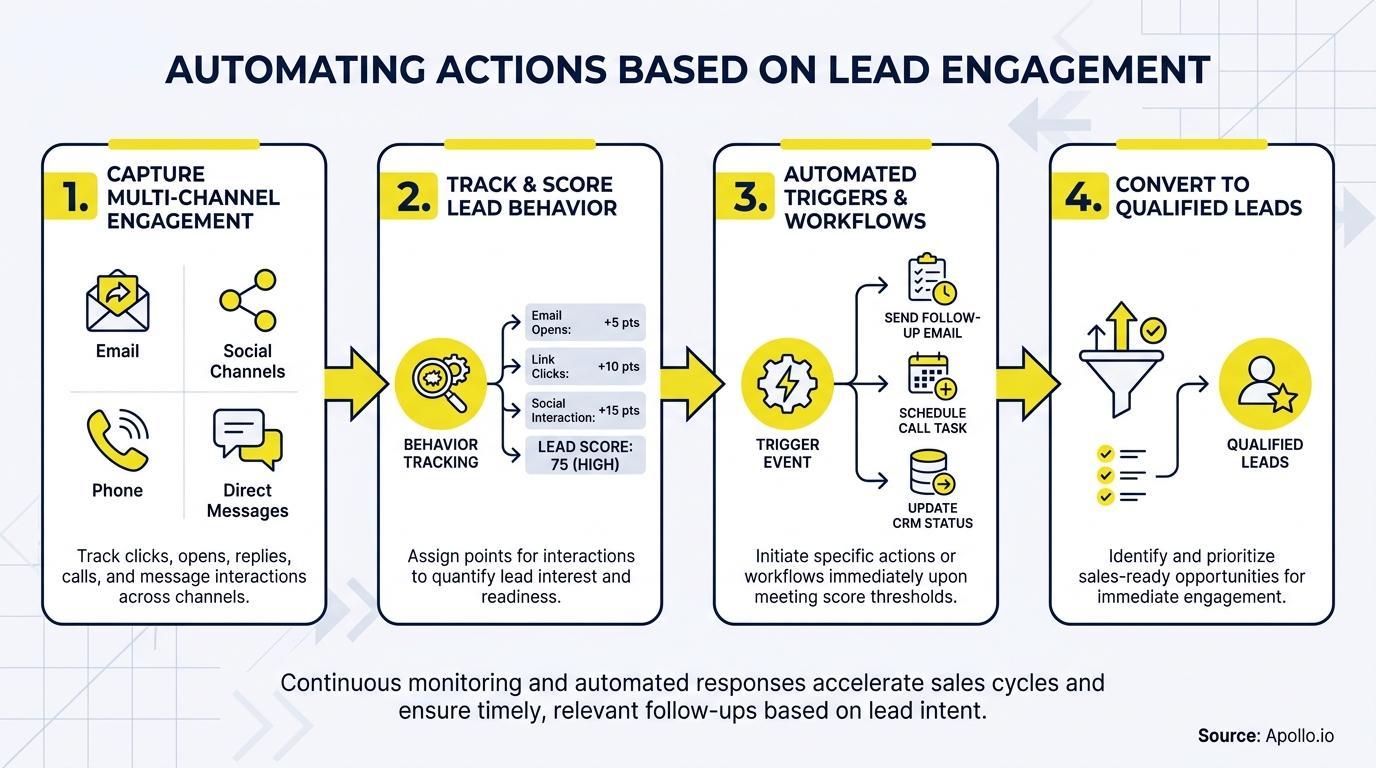
Lead engagement signals are behavioral data points that indicate a prospect's level of buying intent, categorized as low, medium, or high strength based on their proximity to a purchase decision. Understanding signal strength is what separates automation that converts from automation that annoys.
| Signal Strength | Example Signals | Channel Sources |
|---|---|---|
| Low | Email open, blog visit, social click | Email, web, social |
| Medium | Content download, webinar registration, multiple page visits | Web, webinar, email |
| High | Pricing page visit, demo request, chat conversation, trial signup | Web, chat, CRM |
Research from Amra and Elma shows 82% of B2B companies rely on automation for lead nurturing — yet most still use single-channel triggers. Effective automation pulls signals from email, website, webinars, chat, and account-level intent data into one unified score. For smarter lead generation, the signal source matters as much as the signal itself.
What Is an Engagement-to-Action Trigger Matrix?
An engagement-to-action trigger matrix maps each signal strength level to a specific automated response, preventing both under-reaction (ignoring high-intent leads) and over-reaction (sending sales reps after a single email open). This is the operational core of any behavior-based automation strategy.
| Signal Strength | Automated Action | Owner | Cooldown Rule |
|---|---|---|---|
| Low | Add to nurture sequence, serve relevant content | Marketing | 48-hour minimum between touches |
| Medium | Score increment, trigger targeted email, add to retargeting audience | Marketing/RevOps | 72-hour cooldown, max 3 touches/week |
| High | Create SDR task, alert AE, trigger personalized outreach sequence | Sales (SDR/AE) | No duplicate alert within 24 hours |
| Negative trigger | Suppress from active sequences, pause outreach | RevOps | Re-evaluate after 30-day decay |
Negative triggers are the most overlooked guardrail. Unsubscribes, competitor domain visits, out-of-office replies, or a contact marked as a current customer should immediately suppress outreach. A Salesgenie study found 71% of consumers abandon irrelevant experiences — automated outreach that ignores suppression rules directly contributes to that drop-off.
Spending hours manually routing leads to the right rep? Apollo's workflow automation lets you build trigger-based routing rules that fire the moment a lead hits a score threshold — no manual intervention needed.
How Do SDRs and RevOps Teams Implement Trigger Logic in Their CRM?
SDRs and RevOps leaders implement trigger logic by establishing four CRM prerequisites: required contact fields, a scoring taxonomy, decay rules, and a sales feedback loop. Without this data architecture, automation fires on incomplete information and creates noise rather than pipeline.
What CRM Fields Does Trigger Automation Require?
- Engagement score(numeric, auto-updated): Reflects cumulative behavioral activity.
- Last engagement date: Used to calculate score decay and cooldown windows.
- Signal source: Tracks which channel generated the trigger (email, web, chat).
- Trigger history: Logs which actions have already fired to prevent duplicate alerts.
- Suppression flag: Boolean field that halts all automated outreach when true.
- Sales feedback field: Allows reps to mark leads as "not ready," "bad fit," or "converted" to refine future scoring.
What Is Score Decay and Why Does It Matter?
Score decay automatically reduces a lead's engagement score over time when no new activity occurs, preventing stale leads from sitting at high-intent thresholds indefinitely. A standard decay model reduces scores by 10-20% every 14-30 days of inactivity.
This keeps your trigger matrix accurate and ensures SDRs only receive alerts on leads showing current intent.
According to MegaLeads, 61% of B2B teams now use AI for lead scoring, a significant jump from 23% in 2024. AI-assisted scoring accelerates decay calibration by learning which signal combinations actually correlate with closed revenue, not just activity volume.
Turn Funnel Guesswork Into Real Pipeline
Quota stress keeping you up at night? Apollo surfaces quality leads and tracks deal momentum in real time, so your forecast is built on facts — not gut feelings. Nearly 100K paying customers trust Apollo to fill the funnel right.
Start Free with Apollo →How Can SDRs Use Engagement Triggers to Book More Meetings in 2026?
SDRs use engagement triggers to prioritize their daily outreach queue automatically, replacing manual list-sorting with a live feed of high-intent contacts ranked by signal strength. This shifts SDR time from research to conversation. For a practical framework, see how Apollo's sales sequences can be built to fire based on specific engagement events rather than static time delays.
Practical trigger-to-meeting workflow for SDRs:
- High-intent trigger fires (pricing page visit + email click in same session).
- CRM creates an SDR task automatically with contact context.
- SDR reviews the signal summary and selects a personalized opening.
- Multi-channel sequence launches: email, phone, social — in that order.
- If no reply after 5 touches, lead re-enters medium-intent nurture track.
For Account Executives managing active opportunities, account-level triggers — such as a new stakeholder visiting the security documentation page — should fire a deal-alert task directly in the CRM, not just a marketing email. This is where buying-group-level automation creates differentiated pipeline velocity.
Ready to turn engagement signals into booked meetings automatically? Apollo's multi-channel sales engagement platform fires sequences based on real prospect behavior — not just a calendar schedule.

How Do You Measure Whether Engagement Triggers Are Working?
Measure engagement trigger performance by tracking four pipeline metrics beyond MQL volume: SQL creation rate per trigger type, sales cycle velocity, pipeline influence by channel, and revenue attributed per automation rule. MQL counts alone tell you volume; these metrics tell you whether triggers are creating revenue.
| KPI | What It Measures | Target Benchmark |
|---|---|---|
| SQL creation rate | % of triggered leads that become sales-qualified | Track by trigger type; compare month-over-month |
| Cycle velocity | Days from trigger to closed-won | Shorter than non-triggered deals |
| Pipeline influence | Revenue in pipeline touched by a trigger action | Segment by channel (email, web, webinar) |
| Suppression effectiveness | Unsubscribe rate on triggered sequences | Below your baseline sequence average |
RevOps leaders should run a weekly trigger audit: which rules fired most, which produced SQLs, and which generated suppression flags. This feedback loop feeds directly back into scoring weights and decay settings, creating a self-improving system. Proven prospect nurturing strategies always include a measurement layer — without it, even well-designed triggers drift out of calibration over time.
What Role Does AI Play in Engagement-Triggered Automation in 2026?
AI in 2026 moves engagement-triggered automation beyond simple if-then rules into predictive, multi-signal orchestration that recommends next-best actions across the entire buying group. Adobe's 2026 B2B journey report notes that more than half of B2B organizations expect agentic AI to coordinate sales, marketing, and service journeys in real time — though only 41% currently have a unified data foundation to support it.
The shift matters for GTM teams because AI-assisted triggers can:
- Identify high-intent account clusters before any individual lead hits a score threshold.
- Recommend sequence variants based on persona, industry, and prior engagement history.
- Adjust cooldown windows dynamically based on reply rate patterns.
- Flag buying-group engagement spikes and route alerts to the right AE automatically.
Data from Utmost Agency shows 80% of businesses using automation report generating more leads overall. Pairing that automation with AI-assisted trigger logic — rather than static rules — is what separates teams that scale pipeline from those that just scale activity. Explore Apollo's AI and automation tools to see how signal-based workflows can be deployed across your entire GTM motion.

Start Triggering the Right Actions at the Right Time
Engagement-triggered automation works when it connects accurate signal data, a structured trigger matrix, CRM data hygiene, and pipeline-level measurement into one continuous loop. SDRs book more meetings when their queue is prioritized by real intent.
AEs close faster when account-level alerts surface the right moment to engage. RevOps teams build predictable revenue when triggers fire on clean data with suppression guardrails in place.
Apollo consolidates prospecting, engagement, AI automation, and workflow triggers into a single platform — so your team stops stitching together five tools and starts acting on signals in real time. As Cyera put it, "Having everything in one system was a game changer."
Get Leads Now and start building engagement-triggered workflows that turn buyer signals into booked meetings.
Prove Pipeline ROI Before Next QBR
ROI pressure killing your next tool renewal? Apollo delivers measurable pipeline impact — meetings booked, deals influenced, revenue tied to every action. Nearly 100K paying customers make the business case effortlessly.
Schedule a Demo →Don't miss these
Sales
Inbound vs Outbound Marketing: Which Strategy Wins?
Sales
What Is a Sales Funnel? The Non-Linear Revenue Framework for 2026
Sales
What Is a Go-to-Market Strategy? The 2026 GTM Playbook
See Apollo in action
We'd love to show how Apollo can help you sell better.
By submitting this form, you will receive information, tips, and promotions from Apollo. To learn more, see our Privacy Statement.
4.7/5 based on 9,690 reviews
