
How Automation Improves Lead Assignment to Sales Reps
Most sales teams lose their best leads not during prospecting, but during the handoff. Manual lead assignment creates delays, misdirected opportunities, and rep overload — all before a single conversation happens. Automating lead assignment fixes the process that sits between finding the right leads and actually closing them.
According to CXL, organizations that respond to a lead within the first hour are seven times more likely to qualify that prospect than those who wait two hours. Automation closes that gap by routing leads instantly, without waiting for a manager to manually review a queue.

Build Pipeline With Verified Data
Tired of burning hours verifying contacts that bounce anyway? Apollo surfaces accurate business emails and phone numbers so your reps spend time selling, not searching. Join 600K+ companies turning research time into revenue.
Start Free with Apollo →Key Takeaways
- Automated lead assignment eliminates manual routing delays that kill conversion before the first call happens.
- Speed-to-lead is necessary but not sufficient: routing tools must be paired with enrichment, SLA escalation, and fallback rules to work reliably.
- Five assignment methods exist — from simple round-robin to predictive AI matching — each with distinct conversion and capacity tradeoffs.
- RevOps teams should build buyer-fit gating logic to avoid routing low-intent leads to reps prematurely.
- Automation saves reps time only when that time is redirected toward high-intent, best-fit opportunities.
What Are the Five Lead Assignment Methods, and How Do They Compare?
Lead assignment automation spans five distinct methods, ranging from basic queue distribution to predictive rep-to-lead matching. Each method serves a different operational maturity level and produces different outcomes.
| Method | How It Works | Best For | Key Tradeoff |
|---|---|---|---|
| Round-Robin | Distributes leads equally across all available reps | Small teams, homogeneous ICP | Fair distribution, but ignores rep fit or buyer context |
| Rules-Based | Routes by territory, industry, company size, or product line | Multi-product or geo-segmented teams | Scalable, but sprawls quickly — one Salesforce admin shared on Reddit managing 450+ individual rules updated weekly |
| Capacity-Based | Routes to the rep with the lowest active lead load | Teams with large inbound volume | Prevents burnout, but ignores rep specialization |
| Intent/Context-Based | Routes using engagement signals, page visits, or funding events | ABM or signal-driven GTM motions | High relevance, requires enriched and unified data |
| Predictive (AI) | Matches leads to reps based on historical conversion patterns | Mature RevOps teams with CRM history | Highest conversion potential, needs governance and audit trails |
Round-robin is fair but rarely smart. Signal-based and predictive assignment route by buyer context — including account fit, engagement history, vertical expertise, and buying-stage signals — rather than just territory or availability.
How Does Lead Assignment Automation Work in Practice?
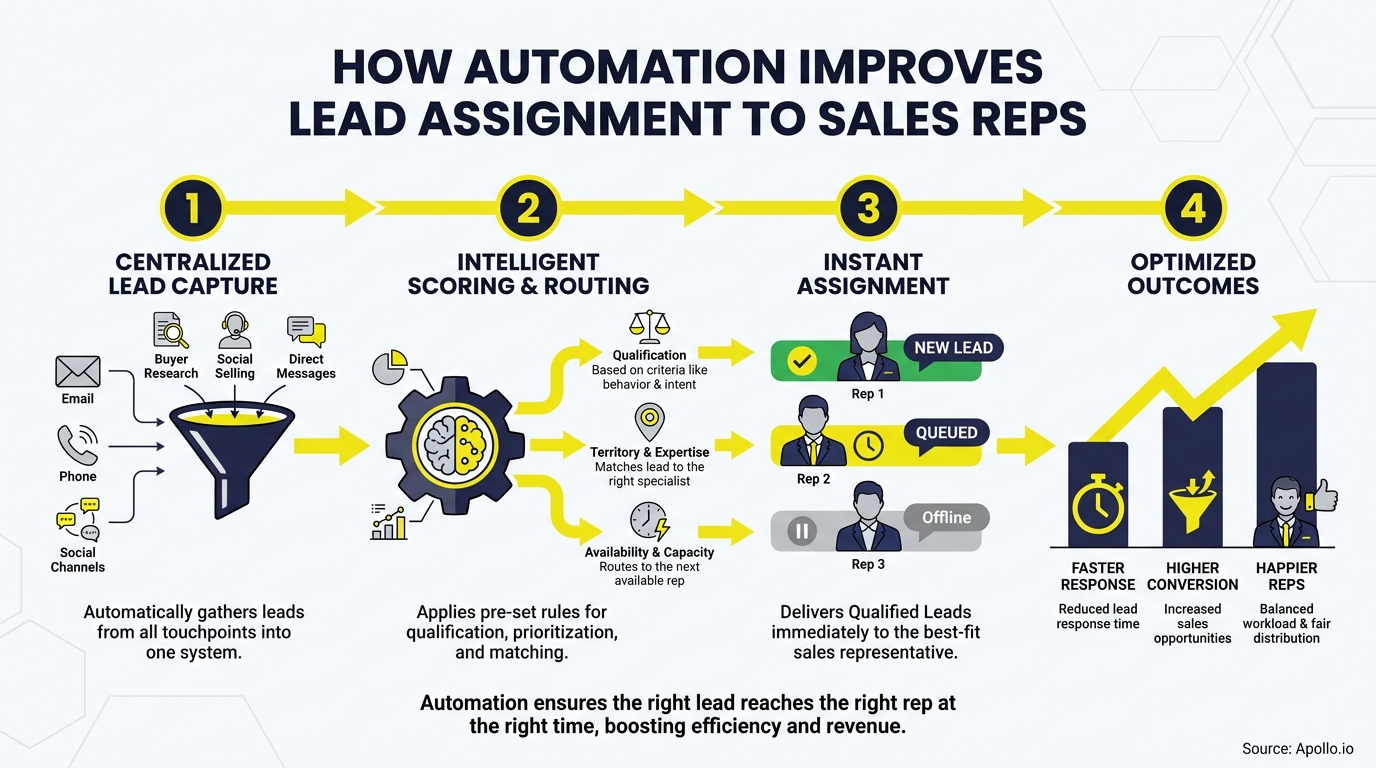
Automated lead assignment works by triggering a routing workflow the moment a lead enters your system, enriching it with firmographic and behavioral data, applying routing logic, and notifying the assigned rep — all without manual review.
A practical implementation follows four steps:
- Enrich on entry: Append missing fields (company size, industry, tech stack, intent signals) before any routing decision is made. Routing automation is only as good as the data feeding it.
- Apply buyer-fit gating: Not every inbound lead should go directly to a sales rep. Leads below a defined ICP threshold should route to nurture sequences, not an SDR queue.
- Execute assignment with SLA timers: Route matched leads instantly. Set a response SLA — a sales professional wrote on Reddit that their team uses a 30-minute action timer before a lead opens to the broader team on a first-come, first-serve basis.
- Escalate on SLA breach: If the assigned rep does not act within the SLA window, the lead automatically reassigns or escalates to a manager queue.
Spending too much time manually routing and qualifying leads? Apollo's Workflow Engine automates lead routing, scoring, and follow-up sequences so reps focus on selling, not admin.

How Does Automation Improve Speed-to-Lead for SDRs and RevOps Teams?
Automation improves speed-to-lead by eliminating the manual review step that creates multi-hour delays between lead capture and first contact.
For SDRs, the impact is direct: fewer leads fall through the cracks, and the leads they receive are already enriched and pre-qualified. Research from Overton Collective shows that sales automation can increase sales productivity by 14.5% and reduce marketing overhead by 12.2%.
For RevOps leaders, the challenge is that routing tools alone don't solve the problem. Speed-to-lead also depends on:
- Enrichment latency (how fast missing fields are appended before routing fires)
- Rep availability and capacity at the moment of assignment
- Queue ownership and fallback rules when the primary rep is unavailable
- SLA escalation paths when no action is taken within the defined window
This is where most teams stall: they implement a routing tool but don't build the operational layer around it. The result is faster assignment to the wrong rep, or to a rep who isn't available. Improving sales efficiency with RevOps requires treating routing as a system, not a feature.
Turn Funnel Guesswork Into Real Pipeline
Pipeline forecasting a guessing game because leads stall before they ever reach your reps? Apollo surfaces high-fit buyers and routes them instantly — so your forecast reflects reality. Join 600K+ companies building pipeline they can actually count on.
Start Free with Apollo →When Should You NOT Route a Lead Directly to Sales?
Not every inbound lead belongs in a sales rep's queue — routing low-fit leads to reps wastes capacity and degrades conversion metrics.
Buyer-fit gating logic should suppress or redirect leads under these conditions:
- ICP mismatch: Company size, industry, or geography falls outside defined target criteria
- Low intent score: Lead engaged with top-of-funnel content only, with no product-page or pricing signals
- Incomplete enrichment: Key routing fields are missing and enrichment has not yet returned data
- Existing account ownership: The lead's company is already owned by an AE — route to account owner, not a new SDR
- Active deal in CRM: A deal is open for this account — suppress from routing and notify the deal owner instead
A well-designed sales automation workflow treats nurture, self-serve, and direct sales routing as three separate outcomes — not a single default queue.
What Do RevOps Teams Need to Know About Automation and Data Quality?
Automated lead assignment breaks down when the underlying data is incomplete or stale — data quality is the primary operational bottleneck, not the routing logic itself.
According to TechImplement, automated lead assignment, often leveraging AI, helps prioritize leads and ensures that the most promising prospects are directed to the appropriate reps quickly — but that prioritization depends entirely on the data signals being accurate.
RevOps teams building reliable assignment systems should maintain:
- A unified enrichment layer that appends firmographic and intent data before routing triggers
- Audit trails showing which rule matched each lead, and why
- Explainable routing logic — not black-box AI — so reps and managers can trust and override assignments when needed
- Governance controls, including approval logic and fallback ownership, for leads that don't match any rule
Need cleaner lead data flowing into your routing system? Apollo enriches contacts with 65+ verified data attributes so your assignment logic fires on complete, accurate records.
Does Automation Actually Help Reps Sell More, or Just Save Admin Time?
Automation improves rep output only when time savings are redirected toward high-intent selling activity — not just absorbed by other administrative work.
A May 2026 Gartner survey found that sales organizations with moderate-to-large AI time savings that reinvest that time into high-impact sales activities are 3.1x more likely to exceed lead-to-opportunity conversion goals. The implication for RevOps and sales leaders: automate assignment, scoring, and SLA follow-up specifically to create focused selling time, not just to reduce queue size.
Data from Cirrus Insight shows that sales representatives spend only 28-30% of their time actively selling, with the majority consumed by administrative tasks, data entry, follow-ups, and internal meetings. Automated lead assignment directly reclaims a portion of that non-selling time by eliminating manual routing, research, and queue management.
For AEs managing active deal pipelines, the benefit is different: automation surfaces which inbound leads map to existing accounts and routes them to the right owner instantly — reducing the risk of a new SDR contacting an account already mid-cycle. Explore how AI-powered sales automation can help your team focus on the conversations that matter most.

How Can Your Team Get Started with Lead Assignment Automation in 2026?
The fastest path to improved lead assignment automation starts with auditing your current routing gaps, not buying a new tool.
A practical three-phase rollout:
- Phase 1 — Baseline audit: Measure current average response time, assignment accuracy rate, and lead fallthrough rate. Identify where leads go unassigned or stall in queue.
- Phase 2 — Rules and enrichment: Implement territory or capacity-based routing with mandatory enrichment before routing fires. Add SLA timers and escalation paths. Keep rules simple enough to maintain.
- Phase 3 — Signal-based and predictive routing: Layer in intent signals, engagement history, and account fit scoring. Introduce buyer-fit gating to suppress low-ICP leads from rep queues. Add audit trails for every routing decision.
Teams using Apollo consolidate prospecting, enrichment, sequencing, and workflow automation into one platform. As Predictable Revenue put it, "We reduced the complexity of three tools into one" — and that consolidation is what makes the routing layer reliable from day one. Learn more about building an automated lead generation system that feeds clean, enriched leads into your assignment workflows.
Ready to automate lead assignment without stitching together five separate tools? Start your free trial of Apollo and see how workflow automation, data enrichment, and sales engagement work together in a single platform.
Ramp Reps Faster, Prove ROI Sooner
Struggling to justify your sales tools when ramp time drags and ROI stays fuzzy? Apollo gives new reps a running start with scalable workflows built in. Teams like Leadium 3x'd revenue — see your return fast.
Start Free with Apollo →Don't miss these
Sales
Inbound vs Outbound Marketing: Which Strategy Wins?
Sales
What Is a Sales Funnel? The Non-Linear Revenue Framework for 2026
Sales
What Is a Go-to-Market Strategy? The 2026 GTM Playbook
See Apollo in action
We'd love to show how Apollo can help you sell better.
By submitting this form, you will receive information, tips, and promotions from Apollo. To learn more, see our Privacy Statement.
4.7/5 based on 9,690 reviews
