
How to Find Decision Makers at Universities for EdTech Sales
Selling edtech into universities is unlike any other B2B sale. There is no single buyer. There is a committee, and that committee has gatekeepers, governance layers, and budget constraints that most vendors never map correctly. According to Fortune Business Insights, the global EdTech market was valued at USD 189.15 billion in 2025 and is projected to reach USD 588.72 billion by 2034. The opportunity is massive, but only for teams that understand how higher-ed buying decisions actually work.
This playbook gives edtech SDRs, AEs, and revenue leaders a role-by-role decision map, a procurement readiness checklist, and account segmentation strategies for 2026. If you want to learn how to find, reach, and win B2B leads in highly complex buying environments, university edtech is the ultimate test case.

Research Less, Close More With Apollo
Tired of your reps burning hours on manual lead research instead of selling? Apollo delivers verified contacts instantly, so your team spends time closing — not digging. Join 600K+ companies building pipeline faster.
Start Free with Apollo →Key Takeaways
- University edtech decisions are committee-based, involving the CIO, provost, procurement, finance, and AI governance stakeholders simultaneously.
- Institution type (R1 vs. non-R1) and IT centralization level dramatically change who to contact first and how to sequence outreach.
- Procurement gatekeepers now prioritize security, compliance, SSO, and accessibility before teaching-and-learning outcomes.
- AI governance committees are an emerging, named buying center that edtech vendors must include in their stakeholder maps.
- Budget pressure is accelerating, making CFO and procurement influencers essential early contacts, not late-stage validators.
Who Actually Owns the University EdTech Buying Decision?
University edtech buying authority is distributed across a committee, not held by a single decision maker. The buying group typically spans five to seven roles, each with veto or influence power at a different stage.
| Role | Authority Type | Primary Concern | When They Enter |
|---|---|---|---|
| CIO / VP of IT | Technical approval | Security, integrations, SSO | Early to mid |
| Provost / VP Academic Affairs | Academic authority | Pedagogical fit, faculty adoption | Mid |
| CFO / Budget Office | Budget approval | Cost, ROI, contract terms | Mid to late |
| Procurement Officer | Process gatekeeper | Compliance, RFP, vendor vetting | Mid to late |
| AI Governance Committee | Policy authority | AI use policy, data privacy | Early (for AI tools) |
| Dean / Department Head | Departmental champion | Use-case fit, faculty buy-in | Early |
| Faculty / Staff | Adoption influencer | Usability, workload impact | Pilot and post-pilot |
Research from Ellucian confirms that Executive Leadership, Information Technology, and Data & Analytics are consistently identified as early adopters and leaders in leveraging new technologies like AI within higher education institutions. For AI-enabled edtech, EDUCAUSE's 2026 research found decision-making authority sits mainly with institution-wide leadership (59%), IT (53%), and AI governance committees (38%), making AI committees a named buying center that vendors can no longer ignore.
Struggling to find verified contacts for these roles? Search Apollo's 230M+ contacts with 65+ filters to pinpoint CIOs, provosts, and procurement leaders by institution type.
How Should EdTech Teams Segment Outreach by Institution Type?
Prospecting strategy should differ materially between R1 research universities, non-R1 institutions, and private colleges because IT centralization and CIO reporting lines vary significantly by type.
- R1 Research Universities: Only 22.9% are highly centralized in IT. The CIO reports to the president (38%), CFO (28%), or provost (18%). Procurement paths are more academic-office oriented, so outreach to the provost or research VP often opens more doors than the CIO alone.
- Non-R1 Public Institutions: 66.2% of all institutions are at least 75% centralized in IT. The CIO is the most efficient entry point. A single IT approval often clears the path for the full buying committee.
- Private Colleges: 84.8% are highly centralized, making C-suite and CIO outreach highly efficient. Budget authority is concentrated, so CFO engagement early accelerates deal timelines.
For AEs managing university accounts, segmenting by institution type before building outreach sequences is the single highest-leverage tactic. Treating all universities as one market wastes pipeline capacity. Use a tiered B2B marketing funnel that routes R1 institutions through academic-leadership sequences and community colleges through IT-first paths.

What Does the Higher-Ed Procurement Readiness Checklist Look Like?
Procurement readiness is the edtech vendor's ability to answer the institutional reviewer's checklist before an RFP is even issued. Failing any single item can stall or kill a deal after months of pipeline work.
According to myabacc.org, Procurement Leaders face significant challenges in keeping up with evolving technology, with 45% citing it as one of their institution's biggest hurdles, especially with AI-embedded products. Your sales content must make their job easier.
- Security and privacy: HECVAT completion, SOC 2 documentation, data processing agreement ready to share
- SSO and authentication: SAML/Shibboleth compatibility confirmed for campus identity systems
- Accessibility: VPAT (Voluntary Product Accessibility Template) current and publicly available
- AI governance: AI acceptable-use documentation, explainability summary, data retention policy
- Integration proof: Confirmed compatibility with Banner, Workday, Canvas, Blackboard, or Brightspace
- Cost and ROI evidence: Per-student pricing model, multi-year contract flexibility, renewal terms
- Procurement cooperative eligibility: E&I, Sourcewell, or NASPO contract availability for faster procurement
SDRs and AEs should distribute this checklist proactively to internal champions so they can pre-socialize procurement readiness before the formal review begins. This is the difference between being on the shortlist and being eliminated in the first screening round.
How Do SDRs Find and Reach University Decision Makers Before the Budget Is Locked?
SDRs selling edtech into universities should prioritize pre-RFP signals to reach decision makers while budget conversations are still open. Once an RFP is issued, vendor positioning is mostly locked.
High-value prospecting signals to monitor:
- New CIO or VP of Academic Technology hires (leadership transition = tech re-evaluation)
- Published institutional AI task force or strategic plan (signals active buying intent)
- Grant announcements (NSF, Title III, FIPSE) that fund technology adoption
- System-wide initiative announcements (multi-campus rollouts multiply deal size)
- Budget hearings or public board meeting agendas mentioning digital transformation
- Procurement cooperative activity (E&I or Sourcewell contract solicitations)
Use intent data to surface universities actively researching edtech categories. Pairing intent signals with verified contact data for the right roles dramatically improves reply rates. Also consider Apollo's email finder to locate verified business contact information for CIOs, directors of academic technology, and procurement officers at target institutions.
Spending hours manually researching university org charts and leadership changes? Automate multi-stakeholder outreach sequences with Apollo's sales engagement platform so your team reaches every committee member at the right time.
Turn Funnel Guesswork Into Pipeline Confidence
Pipeline forecasting a guessing game because leads stall before they ever become opportunities? Apollo surfaces in-market buyers at the right moment, so your funnel fills with prospects that actually convert. Nearly 100K paying customers stopped guessing and started closing.
Schedule a Demo →What Messaging Works for Each Stakeholder in the University Buying Committee?
Effective edtech messaging is stakeholder-specific. The same pitch that resonates with a CIO will create friction with a provost, and vice versa.
| Stakeholder | Message Frame | Proof Asset to Share |
|---|---|---|
| CIO | Security, uptime, integration with existing stack | HECVAT, SOC 2, integration documentation |
| Provost | Faculty adoption, learning outcomes, academic alignment | Peer institution case studies, research evidence |
| CFO | Cost consolidation, measurable ROI, budget predictability | Per-student cost model, consolidation savings narrative |
| Procurement | Compliance, cooperative contracts, vendor transparency | VPAT, cooperative eligibility, contract templates |
| AI Governance Committee | AI policy alignment, data use transparency, explainability | AI governance one-pager, data retention policy |
The B2B sales landscape now requires a holistic selling approach, as research from the University of Kansasconfirms: buyers are highly informed and prefer digital interactions, making multi-channel, committee-aware outreach the baseline expectation. A single champion with a strong relationship can no longer carry a university deal alone.
How Can RevOps Leaders Build a Scalable University EdTech Pipeline?
RevOps leaders should build university account plans as multi-stakeholder objects, not single-contact records. Every university target needs mapped roles, sequenced touches, and procurement readiness assets attached before an SDR makes first contact.
Key RevOps actions for university pipeline health:
- Create account segments by institution type (R1, non-R1, private) and centralization level in your CRM
- Tag accounts by buying stage: pre-signal, active signal, pre-RFP, RFP, pilot, negotiation
- Build multi-contact sequences for at least three roles per account (CIO, academic lead, procurement)
- Track procurement cooperative eligibility as a deal-acceleration field
- Set intent-signal alerts to trigger outreach before budget cycles close
For RevOps teams consolidating their tech stack, tools like Apollo replace the need for separate contact databases, sequencing tools, and intent signal platforms. As Cyera noted: "Having everything in one system was a game changer." Learn more about improving sales efficiency with RevOps using a unified GTM platform.

How Can an EdTech Company Start Finding University Decision Makers Today?
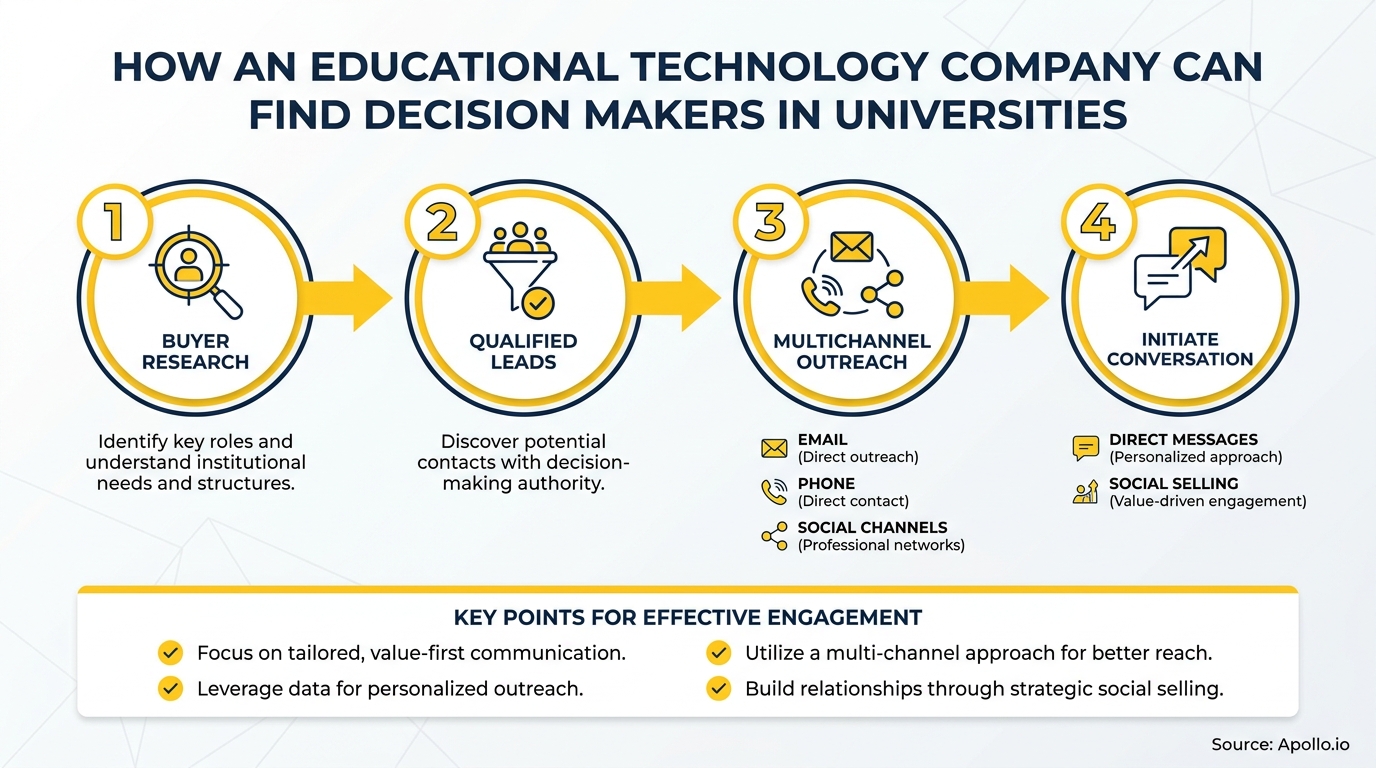
An edtech company can start finding university decision makers by building a committee map for each target institution, identifying the right entry-point role based on institution type, and reaching out with stakeholder-specific messaging backed by procurement-ready documentation.
The market opportunity is real. Academic Institutions are expected to account for a 53.4% share in the EdTech end-user segment by 2026, driven by centralized procurement budgets, according to Future Market Insights. But that share goes to vendors who map the full committee, speak each stakeholder's language, and arrive procurement-ready before the RFP window opens.
Your action plan:
- Segment your target list by institution type and centralization level
- Map five to seven roles per account before outreach begins
- Complete your HECVAT, VPAT, and AI governance documentation now
- Identify pre-RFP signals (leadership changes, strategic plans, grants) and set alerts
- Build multi-stakeholder sequences with role-specific messaging and proof assets
- Engage procurement cooperative directories (E&I, Sourcewell) to accelerate late-stage deals
University deals are winnable when your team treats them as the committee sales they actually are. Apollo gives edtech SDRs, AEs, and RevOps leaders one unified workspace to find contacts, run sequences, track pipeline, and consolidate the tools needed for complex multi-stakeholder outreach. Get Leads Now and start mapping your first university buying committee today.
Prove Pipeline ROI Before Next QBR
ROI pressure killing your tool approvals? Apollo delivers measurable pipeline impact from day one — so your next budget conversation leads with results, not promises. Leadium 3x'd annual revenue. You're next.
Start Free with Apollo →Don't miss these
Sales
Inbound vs Outbound Marketing: Which Strategy Wins?
Sales
What Is a Sales Funnel? The Non-Linear Revenue Framework for 2026
Sales
What Is a Go-to-Market Strategy? The 2026 GTM Playbook
See Apollo in action
We'd love to show how Apollo can help you sell better.
By submitting this form, you will receive information, tips, and promotions from Apollo. To learn more, see our Privacy Statement.
4.7/5 based on 9,690 reviews
