
How Can a Small Startup with Limited Staff Focus on High-Priority Leads in 2026?
Your startup doesn't need more leads. It needs a smaller, smarter lead queue. According to G2, 80% of new leads never translate into sales — which means most of your team's effort is aimed at the wrong accounts. For lean B2B GTM teams, that's a problem you can't afford. The fix isn't more outreach volume. It's a ruthless triage system built around fit, timing, buying-group coverage, and urgency signals. Learn how to find better buyer leads and stop wasting cycles on the ones that won't convert.

Research Less, Pipeline More With Apollo
Tired of burning hours verifying contacts that go nowhere? Apollo delivers 97% accurate emails and business numbers so your reps spend time selling, not searching. Join 600K+ companies building pipeline faster.
Start Free with Apollo →Key Takeaways
- Most new leads will never close — prioritizing accounts by fit, timing, and buying-group signals beats chasing every form fill.
- B2B buyers form their shortlist before talking to any vendor, so early intent signals matter more than demo requests.
- A four-factor triage matrix (fit, stage, buying-group coverage, urgency) gives small teams a repeatable daily decision engine.
- A micro-SLA eliminates the sales-marketing handoff gap that kills deals at resource-constrained startups.
- AI automation lets one SDR or BDR protect their calendar for high-value conversations instead of manual research and routing.
Why Do Small Teams Struggle to Identify High-Priority Leads?
Small teams struggle because they treat all leads equally, chasing volume instead of quality. The Marketing Blender reports that 80% of B2B customers are lost due to indifference or perceived apathy — not a bad product. When a two-person GTM team tries to follow up with every inbound contact, nobody gets the focused attention that converts. The result is a leaky pipeline where high-fit, ready-to-buy accounts slip through while low-fit leads consume the day.
The counterintuitive truth: the newest demo request is often lower priority than an account that has been quietly researching your category for weeks. A 2025 report from 6sense found that 94% of buying groups ranked preferred vendors before first contact, and buyers purchased from that preliminary favorite 77% of the time. Startups need early intent signals, not just form fills.
What Is a Lead Triage Matrix and How Does It Work?
A lead triage matrix is a scoring framework that ranks accounts on four dimensions so your team knows exactly which account to work next. Each dimension gets a score of 1-3, and the combined total determines daily priority.
Here is how to build it:
| Dimension | Score 1 (Low) | Score 2 (Medium) | Score 3 (High) |
|---|---|---|---|
| Fit | Outside ICP (wrong size, industry, or budget) | Partial ICP match | Exact ICP match (size, vertical, tech stack) |
| Buying Stage | Early awareness only | Actively evaluating options | Shortlisting vendors, budget confirmed |
| Buying-Group Coverage | One contact only | 2-3 contacts across functions | Champion + economic buyer + technical evaluator engaged |
| Urgency Signal | No recent activity | Single trigger (job post, funding) | Multiple signals (pricing page + repeat visits + hiring) |
How to use it: Score each account weekly. Tier 1 (9-12 points) gets same-day rep outreach. Tier 2 (5-8 points) enters an automated nurture sequence. Tier 3 (under 5 points) stays in a low-touch drip. This system directly addresses sales efficiency — your reps spend zero time debating who to call next.
Struggling to find qualified accounts to populate your triage queue? Search Apollo's 230M+ contacts with 65+ filters to build a pre-qualified pipeline in minutes.
Why Does Buying-Group Prioritization Beat Individual Lead Scoring?
Buying-group prioritization beats individual lead scoring because B2B purchases involve multiple stakeholders, and single-contact scoring misses the actual decision dynamic. A Gartner 2025 survey found that buying groups range from 5 to 16 people across up to four functions, and groups that reach internal consensus are 2.5x more likely to report a high-quality deal.
Chasing one champion at an account while ignoring the economic buyer or technical evaluator creates stalled deals.
For SDRs and BDRs at early-stage startups, the practical implication is clear: multi-thread from day one. When you identify a Tier 1 account in your triage matrix, map at least three personas before your first outreach touch. Use intent data to see which personas are actively researching, then sequence them in parallel rather than waiting for a single champion to pull you in. The 6sense 2026 BDR report confirmed that multi-threading and persona guidance are more predictive of quota attainment than raw outreach volume.
Turn Weak Leads Into Pipeline With Apollo
Tired of watching marketing leads stall before they ever reach your pipeline? Apollo surfaces ready-to-engage prospects with verified contact data and buyer signals. Join 600K+ companies converting more leads into real opportunities.
Start Free with Apollo →How Do SDRs and Founders Build a Micro-SLA for Small Teams?
A micro-SLA is a one-page agreement that defines who handles each lead tier, the maximum response time, and the handoff trigger — eliminating ambiguity when your entire GTM team is two or three people. Research from Greet Now shows that responding within five minutes makes you 21x more likely to qualify a lead compared to waiting 30 minutes. Without a written SLA, that window closes silently.
Here is a starter micro-SLA template for a lean team:
| Lead Tier | Owner | Response SLA | Next Step |
|---|---|---|---|
| Tier 1 (9-12 pts) | SDR / Founder | Within 5 minutes (business hours) | Personalized call + email + social touch same day |
| Tier 2 (5-8 pts) | Automated sequence + SDR review | Auto-enrolled within 1 hour | 3-touch email sequence; SDR reviews reply within 24h |
| Tier 3 (under 5 pts) | Marketing automation | Auto-enrolled within 24 hours | Educational nurture; re-score monthly |
For founders building outbound from scratch, the micro-SLA also doubles as an onboarding document for your first sales hire. It removes ambiguity and lets you measure the one metric that matters most early on: speed-to-meaningful-contact on Tier 1 accounts. Pair it with sales transformation best practices to keep the system scalable as you grow.

How Can AI Automation Help a Small Startup Protect Rep Time?
AI automation helps small startups protect rep time by handling research, routing, and low-tier nurture so human reps focus exclusively on high-value conversations. Salesforce's 2026 State of Sales report found that 48% of sellers say they lack bandwidth for adequate cold outreach, and high performers are 1.7x more likely to use prospecting agents.
For a two-person team, AI is the force multiplier that makes a micro-SLA actually executable.
Practical AI tasks that free up rep capacity:
- Account research: Auto-populate firmographic data, recent funding events, and hiring signals before a rep touches the account.
- Lead routing: Automatically score and assign inbound leads to the correct tier without manual review.
- Tier 2-3 nurture: Run multi-touch email sequences for mid- and low-priority accounts with no rep involvement.
- Meeting prep briefs: Generate a one-page account summary before every Tier 1 call so reps arrive informed.
Spending hours on manual outreach and research instead of closing? Automate your sequences and research with Apollo's AI-powered GTM system — one unified workspace that replaces the patchwork of tools slowing your team down.
Apollo consolidates prospecting, sequencing, enrichment, and pipeline management into a single platform. As Cyera noted, "Having everything in one system was a game changer." For startups under budget pressure, that kind of tool consolidation directly reduces overhead while accelerating output. You can also learn more about how to use sales automation the right way to avoid common pitfalls.
What Weekly Metrics Should Small Teams Track for Lead Prioritization?
Small teams should track four weekly metrics that balance speed, quality, and coverage — not vanity counts like total leads or emails sent. The goal is to know whether your triage system is working before the quarter ends.
- Tier 1 response time:Average minutes from lead entering Tier 1 to first meaningful contact. Target: under 10 minutes.
- Tier 1 meeting rate: Percentage of Tier 1 accounts that book a meeting within 5 business days. This is your triage accuracy signal.
- Buying-group coverage ratio:Average number of unique contacts engaged per Tier 1 account. Target: 3 or more.
- Tier re-score rate: Percentage of Tier 2-3 accounts that move up to Tier 1 after re-scoring. A rising rate means your nurture sequences are working.
RevOps leaders at growing startups often find that tracking these four metrics weekly surfaces the 20% of accounts generating 80% of pipeline movement. For deeper analytics guidance, explore marketing analytics examples that connect lead quality metrics to revenue outcomes.

How Do You Start Focusing on High-Priority Leads Today?
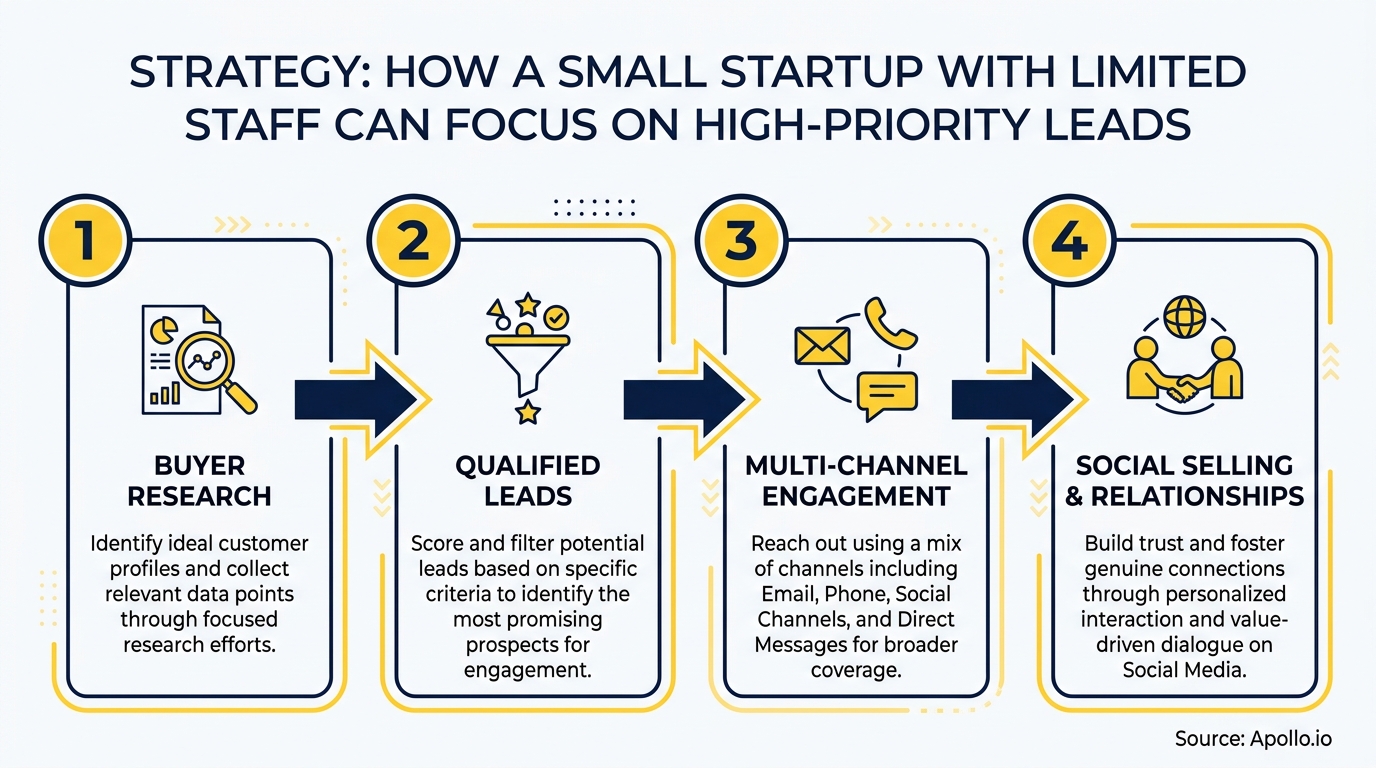
Small startups with limited staff focus on high-priority leads by implementing three things in sequence: a four-factor triage matrix, a one-page micro-SLA, and AI automation for Tier 2-3 accounts. That combination ensures your best reps spend their hours only on accounts most likely to close — and nothing else competes for their attention.
The research is unambiguous. Pipeline360 found that 80% of B2B practitioners agree that getting new, qualified leads is mission-critical. But qualification without prioritization is still wasted effort. Build your triage matrix this week. Write your micro-SLA in one afternoon. Let automation handle the rest so your team can do what only humans can: validate decisions, reduce risk, and close deals for buyers who are already shortlisting you.
For more tactical approaches to building pipeline as a lean team, read the outbound prospecting guide and explore how to generate leads for free using proven strategies that don't require a large team or budget.
Ready to build a smarter lead queue? Start Free with Apollo — the all-in-one GTM platform trusted by nearly 100K paying customers that consolidates prospecting, enrichment, sequencing, and pipeline management into one workspace.
Prove Pipeline ROI With Apollo
ROI pressure killing your tool budget? Apollo delivers measurable pipeline impact from day one — 46% more meetings with AI Research Agent. Join 600K+ companies turning results into renewal confidence.
Start Free with Apollo →Don't miss these
Sales
Inbound vs Outbound Marketing: Which Strategy Wins?
Sales
What Is a Sales Funnel? The Non-Linear Revenue Framework for 2026
Sales
What Is a Go-to-Market Strategy? The 2026 GTM Playbook
See Apollo in action
We'd love to show how Apollo can help you sell better.
By submitting this form, you will receive information, tips, and promotions from Apollo. To learn more, see our Privacy Statement.
4.7/5 based on 9,690 reviews
