
How Accurate Are Company Revenue and Employee Counts in a B2B Data Platform?
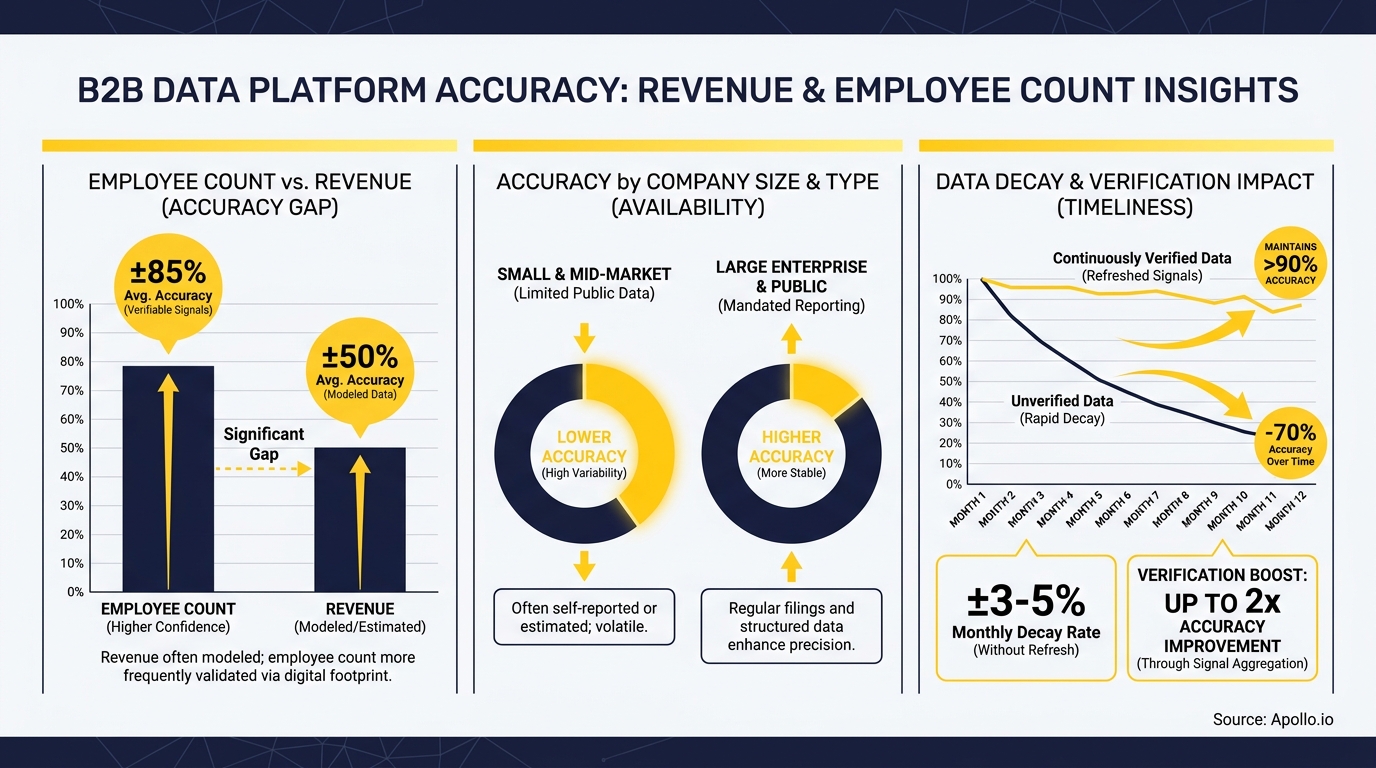
Revenue and employee count fields in B2B data platforms are modeled estimates, not verified facts. Most vendors infer these values from web signals, job postings, financial filings, and partner data rather than sourcing them directly. That distinction matters enormously when your ICP filters, territory assignments, and ABM spend all depend on those numbers being close to reality. According to Landbase, most B2B data providers offer an average accuracy rate of only 50%, leading to significant efficiency gaps for sales and marketing teams. Understanding what data enrichment actually means for your CRM is the first step toward fixing it.

Build Pipeline, Not Spreadsheets
Tired of burning hours verifying contact info that goes nowhere? Apollo surfaces accurate, ready-to-work leads so your team sells instead of searches. Join 600K+ companies turning research time into revenue.
Start Free with Apollo →Key Takeaways
- Firmographic fields like revenue and headcount are typically modeled estimates with confidence bands, not exact figures sourced from verified records.
- Data decay is the primary accuracy problem: employee counts and revenue bands go stale within months without active refresh cadences.
- A significant share of CRM data is already outdated, making vendor accuracy only part of the problem.
- RevOps teams are moving toward waterfall enrichment (multi-provider blending) rather than trusting a single platform's firmographics.
- Firmographic inaccuracies have direct downstream effects on territory planning, lead routing, TAM sizing, and ABM spend allocation.
Why Are Revenue and Employee Counts So Hard to Get Right?
Revenue and headcount are fundamentally difficult to pin down because most companies are not required to disclose them publicly. Private companies (the majority of the B2B universe) have no regulatory obligation to publish financials or payroll figures.
Vendors fill this gap by modeling: they aggregate signals from job boards, web traffic tools, technology footprint data, government registries, and financial filings to produce a range or a point estimate.
The result is that accuracy varies significantly by company type and geography:
- Public companies: Higher accuracy because quarterly filings provide audited revenue and headcount anchors.
- Private SMBs: Lowest accuracy, often estimated from proxy signals with wide confidence bands.
- Subsidiaries and divisions: Frequently misattributed to parent or reported at global level instead of local entity.
- International companies: Coverage thins significantly outside the US and Western Europe.
Data decay compounds the modeling problem. Org restructuring, layoffs, acquisitions, and revenue swings happen constantly. As Reachstream notes, a company that previously fit an ideal customer profile might no longer qualify after a major restructuring. A firmographic field with no refresh timestamp is essentially an unknown vintage.
What Do Accuracy Tolerances Actually Look Like by Field?
Not all firmographic fields decay at the same rate or carry the same accuracy risk. Understanding field-level tolerances helps RevOps teams decide where to validate and where to accept modeled estimates.
| Field | Typical Accuracy Mode | Decay Rate | Best Validation Source |
|---|---|---|---|
| Employee Count (Global) | Range estimate (±20-40%) | Fast (hiring cycles) | professional networks headcount, BLS QCEW aggregates |
| Employee Count (Geo/Function) | Modeled from job postings | Very fast | Job board signals, vendor enrichment |
| Annual Revenue (Public) | Audited filing | Slow (annual reports) | SEC filings, earnings releases |
| Annual Revenue (Private) | Modeled range | Moderate | Credit bureaus, data provider triangulation |
| Industry / NAICS Code | Classification match | Slow | IRS/SBA filings, manual review |
The U.S. Bureau of Labor Statistics' Quarterly Census of Employment and Wages (QCEW) covers more than 95% of U.S. jobs and is a useful calibration baseline for judging whether a vendor's employee count range is plausible for a given sector or region.
It won't give you company-level data, but it provides aggregate benchmarks to sanity-check outliers.
Struggling to know which firmographic fields to trust in your CRM? Apollo's data enrichment keeps your account records continuously refreshed with verified business contact and company data.
Turn Funnel Guesswork Into Closed Deals
Forecasts unreliable because leads stall before they ever become opportunities. Apollo surfaces in-market buyers with pinpoint precision so your pipeline reflects reality. Over 600K companies forecast with confidence.
Start Free with Apollo →How Do RevOps Teams Validate Firmographic Data?
RevOps teams validate firmographic data through a triangulation workflow: combining vendor-supplied fields with internal CRM signals, public records, and secondary providers to arrive at a confidence-weighted answer.
A practical triangulation playbook looks like this:
- Set a primary source hierarchy. Define which source wins for each field (e.g., CRM manually verified data beats vendor estimate).
- Flag fields missing a last-verified date. Any field older than 90 days without a refresh trigger should be treated as low-confidence.
- Cross-reference employee count against professional network headcount signals for accounts above a defined ACV threshold.
- Use waterfall enrichmentfor revenue: route to Provider A first, fall back to Provider B if confidence is below threshold, then flag for manual review if both return null.
- Calibrate revenue bands against public filings for any account where the deal size warrants it (enterprise deals especially).
This approach reflects a broader industry shift: RevOps leaders are operationalizing "best available answer" logic rather than trusting any single platform's firmographics in isolation. Building a structured data enrichment strategy is what makes this triangulation scalable rather than ad hoc.
How Does Bad Firmographic Data Affect SDRs and Revenue Teams?
Bad firmographic data creates compounding problems across the GTM funnel, and SDRs bear the most direct cost.
When employee counts or revenue bands are wrong, SDRs spend time on accounts that fall outside ICP thresholds once the real numbers surface. Misrouted leads land with the wrong AE or go to a segment team that can't support the deal size.
ABM campaigns target accounts in the wrong revenue tier, wasting ad spend. TAM models built on inaccurate headcount ranges produce pipeline forecasts that don't hold.
Research from Demand Gen Reportfound that 43% of CMOs trust less than half of their marketing data. That level of distrust has a practical consequence: teams add manual review steps, slow down routing, and second-guess segmentation decisions that should be automatic.
As Kondo's B2B Sales Report notes, poor data quality undermines the value of a well-used CRM, which otherwise improves forecast accuracy and provides transparency. The CRM is only as trustworthy as the firmographic layer underneath it.
Additionally, Landbase reports that a significant 70% of CRM data is outdated, incomplete, or inaccurate, meaning the problem rarely originates with the vendor alone. Internal data hygiene practices are equally at fault.

What Governance Model Keeps Firmographic Data AI-Ready?
An AI-ready firmographic governance model assigns clear ownership, refresh SLAs, and escalation paths for each critical field. Without this structure, AI-powered scoring and routing tools will amplify bad data at scale instead of correcting it.
A minimal governance framework for RevOps includes:
- Data Steward role: One person (or team) owns firmographic field definitions, source priority, and SLA compliance.
- Refresh SLAs by field tier: High-ICP accounts refreshed every 30 days; mid-tier every 90 days; long-tail annually.
- Confidence scoring: Each firmographic field carries a confidence flag (verified, modeled, stale) visible in the CRM.
- Escalation path: Accounts flagged as "stale + high-ACV" route to manual enrichment review before entering active sequences.
- Audit cadence: Quarterly sample audit of 100 accounts comparing vendor data to ground-truth sources.
This matters even more as AI adoption accelerates. Organizations implementing AI tools need reliable firmographic inputs for segmentation and scoring. B2B data enrichment built for smarter routing gives RevOps teams the continuous refresh layer that governance frameworks require.
How to Choose a B2B Data Platform with Better Firmographic Accuracy
When evaluating a B2B data platform for firmographic accuracy, ask vendors these specific questions rather than accepting accuracy claims at face value:
- What is the source mix for revenue and employee count fields? (Filings? Job boards? Web signals? Partner data?)
- What is the average refresh cadence for firmographic fields?
- Do records include a last-verified date?
- What is the coverage rate for private companies vs public companies in your target geography?
- Is geo/function-specific headcount available, or only global employee count?
Apollo's database of 230M+ people and 30M+ companies includes firmographic attributes across 65+ filters, with CRM enrichment that continuously updates account records rather than delivering a static export. For teams that need both prospecting and enrichment in one workspace, that consolidation removes the data handoff gap that causes firmographic fields to go stale between systems. As Cyera put it: "Having everything in one system was a game changer."
Teams looking to build better ICP filters and segment accounts by verified firmographics can explore Apollo's advanced prospecting search with 65+ company and contact filters.

Start Prospecting with Firmographic Data You Can Trust
Revenue and employee counts in B2B data platforms are estimates, not guarantees. The platforms that earn trust do so through transparent source attribution, measurable refresh cadences, and confidence scoring, not by claiming perfection.
RevOps and marketing teams that treat firmographic data as a governed asset (with defined SLAs, waterfall enrichment logic, and audit cadences) outperform those that accept vendor exports at face value.
Apollo combines a 230M+ contact database, 97% email accuracy, continuous CRM enrichment, and a full GTM engagement layer in one platform, replacing the fragmented stack that lets firmographic data go stale between tools. Start free with Apollo and prospect against verified, continuously refreshed company data from day one.
Prove Pipeline ROI With Apollo
ROI pressure killing your next tool renewal? Apollo delivers measurable pipeline impact from day one — so budget conversations become easy wins. Leadium 3x'd their revenue. You're next.
Start Free with Apollo →Don't miss these
Sales
Inbound vs Outbound Marketing: Which Strategy Wins?
Sales
What Is a Sales Funnel? The Non-Linear Revenue Framework for 2026
Sales
What Is a Go-to-Market Strategy? The 2026 GTM Playbook
See Apollo in action
We'd love to show how Apollo can help you sell better.
By submitting this form, you will receive information, tips, and promotions from Apollo. To learn more, see our Privacy Statement.
4.7/5 based on 9,690 reviews
