
Best GTM Engineer Course: Inside Apollo's 12-Week GTME Program
Most GTM engineer courses teach you how to stitch tools together. Apollo's takes a different position entirely. The Apollo's GTME Program is built on a single conviction: the best GTM Engineer isn't a tool sommelier — they're a revenue strategist who deploys elegant strategy at high velocity.
This isn't a self-paced video library or a certification you earn after a quiz. It's a 12-week hands-on engagement where a dedicated Go-to-Market Engineer builds your entire GTM system alongside your team. For a deeper look at the role itself, visit our comprehensive guide on the GTM Engineer.

Research Less, Close More With Apollo
Tired of your reps burning hours on manual research instead of selling? Apollo delivers verified contacts instantly, so your team spends time closing — not digging. 550K+ companies trust Apollo to fill pipeline fast.
Start Free with Apollo →Key Takeaways
- Apollo's GTME Program is a 12-week, done-with-you GTM engineering course — not a self-paced training.
- A dedicated GTM Engineer builds your system across seven pillars: TAM, Deliverability, Scoring, Messaging, Workflows, Human-in-the-Loop, and Reporting.
- The program requires only 15-20 hours of your team's time across 12 weeks.
- The endgame is Agentic GTM: a system that runs autonomously, without humans duct-taping handoffs between tools.
- Program metrics from the methodology: TAM visibility at 100%, research speed at 10x, automation rate at 90-95%.
What Is Apollo's GTM Engineer Course?
Apollo's GTM engineer course is a structured 12-week partnership, not a classroom. A dedicated Go-to-Market Engineer is assigned to your account, configures the system to your strategy, and trains your team to run it independently after launch.
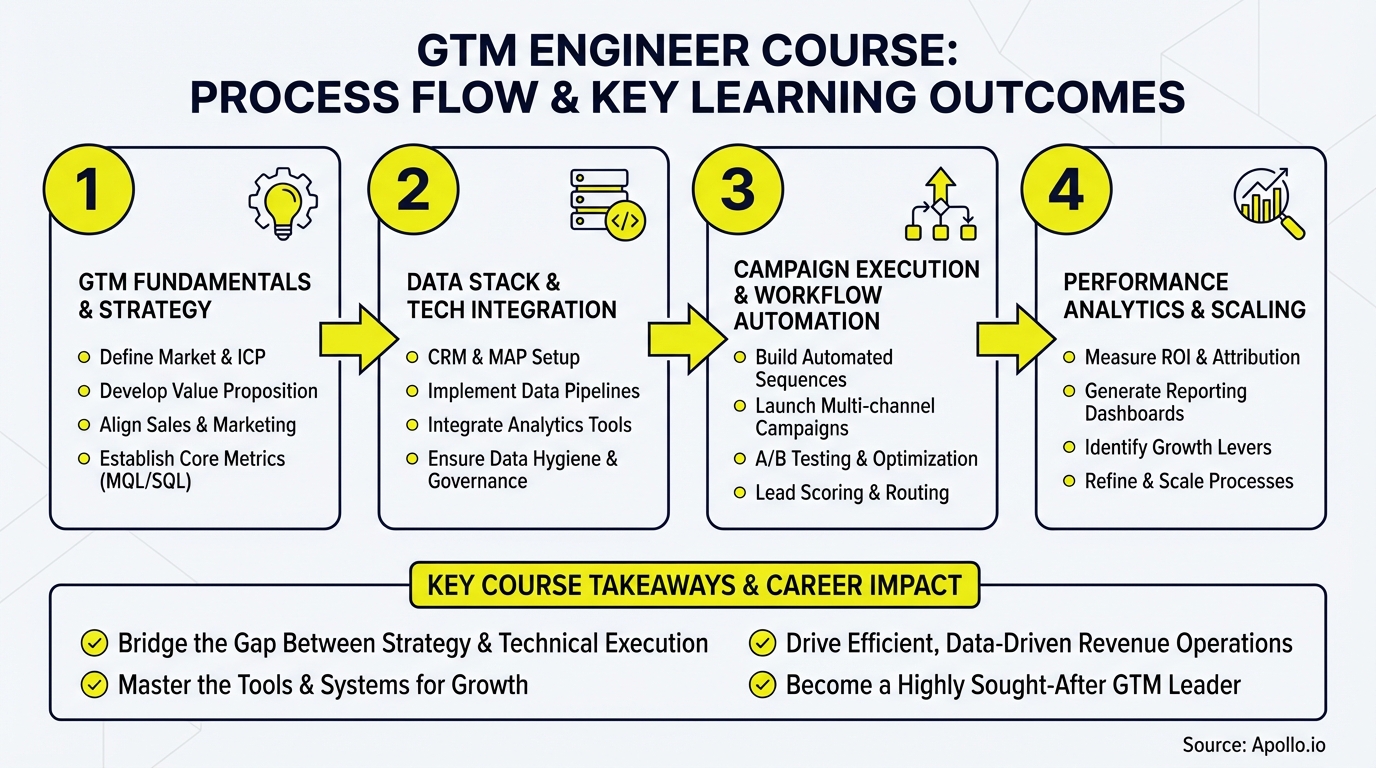
The program is built on seven pillars drawn from Apollo's GTME methodology: Build TAM List, Deliverability and Burn Rate, Scoring and Prioritization, Messaging Intelligence, Data Orchestration Workflows, Human in the Loop, and Reporting and Performance Optimization.
How Is The 12-Week GTME Curriculum Structured?
The GTME Program details break the 12 weeks into four distinct phases, each with clear deliverables and defined roles for both the GTM Engineer and your team.
| Phase | Weeks | Focus | Key Deliverable |
|---|---|---|---|
| Foundation | 1-3 | TAM Unification + Deliverability Setup | Complete TAM segmented by ICP + infrastructure plan sized to your market |
| Intelligence | 4-6 | Scoring Model + Messaging Intelligence | Scoring model encoding your priorities + persona-specific messaging variations |
| Automation | 7-9 | Data Orchestration + Execution Setup | Automated enrichment workflows + sequences with dynamic messaging |
| People + Launch | 10-12 | Human-in-the-Loop Training + Live Launch | Team trained, review queues configured, live dashboards running |
Your current operations keep running throughout. The GTME builds the new system in parallel — no disruption, no learning curve until you're ready.
What Does The GTME Course Teach About Deliverability Math?
One of the most concrete skills in Apollo's GTME curriculum is infrastructure sizing — treating deliverability as math, not guesswork. The program teaches a specific calculation chain to determine exactly how many mailboxes and domains your outbound motion requires.
Here is the exact infrastructure formula taught in the program, using a sample TAM of 75,000 accounts:
| Variable | Value |
|---|---|
| Account TAM size | 75,000 |
| Avg. Contacts per Account | 3 |
| Contact TAM | 225,000 |
| Emails per contact | 4 |
| Total emails | 900,000 |
| Burn rate (months) | 12 |
| Emails per month | 75,000 |
| Mailboxes needed | 125 |
| Domains needed | 42 |
This is a skill that separates GTM Engineers from SDRs — knowing your exact infrastructure requirements before you send a single email.
How Does The GTME Course Teach Account Scoring?
Pillar 3 of Apollo's GTME Program turns your priorities into math. The curriculum teaches you to define scoring dimensions, assign weights across 100 points, and calibrate against real accounts until scores match what your best reps already know intuitively.
Here is the sample signal scoring table from the GTME methodology — showing actual signals, sources, weights, and sample scores:
| Signal | Source | Weight | Sample Score |
|---|---|---|---|
| Uses Shopify | Apollo | 20 | 20 |
| Sustainability focused apparel | AI Research | 15 | 15 |
| Recent funding | Apollo | 15 | 15 |
| Visited website | 1st Party | 15 | 0 |
| Downloaded lead magnet | 1st Party | 15 | 15 |
| Released new product | AI Research | 10 | 10 |
| Growing e-commerce team | Apollo | 10 | 0 |
| Total Score | 100 | 75/100 |
The program also teaches correlation-driven optimization — using r-values to determine which signals actually predict pipeline, and adjusting weights accordingly.

Turn Dry Funnels Into Qualified Pipeline
Running out of fresh leads before the quarter ends? Apollo gives your team access to 224M verified contacts so you never hit a dead end. 550K+ companies use Apollo to keep their pipeline full and predictable.
Start Free with Apollo →| Signal | r-value | Action |
|---|---|---|
| Uses Competitor X | 0.82 | Increase |
| Recent Funding | 0.74 | Increase |
| Intent Score: High | 0.61 | Monitor |
| Company Size | 0.38 | Decrease |
| Industry Match | 0.29 | Remove |
What Does A Day Look Like Before And After The GTME Course?
The program's before-and-after comparison is one of the clearest illustrations of what the GTME curriculum actually changes in day-to-day execution for SDRs and GTM teams.
Before the system: Pull a list from Apollo, research each account manually, check for recent news, review tech stack. Two hours later: 15 accounts researched. Write personalized emails — another hour. By lunch, 15 emails sent. Repeat in the afternoon. End of day: roughly 30 personalized touches, with half the time spent on research and data entry.
After the system: The system surfaces 50 prioritized accounts with AI-researched context. The SDR reviews the top 10 flagged for human review. Thirty minutes later: edits two messages, approves the rest. Forty go out automatically based on pre-set rules. By 10am, high-priority accounts are reviewed. The rest of the day: follow-up calls, working replies, and conversations that close deals.
This is the Human in the Loop pillar in practice — AI handles research and drafting, your people handle judgment and relationships. If you're evaluating whether this role is right for your team, reviewing the gtm engineer job description alongside the GTME curriculum gives a clear picture of what the role demands day-to-day.
How Much Time Does The GTME Course Require?
Apollo's 12-week GTM engineer course is designed for working teams — not full-time students. The total time commitment from your team is 15-20 hours across the entire 12 weeks, with weekly sessions running 45-60 minutes.
After launch, ongoing maintenance requires an estimated 2-4 hours per month for monthly reviews and quarterly refinements — not 20. The system runs; your team tunes it.
What Are The Program's Stated Performance Metrics?
The GTME methodology publishes four headline metrics that define what a fully operational system achieves:
| Metric | Result |
|---|---|
| TAM visibility | 100% |
| Research speed | 10x |
| Automation rate | 90-95% |
| Iteration cadence | Monthly |
The automation rate of 90-95% reflects how much of the research, scoring, and messaging assembly runs without manual intervention — with the remaining percentage reserved for human review of top-priority accounts.

Who Is The GTME Course Built For?
Apollo's GTME Program is not a cold-start solution. It's designed for teams already running an outbound motion who want to systematize and compound what they're doing.
The program fits teams with RevOps capacity to maintain the system after build, leadership committed to data-driven prioritization, and SDRs open to shifting from research-heavy work to judgment-heavy work. If you're still figuring out whether the GTM Engineer role belongs on your team at all, the guide on gtm engineer vs revops clarifies where the boundaries sit.
Apollo's position is that the GTM Engineer who wins long-term isn't the one who builds the most elaborate workflow — it's the one who deploys the most elegant strategy at the highest velocity. The GTME Program is built to produce exactly that outcome, with the endgame being Agentic GTM: a system that runs autonomously, without a human duct-taping handoffs between tools at 2am.
Ready to build a GTM engine that actually executes your strategy without the Frankenstack? Try Apollo Free and start building on the platform that powers the entire GTME workflow from TAM to pipeline — one system, no API babysitting.
Prove Pipeline ROI With Apollo
Can't justify the spend without hard numbers? Apollo gives sales teams measurable pipeline outcomes executives actually approve. Leadium 3x'd their revenue — see what Apollo delivers for yours.
Schedule a Demo →Don't miss these
Sales
Inbound vs Outbound Marketing: Which Strategy Wins?
Sales
What Is a Sales Funnel? The Non-Linear Revenue Framework for 2026
Sales
What Is a Go-to-Market Strategy? The 2026 GTM Playbook
See Apollo in action
We'd love to show how Apollo can help you sell better.
By submitting this form, you will receive information, tips, and promotions from Apollo. To learn more, see our Privacy Statement.
4.7/5 based on 9,690 reviews
