
Generative AI for Sales: How Modern Teams Close More Deals
Generative AI is transforming B2B sales in 2026, with Gartner projecting that 60% of seller work will be executed through AI conversational interfaces by 2028. Sales teams using AI-embedded technologies already reduce prospecting and meeting prep time by over 50%. For SDRs, AEs, and sales leaders juggling multiple tools, AI consolidates workflows into one platform. This guide covers CRM integration, ROI measurement, governance, and practical implementation strategies to help your team leverage generative AI effectively.

Scale Your Team Without The Growing Pains
Struggling with inconsistent processes as your team grows? Apollo standardizes playbooks and automates workflows so every rep performs like your best. Join 550K+ companies scaling smarter.
Start Free with Apollo →Key Takeaways
- Generative AI cuts prospecting time in half and reduces RFP response time by 40% while maintaining win rates
- 89% of B2B buyers now use AI in their buying process, making AI-powered sales engagement essential
- CRM integration and data governance are critical for successful AI implementation in sales organizations
- ROI measurement requires tracking time savings, win rate impact, and tool consolidation benefits
- Sales leaders report 48% revenue increases and 51% shorter sales cycles with AI adoption
What Is Generative AI for Sales?
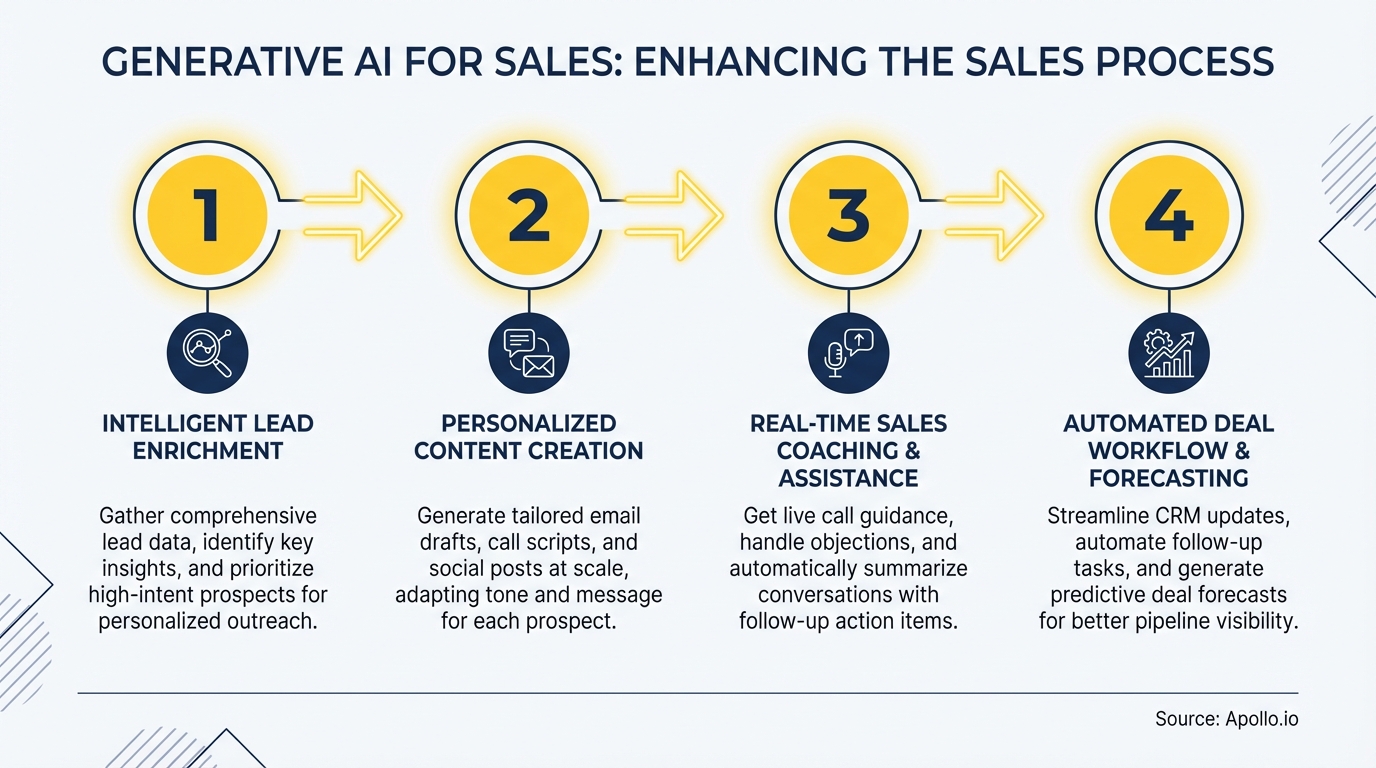
Generative AI for sales uses large language models to create personalized content, automate research, and streamline workflows across prospecting, outreach, and deal management.
Unlike traditional sales automation that follows rigid templates, generative AI adapts messaging based on prospect data, conversation context, and deal stage.
The technology powers three core sales functions: research and prospecting (identifying accounts and building contact lists), content generation (emails, call scripts, proposals), and conversation intelligence (call summaries, next steps, coaching insights). Research by Forrester shows 89% of B2B buyers now use generative AI as a primary information source during their buying journey.
For SDRs, this means AI handles time-consuming tasks like company research and email personalization. For AEs, AI generates proposals and surfaces deal insights.
Sales leaders gain visibility into team performance and coaching opportunities through AI-powered analytics.
How Does Generative AI Improve Sales Performance?
Generative AI improves sales performance by eliminating manual tasks, personalizing outreach at scale, and providing real-time intelligence. Gartner reports that sales teams using AI for proposals reduce RFP response time from 27 hours to 16 hours, a 40% reduction, without sacrificing win rates.
| Sales Activity | Time Savings with AI | Performance Impact |
|---|---|---|
| Account Research | Significant reduction | Higher quality targeting |
| Email Personalization | Automates customization | Improved response rates |
| Call Preparation | Over 50% reduction | Better discovery conversations |
| Proposal Writing | 40% faster completion | Maintained win rates |
| Follow-up Tasks | Automated next steps | Faster deal velocity |
Tired of spending hours on manual research? Automate your sales workflows with Apollo's AI platform.
According to a 2025 B2B AI report, 100% of sales enablement leaders now use AI, with 48% reporting increased revenue and 51% experiencing shortened sales cycles. The key is implementing AI within your existing CRM workflow rather than adding another disconnected tool.
Turn Forecast Chaos Into Revenue Certainty
Missing quota because your pipeline visibility is a guessing game? Apollo tracks every deal stage in real-time so you forecast with confidence. Built-In increased win rates 10% with Apollo's signals and scoring.
Start Free with Apollo →How Do SDRs Use Generative AI to Book More Meetings?
SDRs use generative AI to automate prospect research, personalize outreach at scale, and optimize follow-up sequences. Instead of manually researching each account and crafting individual emails, AI analyzes company data, news, and social signals to generate contextually relevant messages.
The workflow starts with AI-powered prospecting tools that identify ideal customer profiles and build targeted contact lists. SDRs then use AI to generate personalized email sequences that reference specific company initiatives, recent funding, or industry challenges. AI writing tools adapt messaging based on response patterns and engagement signals.
For call preparation, AI summarizes prospect backgrounds, identifies potential pain points, and suggests conversation starters. After calls, AI generates follow-up emails and logs activities automatically.
This allows SDRs to focus on relationship building rather than administrative tasks. Teams report booking more meetings by reallocating time from research to actual conversations.
What Are the CRM Integration Requirements?
Successful generative AI implementation requires seamless CRM integration to maintain data accuracy and workflow continuity. The AI system must access contact data, activity history, deal stages, and custom fields to generate relevant content and insights.
Integration requirements include:
- Bidirectional data sync: Changes in the CRM automatically update the AI platform and vice versa
- Field mapping: Custom fields and properties align between systems to preserve data structure
- Activity logging: AI-generated emails, calls, and tasks sync back to CRM timelines
- Permission controls: Role-based access ensures data security and governance
- Webhook support: Real-time triggers enable instant AI responses to CRM events
For Salesforce and HubSpot users, native integrations eliminate manual data entry and ensure AI recommendations reflect current deal status. The goal is one unified workspace where reps access AI capabilities without switching platforms.
As one Cyera customer noted, "Having everything in one system was a game changer."
How Do You Measure ROI from Generative AI?
Measuring ROI from generative AI requires tracking time savings, revenue impact, and tool consolidation benefits across your sales tech stack. Start by establishing baseline metrics before AI implementation, then monitor changes in key performance indicators.
| ROI Metric | How to Measure | Target Improvement |
|---|---|---|
| Time per Prospect | Track research and outreach minutes | Over 50% reduction |
| Response Rates | Compare AI vs manual email performance | Measurable increase |
| Meetings Booked | Count qualified meetings per rep | Significant growth |
| Win Rate | Track close rates on AI-assisted deals | Maintained or improved |
| Tool Costs | Calculate replaced subscriptions | Substantial savings |
RevOps leaders should calculate total cost of ownership by comparing AI platform costs against replaced tools. A Census customer reported, "We cut our costs in half" by consolidating multiple point solutions.
Factor in productivity gains from eliminating context switching and manual data entry.
For sales leaders, track team-level metrics like pipeline velocity, average deal size, and quota attainment. The most successful implementations show improved efficiency without sacrificing deal quality or customer relationships.
What Are the Governance and Compliance Requirements?
Governance and compliance for generative AI in sales requires clear policies around data usage, content approval, bias mitigation, and regulatory adherence. Sales organizations must establish guardrails before deploying AI at scale.
Key governance requirements include:

- Content review processes: Define when AI-generated content requires human approval before sending
- Data access controls: Limit which customer data the AI can access and process
- Brand voice guidelines: Establish tone, style, and messaging boundaries for AI outputs
- Bias detection: Monitor AI recommendations for discriminatory patterns or unfair targeting
- Audit trails: Maintain logs of AI-generated content and decisions for compliance reviews
For industries with strict regulations (healthcare, financial services), implement additional safeguards around sensitive information. Train sales teams on appropriate AI use cases and prohibited applications.
Regular audits ensure the AI system maintains accuracy and compliance as it adapts to new data.

Struggling to maintain data quality across your tech stack? Consolidate with Apollo's 224M+ verified business contacts.
How Should Sales Teams Implement Generative AI?
Sales teams should implement generative AI using a phased rollout: pilot with early adopters, measure results, refine processes, then scale organization-wide. Start with one high-impact use case rather than attempting full transformation immediately.
Phase 1 (Pilot): Select 5-10 reps to test AI capabilities for 30-60 days. Focus on a specific workflow like email personalization or call preparation.
Gather feedback on accuracy, usability, and time savings. This pilot validates ROI before broader investment.
Phase 2 (Refine): Based on pilot learnings, adjust prompts, integrate with CRM, and develop training materials.
Create templates and best practices documentation.
Address data quality issues and workflow gaps. Establish governance policies and approval processes.
Phase 3 (Scale): Roll out to additional teams with structured onboarding. Provide hands-on training and ongoing support.
Monitor adoption metrics and performance improvements. Continuously optimize based on user feedback and results data.
Change management is critical. Emphasize how AI augments rather than replaces sales roles. As Gartner research indicates, 75% of B2B buyers will prefer human interaction by 2030, so position AI as a tool that frees reps to focus on relationship building.
Ready to Transform Your Sales Process with AI?
Generative AI represents a fundamental shift in how sales teams prospect, engage, and close deals in 2026. The technology delivers measurable improvements in efficiency, personalization, and performance when implemented with proper CRM integration, governance, and change management.
Success requires moving beyond experimentation to strategic deployment. Focus on consolidating your tech stack rather than adding more tools.
As Predictable Revenue shared, "We reduced the complexity of three tools into one" by choosing an all-in-one AI-powered platform.
For SDRs looking to book more meetings, AEs managing complex deals, and sales leaders driving team performance, AI provides the intelligence and automation to compete effectively. The question is no longer whether to adopt generative AI, but how quickly you can implement it to stay ahead of competitors already leveraging these capabilities.
Try Apollo Free to experience AI-powered prospecting, engagement, and intelligence in one unified platform.
Prove Apollo's Value In Your First Week
Budget approval stuck on unclear metrics? Apollo tracks every dollar of pipeline impact from day one. Built-In increased win rates 10% and ACV 10% with Apollo's signals and scoring.
Start Free with Apollo →Don't miss these
Sales
Inbound vs Outbound Marketing: Which Strategy Wins?
Sales
What Is a Sales Funnel? The Non-Linear Revenue Framework for 2026
Sales
What Is a Go-to-Market Strategy? The 2026 GTM Playbook
See Apollo in action
We'd love to show how Apollo can help you sell better.
By submitting this form, you will receive information, tips, and promotions from Apollo. To learn more, see our Privacy Statement.
4.7/5 based on 9,690 reviews
