
How to Write a Follow Up Sales Email That Converts
Most sales reps send one email and wonder why prospects go silent. The truth is simpler: Flowlu reports that 80% of sales require 5 to 12 follow-up attempts, yet Notta found only about 8% of salespeople follow up with potential customers five times. That gap represents millions in lost pipeline. Follow-up sales emails bridge initial outreach and closed deals, but success in 2026 demands more than persistence. Inbox providers now control your reply rate more than your copy does, and buyers actively avoid reps who send irrelevant messages. This guide shows SDRs, AEs, and sales leaders how to build follow-up sequences that get responses by combining deliverability best practices, buyer-enablement content, and multi-channel routing.

Research Less, Close More With Apollo
Tired of burning hours verifying emails and hunting down contact info? Apollo delivers accurate business contacts instantly so your team spends time selling, not searching. Join 550K+ companies building pipeline faster.
Start Free with Apollo →Key Takeaways
- Follow-up emails increase response rates by 11% and boost reply rates by 49% when personalized with relevant context
- Inbox placement now matters more than copy—authentication, list hygiene, and complaint rates determine whether prospects see your message
- Buyers want self-serve assets and clear next steps, not generic check-ins or pressure tactics
- Multi-channel sequences (email, phone, social) outperform email-only follow-ups as engagement drops after 2-3 touches
- Shorter emails (under 80 words) and tighter sequences (4-7 touches) preserve deliverability and reduce unsubscribes
What Is a Follow-Up Sales Email?
A follow-up sales email is a message sent after initial contact to re-engage prospects, answer questions, provide value, or move deals forward. Unlike cold outreach, follow-ups build on existing context from demos, meetings, proposals, or previous emails.
They serve multiple purposes: reminding prospects of commitments, addressing objections, sharing relevant resources, or simply staying visible during long buying cycles.
In 2026, effective follow-ups function as buyer-enablement assets rather than sales nudges. Gartner's 2024 survey of 632 B2B buyers found 73% actively avoid suppliers who send irrelevant outreach, and 61% prefer a rep-free buying experience.
This shift means your follow-ups must offer unique value (ROI calculators, implementation guides, peer case studies) or route prospects to their preferred next action (self-serve demo, pricing page, 15-minute call).
Why Do Follow-Up Emails Matter for SDRs and AEs?
Follow-up emails directly impact pipeline and quota attainment. Salesgenie found follow-up emails increase the chance of a response by 11%, while B2B Rocket reports the first follow-up email can boost the reply rate by 49%. For SDRs focused on meeting bookings, this difference determines whether they hit quota or fall short.
Beyond response rates, follow-ups address three critical sales challenges:
- Deal stalls: Forrester's 2024 report found 86% of B2B purchases stall during the buying process. Follow-ups that de-risk decisions (implementation clarity, peer validation, ROI proof) keep deals moving.
- Multi-threaded engagement: Complex B2B sales involve 6-10 stakeholders. Follow-ups help AEs reach economic buyers, technical leads, and end users with role-specific content.
- Competitive differentiation: When 48% of first-time buyers enter the process with a preferred vendor (Forrester 2024), follow-ups must build or confirm preference early through proof points and peer stories.
Struggling to track all your follow-up sequences across deals? Apollo's deal management consolidates pipeline visibility and automates follow-up workflows in one workspace.
How Do You Write Follow-Up Emails That Get Replies?
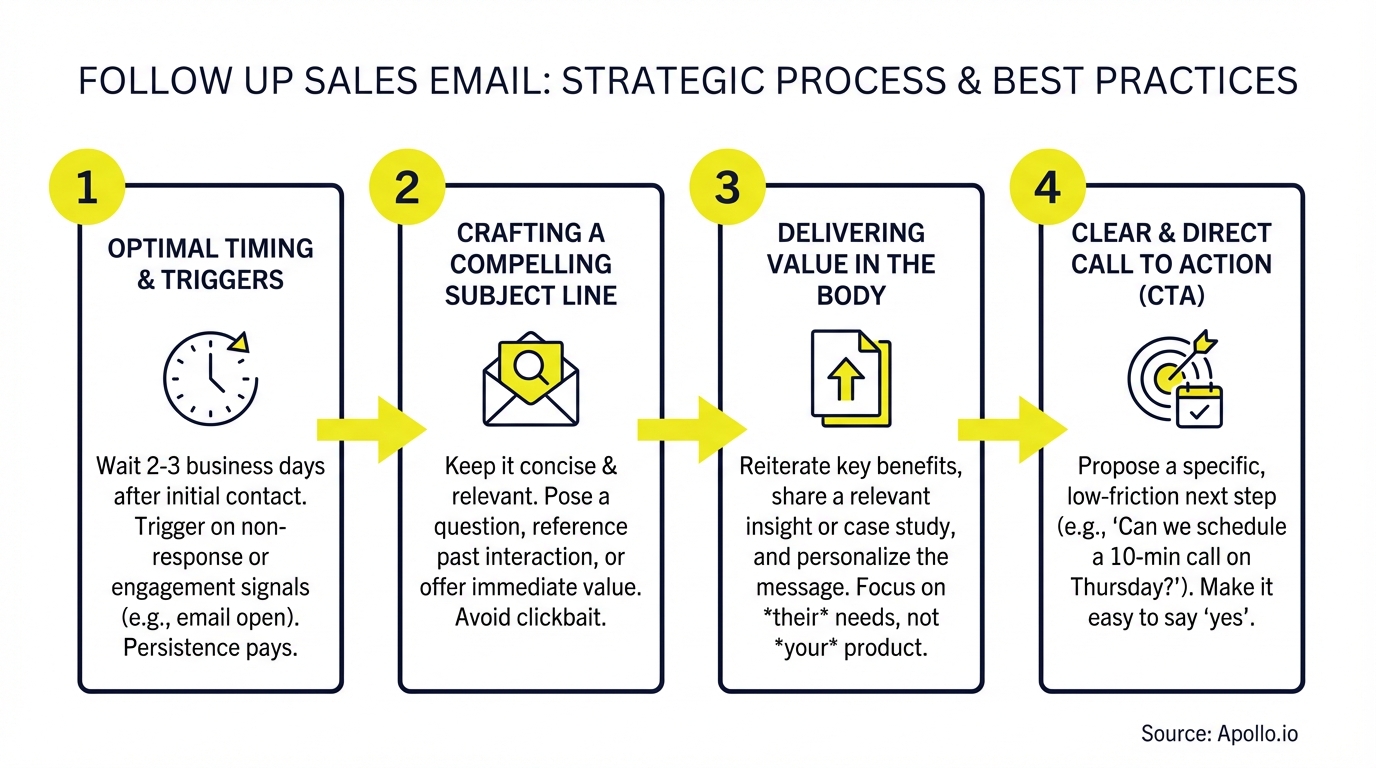
Effective follow-up emails balance persistence with relevance. Start with a clear subject line referencing your previous interaction or offering new value (see subject line examples that convert). Open with context: "Following up on our demo" or "Sharing the ROI model we discussed." Then deliver one new piece of value per email.
Martal Group found personalized emails achieve 29% higher open rates and 41% higher click-through rates. Personalization in 2026 means specificity, not token insertion. Reference trigger events (funding announcements, leadership changes), link to relevant content they've engaged with, or cite industry benchmarks specific to their vertical.
What Should Each Follow-Up Email Include?
Structure each follow-up with these elements:
- Context anchor: Reference your last touchpoint ("After our call on Tuesday...")
- New value: Share one asset, insight, or answer (not a reminder to reply)
- Clear CTA: Offer 2-3 next-step options aligned to channel preference ("Grab time here," "View pricing," "Watch 2-min demo")
- Social proof: Include relevant customer outcome when appropriate ("Cyera cut costs using this approach")
Keep emails under 80 words when possible. Analysis of 16.5 million cold emails in 2024 by Belkins found the highest reply rate (8.4%) came from just one email, with performance steadily declining with each follow-up. Shorter, value-dense messages preserve engagement and deliverability.
Turn Weak Leads Into Real Pipeline
Tired of marketing leads that never become real opportunities? Apollo pinpoints in-market buyers with precision so your team stops chasing dead ends. Join 550K+ companies building predictable pipeline.
Start Free with Apollo →What Follow-Up Email Sequence Works Best in 2026?
The optimal sequence balances persistence with inbox hygiene. Based on 2026 benchmarks, plan 4-7 touches over 14-21 days, with each touch adding distinct value.
Here's a proven framework for SDRs and AEs:
| Touch | Timing | Purpose | Content Type |
|---|---|---|---|
| 1 | Day 1 | Initial outreach | Problem + solution fit |
| 2 | Day 3 | Add credibility | Case study or peer proof |
| 3 | Day 7 | Enable decision | ROI calculator or implementation guide |
| 4 | Day 10 | Multi-channel pivot | Phone call + voicemail + email combo |
| 5 | Day 14 | Breakup or re-route | "Should I close your file?" or self-serve option |
McKinsey's 2024 B2B Pulse found the "rule of thirds" across 4,000 decision makers: one-third prefer in-person, one-third remote, one-third digital self-serve. Your sequence must accommodate all three preferences.
Include calendar links (for meeting-preferrers), pricing pages (for self-serve researchers), and phone numbers (for call-preferrers) in every follow-up.
Consider multi-channel touches after email 2-3.
Research shows blended sequences (email + social + phone) maintain engagement when email-only performance drops.
Use proven templates as starting points, then customize based on persona and buying stage.

How Do SDRs Improve Follow-Up Email Performance?
SDRs face unique follow-up challenges: high volume, short sales cycles, and meeting-booking pressure. Three tactics separate top performers from the pack in 2026:
1. Deliverability-first operations: Inbox placement now determines follow-up success more than copy quality. Authenticate your domain (SPF, DKIM, DMARC enforcement), maintain list hygiene (verify emails before sending), and monitor complaint rates (keep under 0.1%). A 2025 benchmark report found authenticated senders are 2.7× more likely to reach inboxes.
2. Trigger-based sequences: Replace time-based follow-ups with behavior triggers. Send follow-up #2 when a prospect opens your first email twice, visits your pricing page, or downloads a resource. Sales automation platforms enable this without manual monitoring.
3. Value-stacking approach: Each follow-up must add new information. Email 1 introduces the problem, email 2 shares a relevant case study, email 3 offers an ROI calculator, email 4 provides a competitive comparison. Content-driven follow-ups outperform "just checking in" messages by substantial margins.
Spending hours manually personalizing follow-ups across hundreds of prospects? Apollo's sales engagement platform automates sequences while maintaining personalization at scale.
What Are Common Follow-Up Email Mistakes to Avoid?
Even experienced AEs make these critical errors that tank follow-up performance:
- Generic check-ins: "Just following up" or "Circling back" emails provide zero new value. Buyers ignore them or mark as spam.
- Pressure tactics: "Did you get my last email?" or "Is this still a priority?" questions feel accusatory. They damage relationships and increase unsubscribe rates.
- Wall-of-text syndrome: Follow-ups over 150 words rarely get read. Brevity signals respect for the buyer's time.
- Missing CTAs: Emails without clear next steps force prospects to figure out how to respond. Offer 2-3 specific options ("Grab 15 minutes here" + "View pricing" + "Watch demo").
- Ignoring deliverability: Sending from unverified domains, using spam-trigger words ("free," "guarantee," "limited time"), or buying contact lists destroys inbox placement and sender reputation.
For Account Executives managing complex enterprise deals, another mistake is inconsistent messaging across channels. When your email says one thing, your website says another, and your sales deck presents different data, buyers lose trust.
Use canonical assets (single-source ROI models, standardized case studies) linked consistently across all follow-ups.

Conclusion: Build Follow-Up Systems That Scale Revenue
Follow-up sales emails remain pipeline-critical in 2026, but the playbook has fundamentally shifted. Success requires three capabilities: deliverability infrastructure (authentication, list hygiene, complaint management), buyer-enablement content (ROI tools, implementation guides, peer proof), and omnichannel routing (self-serve assets, meeting links, phone options in every message).
The data is clear. Follow-ups increase response rates by double digits, but only when they add value and reach the inbox. Your Lead Machine found follow-ups can improve engagement rates by up to 40%, yet most reps quit after 1-2 attempts. The competitive advantage goes to teams who persist intelligently with shorter, value-dense sequences backed by technical readiness.
For SDRs booking meetings, AEs closing deals, and sales leaders building predictable pipeline, the path forward is consolidation. Replace fragmented tools (separate prospecting platform + engagement tool + data enrichment service + meeting scheduler) with unified systems that maintain consistency, preserve deliverability, and scale personalization.
As Predictable Revenue's team noted: "We reduced the complexity of three tools into one."
Ready to build follow-up sequences that actually convert? Start a Trial and consolidate your prospecting, engagement, and pipeline management in one workspace.
Prove Pipeline ROI With Apollo
Budget approval stuck on unclear metrics? Apollo delivers measurable pipeline impact so you can justify every dollar — fast. Leadium 3x'd their annual revenue after switching. Start your free trial today.
Start Free with Apollo →Don't miss these
Sales
Inbound vs Outbound Marketing: Which Strategy Wins?
Sales
What Is a Sales Funnel? The Non-Linear Revenue Framework for 2026
Sales
What Is a Go-to-Market Strategy? The 2026 GTM Playbook
See Apollo in action
We'd love to show how Apollo can help you sell better.
By submitting this form, you will receive information, tips, and promotions from Apollo. To learn more, see our Privacy Statement.
4.7/5 based on 9,690 reviews
