
How to Find Verified Contact Details by Name and Company
You have a name and a company. Maybe it's from a professional networks post, a webinar attendee list, or an inbound form fill. The problem: that person switched jobs 14 months ago, and 63.2 million U.S. workers changed jobs in 2024 alone, with median tenure now sitting at just 3.9 years. A name-plus-company match that was accurate last quarter can be stale today.
Finding verified contact details isn't just about locating an email address. It's about confirming identity, current employment, and a lawful path to reach that person, in that order.
Here's the 10-minute verification ladder GTM teams use to do it right, plus the tools, cadence, and compliance checks that separate a real contact from a guess.
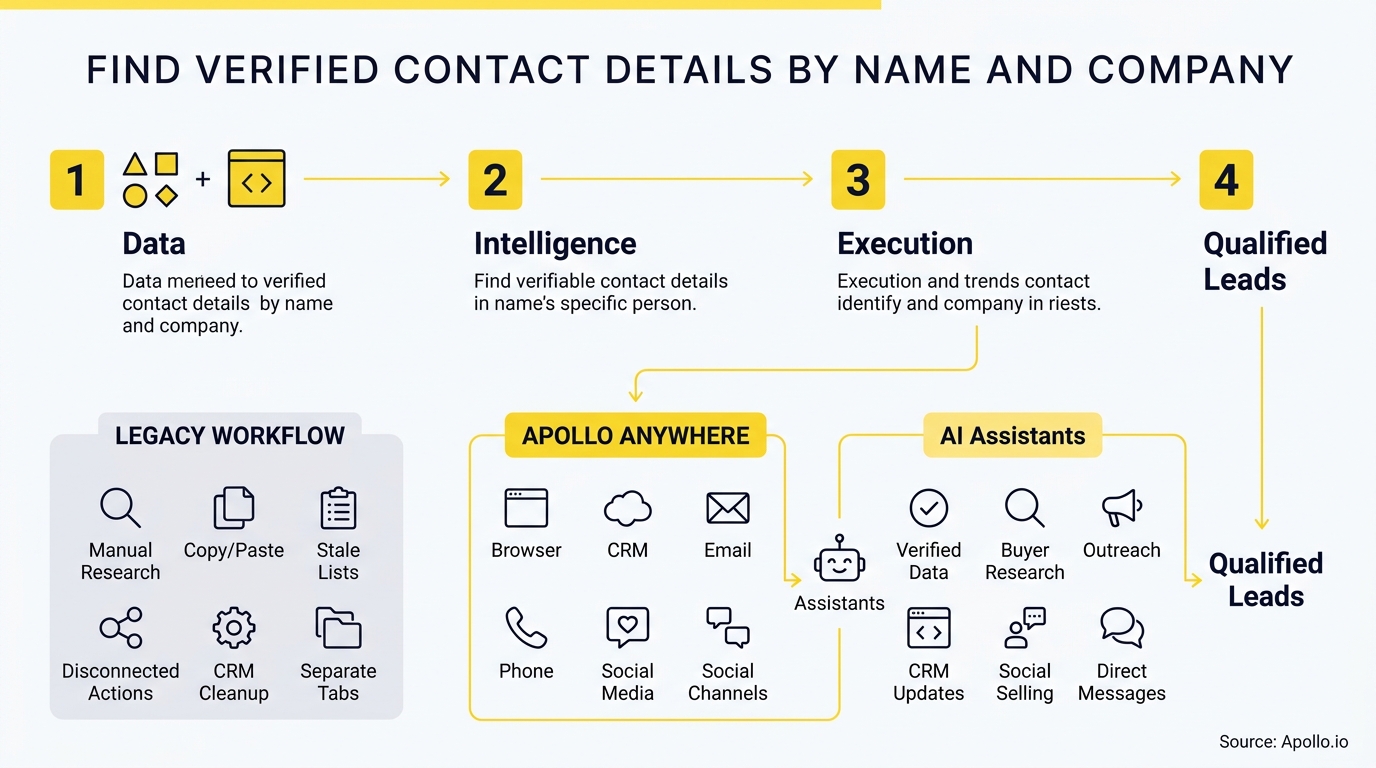

Apollo Ends Hours Of Manual Lead Research
Spending hours a day chasing down emails and phone numbers that turn out wrong. Apollo verifies contact data instantly with 98% email accuracy, so your team spends time selling, not searching. Nearly 5M users trust Apollo's database to skip the busywork.
Start Free with Apollo →Key Takeaways
- Verification has four layers: identity match, current employment, deliverable email or working number, and lawful basis to contact — skipping any layer creates risk.
- Use Apollo MCP when you need to confirm someone's current role and get a verified email without leaving ChatGPT, Claude, Perplexity, or Codex.
- Single-source lookups (one database, one guess pattern) typically miss far more matches than a multi-source waterfall approach.
- Recheck high-value contacts every 60-90 days; job changes cluster around January and Q1, making stale records a recurring risk, not a one-time fix.
- Use Apollo MCP when you need to verify a prospect and queue outreach in the same conversation, instead of switching between a data tool, a verifier, and a sequencer.
What Does It Mean To "Find Verified Contact Details" For Someone?
Finding verified contact details means confirming four separate things, not just locating an email address: the person's identity, their current employer, a working contact method, and your legal basis to reach them. A contact record can pass one check and fail the others.
An email can be technically valid (accepts mail) while the person left that company eight months ago.
This is the gap most tools don't address. A "verified" badge on an email finder usually means the mail server accepted a test ping, called SMTP verification.
It says nothing about whether the person still works there. Treat "verified" as a claim with four possible meanings, and check each one separately before you send anything.

What Is The 10-Minute Verification Ladder?
The verification ladder is a sequential check that moves from cheapest/fastest signals to more definitive ones, stopping as soon as you have enough confidence to act. Work through it in order; don't skip rungs.
- Identity anchor (2 min): Confirm the person's full name, current title, and location using a professional network profile or company "team" page. This is your baseline identity match.
- Employment freshness check (2 min): Look for a start date, recent posts, or a press mention. If the profile hasn't updated in over a year, treat employment as unconfirmed and dig further.
- Company-side confirmation (2 min): Check the company's official site, press page, or org chart tool for the same name and title. Two independent sources agreeing is your first real confidence signal.
- Contact discovery (2 min): Use an email finder or enrichment tool to surface a business email and, where available, a direct dial.
- Deliverability check (2 min): Run the email through syntax, domain (MX record), and mailbox-level (SMTP) verification before it ever touches a sequence.
If any rung fails, don't proceed to outreach. Loop back, find a second source, or mark the contact as "needs review" instead of guessing.
How Do You Score Confidence In A Contact Match?
Score confidence by counting independent, current sources that agree on identity and employer, not by trusting a single database entry. A simple 0-3 scale works for most teams:
| Confidence Score | Criteria | Action |
|---|---|---|
| 0 - Unverified | Single source, no freshness signal, no company-side match | Do not contact; research further |
| 1 - Low | One current source (e.g., professional profile) but no company confirmation | Verify email only; hold outreach |
| 2 - Medium | Two independent sources agree; email passes deliverability check | Safe for single-channel outreach |
| 3 - High | Multiple sources agree, recent activity confirms tenure, email and phone verified | Safe for multi-channel sequence |
Attach a timestamp to every score. A score of 3 from four months ago should be treated as a 1 until you recheck it, especially given how quickly people change roles.
Turn Cold Pipeline Guesswork Into Real Forecasts
Marketing hands off leads that stall before opportunity. Apollo's buying-intent signals show which prospects are ready now, so reps chase real deals instead of dead ends. Built-In saw a 10% lift in win rate using Apollo's scoring.
Start Free with Apollo →Why Do Single-Source Lookups Miss So Many Matches?
Single-source lookups miss matches because no individual database has complete or fully current coverage of every company's employees. According to Unify GTM, platforms using waterfall enrichment, which queries multiple data sources in sequence, achieve substantially higher contact and company match rates than single-source providers.
Waterfall enrichment works like this: query source A, and if no verified match is found, automatically query source B, then C, until a confirmed result surfaces or all sources are exhausted. This is why Apollo's Waterfall Enrichment checks multiple providers sequentially rather than relying on one static database.
Struggling to find qualified contacts on the first try? Search Apollo's database of 240M+ contacts with 65+ filters to narrow by name, company, and title in one pass.
How Can SDRs And AEs Verify Contacts Faster Without Extra Tools?
SDRs and AEs can verify contacts faster by asking an AI assistant to check identity, employment, and email in one conversation instead of toggling between a browser tab, a data tool, and a verifier. This is exactly what Apollo MCP (Model Context Protocol) is built for: it connects Apollo directly inside ChatGPT, Claude, Perplexity, and Codex, so you can ask "find and verify the current VP of Sales at [Company]" and get a matched, enriched result without leaving the conversation.
For SDRs working a name-plus-company list from an event, this means one prompt can search, enrich with a verified email and phone number, and add the contact to a sequence. For technical teams, the Apollo command-line interface (CLI) offers the same access from a terminal.
Setup is no-code: connect Apollo via OAuth inside your AI tool's connectors menu on any plan, including free.
Your best prospecting session shouldn't require opening a new tab for every step of verification.
What Should RevOps Leaders Check Before Trusting A Contact Record?
RevOps leaders should check source provenance, freshness date, and lawful basis before trusting any contact record, not just whether the email format looks valid. Gartner found that privacy concerns and poor data quality are both cited by sales leaders as major barriers to sales analytics performance, which means a "verified" tag alone isn't enough governance.
Build a lightweight audit trail: where did this contact come from, when was it last confirmed, and what's the lawful basis for contacting them in their region? This matters more given recent enforcement activity. Italy's privacy regulator fined a B2B contact-data vendor in July 2026 over sourcing and legal-basis issues, and California's data broker deletion requirements took effect the following month, requiring registered brokers to process deletion requests at least every 45 days.
Tired of reconciling data quality issues across a patchwork of tools? Apollo's data enrichment centralizes sourcing, freshness, and verification in one workspace instead of stitching together separate vendors.
How Often Should You Recheck A Verified Contact?
Recheck high-value contacts every 60-90 days, and immediately before any high-stakes outreach like a executive-level cold email or a renewal conversation. Job-change activity isn't evenly distributed. professional networks research found director-level decision-makers were notably more likely to start new roles in January than other months, which means your Q4-verified list needs a fresh pass before a January campaign.
Build recheck triggers into your workflow rather than relying on memory:
- Before a sequence launch: Re-verify any contact older than 90 days.
- After a bounce: Treat a hard bounce as a signal to re-run the full ladder, not just find a new email guess.
- Quarterly for target accounts: Refresh your top-tier account list every quarter regardless of activity.
This cadence matters for outreach quality too. professional networks and Ipsos research found that 78% of B2B buyers want personalized outreach, and personalization built on a stale title or employer is worse than no personalization at all.
What Does A Lawful Outreach Checklist Look Like Across The US, UK, And EU?
A lawful outreach checklist confirms business context, honors regional consent rules, and keeps an unsubscribe path live before you send a single message. The requirements differ by region:
| Region | Key Requirement | Practical Check |
|---|---|---|
| United States | CAN-SPAM compliance | Accurate sender info, working opt-out link; violations can carry penalties up to $53,088 per email according to Google's sender guidelines |
| United Kingdom | PECR + UK GDPR | Legitimate interest basis documented; opt-out honored immediately |
| European Union | GDPR | Lawful basis for processing business contact data; regional deletion requests honored |
Regardless of region, keep your sender reputation clean. Google recommends senders keep spam complaint rates below 0.1% and never reach 0.3%, and since February 2024, high-volume senders to Gmail must use SPF, DKIM, and DMARC with one-click unsubscribe support.
What's The Fastest Way To Turn A Verified Contact Into A Meeting?
The fastest path from a verified contact to a booked meeting is connecting verification directly to a multi-channel sequence, so there's no manual handoff between finding the contact and reaching out. Manual research eats into selling time; Salesgenie cites reporting suggesting reps can lose as little as 2 hours a day to non-selling tasks like this.
Once you have a confidence-scored contact, move it straight into execution. Verified data matters here too:PR Newswire reported that AI-native GTM platforms using verified data achieved a 2.37% cold-to-meeting conversion rate, well above the industry average of 0.5% to 1.5%.
Teams that consolidate verification and outreach into one workspace skip the export-clean-import cycle entirely. As Collin Stewart of Predictable Revenue put it: "We reduced the complexity of three tools into one." Spending hours stitching together a verifier, a database, and a sequencer? Automate verified outreach with Apollo's multi-channel sequences instead.

Get Verified Contacts And Verified Outreach In One Workflow
Finding a name-plus-company match is the easy part. Confirming identity, current employment, a deliverable contact method, and a lawful basis to reach them is where most workflows break down, especially with median job tenure now under four years and privacy enforcement accelerating across multiple regions.
Apollo brings B2B data, verification, and outreach execution together in one connected system, so GTM teams don't have to stitch together a separate finder, verifier, and sequencer for every contact. Whether you're an SDR clearing a list before a campaign, an AE confirming a stakeholder before a renewal call, or a RevOps leader auditing data provenance, the same workspace covers search, enrichment, and execution.
Try Apollo Free and verify your next contact list without switching tools:Try Apollo Free.
Turn Tool Spend Into Tracked Revenue
Can't justify renewal without hard numbers? Apollo ties every dollar to pipeline generated, so ROI shows up in your dashboard, not a spreadsheet guess. Leadium 3x'd annual revenue after consolidating outreach into Apollo.
Start Free with Apollo →Don't miss these
Sales
Inbound vs Outbound Marketing: Which Strategy Wins?
Sales
What Is a Sales Funnel? The Non-Linear Revenue Framework for 2026
Sales
What Is a Go-to-Market Strategy? The 2026 GTM Playbook
See Apollo in action
We'd love to show how Apollo can help you sell better.
By submitting this form, you will receive information, tips, and promotions from Apollo. To learn more, see our Privacy Statement.
4.7/5 based on 9,690 reviews
