
How to Find Hiring Manager Email Addresses in 2026
Finding a hiring manager's email address is no longer just about clever Google searches or pattern guessing. In 2026, deliverability and personalization determine whether your outreach generates conversations or gets flagged as spam.
This guide covers proven techniques to discover verified contact information while respecting modern authentication requirements and buyer preferences.
The challenge has shifted: it's not whether you can find the email address, but whether your message will reach the inbox and earn a response. According to Forbes, personalized emails can increase open rates by at least 26%, making accurate targeting more valuable than volume.

Apollo Eliminates 4+ Hours Of Daily Research
Tired of spending hours hunting for contact info? Apollo delivers 224M verified contacts with 96% email accuracy. Join 550K+ companies who stopped manual prospecting.
Start Free with Apollo →Key Takeaways
- Deliverability now matters more than email discovery—authentication and verification are mandatory for inbox placement
- Research from Straight-In shows personalized B2B emails are opened 82% more often than generic emails
- Modern hiring managers prefer self-serve research before engaging with outreach—relevance beats frequency
- Email verification and compliance protect your domain reputation and reduce bounce rates
- Multi-channel discovery (professional networks, company sites, sales intelligence platforms) yields the most accurate results
Why Email Discovery Requires a Deliverability-First Approach
Finding an email address is the easy part. Getting that email delivered is where most outreach fails in 2026.
Corporate email providers have tightened enforcement around SPF, DKIM, and DMARC authentication. Microsoft Office365, commonly used by hiring managers at mid-market and enterprise companies, now filters more aggressively based on sender reputation and engagement signals.
Unverified addresses create bounces that damage your domain's credibility with mailbox providers.
Before you send a single message, verify three things: the email address is current, your sending domain is authenticated, and your message content aligns with recipient expectations. Email deliverability protects your ability to reach all prospects, not just the next one.
10 Proven Techniques to Find Hiring Manager Emails
1. Sales Intelligence Platforms With Verification
Sales intelligence platforms aggregate business contact information and verify it continuously. These tools surface hiring manager emails alongside job function data, reporting structure, and recent role changes.
Need verified contacts at scale? Apollo enriches contact records with 224M+ verified profiles, including email addresses, mobile numbers, and org charts. The platform validates emails before you send, reducing bounce rates and protecting deliverability.
"Apollo enriches everything we have: contacts, leads, accounts... And we don't really have to touch it, it just works."
2. Company Website Reconnaissance
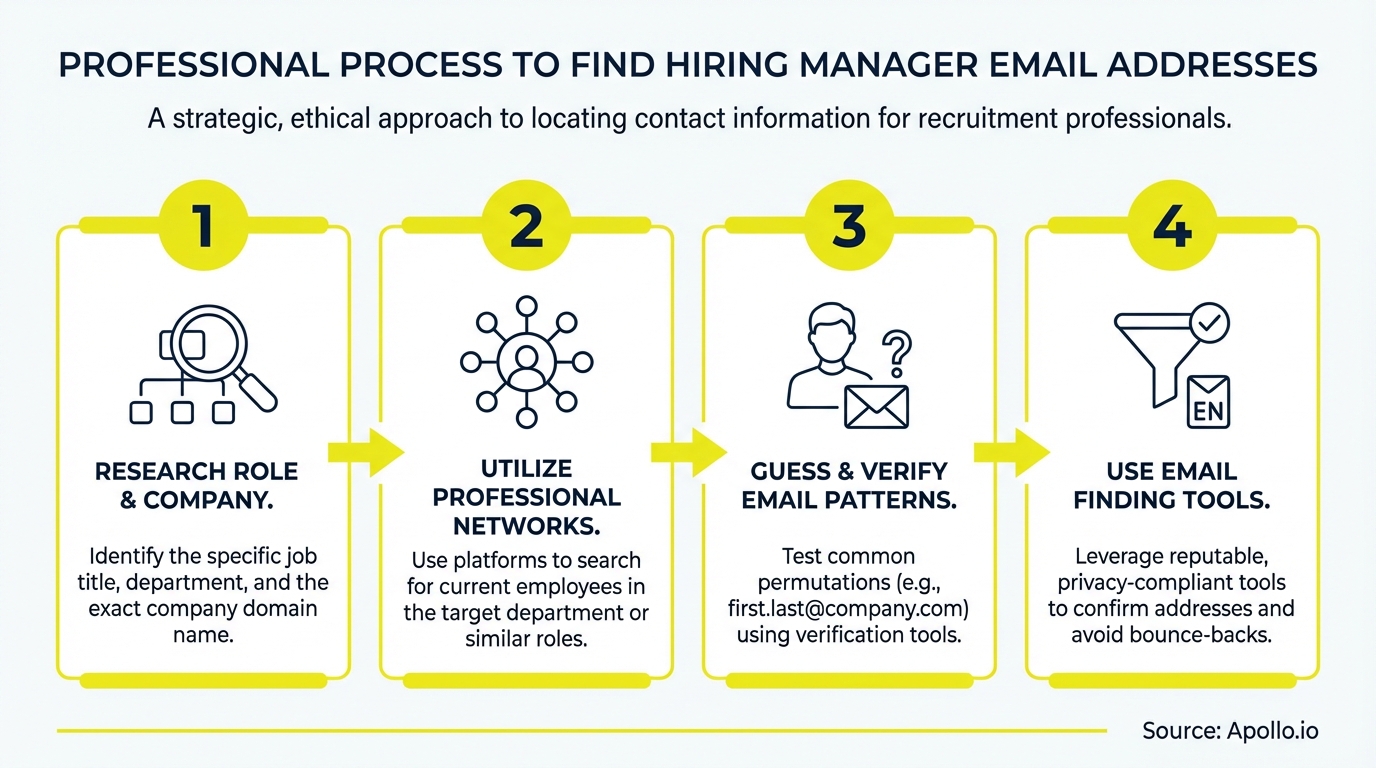
Start with the company's About, Team, or Leadership pages. Many organizations publish leadership emails directly or include contact forms that reveal email patterns.
Press releases, investor relations pages, and blog bylines often contain hiring manager contact information.
Look for email formats in footer disclaimers, support documentation, or partnership announcements. Once you identify the pattern (firstname.lastname@company.com or flastname@company.com), test it against verification tools before sending.
3. Professional Network Search
Professional networks let you filter by company, job title, department, and location. Search for "Hiring Manager," "Talent Acquisition," "Recruiter," or the specific function (e.g., "Engineering Manager" for technical roles).
Contact information may appear in profiles, posts, or profile summaries.
The Apollo Chrome Extension surfaces verified emails while you browse professional networks, company sites, and directories—no switching between tabs or manual lookups required.
4. Email Pattern Testing With Verification
Common B2B email formats include:
- firstname.lastname@company.com
- firstnamelastname@company.com
- flastname@company.com
- lastname.firstname@company.com
Build candidate addresses based on the hiring manager's name and company domain, then verify them using email verification tools. Never send to unverified addresses—bounces harm your sender reputation and reduce deliverability for all future outreach.
5. Advanced Search Operators
Use Google search operators to uncover emails in public documents:
"hiring manager name" @company.comsite:company.com filetype:pdf "email""name" "company" contact OR email
Search conference speaker lists, webinar registrations, podcast guest bios, and industry event pages. Hiring managers who speak publicly often list contact information for follow-up inquiries.
6. Mutual Connection Referrals
Referrals from mutual connections yield higher response rates than cold outreach. Search your network for colleagues, alumni, or industry peers who work at the target company.
Ask for an introduction or context about the hiring manager's priorities and communication preferences.
Warm introductions bypass skepticism and establish credibility before your first message. Even if a mutual connection can't make a direct introduction, they can validate your approach and suggest relevant talking points.
7. Job Posting Analysis
Job postings sometimes include hiring manager names, departmental emails, or application instructions with contact information. Review the "About the Team" or "Who You'll Work With" sections for names, then cross-reference with company directories or professional networks.
Application portals occasionally reveal organizational structure or team pages that list hiring managers by department. Use this information to target the right decision-maker rather than generic HR contacts.
8. Secondary Professional Networks
Hiring managers in technical and creative roles often maintain profiles on GitHub, Dribbble, Behance, Medium, or Substack. These platforms sometimes include contact information in profile bios, project documentation, or article bylines.
Search for the hiring manager's name alongside the company name and role keywords. Technical leads may link to personal sites or portfolio pages with direct contact details.
9. Industry Event and Conference Listings
Conference speaker pages, panel discussions, and webinar registrations list hiring managers alongside their contact information. Search event archives, speaker directories, and association membership lists for target prospects.
Industry association websites often publish member directories with job titles and contact details. Professional groups and forums may require membership but provide access to verified contact databases.
10. Data Enrichment for Existing Records
If you have partial information (name, company, job title), use data enrichment tools to fill gaps. Enrichment appends missing email addresses, phone numbers, and organizational data to existing CRM records.
Enrichment works best when combined with continuous verification. Contact information decays as people change roles, companies restructure, and email addresses expire.
Automate enrichment and verification to maintain list quality over time.
Turn Unreliable Forecasts Into Revenue Clarity
Struggling with pipeline visibility that makes forecasting feel like guesswork? Apollo delivers real-time deal intelligence and lead scoring so you can predict revenue with confidence. Built-In increased win rates 10% with Apollo's signals.
Start Free with Apollo →Email Discovery Comparison: Methods and Accuracy
| Method | Speed | Accuracy | Verification Required | Best For |
|---|---|---|---|---|
| Sales Intelligence Platforms | Instant | High | Built-in | Scale prospecting, verified data |
| Company Website Research | Moderate | High | Yes | Small targeted lists, pattern identification |
| Professional Networks | Moderate | Medium | Yes | Warm outreach, mutual connections |
| Pattern Testing | Fast | Medium | Mandatory | Common domains, established formats |
| Google Operators | Slow | Medium | Yes | Public figures, niche industries |
| Referrals | Slow | High | No | Warm introductions, strategic accounts |
Personalization Framework: Making Contact Count
Finding the email address is step one. Writing a message that earns a response requires research, relevance, and respect for the recipient's time.
Start with context: why are you reaching out, why now, and why them specifically? Reference recent company news, role changes, published content, or shared connections.
Generic templates get ignored—hiring managers receive dozens of cold emails daily and filter ruthlessly.
Structure your message around three elements: credibility (why you're qualified to reach out), relevance (why this matters to them right now), and clarity (what you're asking for). Keep it under 150 words. Sales email best practices emphasize brevity and specificity over feature lists and credentials.
According to RemoteReps247, the average response rate for cold emails is 5.1%. Personalization, timing, and deliverability directly impact whether you beat or fall below that benchmark.
"The thing that made me most excited as somebody who's been in sales development a long time was Apollo's integration between sales data and sales engagement and the magic that you can make happen when those two are together on the same platform."
Deliverability Checklist: Protect Your Sender Reputation
Before sending outreach to discovered email addresses, verify your technical setup:
- SPF, DKIM, DMARC: Authenticate your sending domain to pass mailbox provider filters
- Email Verification: Validate addresses before sending to reduce bounce rates below 2%
- Suppression Lists: Remove unsubscribes, bounces, and complainers from all future sends
- Engagement Monitoring: Track opens, clicks, and replies to identify deliverability issues early
- Volume Ramping: Gradually increase send volume when using new domains or IPs
Corporate mailbox providers penalize senders with high bounce rates, low engagement, and spam complaints. A single campaign with poor list quality can damage your domain reputation for months. Bulk email best practices prioritize verification and authentication over volume.

Compliance and Privacy Considerations
Use only business contact information for professional outreach. Hiring managers expect recruitment and business development messages at work emails—respect opt-out requests immediately and maintain suppression lists to prevent re-contact.
Regulations around business contact data vary by jurisdiction. When sourcing emails, verify that your data provider operates ethically and complies with applicable privacy frameworks.
Transparency builds trust—if asked how you found someone's email, explain your research process honestly.
California's Delete Act (DROP) takes effect in 2026, allowing consumers to request deletion from data brokers with a single submission. As privacy regulations expand, focus on verification, consent-aware sourcing, and permission-based outreach rather than volume-based prospecting.
Measuring Outreach Performance
Track these metrics to evaluate email discovery and outreach effectiveness:
- Bounce Rate: Percentage of emails that fail delivery (target: <2%)
- Open Rate: Percentage of delivered emails opened (benchmark varies by industry and authentication)
- Reply Rate: Percentage of recipients who respond (target: 5-10% for cold outreach)
- Meeting Conversion: Percentage of replies that convert to scheduled conversations
- Time to Response: How quickly prospects reply after initial outreach
Low open rates signal deliverability problems or weak subject lines. Low reply rates indicate poor targeting or messaging. High bounce rates damage sender reputation and require immediate list cleanup. Deliverability diagnostics help identify technical issues before they impact results.
Common Mistakes to Avoid
Sending to unverified addresses creates bounces that hurt deliverability for all future campaigns. Verify every email before sending, even if it follows a predictable pattern.
Using generic templates without personalization signals low effort and gets ignored.
Reference specific details about the recipient, their company, or recent developments to demonstrate research and relevance.
Skipping authentication (SPF, DKIM, DMARC) causes messages to land in spam folders or get blocked entirely. Corporate email providers filter unauthenticated senders aggressively—technical setup is non-negotiable.
Following up too frequently or too generically damages credibility. Space follow-ups 5-7 business days apart and add new information, context, or value with each message. Cold email introduction best practices emphasize restraint and relevance over persistence.
Tools and Technology for Email Discovery
Sales intelligence platforms consolidate discovery, verification, and outreach in one workspace. Look for tools that offer:
- Verified contact databases with regular updates
- Built-in email verification and bounce detection
- Organizational charts and reporting structure data
- Integration with CRM and sales engagement platforms
- Deliverability monitoring and authentication support
Browser extensions streamline in-the-moment discovery while browsing company sites or professional networks. Enrichment APIs append missing contact data to existing CRM records automatically.
Verification services validate email addresses before sending to protect sender reputation.
Spending hours on manual research? Apollo's prospecting platform combines 224M+ verified contacts with advanced search filters, org charts, and real-time enrichment—turning hours of research into minutes of targeted prospecting.
When to Use Multi-Channel Outreach
Email discovery is one channel in a broader outreach strategy. If you can't find a verified email address, consider phone outreach, social engagement, or event-based networking as alternatives.
Multi-channel sequences (email, phone, social) generate higher response rates than single-channel approaches. Layer discovery methods: start with professional networks for context and warm-up, add email for detailed value propositions, and follow up by phone for time-sensitive opportunities.
Some hiring managers prefer specific channels based on role, industry, or communication style. Technical leaders may respond better to GitHub or Stack Overflow engagement.
Creative directors may prefer portfolio-based outreach. Sales leaders often respond to phone calls faster than email.
Conclusion: From Discovery to Delivered Results
Finding a hiring manager's email address requires more than pattern guessing and Google searches in 2026. Deliverability, verification, and personalization determine whether your outreach generates conversations or gets filtered as spam.
Use sales intelligence platforms for verified, continuously updated contact information. Authenticate your sending domain to pass mailbox provider filters.
Personalize every message with research and relevance. Track deliverability metrics to identify problems before they damage sender reputation.
The goal isn't just to find the email address—it's to earn the inbox, respect the recipient's time, and start a conversation that creates value for both parties.
Ready to streamline hiring manager discovery with verified contact data and built-in deliverability tools? Get Leads Now with Apollo's all-in-one prospecting platform.
Prove Apollo's ROI In Your First 30 Days
Budget approval stuck on unclear metrics? Apollo tracks every activity to pipeline dollar so you can justify spend with real numbers. Built-In increased win rates 10% and ACV 10% with Apollo's signals.
Start Free with Apollo →Don't miss these
Sales
Inbound vs Outbound Marketing: Which Strategy Wins?
Sales
What Is a Sales Funnel? The Non-Linear Revenue Framework for 2026
Sales
What Is a Go-to-Market Strategy? The 2026 GTM Playbook
See Apollo in action
We'd love to show how Apollo can help you sell better.
By submitting this form, you will receive information, tips, and promotions from Apollo. To learn more, see our Privacy Statement.
4.7/5 based on 9,690 reviews
