
How to Find and Rank Accounts by Ideal Customer Profile Fit
Most "ICP fit" scores are a single number that tells you nothing about why an account ranks high or whether that rank still holds true next week. To find accounts that match your ideal customer profile and rank them by fit, you need a model with separate subscores for fit, readiness, and buying-group coverage, plus visible evidence behind every score.
Without that structure, reps chase stale lists while real opportunities sit unranked.

Skip The Research, Apollo Verifies Contacts
Burning hours a day chasing bad emails and outdated phone numbers. Apollo hands your team verified contact data instantly, with 98% email accuracy so reps spend time selling, not searching. Start building cleaner pipeline today.
Start Free with Apollo →Key Takeaways
- A defensible fit score combines four factors: firmographic fit, behavioral readiness, buying-group coverage, and data confidence, not a single blended number.
- Use Apollo MCP when you need to pull ranked accounts, enrich contacts, and launch outreach directly inside ChatGPT, Claude, or Perplexity without switching tabs.
- Static ICP lists go stale fast. Rankings need to update as companies hire, raise funding, or adopt new technology.
- Use Apollo MCP when you need a buying-group check before routing an account to an AE, since Forrester found the average B2B purchase involves 13 people.
- Validate your model against closed-won and closed-lost data. A score that isn't tested against real pipeline outcomes is just an opinion with a number attached.
What Is An ICP Fit Score?
An ICP fit score is a numeric rating that shows how closely an account matches your defined ideal customer profile, based on firmographic, technographic, and behavioral attributes. It is not the same as a lead score, which typically rates individual contact engagement rather than the company as a whole.
Fit scores answer "should we sell to this account at all," while readiness scores answer "should we sell to them right now."
Most account-based teams already treat this as core infrastructure. Research from Forrester found that 99% of organizations with a dedicated ABM team reported higher ROI from account-based programs than from traditional marketing, and a separate 2024 study found 64% of marketers already run some form of account-based practice. A clear scoring model is what turns that motion into something repeatable instead of gut-feel targeting.
How Do You Build A Four-Factor Account Ranking Model?
You build a defensible ranking model by scoring four distinct factors instead of collapsing everything into one blended number. This gives reps and RevOps visibility into why an account ranks where it does, not just that it does.
| Factor | What It Measures | Example Signals |
|---|---|---|
| Fit | Structural match to ICP | Industry, headcount, revenue band, tech stack |
| Readiness | Time-sensitive buying signals | Hiring surges, funding rounds, intent spikes, tool changes |
| Buying-Group Coverage | Depth of contacts across the buying committee | Champion, economic buyer, end user, blocker identified |
| Data Confidence | Reliability of the underlying evidence | Field completeness, data age, source agreement |
A sample ranked-account record might look like: Acme Corp — Fit: 92/100 (mid-market SaaS, matches firmographic profile) — Readiness: 78/100 (hired 3 RevOps roles in 60 days) — Buying-Group Coverage: 40% (2 of 5 buying-committee roles identified) — Confidence: Medium (technographic data verified 14 days ago; 1 field conflict on employee count). That level of detail tells a rep exactly what to do next: find the missing champion, not just "call this account."
Gartner warned in an August 2025 report that teams relying on static scoring rules will underperform as buying signals shift faster than annual territory planning cycles. Fit rarely changes quarter to quarter, but readiness can shift within days.

What Is The Step-By-Step Workflow For Ranking Accounts By Fit?
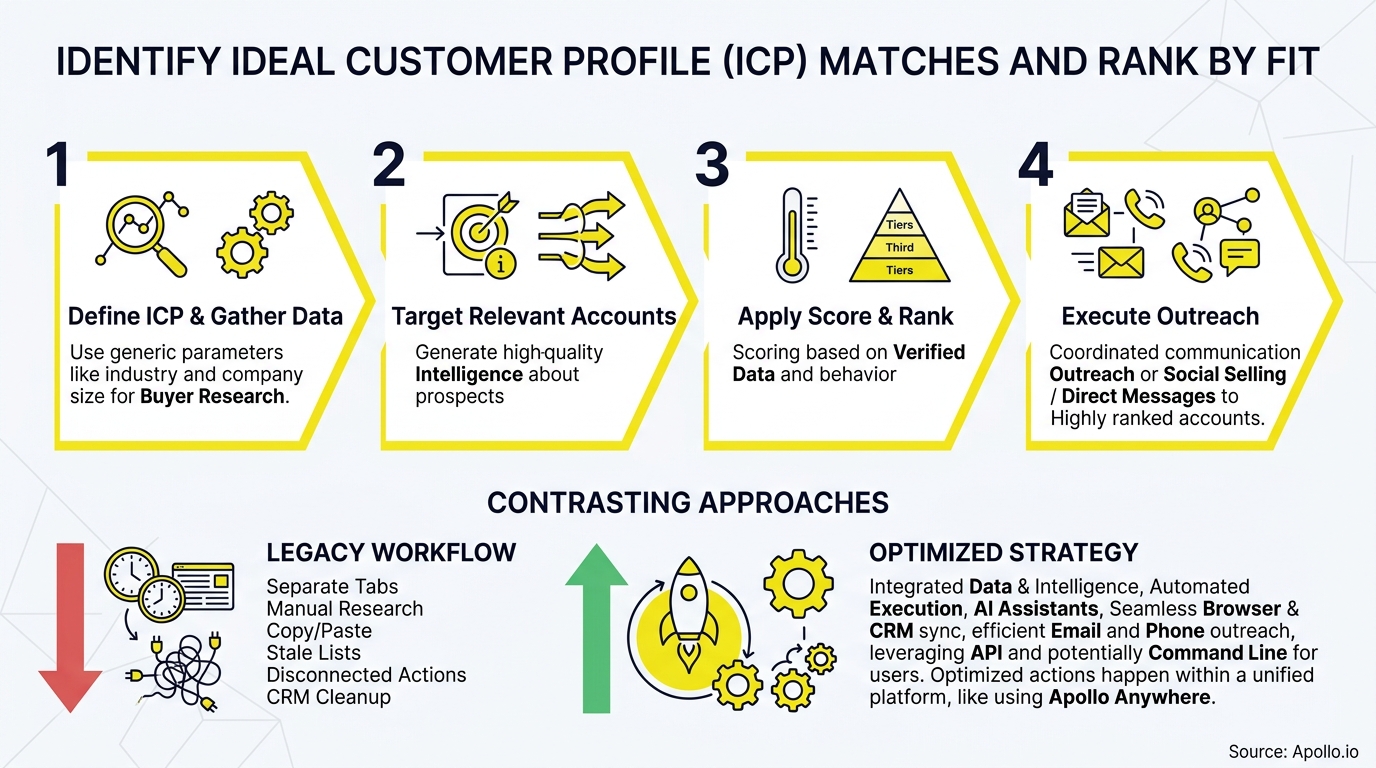
The workflow runs in six stages: define ICP, discover accounts, normalize data, score, route, and validate. Skipping any one stage is why most ICP lists decay into spreadsheets nobody trusts.
- Define the ICP. Document firmographic and technographic criteria based on your best existing customers, not assumptions. Start with a clear ICP definition before you touch scoring logic.
- Discover accounts. Search a B2B database against your defined filters to build the candidate pool. Apollo's search tool lets you filter Apollo's 240M+ person and 30M+ company database across 65+ attributes to build that pool in minutes instead of days.
- Normalize data. Standardize company names, industry taxonomies, and employee bands so accounts compare cleanly.
- Score. Apply the four-factor model above to every account in the pool.
- Route. Send high-fit, high-readiness accounts with strong buying-group coverage straight to AEs; route everything else to nurture or research queues.
- Validate. Compare scored accounts against actual pipeline and win-rate outcomes, covered below.
Struggling to find qualified accounts inside that first discovery step? Search Apollo's database with 65+ filters to build your candidate pool before you ever open a spreadsheet.
How Do You Use A Fit × Readiness Matrix To Prioritize Accounts?
A Fit × Readiness matrix prioritizes accounts by plotting structural ICP match against time-sensitive buying signals in a 2×2 grid. This separates accounts that look right on paper from accounts that are actually in-market right now.
| Low Readiness | High Readiness | |
|---|---|---|
| High Fit | Nurture: strong long-term target, monitor for triggers | Prioritize: route to AE immediately |
| Low Fit | Deprioritize: low ROI on outreach effort | Qualify carefully: intent without fit often churns fast |
This distinction matters because fit and readiness measure different things entirely. An account can closely resemble your ICP with zero current buying activity, or show active intent while being a poor commercial match. Industry guidance from 6sense reinforces this same split between structural fit and time-sensitive signals rather than one conventional lead score.
Score Accounts Right, Route Them Faster
Marketing leads stall before they ever become sales-ready opportunities. Apollo scores and ranks accounts against your ICP so reps chase the deals most likely to close, not guesswork. Built-In improved win rates using Apollo's scoring and signals.
Start Free with Apollo →What Should A Buying-Group Coverage Checklist Include?
A buying-group coverage checklist tracks whether you've identified every role involved in the purchase decision, not just one contact. Forrester found that an average B2B purchase involves 13 people and 89% of purchases touch at least two departments, so a single-contact account is an incomplete ranking no matter how high its firmographic fit scores.
- Economic buyer: Who controls budget approval?
- Champion: Who benefits directly and will advocate internally?
- End users: Who will actually use the product day to day?
- Technical evaluator: Who assesses security, integration, or compliance fit?
- Potential blockers: Which stakeholders might resist the purchase?
Research from Improvado found that reaching 65% of an account's buying committee correlates with 3x higher win rates compared to single-contact engagement. That's the business case for treating buying-group coverage as its own scored dimension, not an afterthought after the deal stalls.
For Account Executives managing multiple deals at once, this checklist becomes a pre-call gut check: don't schedule a demo until you know who else in the account needs to say yes.
How Do RevOps Teams Validate An Account Scoring Model?
RevOps teams validate a scoring model by comparing scored accounts against actual pipeline creation, win rates, and false-positive rates over a defined period, then recalibrating weights based on what the data shows. A model that predicts high fit but produces low win rates is miscalibrated, no matter how sophisticated its inputs look.
- Track pipeline conversion by score tier. Did "high fit" accounts actually convert to pipeline at a higher rate than "low fit" accounts?
- Measure win rate against readiness signals. The Starr Conspiracy's 2024 B2B Buying Study found accounts prioritized by intent and fit converted to closed-won at 21.3%, compared to just 8.4% for non-prioritized accounts.
- Audit false positives. Log accounts that scored high but never engaged, and look for the missing variable (usually stale technographic data or an unidentified blocker).
- Recalibrate quarterly. Weight adjustments should follow evidence, not intuition.
RevOps leaders find that poor data quality is often the real culprit behind a broken model. A 2024 survey of CRM professionals from Validity found 24% of respondents said less than half their data was accurate and complete, and 31% estimated poor data quality cost at least 20% of annual revenue. No scoring model survives dirty inputs.
Tired of rankings breaking down because of bad account data? Start free with Apollo's data enrichment to keep firmographic and technographic fields current before they feed your model.
How Can You Rank Accounts Without Leaving Your AI Workflow?
You can rank accounts without leaving your AI workflow by connecting Apollo directly inside ChatGPT, Claude, Perplexity, or Codex through Apollo MCP. Instead of exporting a list, cleaning it in a spreadsheet, and re-importing it into your CRM, you ask your AI tool to pull, score, and enrich accounts in one conversation.
Setup is no-code: connect Apollo inside your AI tool's connectors or integrations menu via OAuth, on any Apollo plan including free. From there you can search for companies matching your ICP, enrich contacts with verified emails and phone numbers, and push qualified accounts straight into a sequence, all without switching tabs.
Developers can use the Apollo CLI for the same workflow from the terminal. Apollo MCP is built for exactly this: turning account discovery and ranking into a task you complete inside the tool you're already using, instead of a six-tool relay race.
What Are Common Questions About Ranking Accounts By ICP Fit?
What Is The Difference Between ICP Fit And Intent Score?
ICP fit measures how closely an account's structural attributes (industry, size, tech stack) match your ideal customer, while intent score measures active buying signals like content consumption or search behavior. A high-fit account can have zero intent, and a high-intent account can be a poor fit.
Both scores need to be tracked separately and combined, not blended into one number.
How Do You Rank Target Accounts With Limited Data?
Start with the firmographic attributes you can verify confidently (industry, size, location), assign a lower confidence score to accounts with incomplete technographic or intent data, and prioritize enrichment for your top-fit segment first. Ranking with visible confidence levels is more useful than ranking with false precision.
How Often Should You Refresh Account Rankings?
Refresh readiness signals continuously or at minimum weekly, since hiring, funding, and technology changes shift quickly, while core fit criteria can be reviewed quarterly. Treating rankings as a one-time export is the most common reason ICP lists go stale.

Ready To Rank Accounts By Fit, Not Guesswork?
Ranking accounts by ICP fit only works when fit, readiness, and buying-group coverage are scored separately, backed by visible evidence, and validated against real pipeline outcomes. Teams that treat this as a living system, not a one-time list export, catch high-value accounts before competitors do. Collin Stewart of Predictable Revenue put it simply: "We reduced the complexity of three tools into one."
Apollo brings account discovery, enrichment, and outreach execution into one workspace, so your GTM team isn't stitching together separate tools for research, scoring, and sequencing. Whether you're an SDR building a target list, an AE checking buying-group coverage before a call, or a RevOps leader validating a scoring model, Apollo gives you the data and workflow in one place. Start Free with Apollo today.
Justify Spend With Apollo's Real Returns
Struggling to prove ROI before budget season hits? Apollo replaces scattered tools with one platform your CFO can actually measure. Leadium tripled annual revenue and GTM Ops Agency booked 4x more meetings after switching.
Start Free with Apollo →Don't miss these
Sales
Inbound vs Outbound Marketing: Which Strategy Wins?
Sales
What Is a Sales Funnel? The Non-Linear Revenue Framework for 2026
Sales
What Is a Go-to-Market Strategy? The 2026 GTM Playbook
See Apollo in action
We'd love to show how Apollo can help you sell better.
By submitting this form, you will receive information, tips, and promotions from Apollo. To learn more, see our Privacy Statement.
4.7/5 based on 9,690 reviews
