
What Is Enterprise Software Sales? Strategies, Process, and Tools for 2026
Enterprise software sales is one of the most lucrative and complex disciplines in B2B. Deals are large, cycles are long, and buying committees can involve a dozen or more stakeholders across IT, finance, legal, and the C-suite. For AEs and sales leaders navigating this landscape, the difference between winning and losing often comes down to how well you enable buyers to build consensus internally. Explore what enterprise sales solutions look like in 2026 and how AI is reshaping the motion.

Research Less, Pipeline More With Apollo
Tired of burning hours verifying contacts that go nowhere? Apollo surfaces accurate, ready-to-engage prospects so your reps spend time selling — not searching. Join 550K+ companies building predictable pipeline.
Start Free with Apollo →Key Takeaways
- Enterprise software sales involves long cycles, multi-stakeholder buying groups, and high deal values that require structured enablement.
- According to SaaStr, software spending is expected to reach $1.43 trillion in 2026, making this a high-growth market for sellers.
- Most enterprise deals stall not because of product fit but because buyers lack the internal tools to justify and build consensus around a decision.
- ROI-focused content and business-case artifacts are now the primary differentiator for winning competitive deals.
- AEs, SDRs, and RevOps leaders who consolidate their tools into one platform gain a speed advantage across every stage of the enterprise cycle.
What Is Enterprise Software Sales?
Enterprise software sales is the process of selling complex software solutions to large organizations, typically involving deals with six- or seven-figure contract values, multi-month sales cycles, and buying committees with cross-functional stakeholders. It differs from SMB or mid-market sales in scope, risk, and the internal complexity buyers face. Understanding how high-ticket sales work is a prerequisite for succeeding in this motion.
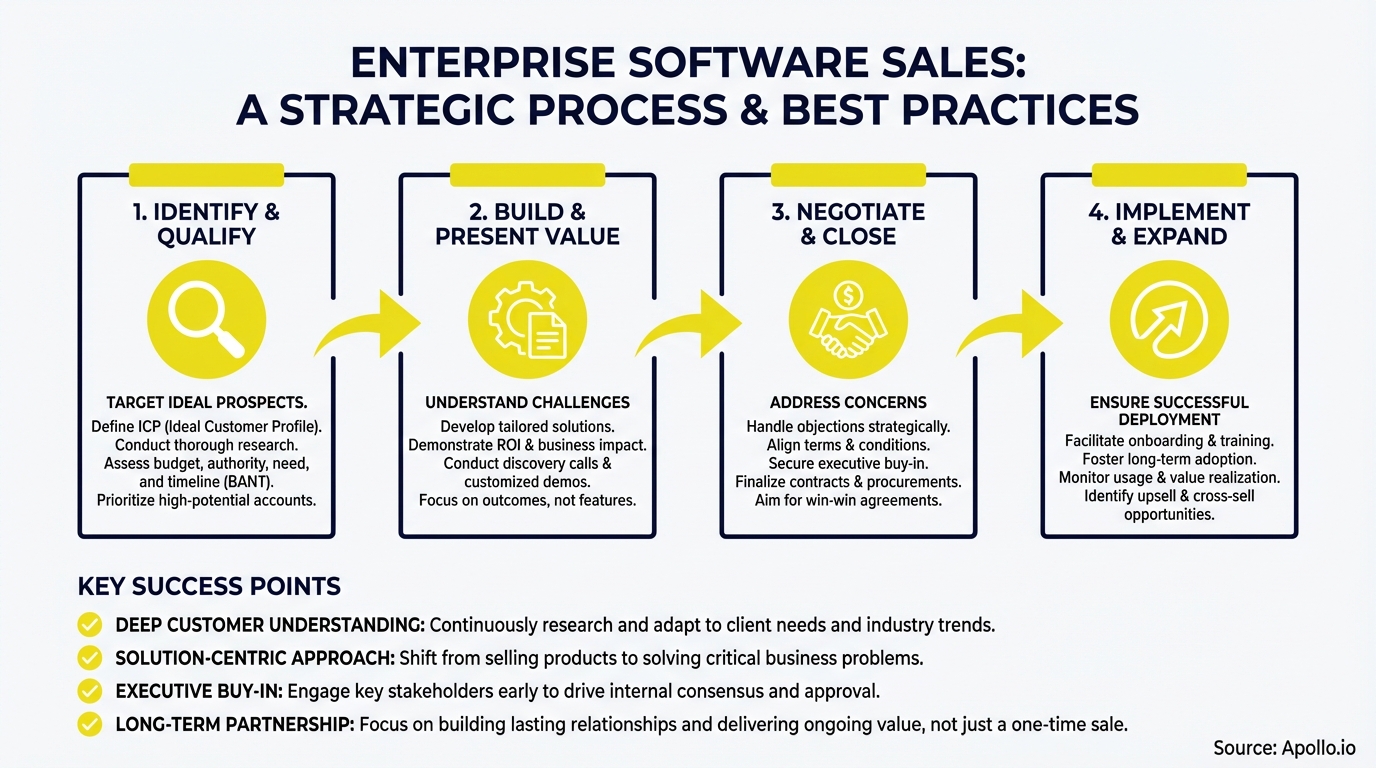
Enterprise deals typically span these stages:
- Discovery: Mapping the account, identifying pain, and finding the economic buyer
- Qualification: Confirming budget authority, timeline, and stakeholder alignment
- Technical evaluation: Security reviews, IT validation, and procurement diligence
- Business case development: Building ROI models and executive briefings
- Negotiation and close: Legal review, procurement sign-off, and contract execution
Why Is the Enterprise Software Market Growing So Fast in 2026?
The opportunity for enterprise software sellers has never been larger. According to Gartner, worldwide IT spending is forecast to total $6.08 trillion in 2026, an increase of 9.8% from 2025. Software is the fastest-growing category within that figure. Data from Grand View Research shows North America accounted for over 41% of global enterprise software market revenue in 2024, making it the dominant region for pipeline and deal flow.
Two trends are accelerating this growth in 2026:

- AI packaging: Vendors are redesigning pricing tiers around agents and consumption models, creating new land-and-expand opportunities but also buyer confusion around ROI.
- Stack rationalization: Enterprises are consolidating tools and pulling partners into decisions earlier, which means sellers need retention and expansion narratives, not just net-new pitches.
Why Do So Many Enterprise Deals Stall?
The biggest obstacle in enterprise software sales is not competition. It is internal buyer paralysis.
Research from Forrester found that 86% of B2B purchases stall during the buying process, and 81% of buyers are dissatisfied with their chosen providers. Deals do not die because the product is wrong.
They die because no one inside the buying organization champions the decision hard enough.
The root causes of stalled deals:
- No clear economic buyer identified early enough
- Procurement and legal requirements surfaced too late
- Lack of a shared business case stakeholders can present internally
- Security and vendor risk reviews that create months of delay
- Competing priorities that push the decision below the threshold of urgency
The fix is proactive buyer enablement: give champions the artifacts they need to sell internally on your behalf. Read how top AEs approach breaking into enterprise accounts and closing mega deals.
Turn Funnel Gaps Into Qualified Pipeline
Pipeline forecasting a guessing game because quality leads never convert? Apollo surfaces in-market buyers at the right moment — so your reps work real opportunities, not dead ends. Top teams trust Apollo to build predictable pipeline.
Schedule a Demo →How Do AEs Build a Winning Business Case for Enterprise Buyers?
For Account Executives managing enterprise deals, the business case is the product. Buyers who can clearly articulate ROI internally are far more likely to get budget approved and close on time.
Research from Demand Gen Report's 2024 B2B Buyer's Survey found that 67% of buyers said they chose the winning vendor because that vendor's content made it easier to demonstrate ROI and build an internal business case.
A complete enterprise business case includes:
| Asset | Purpose | Audience |
|---|---|---|
| ROI calculator | Quantify time saved, risk reduced, revenue impact | CFO, Finance |
| Executive briefing deck | Align vision to strategic priorities | C-Suite |
| Security posture one-pager | Pre-answer IT and compliance questions | CIO, CTO, Procurement |
| Implementation timeline | Reduce risk perception around change management | IT, Operations |
| Customer reference pack | Provide peer validation in relevant verticals | All stakeholders |
Struggling to identify the right contacts in a target account? Search Apollo's 224M+ verified contacts with 65+ filters to map every stakeholder in your enterprise accounts before the first call.
What Does an Omnichannel Enterprise Sales Motion Look Like?
Enterprise buyers do not follow a linear path. McKinsey's 2024 B2B Pulse Survey found that buyers split roughly one-third each across in-person, remote, and digital self-serve preferences, regardless of deal size or industry.
This means your sales motion must support all three simultaneously rather than defaulting to one channel.
A practical omnichannel playbook for enterprise software sales:
- Self-serve: ROI calculators, interactive demos, and procurement-ready documentation available without a rep
- Remote: Video-first discovery, digital business cases, and async stakeholder updates via deal rooms
- In-person: Executive briefing centers, on-site workshops, and QBRs for strategic accounts
The same McKinsey research found that 69% of buyers would complete transactions of $500,000 or more remotely, which means refusing to adapt to digital buying preferences is a direct revenue risk. Explore how sales execution software helps AEs manage multi-channel enterprise deals from a single workspace.
How Do SDRs Build Pipeline for Enterprise Software Deals?
SDRs targeting enterprise accounts face a different challenge than those working SMB lists. The outreach volume is lower, the research per account is higher, and the path to the right stakeholder is rarely direct.
Enterprise prospecting requires account-based thinking: map the org, identify the trigger event, and personalize to the specific business priority of each persona.
Key SDR tactics for enterprise pipeline:
- Use intent signals and technographic data to prioritize accounts already evaluating competitors
- Research trigger events (funding, leadership change, product launch) before the first touch
- Sequence across email, phone, and social with persona-specific messaging for each stakeholder
- Engage multiple contacts in the same account simultaneously to build multi-threaded awareness
SDRs working enterprise accounts need clean, verified contact data across the entire buying committee. Spending too much time on manual research? Automate your enterprise sequences with Apollo's multi-channel engagement platform and focus your time on high-value conversations.
For RevOps leaders, consolidating prospecting, sequencing, and pipeline tracking into one platform eliminates data fragmentation across the enterprise sales cycle. As Cyera's team put it: "Having everything in one system was a game changer."

What Tools Do Enterprise Sales Teams Need in 2026?
Enterprise sales teams historically ran on fragmented stacks: one tool for data, another for sequencing, another for deal management, and another for analytics. Stack rationalization is now a buyer and seller priority.
Predictable Revenue found that consolidating tools reduced complexity significantly: "We reduced the complexity of three tools into one."
The core capabilities an enterprise sales platform must cover:
- Contact and account intelligence: Verified business contact data with firmographic and technographic filters
- Multi-channel engagement: Sequenced outreach across email, phone, and social
- Deal management: Pipeline visibility, stage progression, and stakeholder mapping
- AI automation: Personalization at scale, call summaries, and next-step recommendations
- Analytics: Rep performance, pipeline health, and revenue forecasting
Explore how to build a sales tech stack that scales revenue without adding complexity. Apollo consolidates all of these capabilities into one unified platform used by 90K paying customers and 550K+ companies.
How to Win Enterprise Software Sales in 2026
Enterprise software sales rewards sellers who reduce buyer risk at every stage. The market is growing rapidly: Precedence Research projects the enterprise software market to reach USD 761.73 billion by 2034, expanding at a CAGR of 11.74% from 2025. The sellers who capture that growth will be the ones who show up with ROI-first business cases, omnichannel presence, and the tools to execute without friction.
Three priorities to focus on now:
- Build champion enablement assets before procurement asks for them
- Map the full buying committee and engage each persona with relevant proof points
- Consolidate your sales tech stack so your team operates from a single source of truth
Apollo gives SDRs, AEs, and RevOps teams a unified platform for prospecting, engagement, deal management, and analytics. Discover how AI sales tools are closing more enterprise deals in 2026, then Start Prospecting with Apollo free today.
Prove Pipeline ROI From Day One
Budget approval stuck on unclear metrics? Apollo delivers measurable pipeline impact fast — so you walk into every review with proof, not promises. Leadium 3x'd their revenue. Your turn.
Start Free with Apollo →Don't miss these
Sales
Inbound vs Outbound Marketing: Which Strategy Wins?
Sales
What Is a Sales Funnel? The Non-Linear Revenue Framework for 2026
Sales
What Is a Go-to-Market Strategy? The 2026 GTM Playbook
See Apollo in action
We'd love to show how Apollo can help you sell better.
By submitting this form, you will receive information, tips, and promotions from Apollo. To learn more, see our Privacy Statement.
4.7/5 based on 9,690 reviews
