
Email Scrapers: Compliance Risk vs. Smarter Alternatives in 2026
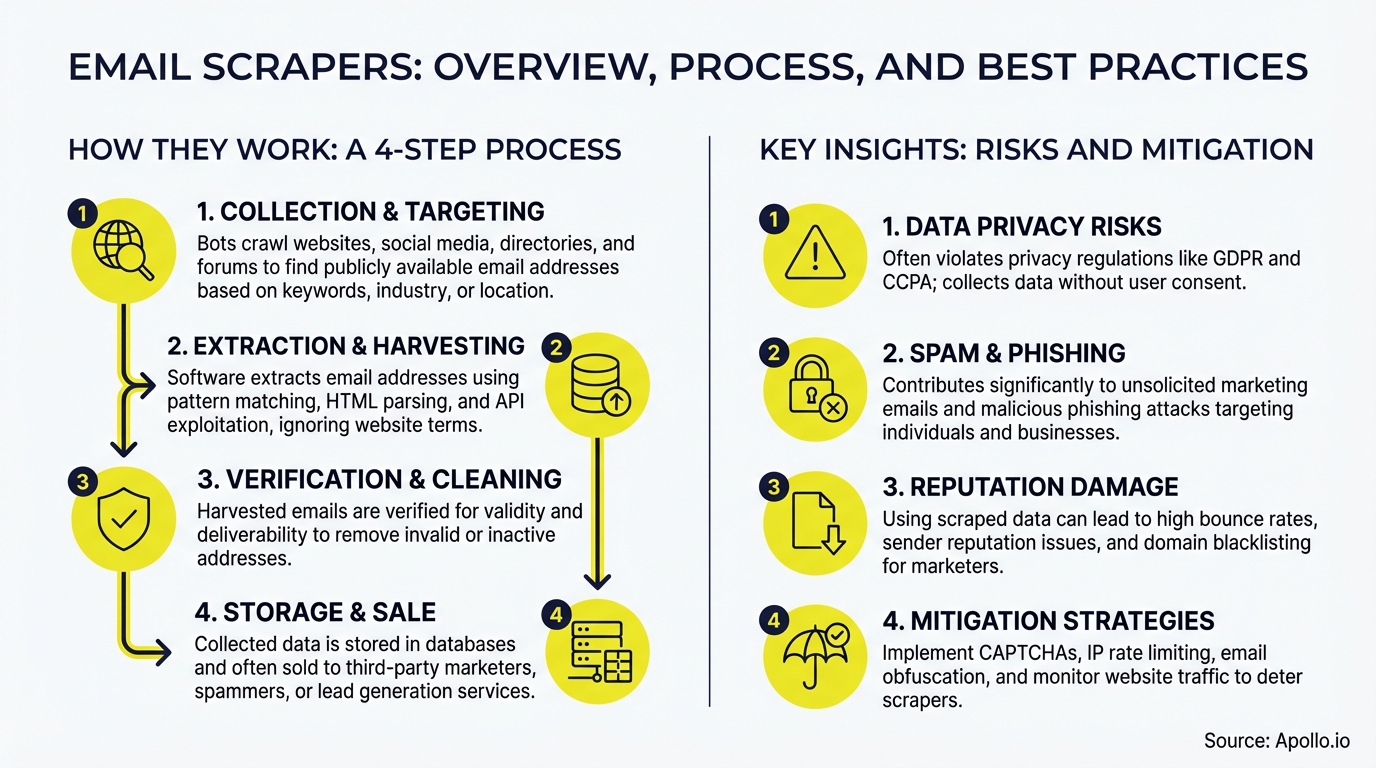
Email scrapers promise fast prospecting, but enforcement actions and deliverability rules have transformed them from automation shortcuts into compliance liabilities. France's data authority fined KASPR €240,000 for contact scraping, and Gmail now enforces strict spam thresholds that can shut down domains using unverified lists.
This guide shows what works today: compliant data sourcing, verified contacts, and permission-based outreach that actually reaches inboxes.

Stop Manual Research—Apollo Finds Contacts Fast
Tired of spending 4+ hours daily hunting for contact info? Apollo delivers 224M verified contacts with 96% email accuracy. Join 550K+ companies who turned research time into selling time.
Start Free with Apollo →Key Takeaways
- Email scrapers collect contact data from websites and platforms, but enforcement actions like the KASPR fine signal regulatory crackdown on harvesting methods
- Gmail's bulk-sender rules require DMARC authentication and mandate spam rates below 0.10%, making scraped lists operationally expensive
- Permission-based databases with verified contacts avoid compliance risk and deliver better deliverability than scraped data
- Effective B2B prospecting combines verified data sources, authentication protocols, and tight ICP targeting instead of volume-first scraping
What Email Scrapers Actually Do (and Where They Break)
Email scrapers are tools that extract contact information from websites, directories, and professional platforms. According to Topo.io, in 2024 there was high demand for sales tools that offer a balance of scalability, accuracy, and compliance, which includes email scraper functionalities.
The appeal is obvious: fast list-building without manual research. The problem? Scraped lists typically lack consent, verification, and audit trails—creating three failure points simultaneously.
Four Common Scraper Types
| Type | How It Works | Primary Risk |
|---|---|---|
| Web-based scrapers | Upload URLs to extract emails from domains | High bounce rates, no verification layer |
| Browser extensions | Extract data from platforms as you browse | Platform ToS violations, account bans |
| Software applications | Installed programs for bulk scraping operations | Data provenance gaps, compliance exposure |
| API-driven scripts | Custom code for programmatic collection | Legal basis failures, retention issues |
"Apollo enriches everything we have: contacts, leads, accounts... And we don't really have to touch it, it just works."
Why 2026 Changed the Email Scraping Playbook
Three enforcement shifts turned scraping from "gray area" into operational liability: regulatory fines, platform crackdowns, and mailbox-provider rules that penalize unverified lists.
CNIL's €240,000 KASPR Fine: The New Enforcement Baseline
France's data protection authority fined KASPR in December 2024 for scraping professional contact details from platforms and building a database of ~160 million contacts. CNIL cited lack of legal basis, transparency failures, weak data-subject access request handling, and excessive retention—setting a clear precedent for how regulators view email-finder tools.
The enforcement rationale: "publicly accessible" does not equal "free to harvest and repurpose for prospecting." Teams using scraped data must document legal basis, provide transparency notices, honor deletion requests, and justify retention periods.
Gmail's Deliverability Enforcement: The 0.10% Ceiling
Gmail's bulk-sender requirements (effective February 2024, continuing through 2026) apply to senders at 5,000+ messages per day and mandate:
- SPF, DKIM, and DMARC authentication
- Spam complaint rates below 0.10% (avoid 0.30%+)
- One-click unsubscribe for marketing messages
Scraped lists typically generate higher complaints and bounces because recipients never opted in. A single campaign to an unverified list can breach the 0.30% threshold, triggering throttling, spam placement, or domain blocks. Learn how to avoid spam filters with proper authentication and list hygiene.
Struggling with low inbox placement? Start with Apollo's 224M+ verified contacts to build compliant lists that reach inboxes.
The Compliance-First Data Sourcing Framework
Effective B2B prospecting in 2026 requires auditable data provenance. Before adding any contact to your CRM, answer three questions: Where did this data come from?
What's the legal basis for use? Can we document consent or legitimate interest?
Source Evaluation Checklist
| Criterion | Scraper-Based Source | Permission-Based Database |
|---|---|---|
| Legal basis documentation | Typically absent or vague | Clearly defined (consent, legitimate interest) |
| Data freshness verification | Static snapshot, no updates | Continuous validation and refresh cycles |
| Opt-out mechanism | No suppression list integration | Honor suppression requests across platform |
| Audit trail | Source unclear, timestamp missing | Timestamped acquisition, source tracking |
According to Marketing Hackers, B2B email scraping continues to be a relevant and scalable method for building prospect lists in 2025, especially when implemented responsibly. Responsible implementation means verified sources, documented legal basis, and respect for platform terms of service. Explore privacy-respecting email lookup strategies that balance scale with compliance.
"We benchmarked ZoomInfo versus Apollo, Clearbit, Lusha, and Seamless, and ultimately Apollo won on all fronts, especially in enrichment. Higher quality than ZoomInfo, greater breadth than Clearbit."
See Every Deal Stage in Real Time With Apollo
Forecasting a guessing game because you can't see where deals actually stand. Apollo gives you real-time pipeline visibility and identifies quality prospects at the right moment. Built-In boosted win rates 10% with Apollo's signals.
Start Free with Apollo →Deliverability Playbook: Authentication and List Quality Gates
Mailbox providers now enforce deliverability at the technical and behavioral level. Teams must implement authentication protocols and quality gates before launching outreach.
Four Critical Implementation Steps
- Deploy DMARC authentication: Set up SPF, DKIM, and DMARC records at p=quarantine or p=reject to signal sender legitimacy. Red Sift reported only 14.9% of domains had DMARC as of December 2025, creating competitive advantage for early adopters.
- Verify every contact: Run email verification on all addresses before adding to sequences. Bounce rates above 5% damage sender reputation and trigger filtering.
- Segment by engagement history: Separate cold lists from warm leads. Send cold outreach at lower volumes with tighter monitoring of complaint rates.
- Monitor complaint thresholds: Track spam complaint rates daily. Gmail's 0.10% target means 1 complaint per 1,000 sends is the ceiling. Above 0.30% triggers enforcement.
Need help improving inbox placement? Check out our guide on boosting email deliverability with sequence diagnostics and real-time monitoring.
Permission-Based Alternatives That Outperform Scraping
Research from Prospect Wallet shows that in 2025, 73% of B2B marketers consider email the most effective way to reach prospects, and 77% of B2B buyers prefer email as their primary contact method. The challenge is reaching them compliantly.
Five Compliant Lead Generation Methods
| Method | Implementation | Key Advantage |
|---|---|---|
| Verified B2B databases | Use platforms with documented consent/legitimate interest | Audit-ready provenance, verified accuracy |
| Content-gated lead magnets | Offer guides, templates, calculators in exchange for opt-in | Explicit consent, high intent signals |
| Webinar registrations | Host educational sessions requiring email signup | Warm audience, permission-based follow-up |
| API-permitted enrichment | Enrich existing contacts via compliant data APIs | Fills gaps without scraping, respects platform ToS |
| Partner co-marketing | Joint campaigns with complementary vendors | Shared audiences, mutual opt-in, expanded reach |
Looking for qualified contacts without scraping risk? Search Apollo's 224M+ verified contacts with 65+ filters to build targeted lists compliantly.

How Apollo Delivers Verified Contacts Without Scraping Risks
Apollo provides access to 224M+ business contacts and 30M+ companies through a permission-based database built on verified, always-fresh data. The platform combines contact discovery, enrichment, and engagement in one workspace—eliminating the need for risky scraping tools.
Apollo's Compliance-First Data Approach
- 96% email accuracy: Continuous verification ensures addresses are current and valid
- Intent and job change signals: Identify prospects actively in-market without scraping social platforms
- Multi-channel sequences: Reach prospects via email, phone, and social in compliant workflows
- Built-in suppression: Honor opt-out requests automatically across all campaigns
- CRM sync: Keep contact data fresh and audit trails complete
Teams switch to Apollo to consolidate their tech stack and reduce dependency on multiple vendors. Learn more in our guide to what works in B2B email marketing with verified data and compliant outreach.
Practical Implementation: Building Your First Compliant Campaign
Ready to move from scraping to verified prospecting? Follow this five-step framework to launch compliant, high-performing outreach.
Step 1: Define Your ICP with Precision
Narrow targeting reduces list size but increases relevance. Use firmographic filters (company size, industry, revenue) and technographic signals (tech stack, tools used) to build tightly-scoped segments.
Smaller, focused lists outperform large scraped lists on every metric: open rates, reply rates, and conversion.
Step 2: Source Contacts from Verified Databases
Use permission-based platforms that document data provenance. Verify each contact before adding to sequences.
Run email validation to catch invalid addresses, spam traps, and role-based emails that damage sender reputation.
Step 3: Set Up Authentication Protocols
Deploy SPF, DKIM, and DMARC before sending. Warm up new sending domains gradually, starting with small sends to engaged contacts.
Monitor bounce rates, complaint rates, and spam folder placement daily.
Step 4: Personalize at Scale with Context
Generic outreach kills reply rates. Use firmographic data, recent news, job changes, and intent signals to craft relevant messages. Our guide on writing sales emails that get responses provides proven frameworks for personalization.
Step 5: Track Engagement and Iterate
Measure open rates, reply rates, and meeting bookings by segment. Cut underperforming segments quickly.
Double down on high-performing messaging and audiences. Maintain complaint rates below 0.10% to protect domain reputation.
Why Buying Email Lists Always Fails
Purchased lists share the same fatal flaws as scraped lists: no consent, poor verification, and high complaint rates. Vendors selling "targeted B2B lists" rarely document legal basis or provide audit trails.
Recipients flag unsolicited emails as spam, damaging your sender reputation permanently.
The math doesn't work either. According to Martal, the average cold email open rate experienced a decrease from approximately 36% in 2023 to 27.7% in 2024, reflecting stricter filtering and lower tolerance for impersonal outreach.
Learn why buying email lists fails and how to build owned lists that perform better over time.

Frequently Asked Questions About Email Scrapers
Are email scrapers legal to use for B2B prospecting?
According to Mailer Find, email scrapers are considered legal in most jurisdictions when data is collected from public sources. However, legality doesn't equal compliance. GDPR, CCPA, and platform terms of service impose additional requirements. Teams must document legal basis, provide transparency notices, and honor opt-out requests regardless of data source.
What's the difference between scraping and using a B2B database?
Scraping extracts data without permission or verification. B2B databases like Apollo collect contact information with documented legal basis, verify accuracy continuously, and provide audit trails.
Permission-based databases deliver higher deliverability, lower complaint rates, and defensible compliance posture.
How do I verify scraped emails before sending?
Run email verification tools that check syntax, domain validity, and mailbox existence. Remove invalid addresses, spam traps, and role-based emails (info@, sales@). Even verified scraped emails carry compliance risk if you lack documented legal basis for use. Our guide on how to verify email addresses provides step-by-step validation workflows.
What happens if my domain gets flagged for spam?
Mailbox providers throttle delivery, route emails to spam folders, or block your domain entirely. Recovery requires proving sender legitimacy, cleaning lists, and gradually rebuilding reputation through engagement with opted-in contacts.
Prevention is easier than recovery: use verified contacts and monitor complaint rates from day one.
Build Compliant Lists That Actually Convert
Email scrapers promise speed but deliver compliance risk, poor deliverability, and damaged sender reputation. The 2026 enforcement landscape—from CNIL fines to Gmail's strict thresholds—makes permission-based prospecting the only sustainable path.
Apollo provides 224M+ verified contacts, 96% email accuracy, and built-in compliance safeguards in one platform. Teams using Apollo report higher reply rates, better inbox placement, and zero scraping-related enforcement risk.
Ready to prospect compliantly? Start your free Apollo trial and build lists that convert without legal exposure.
Prove Apollo's ROI In Your First 30 Days
Budget approval stuck on unclear metrics? Apollo tracks every touchpoint from prospect to close, showing exactly which activities drive pipeline. Built-In increased win rates 10% and ACV 10% with Apollo's signals.
Start Free with Apollo →Don't miss these
Sales
Inbound vs Outbound Marketing: Which Strategy Wins?
Sales
What Is a Sales Funnel? The Non-Linear Revenue Framework for 2026
Sales
What Is a Go-to-Market Strategy? The 2026 GTM Playbook
See Apollo in action
We'd love to show how Apollo can help you sell better.
By submitting this form, you will receive information, tips, and promotions from Apollo. To learn more, see our Privacy Statement.
4.7/5 based on 9,690 reviews
