
Define Sales: The Complete Guide to Modern Revenue Generation
Sales is the process of identifying prospects, building relationships, and converting interest into revenue through value-based exchanges. In 2026, sales has evolved into a hybrid discipline that blends AI-powered automation with human connection, data-driven insights with emotional intelligence. Modern B2B sales teams leverage unified platforms to prospect smarter, engage faster, and close deals more predictably than ever before.

Apollo Eliminates 4+ Hours Of Daily Research
Tired of spending 4+ hours daily hunting for contact info? Apollo delivers verified emails and mobile numbers instantly—no more data entry. Join 550K+ companies who turned research time into selling time.
Start Free with Apollo →Key Takeaways
- Sales combines strategic prospecting, relationship building, and value delivery to generate revenue
- Modern sales teams use AI to automate research and outreach while preserving human connection in critical moments
- Hybrid selling (digital, remote, and in-person) now dominates B2B sales strategies in 2026
- Unified sales platforms replace multiple tools, cutting costs and improving team efficiency
- SDRs, AEs, and RevOps leaders need data-driven workflows to hit quota in competitive markets
What Is Sales?
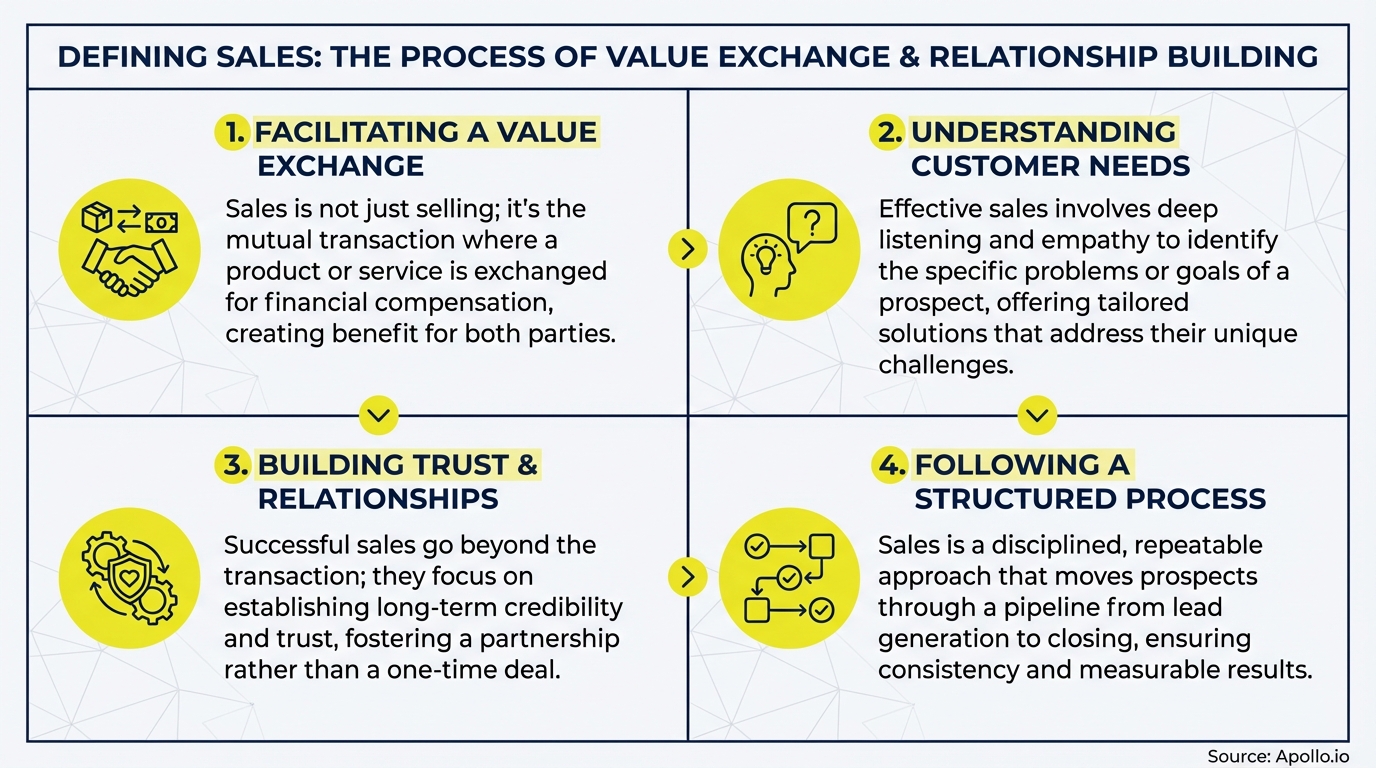
Sales is the strategic process of identifying potential customers, understanding their needs, and guiding them toward a purchase decision that creates mutual value. It encompasses prospecting, relationship building, needs analysis, solution presentation, objection handling, and deal closure.
Unlike passive order-taking, sales requires active engagement to uncover pain points and demonstrate how your solution solves specific business problems.
In 2026, Gartner research shows that 75% of B2B sales organizations now augment traditional playbooks with AI-guided selling solutions. This shift reflects how sales has become a data-informed discipline where technology handles repetitive tasks and humans focus on strategic relationship building. Modern sales professionals combine AI sales tools with consultative expertise to deliver personalized buying experiences.
How Does the Sales Process Work in 2026?
The modern sales process follows a structured framework that integrates automation, intelligence, and human touchpoints. It starts with targeted prospecting using verified contact data, moves through multi-channel engagement sequences, and culminates in deal management with predictable forecasting.
Core stages include:

- Prospecting: Identify ideal customer profiles using firmographic, technographic, and intent data filters
- Qualification: Assess fit using frameworks like BANT (Budget, Authority, Need, Timeline) or MEDDIC
- Engagement: Execute multi-channel outreach across email, phone, and social platforms
- Discovery: Conduct needs analysis through strategic questioning and active listening
- Presentation: Deliver tailored sales pitches that connect features to business outcomes
- Negotiation: Address objections and structure mutually beneficial agreements
- Closing: Finalize contracts and transition accounts to customer success teams
Research by McKinsey confirms that hybrid selling (combining in-person, remote, and digital self-service) has become the dominant strategy. Sales teams that master this balance close deals faster and maintain higher customer satisfaction scores.
What Are the Different Types of Sales?
Sales methodologies vary based on customer type, deal complexity, and buying journey. Understanding these distinctions helps teams deploy the right strategies and resources.
| Sales Type | Characteristics | Ideal For |
|---|---|---|
| B2B Sales | Business-to-business transactions with multiple decision makers and longer cycles | Enterprise software, professional services, industrial equipment |
| B2C Sales | Business-to-consumer sales with shorter cycles and emotional buying triggers | Retail products, consumer services, direct-to-consumer brands |
| Inside Sales | Remote selling via phone, video, and digital channels without face-to-face meetings | SaaS products, subscription services, SMB markets |
| Outside Sales | Field sales with in-person meetings, demonstrations, and relationship building | Complex solutions, high-value contracts, relationship-driven industries |
| Enterprise Sales | Strategic selling to large organizations with extended timelines and executive engagement | Six-figure+ deals requiring specialized enterprise strategies |
Struggling to find qualified leads across different sales channels? Search Apollo's 224M+ verified business contacts with 65+ filters to build targeted prospect lists in minutes, not hours.

See Every Deal In Real Time With Apollo
Forecasting feel like guesswork without real-time deal visibility. Apollo gives you instant pipeline clarity across every stage. Built-In boosted win rates 10% with Apollo's signals.
Start Free with Apollo →How Do SDRs and AEs Drive Revenue?
Sales Development Representatives (SDRs) and Account Executives (AEs) form the core engine of modern revenue teams. SDRs focus on top-of-funnel activities like prospecting, outreach, and meeting generation. They use strategic sales development tactics to identify high-intent prospects and book qualified meetings.
AEs take over qualified opportunities to conduct discovery, deliver demos, and negotiate contracts. They manage complex deal cycles with multiple stakeholders, requiring deep product knowledge and consultative selling skills.
In 2026, top-performing SDRs leverage AI to automate research and personalize outreach at scale, while AEs use conversation intelligence to coach themselves and refine their approach based on what actually closes deals.
Key responsibilities:
- SDRs: Cold outreach, lead qualification, meeting booking, pipeline generation
- AEs: Demo delivery, solution design, proposal creation, contract negotiation
- Both roles: CRM hygiene, forecast accuracy, continuous learning
Why Is Sales Critical for Business Growth?
Sales directly impacts revenue, market share, and company valuation. Without effective sales processes, even superior products fail to reach their target markets.
Sales teams provide crucial market feedback that informs product development, pricing strategies, and competitive positioning.
For Founders and CEOs building outbound motions, sales represents the fastest path to product-market fit validation. RevOps leaders rely on sales data to optimize the entire revenue engine, from lead generation through customer retention. In 2026, companies with unified sales tech stacks report measurable improvements in rep productivity and forecast accuracy.
Business impact:
- Direct revenue generation and cash flow management
- Customer acquisition that fuels growth and market expansion
- Competitive intelligence from frontline buyer interactions
- Brand advocacy through positive customer experiences
What Sales Tools Do Teams Use in 2026?
Modern sales teams consolidate their tech stacks around unified platforms that combine prospecting, engagement, and intelligence. The shift away from point solutions reduces complexity and costs while improving data quality and team adoption.
Essential capabilities:
- Contact Database: Verified business contacts with direct dials and email addresses
- Sales Engagement: Multi-channel sequences across email, phone, and social platforms
- AI Automation: Research assistance, message personalization, and call summaries
- Deal Management: Pipeline tracking, forecasting, and revenue analytics
- Conversation Intelligence: Call recording, transcription, and coaching insights
Teams using Apollo report significant benefits from tool consolidation. As one customer noted, "We reduced the complexity of three tools into one" (Predictable Revenue), while another shared, "We cut our costs in half" (Census). Spending hours on manual outreach and research? Automate your sales workflows with Apollo's AI platform and focus on conversations that close deals.
Start Selling Smarter in 2026
Sales remains the lifeblood of business growth, but the methods have transformed. Today's top performers combine AI-powered efficiency with human expertise to prospect faster, engage smarter, and close more predictably.
They replace fragmented tool stacks with unified platforms that provide complete visibility from first touch to closed-won.
Whether you're an SDR looking to book more meetings, an AE managing complex enterprise deals, or a Sales Leader building a scalable revenue engine, the fundamentals remain constant: understand your buyers, deliver genuine value, and build relationships that last beyond the signature. The teams that master this balance while leveraging modern technology will dominate their markets in 2026 and beyond.
Ready to transform your sales process? Start your free trial and discover how Apollo's all-in-one platform helps 2M+ users prospect, engage, and close deals faster.
Prove Apollo's ROI In Your First 30 Days
Budget approval stuck on unclear metrics? Apollo tracks every touchpoint from prospect to closed deal—quantifying exactly how much pipeline you're generating. Built-In increased win rates 10% and ACV 10% with Apollo's signals.
Start Free with Apollo →Don't miss these
Sales
Inbound vs Outbound Marketing: Which Strategy Wins?
Sales
What Is a Sales Funnel? The Non-Linear Revenue Framework for 2026
Sales
What Is a Go-to-Market Strategy? The 2026 GTM Playbook
See Apollo in action
We'd love to show how Apollo can help you sell better.
By submitting this form, you will receive information, tips, and promotions from Apollo. To learn more, see our Privacy Statement.
4.7/5 based on 9,690 reviews
