
CRM Sales Management: How to Drive Revenue with the Right System
CRM sales management has evolved from basic contact tracking into an AI-powered revenue engine. Sales teams utilizing AI within their CRM report 83% revenue growth compared to 66% for non-AI users, according to CRM.org. Modern CRM sales management combines data intelligence, workflow automation, and predictive analytics to help sales teams close deals faster while reducing manual work.

Apollo Finds Contacts While Your Team Sells
Tired of reps spending hours hunting for verified contact info? Apollo delivers 224M+ prospects with 96% email accuracy instantly. Join 550K+ companies who turned research time into selling time.
Start Free with Apollo →Key Takeaways
- AI-enabled CRM systems drive 83% revenue growth versus 66% for traditional approaches
- Hybrid selling models generate up to 50% more revenue through digital and in-person engagement
- Unified platforms consolidate 3-5 tools, cutting costs while improving team productivity
- RevOps leaders use CRM analytics to align marketing and sales with measurable ROI
- 74% of U.S. businesses now rely on CRM systems for customer relationship management
What Is CRM Sales Management?
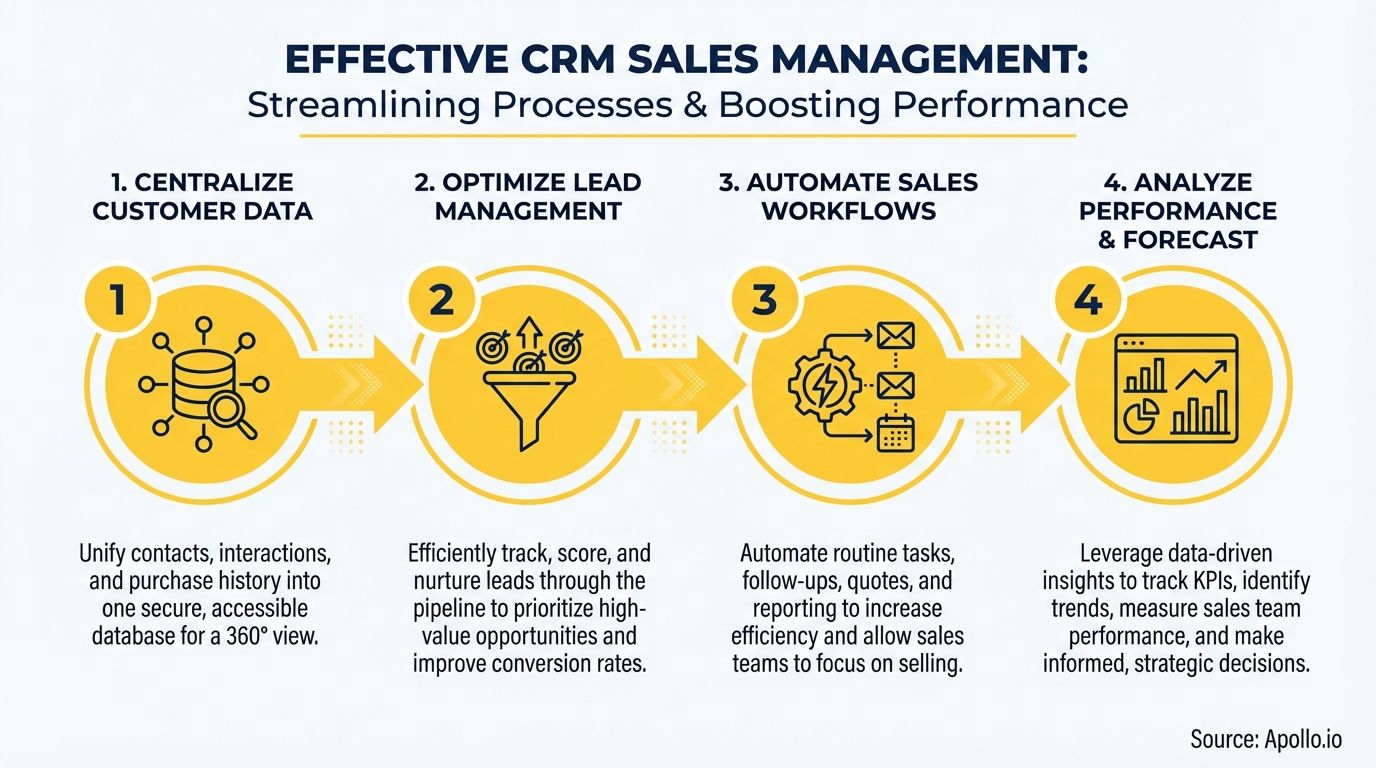
CRM sales management is the strategic use of customer relationship management software to track interactions, automate workflows, and optimize revenue generation. It centralizes prospect data, deal stages, communication history, and performance metrics in one workspace.
Modern CRM sales management goes beyond contact storage to provide AI-driven insights, predictive forecasting, and automated outreach capabilities.
The approach differs from traditional sales tracking by integrating real-time data enrichment, behavioral triggers, and cross-channel engagement. Sales Development Representatives (SDRs) use CRM sales management to prioritize high-intent leads, while Account Executives (AEs) leverage deal intelligence to shorten sales cycles. Gartner forecasts the CRM sales software market will reach $20.6 billion by 2027, growing at 12.9% annually as teams adopt AI-enhanced platforms.
How Does AI Transform CRM Sales Management?
AI transforms CRM sales management by automating research, personalizing outreach, and predicting deal outcomes. Generative AI will account for 60% of AI spending in CRM by 2027, per Gartner research. AI analyzes historical patterns to recommend next actions, score leads based on conversion likelihood, and draft contextual messages tailored to each prospect's business needs.
For SDRs, AI-powered CRM systems eliminate hours of manual research by surfacing buyer intent signals, job changes, and company growth indicators. AEs benefit from AI-generated call summaries, sentiment analysis, and deal risk assessments. RevOps teams use AI to identify pipeline bottlenecks and forecast revenue with greater accuracy. Struggling with scattered data across multiple tools? Consolidate your tech stack with Apollo's 224M+ verified contacts and AI automation.
What Are the Key AI Features in Modern CRM?
- Predictive Lead Scoring: AI ranks prospects by conversion probability using engagement patterns and firmographic data
- Automated Enrichment: Systems append missing contact details, technographics, and org charts without manual work
- Intelligent Sequencing: AI optimizes send times, channel selection, and message personalization across email, phone, and social
- Conversation Intelligence: Call and meeting transcripts auto-generate summaries, action items, and CRM updates
- Revenue Forecasting: Machine learning models predict quarter-end results based on pipeline velocity and historical close rates
Why Is Hybrid Selling Critical for CRM Strategy?
Hybrid selling combines digital engagement with strategic in-person interactions to maximize deal value. Research by McKinsey shows companies using hybrid models report up to 50% more revenue through deeper customer relationships. CRM sales management enables hybrid selling by tracking multi-channel touchpoints, coordinating field and inside sales teams, and maintaining context across digital and physical conversations.

Sales leaders implementing hybrid strategies use CRM analytics to determine which accounts warrant face-to-face meetings versus video calls. SDRs qualify leads digitally before AEs conduct on-site demos for high-value opportunities. The CRM becomes the single source of truth, ensuring every team member sees the complete customer journey regardless of channel. Tired of juggling disconnected sales tools? Unify your outreach with Apollo's multi-channel sequences and CRM integration.
Turn Forecasting Guesswork Into Revenue Certainty
Missing deals because you can't see who's ready to buy? Apollo tracks 224M+ prospects with real-time intent signals so you never miss an in-market buyer. Built-In increased win rates 10% with Apollo's scoring.
Start Free with Apollo →How Do Sales Leaders Align Marketing and Sales with CRM?
Sales leaders align marketing and sales by establishing shared definitions, unified metrics, and integrated workflows within the CRM. Marketing-sales alignment begins with agreement on lead qualification criteria, handoff processes, and attribution models.
The CRM tracks lead source, engagement score, and conversion stage so both teams see which campaigns generate pipeline and revenue.
RevOps leaders configure CRM dashboards that display marketing-influenced deals, cost per acquisition, and sales cycle length by channel. Weekly pipeline reviews use CRM data to identify where leads stall and which content assets accelerate deals. Integrated platforms eliminate data silos by syncing marketing automation, sales engagement, and CRM in real time. Founders building outbound motions benefit from visibility into which messages, offers, and targeting strategies convert prospects into customers.
What Metrics Matter for Marketing-Sales Alignment?
| Metric | Definition | Why It Matters |
|---|---|---|
| MQL to SQL Conversion Rate | Percentage of marketing qualified leads accepted by sales | Measures lead quality and alignment on qualification criteria |
| Sales Cycle Length by Source | Days from first touch to close, segmented by lead origin | Reveals which channels produce fastest-converting prospects |
| Pipeline Velocity | Speed at which deals move through stages | Identifies bottlenecks requiring marketing content or sales enablement |
| Marketing-Influenced Revenue | Closed deals with marketing touchpoints in buyer journey | Quantifies marketing's contribution to revenue goals |

How Do RevOps Teams Implement CRM Sales Management?
RevOps teams implement CRM sales management through phased rollouts that prioritize data hygiene, process standardization, and user adoption. Implementation starts with auditing existing data sources, defining the ideal customer profile, and mapping the sales process to CRM stages.
RevOps configures automation rules for lead assignment, follow-up reminders, and pipeline alerts so reps focus on selling rather than administrative tasks.
Successful implementations include change management: training sessions, documented playbooks, and executive sponsorship. RevOps monitors adoption metrics like login frequency, data entry completeness, and feature utilization.
Teams often consolidate multiple tools into one platform to reduce complexity. As one customer noted, "We reduced the complexity of three tools into one" (Predictable Revenue), while another reported, "We cut our costs in half" (Census).
What Is the CRM Implementation Checklist?
- Data Migration: Clean and deduplicate contacts before importing; enrich missing fields with verified business information
- Workflow Design: Map sales stages, automate repetitive tasks, and create templates for common scenarios
- Integration Setup: Connect email, calendar, phone systems, and existing CRM platforms for seamless data flow
- User Training: Conduct role-specific sessions for SDRs, AEs, and managers with hands-on practice
- Governance Framework: Establish data entry standards, privacy compliance, and regular audit schedules
- Performance Tracking: Define KPIs, build dashboards, and schedule weekly reviews with sales performance metrics
What Are the Benefits of Unified CRM Sales Management?
Unified CRM sales management delivers measurable improvements in productivity, forecast accuracy, and revenue per rep. Teams using integrated platforms eliminate manual data entry, reduce tool switching, and access complete customer context in one workspace. According to CRM.org, 74% of U.S. businesses now use CRM systems to manage customer relationships effectively.
SDRs book more meetings by accessing enriched contact data, AI-generated talking points, and automated follow-up sequences. AEs close deals faster with real-time pipeline visibility, conversation intelligence, and predictive analytics. Sales leaders gain coaching opportunities through call recordings, email performance data, and win-loss analysis. The consolidation benefit extends beyond efficiency: "Having everything in one system was a game changer" (Cyera).
How Does CRM Consolidation Impact Team Performance?
| Before Consolidation | After Unified Platform | Impact |
|---|---|---|
| Data scattered across 3-5 tools | Single source of truth | Reps spend more time selling, less on admin |
| Manual contact enrichment | Automated data verification | SDRs research prospects faster |
| Disconnected outreach channels | Coordinated multi-channel sequences | Higher response rates and meeting conversions |
| Siloed team visibility | Shared dashboards and reporting | Sales leaders coach with real data |
Start Optimizing Your CRM Sales Management in 2026
CRM sales management in 2026 requires AI-powered automation, hybrid selling capabilities, and unified data architecture. The market is moving toward platforms that consolidate prospecting, engagement, and analytics in one workspace.
Sales teams that embrace these tools gain competitive advantages through faster research, personalized outreach, and predictive insights.
Whether you're an SDR looking to book more meetings, an AE managing complex deals, or a RevOps leader optimizing your tech stack, modern CRM sales management delivers measurable results. Focus on AI-enabled platforms that reduce tool sprawl, improve data quality, and provide actionable intelligence. The teams winning in 2026 use integrated go-to-market platforms that turn CRM data into revenue.
Ready to cut your tech stack and accelerate pipeline growth? Request a Demo to see how Apollo's all-in-one platform replaces multiple tools while delivering 224M+ verified contacts, AI automation, and seamless CRM integration.
Prove Apollo's ROI In Your First 30 Days
Budget approval stuck on unclear metrics? Apollo tracks every touchpoint from first contact to closed deal. Built-In increased win rates 10% and ACV 10% with Apollo's scoring and signals.
Start Free with Apollo →Don't miss these
Sales
Inbound vs Outbound Marketing: Which Strategy Wins?
Sales
What Is a Sales Funnel? The Non-Linear Revenue Framework for 2026
Sales
What Is a Go-to-Market Strategy? The 2026 GTM Playbook
See Apollo in action
We'd love to show how Apollo can help you sell better.
By submitting this form, you will receive information, tips, and promotions from Apollo. To learn more, see our Privacy Statement.
4.7/5 based on 9,690 reviews
