
CRM Sales Force Automation: How It Transforms Sales Performance
Sales teams waste hours on manual data entry, follow-ups, and pipeline updates. CRM sales force automation (SFA) eliminates these bottlenecks by combining customer relationship management with intelligent workflow automation. According to Persistence Market Research, the sales force automation market is projected to rise from US$12.5 billion in 2026 to US$22.7 billion by 2033, growing at a CAGR of 8.9%. This explosive growth reflects a fundamental shift: sales workflow automation is no longer optional for teams chasing quota in 2026.

Get 96% Email Accuracy With Apollo's Data
Tired of bounced emails and disconnected numbers? Apollo delivers verified business contacts that actually connect—96% email accuracy across 224M+ prospects. Join 550K+ companies closing more deals with clean data.
Start Free with Apollo →Key Takeaways
- CRM sales force automation combines customer data management with AI-powered workflow automation to reclaim selling time
- Sales forecasting accuracy can increase by 42% with proper CRM technology implementation
- AI agents now handle prospecting, qualification, and drafting inside your CRM instead of requiring separate tools
- Data hygiene is the foundation: clean, connected data determines whether automation drives revenue or creates chaos
- Unified platforms consolidate 3-5 separate tools, cutting costs while simplifying team workflows
What Is CRM Sales Force Automation?
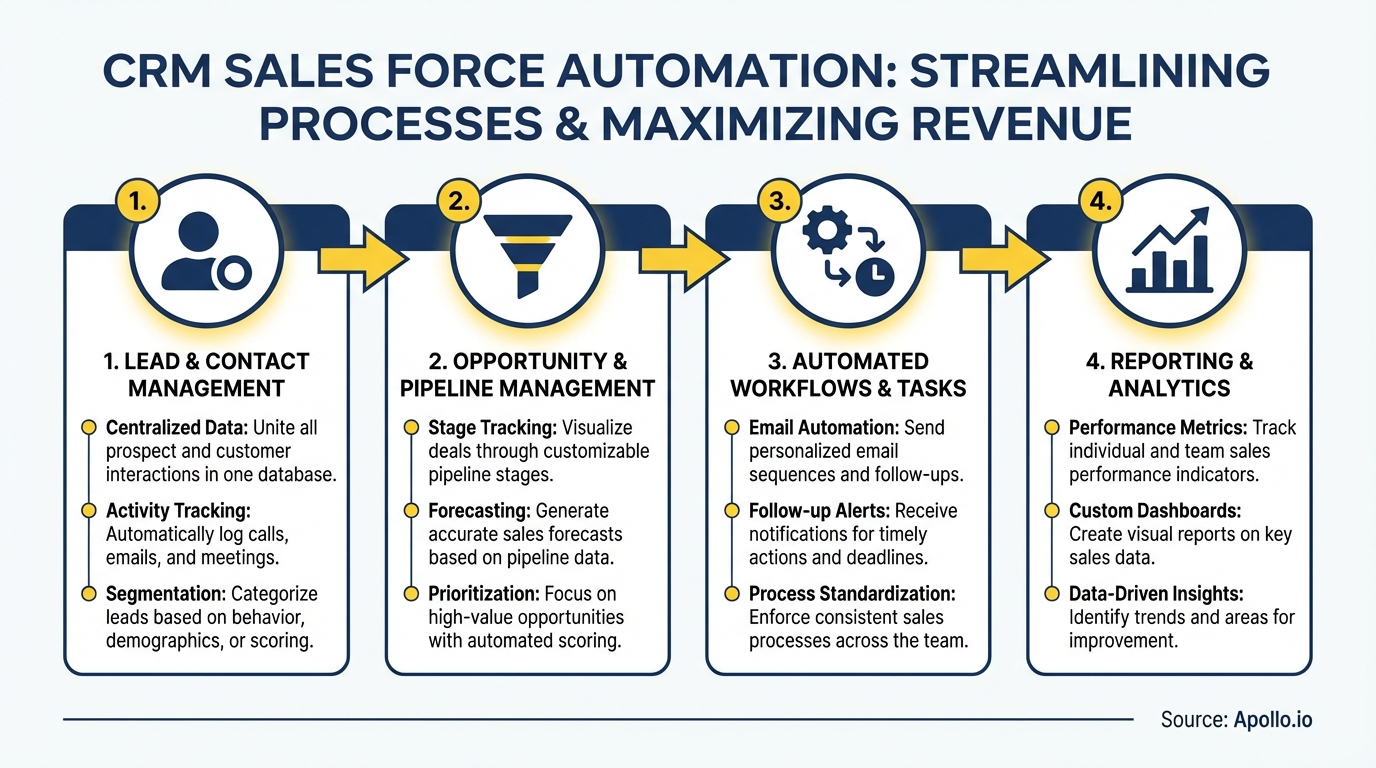
CRM sales force automation is the integration of customer relationship management systems with automated workflows that handle repetitive sales tasks. It combines contact management, pipeline tracking, activity logging, and intelligent automation into one workspace. Instead of manually logging calls or scheduling follow-ups, sales automation handles these processes based on triggers and rules you define.
SFA includes lead management, opportunity tracking, forecasting, email sequences, task automation, and reporting. Modern platforms add AI capabilities like next-best-action recommendations, conversation intelligence, and predictive scoring. Research from LinkPoint360 shows 91% of companies with more than 10 employees use some type of CRM system, making automation the competitive differentiator.
Why Do Sales Teams Need CRM Automation in 2026?
Reps spend just 34% of their week selling. The other 66% goes to admin work, data entry, internal meetings, and manual follow-ups. CRM automation reclaims this lost time by handling routine tasks automatically. Tebillion reports sales forecasting accuracy can increase by as much as 42% with CRM technology, giving leaders predictable pipeline visibility.
The shift from rules-based automation to AI agents marks 2026's defining trend. Platforms now offer agents that research accounts, qualify leads, draft personalized emails, and trigger workflows without human intervention. According to HubSpot, AI adoption in sales surged from 24% in 2023 to 43% in 2024. Teams with AI report measurable productivity gains and faster deal cycles.
How Does CRM Automation Help SDRs Book More Meetings?
SDRs using CRM automation save hours on prospecting and outreach. Automated sequences send personalized emails, follow-ups, and social touches based on prospect behavior. AI-powered sales automation surfaces high-intent accounts, suggests messaging, and books meetings directly on your calendar. SDRs focus on conversations instead of admin work, leading to more pipeline coverage and quota attainment.

What Are the Core Components of Sales Force Automation?
Effective SFA platforms combine these essential capabilities:
| Component | Function | Business Impact |
|---|---|---|
| Contact & Account Management | Centralized customer data with enrichment | Single source of truth eliminates duplicate work |
| Pipeline & Deal Tracking | Visual pipeline with stage automation | Real-time forecast accuracy and deal visibility |
| Activity Automation | Auto-logging calls, emails, meetings | Reps spend time selling, not entering data |
| Multi-Channel Sequences | Email, phone, social outreach automation | Consistent touchpoints without manual effort |
| AI & Intelligence | Scoring, recommendations, conversation summaries | Prioritize high-value activities with data |
| Reporting & Analytics | Performance dashboards and forecasting | Data-driven coaching and strategy adjustments |
Struggling to maintain clean CRM data across your team? Start free with Apollo's 224M+ verified contacts and automatic enrichment.
Turn Forecasting Guesswork Into Revenue Certainty
Pipeline forecasting feel like a coin flip? Apollo surfaces real-time deal intelligence and buyer signals so you predict revenue with confidence. Built-In boosted win rates 10% with Apollo's scoring.
Start Free with Apollo →How Do Account Executives Use CRM Automation to Close Deals Faster?
Account Executives benefit from pre-meeting intelligence, automated follow-ups, and deal insights. CRM automation surfaces account history, stakeholder maps, and engagement patterns before discovery calls. Deal management automation tracks next steps, sends reminders, and flags at-risk opportunities based on activity gaps.
AI call assistants transcribe conversations and generate summaries automatically. AEs review key points instead of taking notes during calls.
Automated workflows trigger contract generation, approval routing, and renewal reminders. This eliminates administrative friction that slows deal cycles.
What Is the ROI of Sales Force Automation?
The primary ROI driver is reclaimed selling time. When reps spend more hours on revenue-generating activities, pipeline coverage increases and quota attainment improves. Research from GlobeNewswire shows 73% of salespeople using AI-powered CRMs reported a significant boost in team productivity by automating manual tasks and enabling better data-driven decisions.
Additional ROI sources include:
- Tool consolidation: Replace 3-5 separate tools with one unified platform, cutting subscription costs. "We reduced the complexity of three tools into one," reports Collin Stewart from Predictable Revenue.
- Forecast accuracy: Better data hygiene and pipeline visibility lead to predictable revenue planning.
- Faster ramp time: New reps onboard faster with automated playbooks and guided workflows.
- Higher win rates: AI-powered insights help reps prioritize high-intent accounts and personalize outreach.
How Should RevOps Leaders Implement CRM Automation?
RevOps teams own the technical implementation and governance model for SFA. Start with a data readiness audit: identify duplicate records, missing fields, incomplete account hierarchies, and activity capture gaps.
Clean data is the foundation for effective automation and AI.
Next, map your sales plays to CRM workflows. Document each stage of your sales process, define required activities, and build automation rules that enforce these standards. CRM integration strategy connects your automation platform to existing tools like email, calendar, and communication apps for seamless activity capture.
What Data Standards Matter Most for SFA Success?
Focus on these critical data hygiene standards:
- Dedupe rules: Prevent duplicate contacts and accounts with matching logic and merge workflows
- Required fields: Enforce industry, company size, and contact role fields for accurate segmentation
- Activity capture: Auto-log emails, calls, and meetings to maintain complete engagement history
- Account hierarchies: Map parent-child relationships for accurate territory and reporting
- Enrichment cadence: Schedule regular data refreshes to maintain contact accuracy
Why Is Unified Data the Differentiator in 2026?
CRM automation outcomes depend on clean, connected customer data. Fragmented data across multiple tools creates hallucinations in AI recommendations and breaks automation workflows.
Vendors now invest heavily in unified profile layers that consolidate contact data, engagement history, and intent signals into one record.
For Sales Leaders managing teams across multiple tools, unified platforms eliminate integration headaches. Apollo CRM integration syncs contact data, sequences, and activity between your automation platform and CRM automatically. "Having everything in one system was a game changer," says the team at Cyera.

Start Automating Your Sales Workflows Today
CRM sales force automation transforms how revenue teams work in 2026. By combining customer data management with AI-powered workflows, sales professionals reclaim selling time, improve forecast accuracy, and close deals faster.
The market shift toward unified platforms and agentic AI means consolidation delivers both cost savings and competitive advantage.
For teams at every stage, from growing startups to mid-market and enterprise organizations, the path forward is clear: clean your data, map your playbooks to workflows, and choose platforms that consolidate your tech stack. "We cut our costs in half," reports the Census team after moving to a unified GTM platform.
Ready to automate your sales workflows and cut your tech stack? Schedule a Demo to see how Apollo consolidates prospecting, engagement, and CRM automation in one workspace.
Prove Apollo's ROI In Your First 30 Days
Budget approval stuck on unclear metrics? Apollo delivers measurable pipeline impact from day one—track time saved, meetings booked, and revenue influenced. Built-In increased win rates 10% and ACV 10% using Apollo's scoring.
Start Free with Apollo →Don't miss these
Sales
Inbound vs Outbound Marketing: Which Strategy Wins?
Sales
What Is a Sales Funnel? The Non-Linear Revenue Framework for 2026
Sales
What Is a Go-to-Market Strategy? The 2026 GTM Playbook
See Apollo in action
We'd love to show how Apollo can help you sell better.
By submitting this form, you will receive information, tips, and promotions from Apollo. To learn more, see our Privacy Statement.
4.7/5 based on 9,690 reviews
