
Company Insights, Pipeline Generation, and Opportunity Tracking Explained
Most of the buying decision is already over before a prospect ever hits your CRM. Buyers research vendors, build requirements, and shortlist solutions largely on their own, which means company insights, pipeline generation, and opportunity tracking can't just live in separate tools anymore.
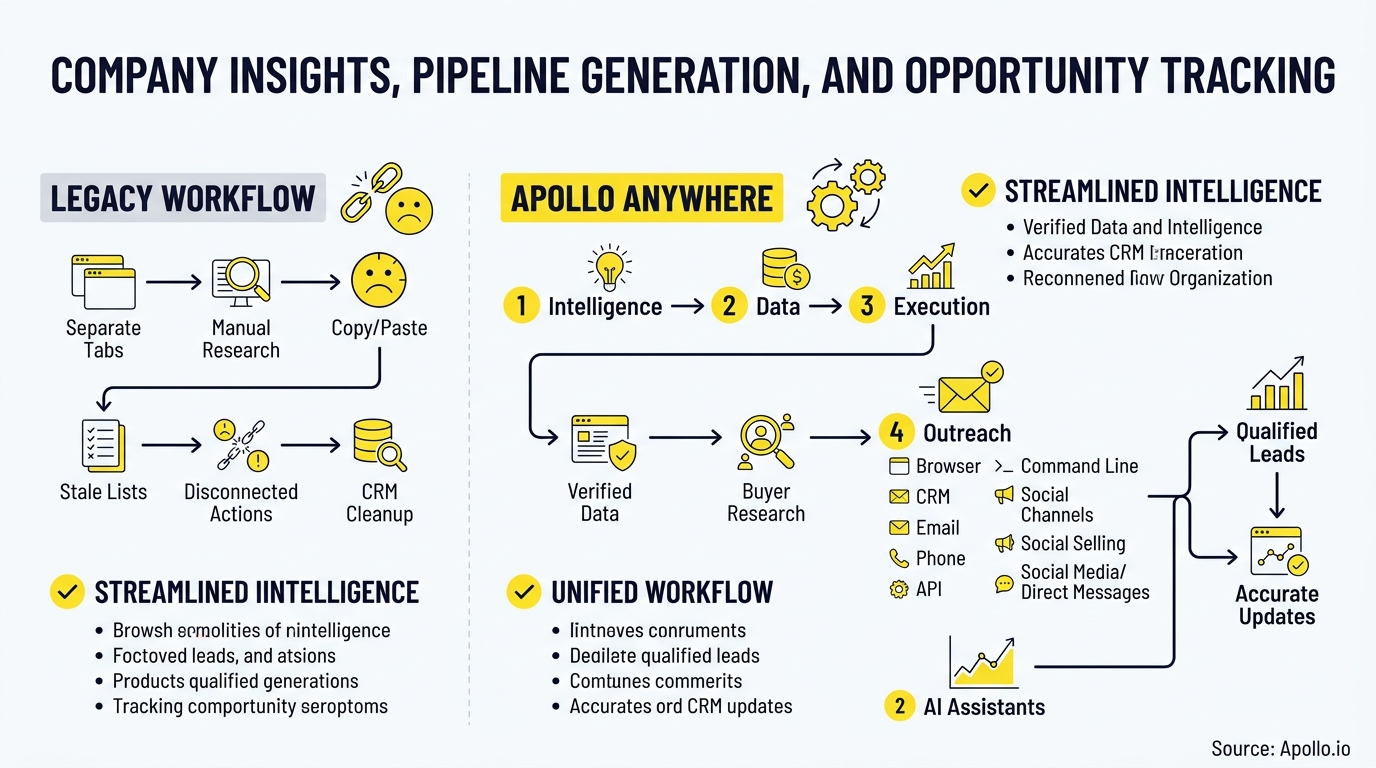
They need to work together as one connected system that starts before the first sales conversation and continues through close.
This matters because forecasting is getting harder, not easier. Sales operations leaders report that pipeline visibility has degraded even as data volume has grown.
The fix isn't more dashboards. It's a workflow that turns raw signals into verified, trackable opportunities.

Apollo Verifies Contacts So Reps Don't Have To
Still spending hours manually researching leads and double-checking contact info before you even send an email? Apollo verifies emails and phone numbers automatically with 98% accuracy, so your team spends time selling, not searching. Get your reps back to closing deals.
Start Free with Apollo →Key Takeaways
- Most B2B buying happens before sellers get involved, so pipeline strategy has to start with account-level signals, not just inbound leads.
- CRM stage names don't equal buyer commitment. Teams need buyer-verified milestones to catch deals that are quietly stalling.
- Modern opportunities involve buying committees, not single champions, so tracking needs to cover multiple stakeholders per account.
- AI-enabled reps find it easier to access the customer insights they need to close, but trust in underlying data is still a major gap.
- Consolidating company data, outreach, and pipeline tracking into one workspace reduces the handoff gaps where deals go dark.
What Is Company Insights, Pipeline Generation, and Opportunity Tracking?
Company insights, pipeline generation, and opportunity tracking is the connected process of identifying buying signals at the account level, converting those signals into qualified pipeline, and monitoring deal progress with verified milestones instead of static CRM stages. It's often treated as three separate disciplines: research tools for company data, prospecting tools for pipeline building, and CRM fields for tracking deals.
In practice, these three functions only create revenue when they're linked.
This is different from simple lead tracking. Lead tracking watches individual contacts.
This operating model watches accounts, buying committees, and the signals that precede a formal sales conversation. It's also different from generic sales forecasting, which reports on stages after the fact rather than verifying whether a buyer has actually made progress.
Why Does Pipeline Formation Happen Before the CRM Sees It?
Pipeline formation happens before the CRM sees it because most B2B buyers complete their research and vendor shortlisting privately, long before contacting a sales rep. According to Geisheker, the vendor eventually selected was already on the buyer's shortlist from day one in 95% of cases. That means the real pipeline-generation battle is won or lost during the invisible research phase, not during discovery calls.
For Sales and Revenue Leaders, this reframes what "pipeline generation" should measure. Instead of counting form fills, teams need to track account-level engagement signals: job changes, funding events, tech stack shifts, and content consumption patterns that indicate active evaluation.
This is also why AI-search referral traffic matters. Buyers are increasingly starting research in answer engines before they ever visit a vendor's website, creating a partially invisible layer of demand that traditional attribution misses entirely.
Struggling to find qualified leads before your competitors do? Search Apollo's 240M+ contacts with 65+ filters to surface accounts showing buying intent before they enter a form.
How Do You Turn Company Signals Into Pipeline?
You turn company signals into pipeline by mapping each signal type to a specific, immediate action rather than letting it sit in a dashboard. A signal without an assigned action is just noise.
The table below shows how to operationalize the most common company insights.
| Signal Type | What It Indicates | Recommended Action |
|---|---|---|
| Job change (new exec hire) | New buyer with budget authority and no incumbent loyalty | Trigger a personalized outreach sequence within 48 hours |
| Funding announcement | Increased budget and hiring velocity | Prioritize account for outbound and flag for AE review |
| Tech stack change | Active evaluation or dissatisfaction with current vendor | Route to a rep with relevant competitive positioning |
| Website/content engagement spike | Research phase, not yet ready for direct contact | Add to a nurture sequence, not a cold call queue |
| Multiple contacts engaging from one account | Buying committee is forming | Map stakeholders and assign account-based plays |
For RevOps leaders, this table format works better as a workflow rule set inside your sales process automation than a static reference doc. Signals decay in value fast, so the action needs to fire automatically.

Why Does Opportunity Tracking Fail With CRM Stages Alone?
Opportunity tracking fails with CRM stages alone because stage names reflect internal sales activity, not verified buyer commitment. A deal can sit in "Proposal Sent" for months while the buyer has quietly gone cold.
Gartner has reported that only a small share of sales teams hit strong forecast accuracy, and most sales operations leaders say forecasting has gotten harder, not easier, in recent years.
Part of the problem is data trust. Salesforce's 2024 research found that reps on AI-enabled teams had a much easier time getting the customer insights they needed to close deals compared to reps without AI support, yet a much smaller share of sales professionals said they completely trusted their organization's data.
You can have more insight and still not trust the pipeline in front of you.
Deals also stall more than most forecasts assume. This is compounded by buying committees: Forrester reported an average of 13 people participate in a typical B2B buying decision, and most purchases involve at least two departments.
A single champion moving a deal forward doesn't mean the full committee has bought in.
What Is the Seven-Milestone Buyer-Verification Scorecard?
The seven-milestone scorecard replaces stage-based guessing with buyer-confirmed proof points you can track per opportunity. Use it alongside, not instead of, your CRM stages.
- Pain confirmed by buyer: Prospect has stated the problem in their own words, not just agreed with yours.
- Budget owner identified: You know who controls spend, not just who requested a demo.
- Multiple stakeholders engaged: At least two people from the buying committee have interacted with your team.
- Success criteria documented: The buyer has shared what a win looks like for them internally.
- Internal champion actively selling: Your contact is advocating for you in meetings you're not in.
- Procurement or legal engaged: The deal has moved beyond the champion into process.
- Verbal or written commitment to timeline: The buyer has confirmed a decision date, not just a target quarter.
Deals missing three or more milestones deserve a second look before they're counted in forecast, regardless of what stage they show in the CRM.
Spot Sales-Ready Buyers With Apollo
Marketing leads going cold before sales ever touches them? Apollo surfaces buying intent and account activity so reps engage the moment prospects are ready. Built-In saw a 10% lift in win rate using Apollo's signals.
Start Free with Apollo →How Do SDRs and AEs Use Company Insights Differently?
SDRs and AEs use company insights differently because they're solving different problems at different points in the funnel. SDRs need broad, fast signals to prioritize outbound targets and book qualified meetings.
AEs need deep, account-specific context to run a pre-meeting intelligence check and shorten the sales cycle once a deal is open.
SDRs report better meeting-booking rates when they can filter by firmographic and intent signals instead of cold-calling a flat list. For Account Executives, the priority shifts to buying-committee mapping and stalled-deal diagnostics once a deal opens.
Both roles are working from the same underlying data, just at different depths.
This is also where tool sprawl quietly kills productivity. When company data lives in one tool, outreach lives in another, and opportunity tracking lives in a third, reps lose time stitching context together instead of selling. Collin Stewart of Predictable Revenue put it directly: "We reduced the complexity of three tools into one."
How Do You Diagnose a Stalled Opportunity?
You diagnose a stalled opportunity by checking it against a short list of warning signs rather than waiting for the close date to slip. Run this checklist on any deal that hasn't moved in two or more weeks:
- Has your champion gone quiet on email and calls?
- Has no new stakeholder engaged in the last 30 days?
- Is the champion's job title below director level with no visible budget authority?
- Has the account shown a job change, reorg, or leadership shift?
- Is there no documented next step with a date attached?
- Has procurement or legal never been looped in despite a late-stage label?
Two or more "yes" answers means the opportunity needs a buying-committee refresh, not just a follow-up email. Win rates for growth-stage SaaS companies have been falling, according to Zenit Data, which makes catching stalls early more important than ever for hitting quota.
Tired of guessing why deals go quiet? Get full pipeline visibility with Apollo's deal management tools and catch stalled opportunities before they slip off the forecast.
Why Does Data Hygiene Determine Pipeline Accuracy?
Data hygiene determines pipeline accuracy because stale or duplicate records make every downstream insight, sequence, and forecast unreliable. Research from Landbase found that a large majority of companies report their CRM data is inaccurate, with a significant share of records going stale every year. If your company insights are built on bad data, your pipeline generation and opportunity tracking inherit that same error rate.
This is where consolidation pays off structurally, not just financially. Every additional data source or manual export is another point where records drift out of sync. Teams that unify enrichment, engagement, and tracking in one system reduce that drift by design. As Census put it after switching: "We cut our costs in half." A single source of truth also means demand gen metrics and sales pipeline metrics finally reconcile instead of contradicting each other in separate reports.
How Do Job Changes and Buying Committees Create Hidden Pipeline?
Job changes and buying committees create hidden pipeline by revealing new decision-makers and expansion opportunities that don't show up in a standard lead list. A champion moving to a new company is a warm intro to an entirely new account.
A new VP joining an existing customer is a signal to check for expansion or renewal risk.
Job change alerts turn these moments into immediate outbound triggers instead of missed opportunities discovered months later. Combine that with buying-committee mapping, and RevOps teams get a clearer picture of expansion pipeline sitting inside accounts they already have a relationship with, not just new-logo pipeline. This is also where outbound prospecting and account expansion start to overlap: the best next opportunity is often inside a company you've already sold to.

Conclusion: Build One System, Not Three Disconnected Tools
Company insights, pipeline generation, and opportunity tracking only produce results when they operate as one connected workflow: signals trigger action, action builds verified pipeline, and pipeline gets tracked against real buyer commitment instead of stage labels. Teams that keep these functions in separate tools lose time and context at every handoff.
Teams that unify them catch stalled deals earlier and act on buying signals while they're still fresh.
Apollo brings B2B data, sales engagement, and AI-powered execution together in one connected go-to-market system, so teams don't have to stitch together separate vendors for research, outreach, and analysis. As Ashley Wolfe of Cyera said, "Having everything in one system was a game changer."
Ready to see it in action? Request a Demo and see how Apollo connects company insights, pipeline generation, and opportunity tracking in one workspace.
Prove ROI Fast With Apollo's Live Pipeline Data
Struggling to prove pipeline impact before your next budget review? Apollo connects prospecting, outreach, and revenue data in one workspace so leaders see measurable results fast. Leadium tripled annual revenue after consolidating their stack with Apollo.
Schedule a Demo →Don't miss these
Sales
Inbound vs Outbound Marketing: Which Strategy Wins?
Sales
What Is a Sales Funnel? The Non-Linear Revenue Framework for 2026
Sales
What Is a Go-to-Market Strategy? The 2026 GTM Playbook
See Apollo in action
We'd love to show how Apollo can help you sell better.
By submitting this form, you will receive information, tips, and promotions from Apollo. To learn more, see our Privacy Statement.
4.7/5 based on 9,690 reviews
