
What Is the Best Tool for Technology Stack Filtering in 2026?
The best tool for technology stack filtering depends on your use case: web-visible tech detection, enterprise technographics, or full GTM signal orchestration. Choosing the wrong tool means wasting budget on stale data or missing the accounts your product is built for. If you're building a sales tech stack that scales revenue, technographic filtering is one of the highest-leverage inputs you can add.
In 2026, the category has shifted. The best technographic tools are no longer simple installed-tech lookups. They combine stack detection with intent signals, contact data, and AI-powered workflow execution. According to JohnnyGrow, companies that align people, processes, and technology through RevOps grew revenue nearly 3 times faster than those that did not. Stack-aware targeting is a core RevOps capability, not a nice-to-have.

Scale Your Team Without the Chaos
Tired of inconsistent processes slowing your reps down? Apollo gives every SDR, BDR, and AE a unified playbook — verified contacts, automated outreach, and scalable workflows built in. Join 600K+ companies growing pipeline predictably.
Start Free with Apollo →Key Takeaways
- No single tool wins every use case: match your detection method (web-crawl, multi-source technographics, or intent) to your GTM motion.
- Data freshness now matters more than database size: vendors are competing on how accurately they detect current usage, not just how many contacts they list.
- SDRs and RevOps teams get the most value when tech-stack filters trigger automated sequences, not just exported lists.
- Apollo uses AI to extract technographic signals from 10M+ job postings, nearly doubling technologies per organization for more precise account targeting.
- Poor technographic data creates real risk: 75% of RevOps teams already cite data inconsistencies as their biggest tech-stack frustration.
What Is Technology Stack Filtering and Why Does It Matter?
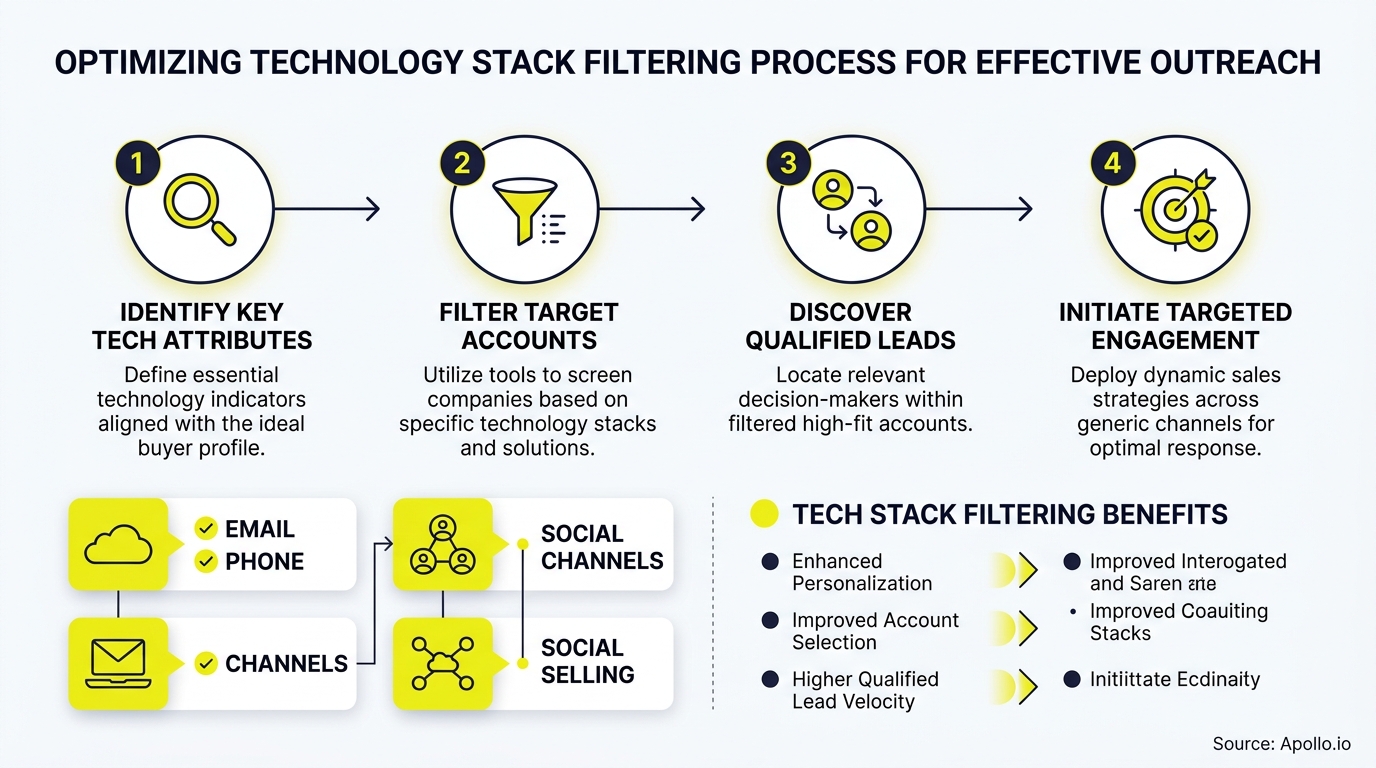
Technology stack filtering is the practice of identifying and segmenting prospect accounts by the software, platforms, or tools they currently use. A sales team selling a Salesforce integration, for example, filters for companies running Salesforce before building any outreach sequence. This makes outreach specific and relevant, which is critical: a Gartner survey found 73% of B2B buyers actively avoided suppliers sending irrelevant outreach.
For SDRs and BDRs, tech-stack filters convert a cold list into a warm, qualified one. For RevOps leaders, they create cleaner segmentation and more predictable pipeline. Research from MarketingOps found 75% of RevOps teams cite data inconsistencies as the single most frustrating part of their tech stack, which is exactly the problem accurate technographic filtering solves.
Which Coverage Model Do You Actually Need?
The right coverage model depends on your sales motion. There are three distinct approaches, and each serves a different buyer profile.
| Coverage Model | How It Works | Best For | Example Tools |
|---|---|---|---|
| Web-Visible Detection | Crawls public websites to detect front-end and back-end tech signals | SaaS companies targeting web-tech buyers (CMS, analytics, ads) | BuiltWith |
| Multi-Source Technographics | Aggregates vendor data, job postings, intent signals, and spend data | Enterprise GTM teams targeting IT buyers across software categories | HG Insights, ZoomInfo |
| Prospecting-Native Technographics | Embeds stack filters directly in a contact and account database with sequencing | SDRs and AEs who need to filter, find contacts, and launch outreach in one workspace | Apollo |
| Enrichment Orchestration | Pulls technographic data from 150+ providers via AI agents and workflows | RevOps and growth teams building custom enrichment waterfalls | Clay |
On March 24, 2026, HG Insights announced its Revenue Growth Intelligence Platform, combining technographics, buyer intent, IT spend, buying-center data, and contact intelligence into a single AI-driven experience. This signals that enterprise-grade technographic filtering is moving beyond stack lookup into full account prioritization. For teams evaluating top market intelligence tools, the question is no longer just "what tech do they use?" but "what tech, and are they ready to buy?"
How Do SDRs Turn Tech-Stack Filters Into Pipeline?
SDRs get the most value from technographic filtering when filters trigger specific outreach plays, not generic sequences. The filter is not the output; it is the signal that determines the play.
High-converting technographic triggers for SDRs include:
- Competitor installed: prospect uses a direct competitor, ideal for displacement messaging
- Complementary tool present: prospect already uses an integration partner, reducing onboarding friction
- Missing integration: prospect uses two tools your product connects, creating a gap-fill story
- Hiring for a platform: job postings signal active investment in a technology your product extends
- Cloud migration signals: stack changes indicate active vendor evaluation windows
Spending hours manually building lists from raw technographic exports? Search Apollo's 230M+ contacts with 65+ filters, including technographics, and launch sequences without leaving the platform.
Apollo's 2026 updates use AI to extract technology signals from 10M+ job postings, nearly doubling detected technologies per organization and adding tech data for 12,000+ companies for the first time. This means SDRs using Apollo get fresher stack data tied directly to verified contacts and multi-channel sequences, all in one workspace. See how automated prospecting tools integrate with technographic signals to accelerate pipeline.

What Is the Tool Selection Scorecard for Tech-Stack Filtering?
Evaluate any technographic tool across five dimensions before committing. This scorecard prevents overpaying for coverage you won't use or under-buying on data freshness.
| Criterion | What to Evaluate | Red Flag |
|---|---|---|
| Data Freshness | How often is technographic data refreshed? Are job postings and intent signals included? | No stated refresh cadence; static database snapshots only |
| Coverage Depth | How many technologies and vendors are tracked? Does it cover your target category? | Strong on web tech but blind to enterprise software categories |
| CRM and Workflow Integration | Does it push data directly to your CRM, sequencing tool, or workflow engine? | Export-only; requires manual re-import into your sales tools |
| Contact Pairing | Are technographic filters tied to verified business contacts at the account? | Account-level data only, no contact discovery in the same platform |
| Security and Governance | Does the vendor provide data sourcing transparency for IT/InfoSec review? | No documentation; vague sourcing methodology |
Governance matters more than most buyers expect. A G2 Buyer Behavior Report found security and integrations were top software-buying considerations, and 48% of buyers reported purchasing software not vetted by IT or InfoSec. Stale or inaccurate technographic data creates outreach that misfires at scale, a real brand-risk for high-volume SDR teams.
Turn Funnel Guesswork Into Closed Deals
Pipeline forecasting a guessing game because marketing leads never convert? Apollo surfaces high-intent prospects and delivers 97% email accuracy so your pipeline reflects reality. Nearly 100K paying customers stopped forecasting blind.
Start Free with Apollo →How Does Apollo Compare as a Technographic Filtering Tool?
Apollo serves as a prospecting-native technographic filtering platform, meaning stack filters are built directly into the same interface where SDRs find contacts, build sequences, and manage pipeline. There is no separate export-import workflow.
Key technographic capabilities in Apollo in 2026:
- Tech filters available alongside 65+ other firmographic and behavioral filters
- AI-extracted technology signals from 10M+ job postings, expanding coverage depth
- Technographic data paired with 230M+ verified business contacts
- Filters feed directly into multi-channel sequences (email, phone, and social) without leaving the platform
- CRM sync pushes technographic-enriched accounts to Salesforce, HubSpot, and others automatically
This consolidation is why teams like Census report "We cut our costs in half" and Cyera note "Having everything in one system was a game changer." For RevOps leaders managing tool sprawl, Apollo replaces the need for a separate prospecting database, a separate technographic lookup tool, and a separate sequencing platform. Explore the best B2B marketing tools for 2026 to see how Apollo fits into a modern GTM stack.
Need technographic-enriched accounts flowing into your CRM automatically? Apollo's data enrichment keeps your CRM current with the latest technographic and firmographic signals.
What Are the Key Differences Between Technology Stack Detection and Technographics?
Technology stack detection and technographics are related but distinct: detection identifies what technologies a company's website or infrastructure currently runs, while technographics is a broader sales intelligence category covering all software a company uses, including internal tools not visible on public web properties.
- Stack detection(BuiltWith-style): scans public web properties for front-end and back-end signals; fast, affordable, ideal for web-tech vendors
- Technographics(HG Insights, ZoomInfo, Apollo): aggregates data from job postings, vendor partnerships, intent data, and surveys to map internal software usage; broader coverage for enterprise and SaaS sales
- Software intent: behavioral signals showing a company is actively researching or evaluating a software category, layered on top of technographic data for timing context
For lead generation tools that drive measurable ROI, the combination of technographics plus intent is more powerful than either signal alone. Teams that layer both signals identify accounts at the intersection of "right fit" and "right time."

Which Tool Should You Choose?
The best tool for technology stack filtering in 2026 is the one that matches your detection method to your GTM motion and connects directly to your execution layer. Here is the summary decision framework:
- Web-tech vendors targeting ecommerce or SaaS platforms: BuiltWith for deep web-crawl coverage
- Enterprise GTM teams targeting IT buyers across software categories: HG Insights RGI Platform for depth and spend data
- SDRs and AEs who need filters, contacts, and sequences in one workspace: Apollo for prospecting-native technographics with AI-extracted job-posting signals
- RevOps teams building enrichment waterfalls from multiple data sources: Clay for multi-provider orchestration
- ABM teams combining technographics with intent and account engagement: Demandbase for cross-channel activation
The shift from static database lookups to AI-driven signal engines is already underway. Demandbase's April 2026 MCP integrations deliver technographic data directly into AI assistants like ChatGPT and Claude.
Apollo's Perplexity connector ties its 230M+ contact database to AI-native workflows. The teams that win in 2026 will not be manually filtering lists; they will be asking AI agents to surface the right accounts and route them to sequences automatically.
If you want technographic filtering, verified contacts, multi-channel sequencing, and CRM enrichment in a single workspace, start your free Apollo trial and experience the consolidation that teams like Predictable Revenue describe as reducing "the complexity of three tools into one."
Prove Pipeline ROI From Day One
ROI pressure killing your next budget approval? Apollo delivers measurable pipeline impact fast — 46% more meetings with AI, real results your leadership can't ignore. Nearly 100K paying customers stopped guessing and started growing.
Start Free with Apollo →Don't miss these
Sales
Inbound vs Outbound Marketing: Which Strategy Wins?
Sales
What Is a Sales Funnel? The Non-Linear Revenue Framework for 2026
Sales
What Is a Go-to-Market Strategy? The 2026 GTM Playbook
See Apollo in action
We'd love to show how Apollo can help you sell better.
By submitting this form, you will receive information, tips, and promotions from Apollo. To learn more, see our Privacy Statement.
4.7/5 based on 9,690 reviews
