
Best Tool for Improving Email Deliverability for Outbound Sales Teams in 2026
Email deliverability is no longer a technical afterthought. It is a compliance discipline that directly determines whether your pipeline lives or dies in the inbox. According to Shopify, 65% of email marketing professionals reported in December 2024 that email deliverability is becoming more difficult. For outbound sales teams, that difficulty translates directly to missed quota. If you want to improve email deliverability in five practical steps, the tools you choose matter as much as the tactics you run.
The good news: the right platform collapses verification, authentication monitoring, list hygiene, and multi-channel sequencing into a single workflow. This guide breaks down what to look for and how to build a deliverability-first outbound stack in 2026.

Research Less, Pipeline More With Apollo
Tired of burning hours verifying contact info that still bounces? Apollo delivers 97% email accuracy across 230M+ verified contacts so your team sells instead of searches. Start building real pipeline today.
Start Free with Apollo →Key Takeaways
- Roughly one in six outbound emails never reaches the inbox globally, making deliverability a direct revenue risk, not just a technical metric.
- Gmail and Microsoft now enforce measurable spam-rate thresholds, making compliance tooling (SPF/DKIM/DMARC + one-click unsubscribe) mandatory, not optional.
- B2B inboxes are structurally harder to reach than B2C due to corporate gateway filtering, so B2B teams need platform-specific strategies.
- Open rates are unreliable signals in 2026. SDRs and RevOps leaders should track inbox placement, reply rates, and complaint rates instead.
- The best tool for outbound deliverability consolidates verification, sequencing, and compliance controls into one platform, eliminating costly tool sprawl.
Why Is Email Deliverability So Hard for Outbound Sales Teams in 2026?
Deliverability is hard because mailbox providers now enforce policy thresholds, not just spam-score heuristics. Research from Mailreach shows that globally, inbox placement averages 83 to 84% between 2023 and 2025, meaning roughly one in six emails never reaches the inbox. For B2B specifically, Verified.email reports the inbox rate drops closer to 80% due to aggressive corporate gateway filtering, even when mail is technically accepted at a 98%+ delivery rate.
The gap between "delivered" and "placed in inbox" is the real problem. Deliverability issues also hit revenue directly:Kickbox reports that 64.6% of businesses say email deliverability issues have directly impacted revenue or customer retention.
Two structural shifts make 2026 especially challenging:
- Gmail/Yahoo enforcement: Google specifies a 0.3% spam-rate ceiling for bulk senders and requires one-click unsubscribe compliance.
- Microsoft Outlook algorithm changes: Enforcement updates in 2025 broke previously safe outbound setups, forcing teams to adopt active placement testing and authentication monitoring, not just warmup tools.
What Features Should the Best Email Deliverability Tool Have?
The best tool for improving email deliverability for outbound sales teams combines compliance enforcement, list hygiene, placement monitoring, and sequencing in a single platform. Buying separate tools for each function creates configuration drift and blind spots.
| Feature Category | What to Look For | Why It Matters in 2026 |
|---|---|---|
| Authentication Monitoring | SPF, DKIM, DMARC audit and drift alerts | Auth failures are the top driver of B2B inbox placement drops |
| Contact Verification | Real-time email validation before send | Hard bounces above threshold damage domain reputation instantly |
| Suppression Management | Auto-suppress bounces, complaints, and unsubscribes | Keeps complaint rate below Gmail's 0.3% ceiling |
| Inbox Placement Testing | Pre-send tests across Gmail, Outlook, and corporate filters | Identifies spam routing before it hits your domain reputation |
| Send Throttling and Ramp Controls | Daily send limits, auto-pause on bounce spikes | Prevents volume surges that trigger provider-level filtering |
| Engagement-Based Sequencing | Sequences that pause or branch on non-reply signals | Reduces spam complaints from over-contacted prospects |
Struggling to keep bounce rates under control? Start free with Apollo's 230M+ verified business contacts and reduce invalid sends before they damage your sender reputation.
Turn Funnel Guesswork Into Pipeline Confidence
Quota stress mounting while marketing leads stall before they ever reach your pipeline? Apollo surfaces high-intent prospects and arms your team with real buying signals. Join 600K+ companies building predictable revenue.
Start Free with Apollo →How Do SDRs and RevOps Leaders Measure Deliverability Correctly?
SDRs and RevOps leaders should stop optimizing for open rates and start tracking inbox placement, reply rates, and complaint rates instead. Open rates are now structurally unreliable as a performance signal because Apple's Mail Privacy Protection proxies opens at scale, inflating reported figures well beyond actual engagement.
The metrics that actually reflect deliverability health in 2026:
- Inbox placement rate: What percentage of sent messages land in the primary inbox (not spam, not missing)?
- Spam complaint rate: Must stay below 0.3% for Gmail bulk senders. Even a small spike triggers placement penalties.
- Bounce rate (hard vs. soft): Hard bounces above 2% signal list hygiene failure. Verifying email addresses before sending eliminates most hard bounces before they occur.
- Reply-to-send ratio: The cleanest proxy for real engagement when open signals are distorted.
- Missing mail rate: Emails neither delivered to inbox nor spam, often rejected at the gateway. Especially high in B2B Outlook environments.
RevOps leaders building reporting frameworks should connect these metrics to pipeline created, not just email volume. Many teams still cannot track email ROI, which makes it impossible to justify deliverability investment or diagnose what is costing pipeline.

What Is the Best Deliverability Stack for Outbound Teams in 2026?
The best outbound deliverability stack in 2026 combines a verified contact database, compliance-aware sequencing, and placement monitoring in as few tools as possible. The trend is clear: buyers are consolidating from four to six separate tools down to one or two systems of record.
Platforms that handle verification, sequencing, suppression, and reporting together eliminate the configuration gaps that create deliverability failures.
Apollo gives SDRs, AEs, and RevOps teams a unified platform for multi-channel outreach with built-in deliverability controls, including verified contact data at 97% email accuracy, sequence throttling, bounce suppression, and engagement-based branching. That means fewer tools to maintain, fewer configuration errors, and a cleaner sender reputation over time.
As Cyera's team put it: "Having everything in one system was a game changer." For outbound teams where every misconfiguration costs pipeline, that consolidation is not a convenience. It is a competitive advantage.
Key stack principles for 2026:
- Verify contacts before every send, not just at list import. Contacts decay quickly in B2B databases.
- Use domain segmentation: separate domains for cold outbound vs. transactional or marketing email.
- Enforce one-click unsubscribe across all sequences. Gmail compliance is non-negotiable.
- Monitor authentication alignment continuously. DMARC drift happens silently and causes sudden placement drops.
- Review bulk email best practices before scaling volume on new domains or sequences.
How Does List Hygiene Directly Improve Inbox Placement?
List hygiene improves inbox placement by reducing hard bounces, complaint rates, and spam trap hits that damage sender reputation with mailbox providers. Data from Mailgun's State of Email report shows that 35.8% of senders increased list hygiene efforts in 2024 to adapt to new sender requirements. That is a direct response to Gmail and Microsoft enforcement changes.
Practical hygiene steps that move the needle:
- Remove hard bounces immediately after each send cycle.
- Suppress contacts who have not engaged in 90 days before adding them to high-volume sequences.
- Validate email syntax and MX records at the point of contact import, not at send time.
- Exclude role-based addresses (info@, admin@) from cold sequences. They generate complaints and rarely convert.
- Use personalized, relevant email content to reduce complaint rates from recipients who do receive your messages.
Note that 67% of B2B buyers will set up a dedicated junk email address to avoid unwanted marketing emails, according to Powered by Search. That means even delivered mail may never reach a real decision-maker if your targeting and personalization are off.
What Are the Best Practices for B2B Outbound Email Deliverability?
The best practices for B2B outbound email deliverability focus on authentication, segmentation, volume control, and content quality. B2B environments are structurally more restrictive than B2C because corporate email gateways apply additional filtering layers on top of Gmail and Outlook defaults.
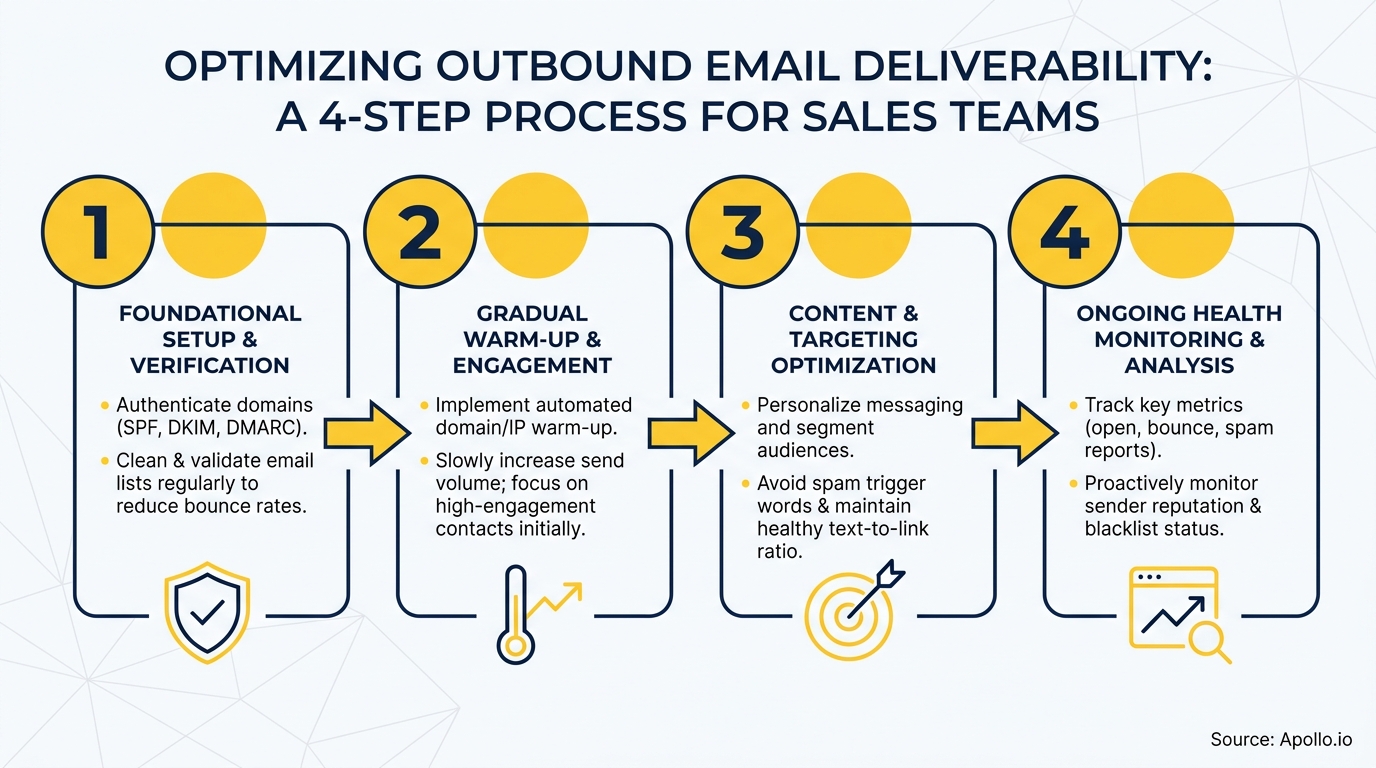
- Authenticate every sending domain: SPF, DKIM, and DMARC records are table stakes. Missing or misconfigured records are the primary driver of placement failures in Microsoft environments.
- Warm new domains gradually: Start at 20 to 30 sends per day and increase weekly. Sudden volume spikes trigger provider-level rate limiting.
- Segment by engagement level: Send highest-volume sequences only to recently verified, engaged contacts. Reserve aggressive cadences for warm or inbound leads.
- Test placement before scaling: Use inbox placement tools to check where messages land across Gmail, Outlook, and major corporate filters before running a new sequence at scale.
- Time sends strategically: Review the best times to email prospects to maximize reply rates and minimize complaint risk from poorly timed outreach.
- Keep copy human and specific: Template-heavy, link-dense emails trigger spam filters. Personalization reduces complaint rates and improves placement.

Start Hitting More Inboxes with Apollo
Email deliverability in 2026 is a compliance, data, and workflow problem simultaneously. The teams winning outbound are not the ones with the most sequences.
They are the ones with verified contact data, clean authentication, and engagement-aware sending built into a single platform.
Apollo consolidates verified B2B contact data (230M+ people, 97% email accuracy), multi-channel sequencing, bounce suppression, and CRM sync into one workspace, so SDRs, AEs, RevOps, and sales leaders spend less time firefighting deliverability and more time booking meetings. Explore the full outbound sales software built for pipeline generation, or dive into the complete guide to email deliverability and spam filter avoidance.
Ready to reach more inboxes without adding more tools? Start a free trial of Apollo today and see how a unified GTM platform protects your sender reputation while scaling your outbound.
Prove Pipeline ROI With Apollo
ROI pressure killing your tool budget before it ever gets approved? Apollo delivers measurable pipeline impact from day one — teams like Leadium 3x'd annual revenue. Start your free trial and show leadership real numbers fast.
Start Free with Apollo →Don't miss these
Sales
Inbound vs Outbound Marketing: Which Strategy Wins?
Sales
What Is a Sales Funnel? The Non-Linear Revenue Framework for 2026
Sales
What Is a Go-to-Market Strategy? The 2026 GTM Playbook
See Apollo in action
We'd love to show how Apollo can help you sell better.
By submitting this form, you will receive information, tips, and promotions from Apollo. To learn more, see our Privacy Statement.
4.7/5 based on 9,690 reviews
