
Best Sales Automation Tool for Teams Ditching Manual Prospecting
Your team is done with manual prospecting. Copy-pasting contacts, one-off emails, zero visibility into what works — it's costing you pipeline and burning out your reps.
The shift to structured sequences sounds simple, but picking the wrong tool means deliverability failures, fragmented data, and a tech stack that costs more than it saves.
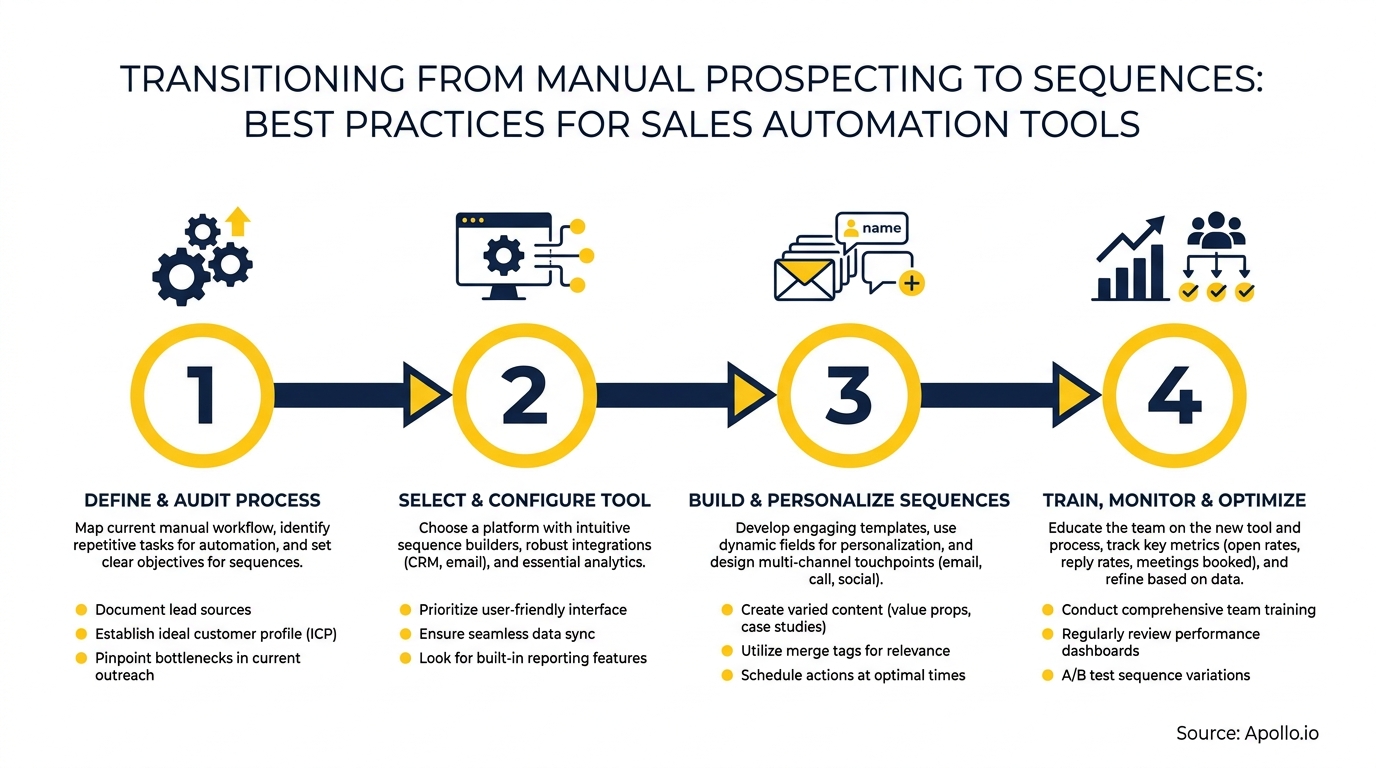
This guide cuts through the noise with a constraint-driven framework for choosing the best sales automation tool when your team is making the leap from manual prospecting to sequences in 2026.

Research Less, Pipeline More With Apollo
Tired of burning hours verifying contacts before a single email goes out? Apollo surfaces accurate, ready-to-engage prospects so your reps spend time selling. Over 600K companies scaled pipeline without the manual grind.
Start Free with Apollo →Key Takeaways
- Most reps spend the majority of their week on non-selling tasks — the right automation tool directly reclaims that time.
- Deliverability is now a first-order evaluation criterion, not an afterthought, due to strict 2024 sender enforcement rules.
- AI features only create real time savings when paired with clean data, CRM hygiene automation, and governance controls.
- Buyers increasingly self-select vendors before engaging sales — your sequences must align with their research journey, not just your outreach calendar.
- Tool consolidation (data + engagement + CRM in one platform) reduces admin overhead and closes attribution gaps that fragment point solutions create.
Why Does the Manual-to-Sequences Transition Fail So Often?
The transition fails when teams bolt a sequencing layer onto a broken data foundation. Stale contacts, missing CRM context, and no throttling controls mean scaled outreach just scales the problems. According to Autobound, 81% of sales teams are either experimenting with or have fully implemented AI — yet adoption alone doesn't produce results without the right workflow architecture underneath it.
The second failure mode is ignoring deliverability. Google and Yahoo's 2024 sender requirements enforce a 0.3% spam-complaint threshold.
Teams that go from 50 manual emails a week to 500 automated ones — without domain authentication, throttling, and list hygiene — hit that ceiling fast and lose sending reputation. Picking a tool with native deliverability controls isn't optional anymore.
What Is the Right Decision Framework for Choosing a Sales Automation Tool?
The best sales automation tool for a team transitioning from manual prospecting to sequences passes four constraint filters before anything else.
| Constraint | What to Evaluate | Red Flag |
|---|---|---|
| Selling Time | Does automation reduce research and admin, not just send volume? | AI features that generate emails but don't enrich or route contacts |
| Deliverability | Native SPF/DKIM/DMARC support, throttling, warm-up controls | No sending limits, no bounce management, no spam monitoring |
| CRM Hygiene | Automated data enrichment, deduplication, field mapping to your CRM | Manual CSV imports, no enrichment, contacts siloed from CRM |
| Governance | Admin controls, usage dashboards, role permissions, audit logs | No visibility into rep activity, no credit/usage reporting |
Run every vendor through this rubric before evaluating feature lists. A tool that fails on deliverability or CRM hygiene will cost more to fix than it saves in outreach time. For a deeper look at how these layers connect, see how to build a sales tech stack that scales revenue.

How Do SDRs and AEs Actually Get Time Back from Automation?
SDRs and AEs recover selling time when automation handles the research, enrichment, and routing steps that currently happen manually before a single email is sent. A 2025 analysis on Medium found that CRM data entry automation alone reduces administrative time by at least 17% — and that's before accounting for AI-assisted prospecting and sequence execution.
For SDRs, the biggest time recovery comes from:
- AI-generated contact research that surfaces intent signals before outreach
- Automated enrollment triggers that add contacts to sequences based on CRM activity
- Email personalization drafts that require editing, not writing from scratch
For AEs, the value shifts to pre-meeting intelligence and deal-stage automation — knowing which accounts are active in a sequence, which touchpoints drove engagement, and which contacts need a follow-up call rather than another email.
Spending hours building lists by hand? Search Apollo's 230M+ contacts with 65+ filters and enroll prospects directly into sequences without leaving the platform.
What Makes Deliverability a Tool-Selection Criterion, Not an Afterthought?
Deliverability determines whether your sequences actually land in inboxes — making it a foundational criterion, not a post-purchase concern. With Microsoft joining Google and Yahoo in enforcing strict DMARC, SPF, and DKIM policies in 2025, any tool that doesn't support native authentication setup creates immediate risk for teams scaling from dozens to hundreds of sends per week.
Evaluate every candidate tool against this checklist:
- Authentication support: Does the tool guide SPF, DKIM, and DMARC setup natively?
- Sending throttles: Can you cap daily send volume per rep or domain?
- Bounce and unsubscribe handling: Are hard bounces automatically suppressed?
- Spam-risk monitoring: Does the tool flag sequences with high complaint signals before they damage your domain?
- List hygiene integration: Is contact verification built in, or do you need a separate tool?
Tools that treat deliverability as a configuration task rather than a platform feature force teams to stitch together external services — adding cost and complexity at the worst possible time in a transition.
Turn Funnel Gaps Into Pipeline Wins
Quota slipping because marketing leads never convert? Apollo surfaces in-market prospects with verified contact data and real buying signals — so your team reaches the right buyer at right moment. Over 600K companies trust Apollo to build predictable pipeline.
Start Free with Apollo →Which AI Features Drive Real Time Savings vs. Vanity Metrics?
AI features drive real time savings when they eliminate a manual step that reps currently do before or after outreach — not just when they add a new capability. Copy.ai reports that sales professionals leveraging AI have seen a 50% surge in both leads and appointments, expanding pipeline without adding headcount. But that outcome depends on which AI features you're actually using.
High time-back AI features:
- Account research agents that summarize company news, job changes, and intent signals automatically
- AI-drafted emails that personalize based on contact data and sequence context (not just merge fields)
- CRM enrichment that auto-fills missing fields from verified data sources
- Sequence recommendations based on engagement signals (opens, clicks, reply sentiment)
Vanity AI features (look impressive, low time-back):
- Generic AI email writers with no contact-data integration
- AI scoring that doesn't connect to sequence enrollment triggers
- Chatbots that summarize content reps already have in their CRM
Apollo's AI sales automation platform connects research, enrichment, and sequence execution in one workflow — so AI acts on verified contact data rather than generating generic output. Teams using Apollo's AI Research Agent have reported 46% more meetings booked.
How Should Sequences Map to the Buyer's Research Journey?
Sequences should map to buyer education stages because research shows most B2B buyers form a vendor shortlist before any sales contact occurs. That means your sequence touchpoints need to deliver value at each stage, not just create outreach volume.
A practical sequence-to-content mapping for teams transitioning from manual prospecting:
| Sequence Step | Buyer Stage | Content to Align |
|---|---|---|
| Step 1: Intro email | Problem-aware | Short insight or stat relevant to their role/industry |
| Step 2: Follow-up email | Solution-aware | Case study or outcome reference (not a product pitch) |
| Step 3: Phone call | Vendor-aware | Personalized value prop tied to their tech stack or team size |
| Step 4: Social touch | Decision-stage | Peer proof — customer story or community reference |
| Step 5: Breakup email | Any | Low-friction offer: resource, benchmark, or self-serve demo |
For guidance on building sequences that convert, see how to build winning sequences with Apollo and explore data-backed email subject lines that improve open rates at each stage.
Why Is Apollo the Best Sales Automation Tool for Teams Making This Transition?
Apollo is purpose-built for the manual-to-sequences transition because it consolidates the four constraint layers — data, engagement, AI, and CRM hygiene — into one platform instead of requiring separate tools for each. RevOps leaders find that stitching together a data vendor, a sequencer, and a CRM enrichment tool creates attribution gaps and admin overhead that slow adoption during a transition.
As Collin Stewart of Predictable Revenue put it: "We reduced the complexity of three tools into one." That consolidation matters most when a team is changing workflows for the first time and can't afford a fragmented stack to slow momentum.
Apollo's core capabilities for transitioning teams:
- 230M+ verified contacts with 65+ filters for precise ICP targeting from day one
- Multi-channel sequences (email, phone, social) with engagement-based branching
- AI Research Agent that automates account research before outreach
- Native CRM sync with HubSpot and Salesforce for clean data without manual entry — see how to connect Apollo with your CRM fast
- Workflow automation that enrolls contacts into sequences based on triggers, not manual action
- 97% email accuracy to protect deliverability from the first send
Data from Reporder Management shows the global sales force automation market was valued at $8.6 billion in 2023 and is projected to reach $19.5 billion by 2030 — reflecting the sustained investment teams are making in exactly this kind of infrastructure. Apollo gives growing teams access to enterprise-grade automation without the enterprise-grade complexity or cost.

Ready to Make the Switch from Manual Prospecting to Sequences?
The transition from manual prospecting to structured sequences is one of the highest-leverage moves a B2B GTM team can make — but only with the right foundation. Prioritize deliverability controls, CRM hygiene automation, and AI features that eliminate manual steps rather than add new ones.
Consolidate your stack before you scale your outreach.
Apollo gives SDRs, AEs, RevOps leaders, and sales managers a single workspace to find the right contacts, build sequences that land in inboxes, and automate the admin work that's been eating their selling time. Trusted by nearly 100K paying customers including Anthropic, Cyera, and Smartling.
Start Your Free Trial and run your first sequence from the same platform where you find, enrich, and engage your best-fit prospects.
Apollo Turns Pipeline Into Proof
ROI pressure killing your tool budget? Apollo delivers measurable pipeline impact from day one — so you walk into every budget review with numbers, not excuses. Join 600K+ companies that made the case and won.
Start Free with Apollo →Don't miss these
Sales
Inbound vs Outbound Marketing: Which Strategy Wins?
Sales
What Is a Sales Funnel? The Non-Linear Revenue Framework for 2026
Sales
What Is a Go-to-Market Strategy? The 2026 GTM Playbook
See Apollo in action
We'd love to show how Apollo can help you sell better.
By submitting this form, you will receive information, tips, and promotions from Apollo. To learn more, see our Privacy Statement.
4.7/5 based on 9,690 reviews
