
Best Sales Automation Platform for a GTM Engineer Managing Outbound Workflows in 2026
Most conversations about the best sales automation platform for a GTM Engineer managing outbound workflows start in the wrong place. They obsess over which tool has the best sequencer or the most integrations. That framing misses the point entirely. The real question is: which platform lets you build a complete, self-optimizing outbound system without duct-taping a dozen tools together at 2am?
The global sales automation market reached $16 billion in 2025, according to Cirrus Insight. GTM Engineers are the buyers driving that growth. And the ones winning aren't the ones with the most elaborate Frankenstack. They're the ones who collapsed their stack into one elegant workflow and redirected that saved capacity toward strategy and revenue.

Research Less, Pipeline More With Apollo
Tired of burning hours verifying contact info instead of closing deals? Apollo delivers 230M+ accurate contacts so your team spends time selling, not searching. Start building pipeline today.
Start Free with Apollo →Key Takeaways
- The best platform for GTM Engineers isn't the one with the most integrations — it's the one that eliminates the most integration overhead.
- Outbound automation quality degrades without unified data: TAM list, scoring, enrichment, and sequencing must share the same context layer.
- Signal-based, event-driven outbound is replacing static cadences — the platform you choose must support "if X happens, do Y" logic natively.
- SDRs and RevOps leaders both benefit when AI handles research and drafting, reserving human judgment for high-value review and approval.
- Tool consolidation is a competitive advantage: teams that reduce point-tool sprawl move faster, maintain cleaner data, and compound learning across cycles.
What Does a GTM Engineer Actually Need from a Sales Automation Platform?
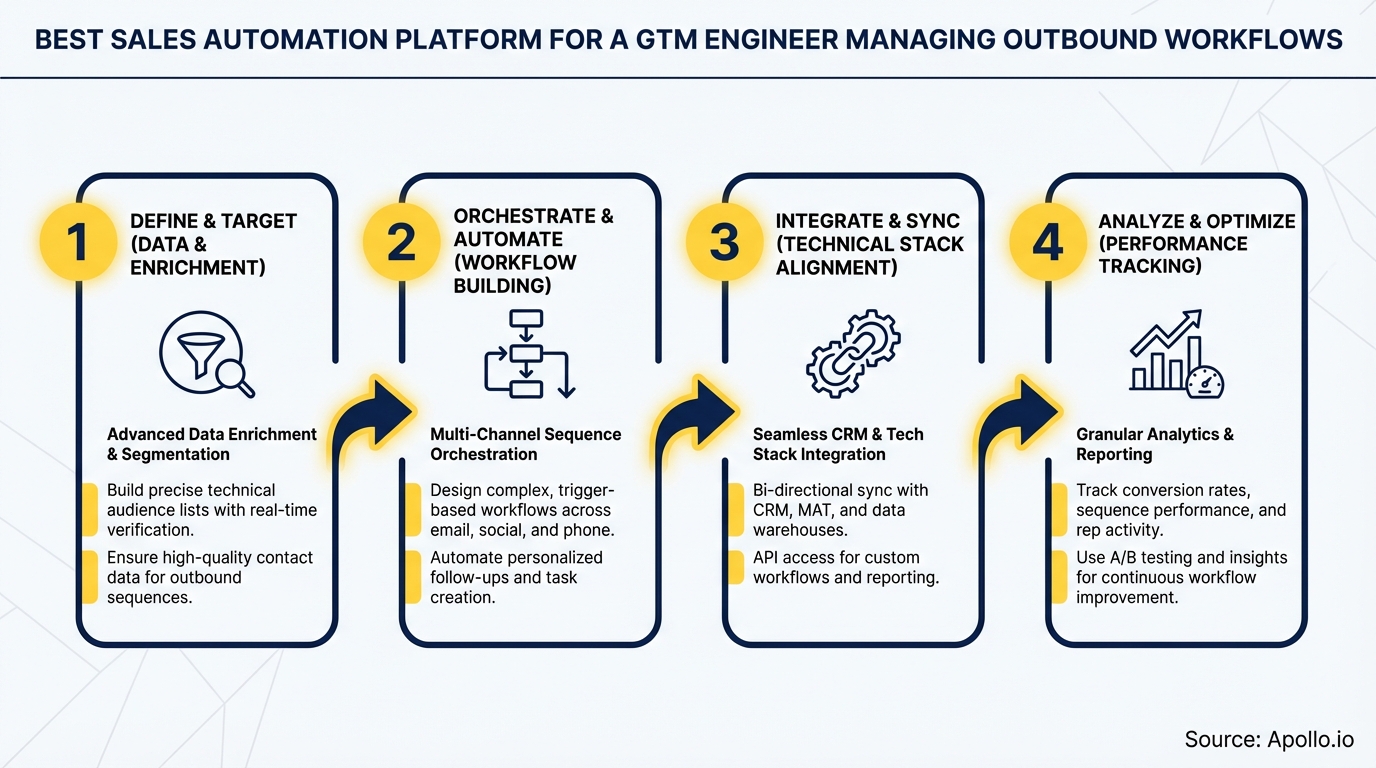
A GTM Engineer needs a platform that functions as an outbound control plane, not just a sequencer. The role exists to collapse fragmented workflows into one system where TAM data, account scoring, enrichment, messaging, and CRM logging all share a single source of truth.
The best GTM Engineers are revenue strategists. They're not tool sommeliers.
Wearing a badge of honor around how many disparate tools you've wired together in n8n misses the irony: "seamless" and "14-tool Frankenstack" are an oxymoron. Every handoff between tools is a potential failure point, a data inconsistency, and a maintenance burden that grows over time.
The core requirements for a GTM engineer-grade outbound platform:
- Unified data layer: TAM list, enrichment, scoring, and CRM sync in one system
- Signal-based workflow logic: Event-triggered branching, not just linear cadences
- AI-assisted research and messaging: Account-specific context at scale, not generic mail-merge
- Human-in-the-loop controls: SDR review queues for top-scored accounts before sequences fire
- Observability: Signal-level reporting that shows which inputs predict meetings and pipeline
Spending too much time on manual research before any email goes out? Apollo's AI sales automation handles account research, scoring, and draft messaging so your team focuses on decisions, not data entry.
What Is the Outbound Workflow Architecture a GTM Engineer Should Build?
The outbound workflow architecture a GTM Engineer should build has seven interconnected layers, each feeding the next. This is the control plane model, not a campaign model.
| Layer | Function | Owner |
|---|---|---|
| TAM List | Single qualified market universe, AI-filtered | Sales Lead |
| Deliverability Infrastructure | Domains, mailboxes, send limits sized to TAM | RevOps |
| Scoring and Prioritization | Multi-signal account scoring, weighted by fit/intent/timing | Management |
| Messaging Intelligence | AI-generated, research-backed, persona-specific drafts | Management |
| Data Orchestration | 1st/2nd/3rd-party signals unified and processed automatically | RevOps |
| Human-in-the-Loop | SDR review queues for top accounts before sequences fire | Leadership |
| Reporting and Optimization | Signal correlation analysis, weight tuning, self-optimizing motion | Sales Management |
This architecture replaces the campaign model entirely. Instead of "launch a healthcare campaign," you increase the industry weight from 10 to 40 and the system re-prioritizes your entire market overnight. The GTME methodology maps this framework in detail across all seven pillars.

How Do SDRs Benefit When GTM Engineers Build This System?
SDRs benefit because they stop doing research and start doing selling. Before a properly engineered outbound system, a typical SDR morning looks like: pull a list, research 15 accounts manually, write personalized emails, send 30 touches by EOD with half the day gone to data entry.
After the system runs: the platform surfaces 50 prioritized accounts with AI-researched context. The SDR reviews the top 10 flagged for human approval, edits two messages, approves the rest, and 40 sequences fire automatically based on pre-set rules.
By 10am, the SDR is working replies and booking calls.
Research from In-Flow shows a typical sales professional saves 5 hours each week by automating routine work. For a GTM Engineer, the goal is to systematize that time reclamation across the entire team, not just individual reps.
RevOps leaders find the biggest gains come from eliminating duplicated work: no more list rebuilding each quarter, no more scattered territory spreadsheets, no more new hires starting from scratch. The system compounds instead of resetting.
Turn Funnel Guesswork Into Real Pipeline
Tired of watching marketing leads stall before they ever reach your pipeline? Apollo surfaces high-intent prospects and puts your team in front of real buyers. Over 600K companies have replaced forecast anxiety with predictable revenue.
Start Free with Apollo →Why Does Platform Consolidation Matter for Outbound Governance?
Platform consolidation matters because governance breaks down at integration seams. Every tool-to-tool handoff is a potential data inconsistency: enrichment that doesn't sync to the CRM, sequences that fire against stale contact data, scoring that doesn't reflect the latest inbound signals.
Data governance for outbound automation requires:
- Deduplication rules: One account record per company across all data sources
- Enrichment refresh cadence: Automated re-enrichment on a defined schedule, not on-demand only
- Sequence suppression logic: Contacts in active deals or with recent replies suppressed automatically
- Deliverability monitoring: Bounce rates, spam complaints, and domain health tracked in real time
- Audit trail: Every sequence trigger and CRM update logged for review
Security and governance scrutiny for revenue workflow stacks is rising in 2026, particularly as automation becomes more autonomous. GTM Engineers building on consolidated platforms carry significantly less vendor risk than those managing permissions across multiple integrated tools.
As Census put it: "We cut our costs in half." As Cyera noted: "Having everything in one system was a game changer." Consolidation is a governance strategy as much as a cost strategy.
How Does Apollo Function as the GTM Engineer's Outbound Control Plane?
Apollo functions as an end-to-end outbound control plane by unifying TAM data, AI-powered scoring, multi-channel sequencing, CRM enrichment, and performance reporting inside a single platform. There's no API babysitting, no data pipeline to maintain between a prospecting tool and a sequencer and a dialer.
The platform covers every layer of the outbound architecture:
- Data: 230M+ contacts, 97% email accuracy, 65+ enrichment filters for TAM qualification
- Scoring:Apollo Scores lets GTM Engineers assign weights to fit, intent, timing, and engagement signals in a single model
- Sequences: Multi-channel email, phone, and social outreach with event-triggered branching logic
- AI Messaging: Account-specific draft generation using inbound activity as context — not generic templates
- Workflows:Apollo's workflow engine automates enrichment, routing, CRM logging, and sequence enrollment without external orchestration tools
- Reporting: Signal-level attribution showing which inputs correlate with meetings and deals
According to Martal, 82% of organizations plan to integrate AI agents into business operations within 1-3 years. Apollo's trajectory toward agentic GTM, where research, scoring, messaging, and CRM updates execute autonomously, positions GTM Engineers for that shift without requiring a new stack rebuild.
Predictable Revenue put it directly: "We reduced the complexity of three tools into one." That's the consolidation thesis in practice.
Struggling to keep enrichment, scoring, and sequencing in sync across separate tools? Apollo's sales engagement platform runs all three from one workspace, so your sequences always fire against current data.

What Does an Implementation Playbook Look Like for GTM Engineers?
A GTM Engineer implementation playbook moves in four phases: Foundation, Intelligence, Orchestration, and Launch. Each phase builds on the last and runs alongside existing operations without disruption.
| Phase | Weeks | Key Deliverable |
|---|---|---|
| Foundation | 1-3 | Complete TAM list, deliverability infrastructure sized to market |
| Intelligence | 4-6 | Scoring model with weighted signals, persona-specific messaging architecture |
| Orchestration | 7-9 | Data connections, enrichment automation, sequences with dynamic messaging |
| Launch | 10-12 | SDR training, HITL review queues, live dashboards, monthly optimization cadence |
After launch, RevOps owns 2-4 hours per month of tuning: adjusting signal weights based on outcome data, refreshing the TAM, and reviewing deliverability health. That's the maintenance cost of a self-optimizing outbound system. Apollo's GTME Program runs this exact 12-week build for teams that want it done with a dedicated engineer.
For teams building independently, the sales automation fundamentals guide and workflow automation documentation provide the implementation foundation.
Which Platform Should a GTM Engineer Choose in 2026?
For a GTM Engineer managing outbound workflows in 2026, Apollo is the strongest choice for teams that want to consolidate data, scoring, sequencing, and reporting into one system without integration overhead. The platform's native workflow engine, AI-powered research and messaging, and signal-based scoring model cover every layer of the outbound control plane architecture without requiring external orchestration tools.
The GTME who wins isn't the one who builds the most elaborate multi-tool workflow. It's the one who deploys the most elegant strategy at the highest velocity and produces real pipeline.
One platform, one workflow, no API babysitting.
Ready to build your outbound control plane on a single platform? Schedule a Demo to see how Apollo unifies TAM data, AI scoring, multi-channel sequences, and reporting in one workspace built for GTM Engineers.
Prove Pipeline ROI With Apollo
ROI pressure killing your next budget approval? Apollo delivers measurable pipeline impact from day one — teams like Leadium 3x'd their annual revenue. Start your free trial and show leadership real numbers fast.
Start Free with Apollo →Don't miss these
Sales
Inbound vs Outbound Marketing: Which Strategy Wins?
Sales
What Is a Sales Funnel? The Non-Linear Revenue Framework for 2026
Sales
What Is a Go-to-Market Strategy? The 2026 GTM Playbook
See Apollo in action
We'd love to show how Apollo can help you sell better.
By submitting this form, you will receive information, tips, and promotions from Apollo. To learn more, see our Privacy Statement.
4.7/5 based on 9,690 reviews
