
Best Prospecting Software With Team Collaboration Features in 2026
Most prospecting tools are built for individual reps, not revenue teams. That's a problem. According to Gartner, 61% of B2B buyers now prefer a rep-free buying experience, which means your SDRs, AEs, and marketing team must coordinate seamlessly behind the scenes before a buyer ever raises their hand. The best prospecting software with team collaboration features unifies that coordination into a single workspace. For a deeper foundation, explore outbound prospecting strategies for B2B teams before evaluating tools.

Apollo Turns Research Hours Into Pipeline
Tired of your reps burning the day on manual research instead of selling? Apollo surfaces verified contacts instantly, so your team spends time closing — not digging. Join 600K+ companies building predictable pipeline.
Start Free with Apollo →Key Takeaways
- Team collaboration in prospecting software directly reduces deal-killing messaging inconsistencies between reps and marketing.
- Aligned sales and marketing teams achieve 38% higher sales win rates, making collaboration a revenue driver, not just a convenience.
- The best platforms unify contact data, sequences, shared templates, and pipeline visibility in one workspace.
- Apollo consolidates prospecting, engagement, enrichment, and deal management so teams stop swivel-chairing between tools.
- RevOps and sales leaders should evaluate tools on governance features: role-based access, shared templates, and unified engagement history.
Why Does Team Collaboration Matter in Prospecting Software?
Team collaboration in prospecting software matters because misaligned messaging between reps and marketing actively destroys buyer trust. A Gartner survey found that 69% of B2B buyers report inconsistencies between information on a seller's website and what reps say in conversations. That gap is a direct result of siloed tools and disconnected teams.
Research from EasyWebinar shows that teams working together achieve 38% higher sales win rates and are 67% more effective at closing deals. The ROI case for collaboration features is not soft, it is structural.
Modern B2B buying also involves multiple stakeholders across multiple channels. McKinsey's B2B Pulse found that B2B customers now use an average of 10 interaction channels in their buying journey. A single rep with a single sequence cannot cover that surface area alone. Cross-functional coordination is the only answer.
What Collaboration Features Should Prospecting Software Include?
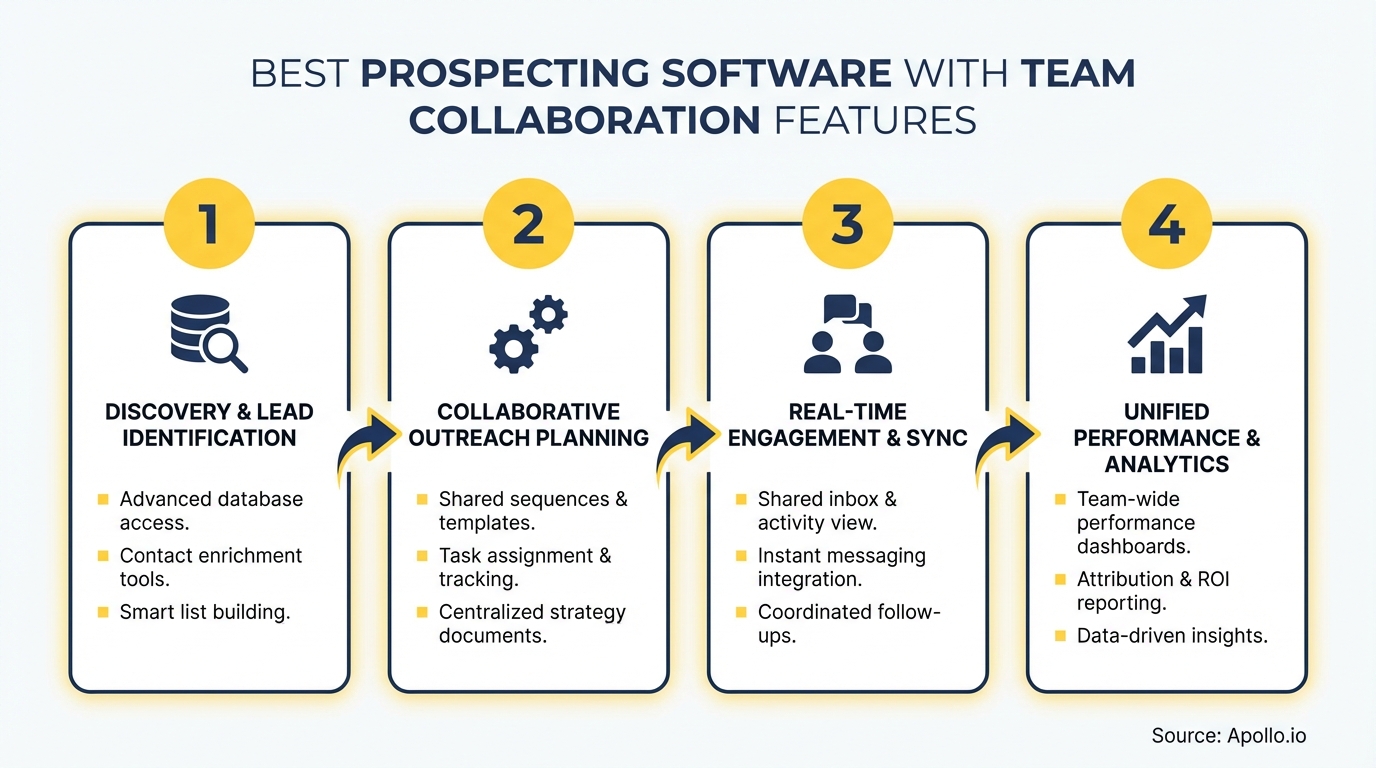
The core collaboration features to evaluate in any prospecting platform are shared workspaces, role-based permissions, unified engagement history, and co-managed sequences. These features let SDRs, AEs, RevOps, and marketing operate from the same playbook without duplicating effort or contradicting each other.
| Feature | Why It Matters for Teams |
|---|---|
| Shared sequence templates | Ensures messaging consistency across every rep |
| Role-based access control (RBAC) | Prevents rogue outreach; enforces governance |
| Unified engagement history | AEs see every touchpoint before taking a call |
| Team-level analytics | Sales leaders spot coaching gaps and sequence performance |
| CRM sync and integrations | Single source of truth for contact and deal data |
| Shared contact lists and filters | Prevents territory overlap and duplicate outreach |
According to Yesware, 70% of growing companies share the exact same content with over a quarter of their sales team.
Standardized templates inside a shared prospecting platform are how that consistency gets enforced at scale.

How Do SDRs and AEs Benefit From Shared Prospecting Workspaces?
SDRs benefit from shared workspaces by inheriting proven sequence templates and account research from AEs, cutting ramp time and improving first-touch quality.
AEs benefit by seeing every SDR touchpoint in one timeline before joining a conversation, eliminating awkward repeat questions and missed context.
For cross-functional GTM teams, this handoff quality is the difference between a warm intro and a cold restart. When SDRs use Apollo's shared sequences and AEs pick up the same account record with full engagement history, the handoff is invisible to the buyer.
RevOps leaders find that shared workspaces also simplify governance. Instead of managing separate email tools, dialers, and CRM fields, everything lives in one place with consistent field mapping and auditability. As Cyera noted after consolidating their stack: "Having everything in one system was a game changer."
Struggling to align your SDR and AE teams on the same accounts? Run coordinated multi-channel sequences with Apollo's shared engagement platform.
Turn Funnel Guesswork Into Real Pipeline
Pipeline forecasting a guessing game because marketing leads never convert? Apollo surfaces high-intent prospects already primed for sales conversations. Nearly 100K paying customers replaced unreliable forecasts with predictable revenue.
Start Free with Apollo →What Is the Best Prospecting Software With Team Collaboration in 2026?
Apollo is the best prospecting software with team collaboration features for B2B GTM teams in 2026 because it combines a 230M+ contact database, multi-channel engagement, AI automation, and deal management in a single unified workspace. Teams get shared sequences, RBAC, CRM sync, and pipeline visibility without stitching together separate tools.
The B2B prospecting tool market reached $4.49 billion in 2026 and is growing at over 16% annually, reflecting how central these platforms have become to revenue operations. Apollo stands out by solving both the data and collaboration layers in one platform.
Key Apollo collaboration capabilities for teams:
- Shared sequence templates with team-level access controls so every rep sends on-brand messages
- Unified contact and account records visible across SDRs, AEs, and marketing in real time
- Role-based permissions for admins, managers, and reps to govern what each user can edit or export
- Integrated dialer software with call recordings accessible to the whole team for coaching and continuity
- AI-powered workflow automation that handles research, follow-ups, and routing so reps focus on selling
- Lead scoring shared across the team so SDRs and AEs prioritize the same high-intent accounts
Predictable Revenue put it directly: "We reduced the complexity of three tools into one." Census added: "We cut our costs in half." That is the consolidation advantage Apollo delivers for growing teams.
How Should RevOps Teams Govern a Shared Prospecting Platform?
RevOps teams should govern a shared prospecting platform by establishing role-based access tiers, standardizing sequence templates before launch, and auditing engagement data quarterly.
Governance is what separates a productive shared workspace from a chaotic free-for-all.
A practical governance framework for RevOps includes:
- RBAC setup: Admins control template publishing; reps can clone but not edit master sequences
- Template library: Approved email and call scripts versioned by use case (cold outreach, follow-up, re-engagement)
- Territory rules: Shared filters and lists that prevent duplicate outreach to the same accounts
- Engagement SLAs: Defined response windows for SDR-to-AE handoffs baked into workflows
- Quarterly audits: Review sequence performance, data hygiene, and CRM field consistency
For teams building their outbound motion from scratch, reviewing data-driven prospecting strategies alongside governance setup ensures the playbook and the platform are aligned from day one.
Need a single source of truth for your entire GTM team's prospecting data? Search 230M+ verified contacts with Apollo's advanced filters and share lists instantly across your team.
What Are the Most Important Evaluation Criteria When Choosing Prospecting Software for Teams?
The most important evaluation criteria for team-focused prospecting software are collaboration depth, data quality, AI capability, and integration breadth. Feature checklists matter less than whether the platform actually reduces coordination friction across your GTM team.
Use this evaluation checklist:
- Does the platform support shared sequences and templates with access controls?
- Can multiple users work the same account without creating duplicate outreach?
- Is there a unified engagement timeline visible to all roles?
- Does it integrate natively with your CRM without a middleware layer?
- Can sales leaders run team-level performance analytics from inside the tool?
- Does the AI handle research and personalization to reduce non-selling admin time?
For teams evaluating automated prospecting tools, the consolidation question is increasingly decisive. Salesforce research found that 9 out of 10 sales organizations plan to consolidate their tech stacks, and 70% of reps report feeling overwhelmed by the number of tools they manage. Platforms that unify prospecting, engagement, and collaboration in one workspace directly address both problems.

Start Prospecting as a Team, Not as Individuals
The best prospecting software with team collaboration features in 2026 is the platform that eliminates the gaps between your SDRs, AEs, RevOps, and marketing functions.
Shared templates, unified engagement history, RBAC, and AI-powered automation are not luxury features; they are the infrastructure for consistent, scalable outbound.
Apollo gives revenue teams everything in one workspace: a 230M+ contact database, multi-channel sequences, AI research automation, integrated dialer, lead scoring, deal management, and deep CRM integrations. Nearly 100K paying companies use Apollo to build pipeline without building a fragmented tech stack.
Ready to unify your team's prospecting motion? Request a Demo and see how Apollo consolidates your entire GTM workflow into one collaborative platform.
Prove Pipeline ROI With Apollo
ROI pressure killing your tool budget approval? Apollo delivers measurable pipeline impact your leadership can see — fast. Leadium 3x'd their annual revenue after switching. Start your free trial today.
Start Your Free Trial →Don't miss these
Sales
Inbound vs Outbound Marketing: Which Strategy Wins?
Sales
What Is a Sales Funnel? The Non-Linear Revenue Framework for 2026
Sales
What Is a Go-to-Market Strategy? The 2026 GTM Playbook
See Apollo in action
We'd love to show how Apollo can help you sell better.
By submitting this form, you will receive information, tips, and promotions from Apollo. To learn more, see our Privacy Statement.
4.7/5 based on 9,690 reviews
