
Hybrid Revenue Orchestration: How to Choose the Best Outbound Platform for a B2B Company with SDRs
Most SDR teams are losing the majority of their week before they make a single call. Research consistently shows reps spend only about 30% of their time actually selling, with the rest consumed by logging, switching tools, and chasing context between inbound leads and outbound sequences. The cost of that fragmentation compounds fast. If your SDRs handle both outbound prospecting and inbound follow-up, a single disconnected platform creates two broken workflows instead of one unified motion.
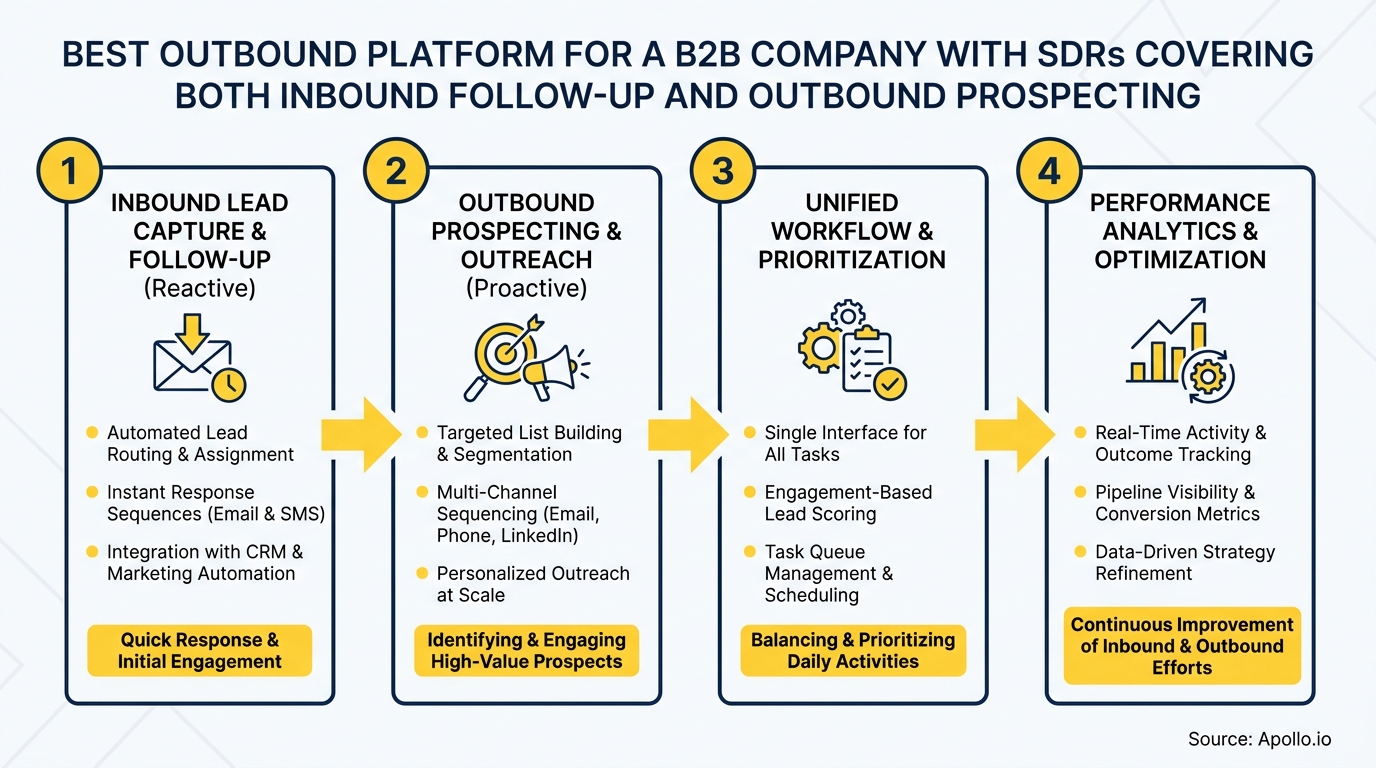
The best outbound platform for a B2B company with SDRs covering both inbound follow-up and outbound prospecting is one that unifies contact data, sequencing, AI prioritization, and CRM sync in a single workspace. This article gives you a practical framework to evaluate, select, and implement that platform in 2026.

Let Apollo Find Your Leads Instantly
Tired of burning hours on manual research just to hit dead ends? Apollo surfaces verified contacts so your team sells instead of searches. Join 600K+ companies building pipeline faster.
Start Free with Apollo →Key Takeaways
- SDR teams covering inbound and outbound need one unified platform, not two disconnected tools stitched together.
- The best platforms combine verified contact data, multichannel sequencing, and AI-driven prioritization in a single workspace.
- Speed-to-lead on inbound and signal-driven outbound cadences require shared context, not separate queues.
- AI features should be evaluated on measurable outcomes (meeting rate, time-to-first-touch) rather than marketing claims.
- Platform consolidation reduces tool sprawl and gives RevOps a single source of truth for attribution and reporting.
What Is Hybrid Revenue Orchestration for SDR Teams?
Hybrid revenue orchestration is the practice of running inbound follow-up and outbound prospecting from a single, unified platform with shared data, routing logic, and AI prioritization. It treats inbound and outbound not as separate motions but as one coordinated workflow where signals from either channel inform the other.
Traditional setups force SDRs to context-switch constantly: one tool for prospecting lists, another for sequences, a third for inbound routing, and CRM as an afterthought. Hybrid orchestration collapses this into one prioritized work queue. According to Persistence Market Research, companies implementing unified sales engagement platforms report an average 25% productivity increase and 20% decrease in sales rep ramp-up time.
This model is particularly important now. In 2026, outbound volume alone is no longer sufficient. Signal-driven prospecting and rapid inbound response are converging into a single prioritized workflow that only a unified platform can execute well. See how inbound and outbound motions complement each other when run from the same system.
What Features Must the Best Outbound Platform Include for SDRs in 2026?
The best outbound platform for SDR teams handling both motions must include five non-negotiable capability layers.
| Capability | Why It Matters for Hybrid SDR Teams |
|---|---|
| Verified B2B Contact Database | Outbound prospecting requires accurate contact data without a separate enrichment subscription |
| Multichannel Sequencing | Buyers engage across email, phone, and social — fixed single-channel cadences underperform |
| Inbound Routing and Lead Conversion | Inbound leads need instant enrichment and speed-to-lead routing, not manual triage |
| AI Prioritization and Next-Best-Action | SDRs need a ranked work queue, not a flat task list, to focus on the highest-value actions |
| Native CRM Integration | Closed-loop attribution and shared context between inbound and outbound require CRM sync |
Research from Salesloop confirms that top sales engagement platforms for 2026 include multichannel outreach (email, calls, social touches), automated sequences, CRM integration, AI-powered insights, and built-in B2B contact databases. A platform missing any one of these forces your SDRs to use a workaround tool, which reintroduces the fragmentation problem.
Struggling to find qualified leads while juggling inbound follow-up? Search Apollo's 230M+ contacts with 65+ filters without leaving your sequencing workflow.

How Do SDRs Manage Inbound and Outbound in One Workflow?
SDRs manage both motions effectively when inbound leads and outbound prospects share a single prioritized task queue with routing rules that surface the highest-urgency actions first. The key design principle is a shared work queue, not separate dashboards.
Here is a practical inbound-plus-outbound SLA model for SDR teams:
- Inbound priority tier: Leads matching ICP criteria get routed to a rep within minutes via automated enrichment and assignment rules. Speed-to-lead is the primary metric here.
- Signal-triggered outbound tier: Accounts showing buying intent signals (job changes, funding, web visits) get surfaced as high-priority outbound tasks, not buried in a flat sequence queue.
- Nurture outbound tier: Standard outbound cadences run on a fixed or AI-adaptive schedule for accounts without recent signals.
- Re-engagement tier: Inbound leads that went cold reenter an outbound sequence automatically based on CRM status, closing the loop without manual intervention.
This design requires the platform to read both inbound form data and outbound engagement signals simultaneously. Apollo's inbound optimization tools enrich form submissions instantly and route them to sequences without rep intervention, while outbound sequences adapt based on engagement signals in the same workspace.
Turn Funnel Guesswork Into Pipeline Clarity
Pipeline forecasting a guessing game while deals stall at every stage? Apollo surfaces high-intent leads and keeps your pipeline moving with real-time signal intelligence. Join 600K+ companies closing with confidence.
Schedule a Demo →How Should SDR Teams Evaluate AI Features Before Buying?
SDR teams should evaluate AI features against three concrete outcomes: time-to-first-touch on inbound leads, meeting booking rate on outbound sequences, and reduction in manual admin time per rep per week. Any AI feature that cannot be tied to one of these outcomes should be deprioritized in your evaluation.
The AI landscape shifted significantly in 2026. Platforms are no longer shipping AI as email-writing assistance only.
Apollo's acquisition of Pocus strengthens signal intelligence and workflow prioritization, reflecting a broader industry consolidation where the most competitive platforms own the full signals-to-action loop. Before committing, run a 30-day pilot with these criteria:
- Measure time-to-first-touch on inbound leads before and after AI routing activation
- Track meeting rate on AI-prioritized outbound tasks versus standard sequence tasks
- Count manual logging actions per rep per day to quantify admin reduction
- Audit AI-generated messaging for brand voice consistency and deliverability impact
Apollo's AI Research Agent has driven measurable outcomes for GTM teams, with users reporting 46% more meetings booked. For RevOps leaders building the evaluation rubric, Apollo's AI and automation capabilities provide a concrete benchmark for what embedded AI should deliver in practice.
What Does the Platform Consolidation Trend Mean for SDR Leaders?
Platform consolidation means SDR leaders can now replace three to five separate tools with one unified GTM platform, reducing cost, integration risk, and data silos simultaneously. This is not a future trend.
It is the current buying behavior among high-growth B2B teams in 2026.
The driver is clear: running separate tools for prospecting data, sequencing, inbound routing, and CRM creates attribution gaps and forces reps to context-switch constantly. As noted above, that context-switching erodes the selling time percentage that is already critically low.
Customer proof from Apollo's own base reflects this shift directly:
- "We reduced the complexity of three tools into one." — Collin Stewart, Predictable Revenue
- "We cut our costs in half." — Census
- "Having everything in one system was a game changer." — Cyera
For a detailed comparison of how unified platforms stack up against point solutions, see Apollo vs. Outreach vs. Salesloft. RevOps leaders evaluating enterprise sales solutions should weigh total cost of ownership across all replaced tools, not just per-seat license cost.
Spending too much time managing multiple platforms? Run inbound follow-up and outbound prospecting from one Apollo workspace and cut your tech stack.
What Metrics Should SDR Leaders Track on a Unified Platform?
SDR leaders on a unified platform should track six core metrics that span both inbound and outbound motions in a single dashboard: time-to-first-touch, inbound-to-meeting conversion rate, outbound sequence reply rate, meetings booked per rep per week, pipeline sourced by channel (inbound vs. outbound), and sequence step completion rate.
The value of a unified platform is that these metrics share a single data model. Inbound leads and outbound prospects live in the same contact record, so attribution is clear and managers can coach based on actual activity data, not rep self-reporting. For teams building inbound lead conversion alongside outbound pipeline, this shared attribution is critical for demonstrating ROI to revenue leadership.
Why Is Apollo the Best Outbound Platform for B2B SDR Teams in 2026?
Apollo is the best outbound platform for B2B SDR teams covering both inbound follow-up and outbound prospecting because it unifies contact data, multichannel sequencing, AI prioritization, inbound routing, and CRM sync in one workspace, eliminating the tool fragmentation that costs SDRs their selling time.
Key platform facts relevant to SDR team selection:
- 230M+ contacts, 30M+ companies with 97% email accuracy — no separate data subscription needed
- 65+ search filters for precise ICP targeting on outbound lists
- Inbound optimization tools that enrich and route form submissions automatically
- AI-powered sequencing with 35% increase in bookings reported with AI-powered messaging
- Native CRM integrations for closed-loop attribution across both motions
- Signal intelligence strengthened through the 2026 Pocus acquisition for next-best-action workflows
Apollo serves B2B GTM teams from startups through enterprise, including SDRs, BDRs, AEs, RevOps, and revenue leaders. Trusted by nearly 100K paying customers including Anthropic, Smartling, Redis, and Cyera, Apollo earned the 2026 MarTech Breakthrough Award for Best AI-Powered Sales Solution and was recognized in G2's 2026 Best Software Awards.
According to Sales Hive, approximately 80% of B2B sales interactions now occur through digital channels, which means your platform's multichannel execution capability is no longer optional. Apollo's sequences span email, phone, and social outreach in one coordinated workflow, matching how modern buyers actually engage. Explore the best B2B marketing and sales tools for 2026 to see how Apollo fits into a modern GTM stack.

Start Running Inbound and Outbound from One Platform
The SDR teams winning in 2026 are not the ones sending more emails. They are the ones operating from a single unified platform where inbound leads and outbound prospects share context, AI surfaces the highest-priority actions, and every touchpoint feeds clean attribution data back to RevOps.
Fragmented stacks create fragmented results.
Apollo gives SDR teams the contact data, sequencing, AI prioritization, and inbound routing they need in one workspace. No extra tools, no context switching, no attribution gaps.
Ready to consolidate your stack and give your SDRs more time to sell?
Start Prospecting with Apollo for Free
Prove Pipeline ROI With Apollo
ROI pressure killing your next budget approval? Apollo delivers measurable pipeline impact from day one — no guesswork, no waiting. Leadium 3x'd annual revenue. See your ROI before you commit.
Schedule a Demo →Don't miss these
Sales
Inbound vs Outbound Marketing: Which Strategy Wins?
Sales
What Is a Sales Funnel? The Non-Linear Revenue Framework for 2026
Sales
What Is a Go-to-Market Strategy? The 2026 GTM Playbook
See Apollo in action
We'd love to show how Apollo can help you sell better.
By submitting this form, you will receive information, tips, and promotions from Apollo. To learn more, see our Privacy Statement.
4.7/5 based on 9,690 reviews
