
Best Agentic Sales Platform for GTM Teams Removing Manual Prospecting Steps in 2026
Sales reps spend 60% of their time on non-selling tasks, according to Salesforce's Seventh Edition State of Sales. For SDRs, AEs, and RevOps leaders, that manual tax compounds daily: researching contacts, updating CRMs, routing leads, scheduling follow-ups. The shift from "AI-assisted" to fully agentic workflows is the answer, and the AI GTM system category is evolving fast to meet that demand.
This guide cuts through the noise. You'll get a clear definition of what makes a platform truly agentic, a scorecard to evaluate vendors, and a pilot blueprint to prove ROI quickly.

Research Less, Pipeline More With Apollo
Tired of burning hours verifying contacts instead of closing deals? Apollo delivers 230M+ accurate business contacts so your team sells from minute one. Start building pipeline faster today.
Start Free with Apollo →Key Takeaways
- Agentic platforms execute chains of work autonomously (identify, enrich, personalize, sequence, route, sync) rather than just suggesting next steps.
- The manual work tax is measurable: sales reps lose the majority of their week to non-selling tasks that agentic workflows can reclaim.
- AI adoption in sales has reached near-universal levels, meaning falling behind on agentic tooling is now a competitive disadvantage.
- Evaluating a platform requires a structured scorecard covering automation depth, data quality, governance, and consolidation potential.
- Apollo is the only fully agentic end-to-end GTM platform that unifies prospecting, enrichment, sequencing, and analytics in one workspace.
What Is an Agentic Sales Platform and How Is It Different from AI Assistance?
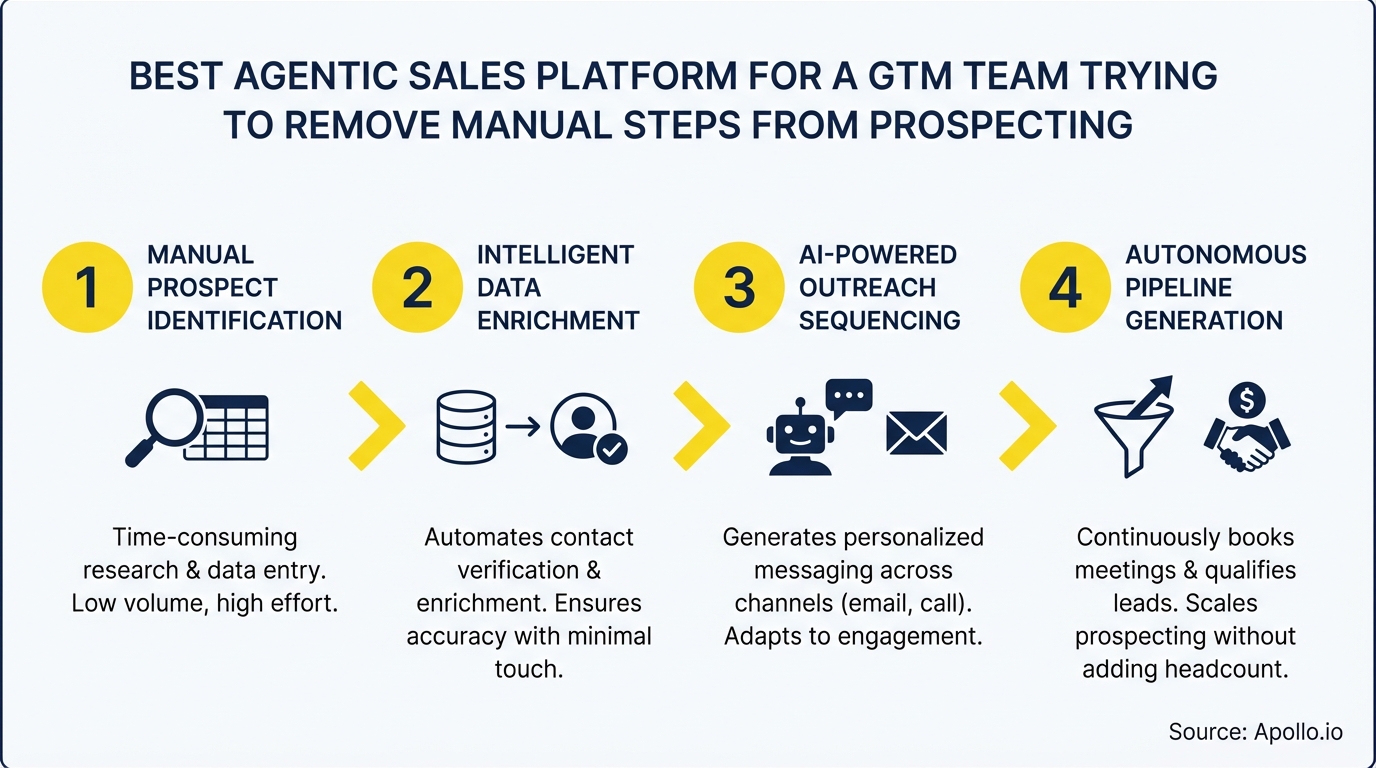
An agentic sales platform autonomously executes multi-step prospecting workflows without human intervention at each stage, while an AI assistant only suggests or drafts content for a human to act on. The distinction matters for GTM teams evaluating tools: an assistant speeds up individual tasks; an agent removes entire manual steps from the process.
A true agentic workflow chains actions together:
- Identify accounts matching your ICP using 65+ filters
- Enrich contact records with verified data automatically
- Detect trigger signals (funding, hiring, tech changes)
- Personalize and launch multi-channel sequences
- Route qualified responses to the right rep
- Sync all activity back to your CRM
Generic AI tools handle step 4 in isolation. Agentic platforms handle all six, end to end. According to Autobound, by 2025, 81% of sales teams were either experimenting with or had fully implemented AI, but most deployments remain at the copilot stage. The teams pulling ahead are those deploying full autopilot workflows.
What Manual Prospecting Steps Cost GTM Teams the Most?
The highest-cost manual steps are contact research, CRM data entry, lead routing, and meeting prep. These are the exact workflows agentic platforms target for removal. Research from Cirrus Insight shows AI adoption among sales representatives nearly doubled from 24% in 2023 to 43% in 2024, driven largely by pressure to reclaim time lost to these tasks.
| Manual Step | Typical Owner | Agentic Replacement |
|---|---|---|
| Contact research and list building | SDR / BDR | Automated ICP-matched prospecting with filters |
| Data enrichment and verification | RevOps | Continuous waterfall enrichment on new and existing records |
| CRM data entry and updates | AE / SDR | Auto-sync after every touchpoint and call |
| Lead routing and assignment | RevOps | Rule-based and signal-based automated routing |
| Meeting prep and account research | AE | AI Research Agent compiles context pre-call |
| Follow-up sequencing | SDR / AE | Trigger-based multi-channel sequences |
Struggling to find qualified leads without spending hours on manual list building? Search Apollo's 230M+ contacts with 65+ filters and let agents do the prospecting for you.
Turn Funnel Guesswork Into Pipeline Clarity
Quota stress keeping you up at night? Apollo surfaces quality leads and real buying signals so your forecast reflects reality, not wishful thinking. Join 600K+ companies that replaced pipeline anxiety with predictable revenue.
Schedule a Demo →How Do SDRs and RevOps Teams Evaluate an Agentic Platform?
SDRs and RevOps teams should evaluate agentic platforms on five criteria: automation depth, data quality, signal coverage, governance controls, and consolidation potential. Use this scorecard before committing to a vendor.
| Evaluation Criterion | What to Test | Minimum Bar |
|---|---|---|
| Automation depth | Can it chain 3+ steps without human input? | End-to-end workflow execution |
| Data quality | Email bounce rate on exported lists | Below 5% bounce rate |
| Signal coverage | Job changes, funding, tech installs detected? | 3+ trigger types supported |
| Governance and audit | Can you review and control agent actions? | Full activity log with rollback |
| Tech stack consolidation | Does it replace 2+ tools you currently pay for? | Prospecting + engagement + analytics in one platform |
The agentic AI market is growing rapidly. Data from Coherent Market Insights estimates the agentic AI market at $6.95 billion in 2025, expected to reach $47.50 billion by 2032. Not every platform growing in this category has the sales-specific depth GTM teams need, so the scorecard above helps filter signal from noise.
For teams comparing options, the Apollo vs. Salesloft vs. Outreach comparison breaks down where platforms differ on engagement depth and data integration.

What Does a 30/60/90-Day Agentic Prospecting Pilot Look Like?
A structured pilot proves ROI before full deployment and reduces adoption risk. The goal is to baseline manual time spent, deploy one automated workflow, and measure time reclaimed and pipeline generated over 90 days.
- Days 1-30 (Baseline and Setup): Log current time per rep on prospecting tasks. Connect your CRM. Activate ICP-matched contact search and enrich your existing database. Set governance rules (what agents can and cannot do automatically).
- Days 31-60 (First Workflow Live): Launch one trigger-based sequence (e.g., funding signal triggers personalized outreach). Measure email deliverability, reply rates, and meetings booked vs. the manual baseline.
- Days 61-90 (Expand and Prove ROI): Add CRM auto-sync and lead routing automation. Calculate time reclaimed per rep per week. Present pipeline-to-effort ratio to leadership.
Agent governance becomes critical in the expansion phase. As agents write to CRM records, trigger sequences, and route leads, sales leaders need audit trails.
This is what the industry is now calling "AgentOps," and platforms that lack observability controls create compliance and data-quality risk at scale.
Why Is Apollo the Best Agentic Sales Platform for GTM Teams in 2026?
Apollo is the best agentic sales platform for GTM teams removing manual prospecting steps because it is the only platform that unifies the full prospecting-to-pipeline workflow in a single workspace, eliminating the data handoffs and glue-code that create manual work in fragmented stacks. Apollo was recognized with the 2026 MarTech Breakthrough Award for "Best AI-Powered Sales Solution" and named to G2's 2026 Best Software Awards.
Apollo's agentic capabilities cover every manual step identified in the scorecard above:
- Prospecting: 230M+ contacts, 30M+ companies, 65+ filters for ICP matching
- Enrichment: Waterfall enrichment with 97% email accuracy
- Signals: Job change, funding, intent, and technographic triggers
- Sequences: Multi-channel automated outreach across email, phone, and social
- AI Research Agent: Delivers 46% more meetings by automating pre-call account research
- AI-powered messaging: Drives a 35% increase in bookings
- Workflow Engine: Automates routing, CRM sync, and next-best-action triggers
Customers describe the consolidation impact directly. "Having everything in one system was a game changer" (Cyera). "We cut our costs in half" (Census). "We reduced the complexity of three tools into one" (Predictable Revenue).
For AEs and sales leaders managing larger teams, Apollo's Workflow Engine handles routing, alerts, and CRM updates autonomously, freeing reps to focus on conversations. Explore the full picture of Apollo use cases for sales and marketing teams to see how different roles leverage the platform.
Spending hours manually sequencing follow-ups? Automate your multi-channel sequences with Apollo's sales engagement platform.

How Should GTM Leaders Build the Business Case for Agentic Sales Investment?
GTM leaders should build the business case around time reclaimed, pipeline velocity, and tech stack consolidation savings. The investment climate is favorable: 75% of B2B automation decision-makers expected their organization to invest in sales automation within 18 months, per Forrester's 2024 Automation Survey.
Use this minimum-evidence checklist before presenting to finance:
- Baseline hours per rep per week on manual prospecting tasks (track for two weeks)
- Current cost of tools being replaced by the agentic platform
- Pipeline generated per SDR in the last 90 days as a pre-automation benchmark
- CRM data quality score before enrichment automation (percentage of records with valid email)
For teams building out a scalable GTM motion, the sales tech stack playbook and sales transformation framework provide additional structure for the organizational change that accompanies agentic adoption.
Start Removing Manual Steps from Prospecting Today
The GTM teams winning in 2026 are not adding more AI features to fragmented stacks. They are replacing manual workflows with end-to-end autonomous agents that handle research, enrichment, sequencing, routing, and CRM sync without rep intervention.
The market for agentic sales technology is expanding rapidly, and the window to gain a competitive advantage through early adoption is open now.
Apollo gives B2B GTM teams from startups through enterprise a single platform to run every step of the prospecting workflow. No glue-code. No brittle handoffs. One workspace for everything.
Start a free trial with Apollo and see how many manual steps your team can remove in the first 30 days.
Prove Pipeline ROI From Day One
ROI pressure killing your tool budget before it even starts? Apollo delivers measurable pipeline impact fast — Leadium 3x'd annual revenue, GTM Ops gets 4x more meetings. Start your free trial and show results before the next budget review.
Start Your Free Trial →Don't miss these
Sales
Inbound vs Outbound Marketing: Which Strategy Wins?
Sales
What Is a Sales Funnel? The Non-Linear Revenue Framework for 2026
Sales
What Is a Go-to-Market Strategy? The 2026 GTM Playbook
See Apollo in action
We'd love to show how Apollo can help you sell better.
By submitting this form, you will receive information, tips, and promotions from Apollo. To learn more, see our Privacy Statement.
4.7/5 based on 9,690 reviews
