
B2B Sales Cycle: How to Navigate Each Stage and Close More Deals
The B2B sales cycle in 2026 looks radically different from just two years ago. Gartner predicts that 75% of B2B sales organizations now augment traditional playbooks with AI-guided selling solutions. Yet buyers increasingly demand human connection. The winning approach combines data-driven precision with authentic relationship-building across every stage of your B2B sales process.

Apollo Eliminates 4+ Hours Of Daily Research
Tired of spending 4+ hours daily hunting for contact info? Apollo delivers 224M verified contacts with 96% email accuracy instantly. Join 550K+ companies who turned manual research into selling time.
Start Free with Apollo →Key Takeaways
- The B2B sales cycle has seven distinct stages from prospecting through post-sale, with AI augmenting each phase while preserving human touchpoints
- Data-driven selling now dominates, with 60% of organizations transitioning from experience-based to analytics-powered approaches
- Buyers prefer self-service for research but value human guidance for complex decisions, requiring hybrid engagement models
- Sales cycles accelerate when teams consolidate tools into unified platforms, cutting complexity and improving data consistency
- SDRs and AEs using AI for prospecting and qualification report measurably faster pipeline velocity and higher conversion rates
What Is the B2B Sales Cycle in 2026?
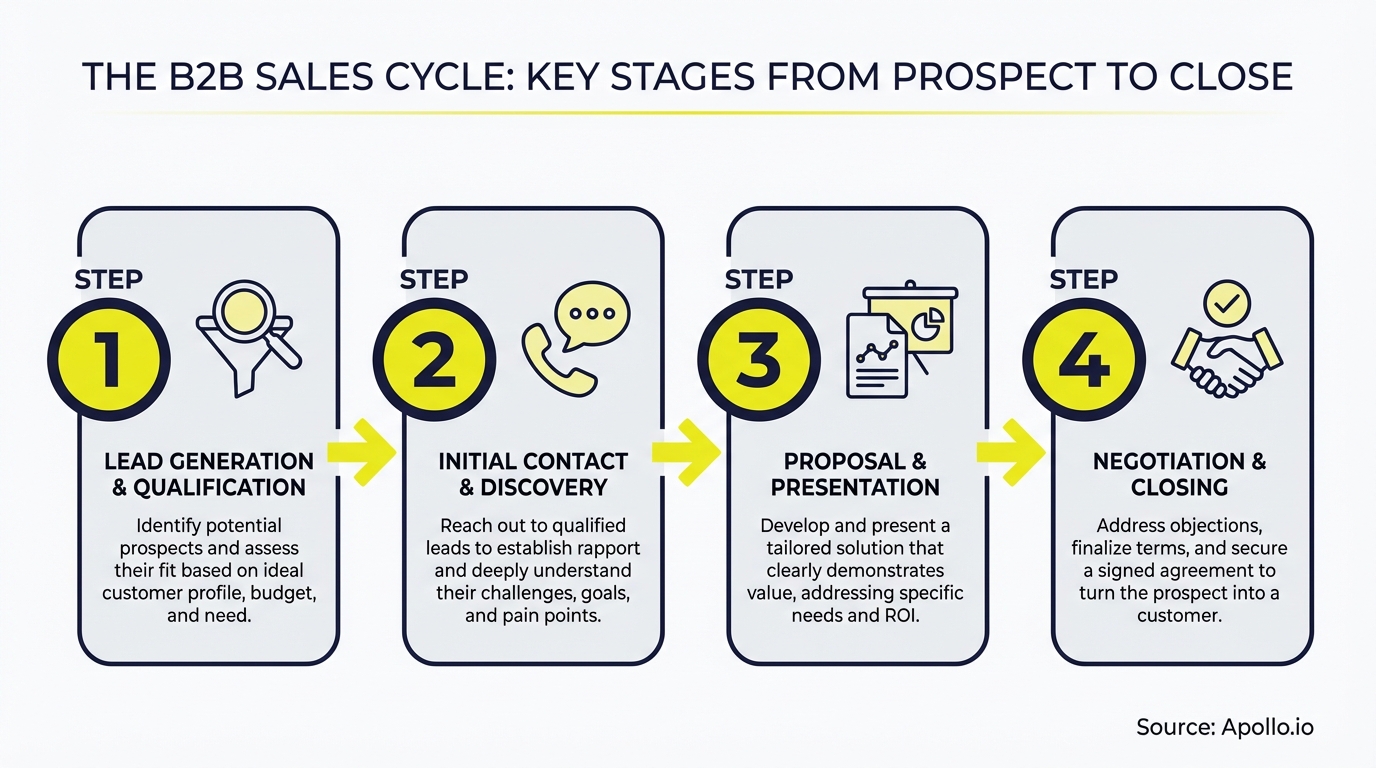
The B2B sales cycle is the complete journey from identifying a prospect to closing a deal and nurturing the customer relationship. It encompasses seven core stages: prospecting, qualification, discovery, proposal, negotiation, close, and post-sale engagement.
Each stage requires specific actions, tools, and metrics to move opportunities forward.
According to Gartner research, 60% of B2B sales organizations have transitioned to data-driven selling approaches that integrate processes, applications, and analytics. This shift fundamentally changes how sales teams execute each stage, replacing gut instinct with verified contact data and behavioral signals.
Modern B2B sales organizations balance automation with personalization. While AI handles research and outreach sequencing, human sellers focus on relationship-building and complex problem-solving that buyers still demand for high-value purchases.
Why Has the B2B Sales Cycle Changed So Dramatically?
Three major forces reshaped the B2B sales cycle between 2024 and 2026: buyer preference for self-service, AI adoption in sales workflows, and the rise of hybrid sales models.

Gartner surveys show that 61% of B2B buyers now prefer rep-free buying experiences, favoring digital self-service for research and evaluation. This doesn't eliminate sales teams but redefines when and how they engage. Sellers must provide value beyond information that buyers can access independently.
Research by McKinsey confirms that 85% of B2B organizations now expect hybrid sales roles combining digital and in-person interactions to be the norm. Sales professionals who master both channels outperform specialists focused on just one approach.
Apollo Turns Forecast Guesswork Into Revenue
Pipeline forecasting feel like a coin flip? Apollo delivers real-time deal visibility and intent signals so you can predict revenue with confidence. Join 550K+ companies who turned unreliable forecasts into predictable growth.
Start Free with Apollo →What Are the Seven Stages of the B2B Sales Cycle?
Each stage of the B2B sales cycle serves a distinct purpose and requires specific actions from your sales team:
| Stage | Primary Goal | Key Activities | Success Metrics |
|---|---|---|---|
| Prospecting | Identify potential buyers | Search databases, build target lists, verify contacts | Qualified leads per week |
| Qualification | Assess fit and readiness | BANT analysis, stakeholder mapping, budget confirmation | SQL conversion rate |
| Discovery | Understand pain points | Needs assessment calls, technical deep-dives, demo scheduling | Discovery call completion |
| Proposal | Present tailored solution | Custom proposals, ROI analysis, pricing discussions | Proposal acceptance rate |
| Negotiation | Address objections | Contract revisions, stakeholder alignment, legal review | Days in negotiation |
| Close | Secure signed agreement | Final approvals, contract signing, payment processing | Win rate percentage |
| Post-Sale | Ensure adoption and retention | Onboarding, check-ins, upsell identification | Customer lifetime value |
Struggling to find qualified leads at scale? Search Apollo's 224M+ verified contacts with 65+ filters to build targeted prospect lists in minutes.
How Do SDRs Accelerate the Early Sales Cycle Stages?
SDRs and BDRs own the critical prospecting and qualification stages that determine pipeline quality. In 2026, top-performing SDRs use AI to automate research while preserving personalized outreach that resonates with prospects.
Modern SDRs consolidate prospecting, enrichment, and engagement tools into unified platforms. This eliminates data silos and reduces the time spent switching between systems.
Teams using integrated solutions report spending more time on actual conversations and less on administrative tasks.
For SDRs building outbound motion, AI sales tools handle contact discovery, email verification, and sequence personalization. This allows reps to focus on crafting compelling messaging and handling objections rather than manual list building.
What Qualification Framework Works Best in 2026?
The BANT framework (Budget, Authority, Need, Timeline) remains foundational but requires adaptation for consensus-driven buying. Research from Gartner found that 74% of B2B buyer teams demonstrate unhealthy conflict during decision processes.
Effective qualification now includes stakeholder mapping, consensus-building assessment, and change readiness evaluation. SDRs must identify all decision-makers early and understand internal politics that could derail deals later in the cycle.
How Do Account Executives Shorten the Sales Cycle?
Account Executives managing complex deals face longer cycles with more stakeholders involved. The key to acceleration is providing the right information at the right time to all decision-makers, not just your primary contact.
AEs in 2026 leverage conversation intelligence to capture insights from every call and share them across the buying committee. This ensures consistent messaging and prevents miscommunication that extends negotiations. Conversation intelligence platforms automatically generate call summaries, action items, and deal risk signals.
Top AEs also use intent data to identify when prospects actively research solutions. This signals buying readiness and optimal timing for outreach, reducing wasted effort on accounts not yet in-market.
Tired of juggling multiple tools for prospecting, outreach, and deal tracking? Manage your entire pipeline in one platform with Apollo's deal management system.
What Role Does AI Play Across the Sales Cycle?
AI augments every stage of the B2B sales cycle without replacing human judgment. The technology excels at pattern recognition, data processing, and routine task automation, freeing sellers to focus on strategic activities.
In prospecting, AI analyzes firmographic and technographic data to surface ideal customer profile matches. During discovery, AI suggests relevant questions based on previous successful deals.
For proposals, AI can generate first-draft ROI calculations and pricing scenarios.
However, Gartner predicts that by 2030, 75% of B2B buyers will prefer sales experiences prioritizing human interaction over AI. This means sellers must thoughtfully integrate AI as a supporting tool, not a replacement for authentic relationship-building.
How Can Sales Leaders Optimize Their Team's Sales Cycle?
Sales leaders in 2026 focus on three optimization levers: tool consolidation, process standardization, and continuous coaching based on performance data.
Tool consolidation delivers immediate impact. Teams using 3-5 separate systems for prospecting, engagement, and CRM face data fragmentation and workflow inefficiencies. As one Apollo customer noted, "We reduced the complexity of three tools into one." Another reported, "We cut our costs in half."
Process standardization ensures consistent execution across the team. This includes defining stage exit criteria, required activities per stage, and handoff protocols between SDRs and AEs. B2B sales processes that document best practices enable faster rep ramp-up and more predictable results.
RevOps leaders find that unified platforms provide complete visibility into pipeline health, stage conversion rates, and individual rep performance. This data-driven approach identifies bottlenecks and coaching opportunities that accelerate the entire sales cycle.
Start Optimizing Your B2B Sales Cycle Today
The B2B sales cycle in 2026 demands a hybrid approach: AI-powered efficiency combined with human-centered relationship building. Organizations that master this balance will outpace competitors still relying on outdated, experience-based selling methods.
Begin by auditing your current sales cycle. Map each stage, measure conversion rates, and identify where deals stall.
Then consolidate your tech stack to eliminate data silos and workflow friction. Finally, implement AI thoughtfully to augment your team's capabilities without sacrificing the authentic connections buyers still value.
Ready to accelerate your sales cycle with a unified platform? Request a Demo to see how Apollo helps teams prospect, engage, and close faster.
Prove Apollo's ROI In Your First 30 Days
Budget approval stuck on unclear metrics? Apollo tracks every touchpoint from prospect to closed deal, giving you measurable pipeline impact. Built-In increased win rates 10% and ACV 10% with Apollo's data-driven approach.
Start Free with Apollo →Don't miss these
Sales
Inbound vs Outbound Marketing: Which Strategy Wins?
Sales
What Is a Sales Funnel? The Non-Linear Revenue Framework for 2026
Sales
What Is a Go-to-Market Strategy? The 2026 GTM Playbook
See Apollo in action
We'd love to show how Apollo can help you sell better.
By submitting this form, you will receive information, tips, and promotions from Apollo. To learn more, see our Privacy Statement.
4.7/5 based on 9,690 reviews
