
Apollo vs Mailchimp (2026): Which Platform Is Right for B2B Sales Teams?
If you're comparing Apollo and Mailchimp for outbound email and sales engagement, you're really comparing two different philosophies. Mailchimp is built for marketing teams that want to nurture existing audiences with campaigns and automation.
Apollo is built for B2B sales teams that need to find, contact, and convert new prospects. Both send emails.
The similarities largely stop there.
This comparison breaks down what each platform actually does, where they differ, and which one fits your workflow in 2026.

Research Smarter, Not Harder With Apollo
Tired of burning hours verifying contact info that goes nowhere? Apollo delivers 240M+ contacts with 98% email accuracy so your reps spend time selling, not searching. Start building real pipeline today.
Start Free with Apollo →Key Takeaways
- Platform scope: Apollo combines a B2B contact database, multi-channel sequencing, dialer, and analytics in one connected GTM system. Mailchimp focuses on email and SMS marketing campaigns for existing contact lists.
- Audience fit: Apollo serves B2B GTM teams, GTM Engineers, and AI Builders building headless GTM workflows with the Apollo API, CLI, and MCP, alongside Sales Professionals, SDRs/BDRs, AEs, RevOps, Marketing, and Revenue Leaders. Mailchimp primarily serves small businesses, e-commerce brands, and marketing teams managing subscriber lists.
- Prospecting capability: Apollo includes a database of 240M+ people with verified contact data built in. Mailchimp does not include a prospecting database.
- AI capabilities: Apollo's AI features span sequence building, lead scoring, call summaries, and research agents. Mailchimp's AI tool (Intuit Assist) focuses on email content generation.
- Pricing model: Apollo prices per user with a credit system for data. Mailchimp prices per contact count, with costs scaling as your list grows.
What is Apollo?

Apollo is an AI GTM system that unifies data, intelligence, and execution into one connected GTM system, purpose-built for B2B revenue teams that need to generate pipeline from scratch. Rather than starting with a list you already own, Apollo helps teams identify, research, and reach the right buyers using a verified database alongside integrated outreach tools.
Core capabilities include prospecting with 65+ filters, multi-channel sequences across email, phone, and social, a Power Dialer and Parallel Dialer, AI-driven lead scoring and research agents, inbound routing, CRM enrichment, and outbound analytics. Apollo's B2B data network carries 98% email accuracy, and the platform is used by nearly 5M users across 600K+ companies, including 100+ teams at Fortune 500 companies.
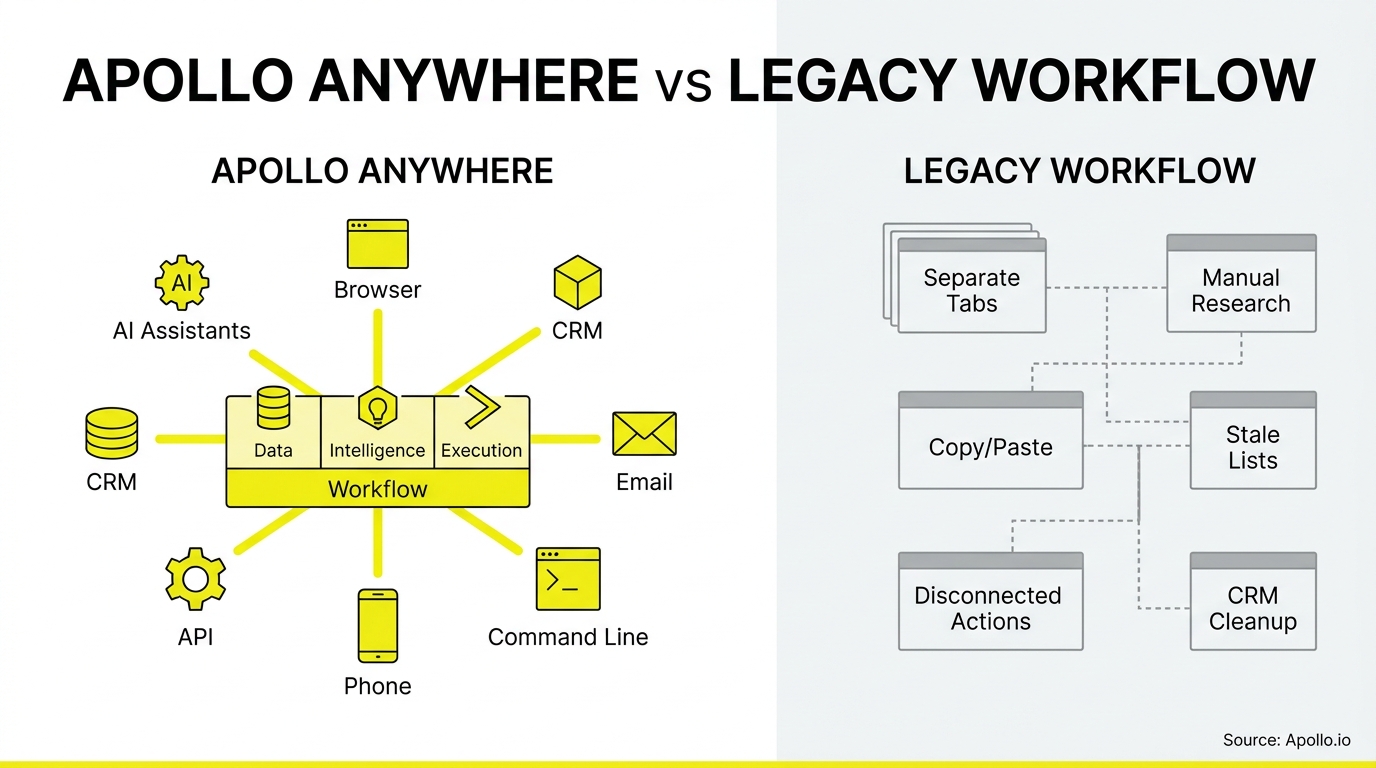
Apollo meets sellers inside the tools they already use. Through Apollo MCP, Apollo's Model Context Protocol, teams can surface contact and account intelligence directly inside AI assistants like ChatGPT, Codex, Claude, and Perplexity. The Chrome extension enables prospecting across the web without leaving your browser. For technical and advanced users, the Apollo CLI provides terminal-native access for headless GTM workflows.
Market adoption reflects that reach. According to Ramp's vendor data, as of July 2026, Apollo holds a 38% adoption rate among businesses using sales data provider software, up 5 percentage points year-over-year, with 34% of all first-time buyers in the category choosing Apollo as their first vendor. Apollo offers transparent pricing starting at $49/user/month (annual billing), with a free tier available.

Apollo has earned the 2026 MarTech Breakthrough Award for "Best AI-Powered Sales Solution" and holds a 4.7/5 rating on G2.
What is Mailchimp?

Mailchimp is an email and SMS marketing platform designed to help businesses manage and communicate with existing audiences. Its core use case is campaign-based: you upload or build a contact list, design an email, and send it to subscribers. The platform has expanded over the years to include marketing automation flows, landing pages, signup forms, and a marketing CRM that stores customer tags and behavioral data.
Mailchimp's automation builder supports flows up to 200 steps on Standard and Premium plans, enabling drip sequences based on subscriber behavior, purchase events, or time triggers. The platform's AI tool, Intuit Assist, helps generate email subject lines and body copy.
A/B and multivariate testing are available for optimizing campaigns.
The platform connects to 300+ third-party apps, including Shopify, WooCommerce, and Canva, making it a fit for e-commerce and direct-to-consumer brands managing subscriber relationships. Mailchimp does not include a B2B prospecting database or built-in dialer.
Outreach is limited to email and SMS, and contact records must be imported or collected through forms rather than discovered through the platform itself.
Mailchimp's pricing follows a per-contact model. The Free plan allows up to 250 contacts and 500 sends per month.
The Essentials plan starts at $13/month for 500 contacts (monthly billing). The Standard plan starts at $20/month for 500 contacts and unlocks automation flows up to 200 steps and generative AI features.
The Premium plan starts at $350/month for 10,000 contacts and includes phone support, a dedicated onboarding specialist, and unlimited seats. Pricing scales upward as contact counts grow, and SMS credits are purchased separately as an add-on.
Mailchimp's target audience is primarily small businesses, e-commerce retailers, and marketing teams focused on subscriber engagement rather than outbound prospecting.

Feature Comparison
| Feature | Apollo | Mailchimp |
|---|---|---|
| Starting Price | $49/user/month (annual billing), see full pricing | $13/month for 500 contacts (monthly billing), see full pricing |
| B2B Database | 240M+ people, 30M+ companies with 65+ filters | Not included, contacts must be imported or collected via forms |
| Email Accuracy | 98% verified email accuracy | Not applicable, no prospecting database |
| Sequences | Multi-channel (email, calls, social, tasks) with AI sequence builder | Email automation flows up to 200 steps (Standard/Premium); SMS add-on available |
| Dialer | Power Dialer and Parallel Dialer with AI call summaries and voicemail drop | Not included |
| AI Capabilities | AI sequence builder, lead scoring, research agent, call summaries, sentiment analysis | Intuit Assist for email content generation (subject lines, body copy) |
| Data Enrichment | Waterfall enrichment, CRM sync, CSV enrichment, API enrichment | Marketing CRM with tags and behavioral data; no sales intelligence enrichment |
| Free Trial | Free tier with 900 credits/year; no time limit | Free plan (up to 250 contacts); 14-day free trial on paid plans |
The core difference is scope. Apollo is built to generate new pipeline, combining prospecting, outreach execution, and analytics in one system.
Mailchimp is built to manage and message contacts you already have, with strong campaign tooling for marketers. For B2B sales teams running outbound, these are meaningfully different tools.
Turn Funnel Guesswork Into Real Pipeline
Tired of watching marketing leads stall before they ever reach your pipeline? Apollo surfaces in-market buyers the moment they're ready, so your team stops guessing and starts closing. 600K+ companies trust Apollo to hit quota.
Start Free with Apollo →Pricing Comparison
Apollo and Mailchimp use different pricing models, which makes a direct comparison more nuanced than looking at a single number.
Apollo prices per user on annual billing plans:
- Free: $0, 900 credits/year, 2 sequences, basic filters
- Basic: $49/user/month, 30,000 credits/year, unlimited sequences, CRM integrations, 6 intent topics
- Professional: $79/user/month, 48,000 credits/year, US dialer, 5 mailboxes, automated workflows, AI research
- Organization: $119/user/month (minimum 3 users), 72,000 credits/year, international dialer, 15 mailboxes, SSO, advanced security
Credits are used for data access and enrichment. Apollo's pricing gives teams a predictable per-seat cost regardless of how large their target market is.
Mailchimp's pricing scales with contact count rather than user count:
- Free: $0, up to 250 contacts, 500 sends/month, 1 seat
- Essentials: starts at $13/month for 500 contacts, 3 seats, basic automation
- Standard: starts at $20/month for 500 contacts, 5 seats, 200-step automation flows, Intuit Assist AI
- Premium: starts at $350/month for 10,000 contacts, unlimited seats, phone support, dedicated onboarding
Mailchimp's entry-level pricing is lower for small lists, but costs grow as your contact database expands. SMS credits are a separate add-on purchase.
Teams with large lists or who send at high volume should model out actual costs carefully before assuming the base price applies to their situation.
The fundamental difference: Apollo's cost is driven by seats and data credit usage, supporting prospecting into new markets. Mailchimp's cost is driven by list size, suited to campaigns sent to known subscribers.
How Apollo Differs from Mailchimp
For B2B sales teams running cold outreach, the most important distinction is that Apollo includes the database. Teams using Mailchimp for cold email still need to source contacts from elsewhere, import them, manage deliverability externally, and run sequences without a dialer.
Apollo handles all of that within the same platform, with sender health monitoring, email warmup, and deliverability guardrails built in alongside the outreach tools. As Collin Stewart at Predictable Revenue put it:
"We reduced the complexity of three tools into one.", -Collin Stewart, CEO at Predictable Revenue
Apollo's AI capabilities also extend further into the sales workflow. Where Mailchimp's Intuit Assist generates email content, Apollo's AI research agent pulls account context to personalize outreach at scale, scores leads against your ICP, summarizes calls, and flags sentiment across sequences. Teams can build entire sequences from a natural language prompt using the AI Sequence Builder, then let the platform optimize timing and follow-ups automatically. Learn more about building effective email campaigns in Apollo.
According to Ramp's Sales Data Providers category data, as of July 2026, Apollo is the fastest-growing vendor in the category, averaging +0.7 percentage points per month in adoption, outpacing every other sales data provider tracked. That growth reflects teams actively consolidating their prospecting and engagement stack rather than running disconnected tools.

Apollo also serves a different execution model for technical teams. GTM Engineers and AI Builders can access Apollo's contact and account data programmatically through the Apollo API or build headless workflows using Apollo MCP inside AI assistants. Mailchimp offers an API as well, but its design is oriented around campaign management rather than sales intelligence retrieval or outbound workflow automation.
Frequently Asked Questions
Can you use Mailchimp for B2B cold outreach?
Mailchimp can send email to any list you upload, but it is not designed for cold outreach. It does not include a B2B prospecting database, and cold emailing to purchased or third-party lists may conflict with its terms of service.
Teams focused on cold outbound typically use platforms built for that workflow, with verified contact data and deliverability tooling included.
Does Apollo replace Mailchimp?
For B2B sales teams, Apollo covers the outbound use case end to end, as detailed above. For marketing teams managing newsletter subscribers, promotional campaigns, or e-commerce automations, Mailchimp's contact-management and campaign features may still be relevant.
The overlap is limited because the core use cases are different.
Is Apollo suitable for teams at all stages, including enterprise?
Apollo serves B2B GTM teams, GTM Engineers, and AI Builders building headless GTM workflows with the Apollo API, CLI, and MCP, alongside Sales Professionals, SDRs/BDRs, AEs, RevOps, Marketing, and Revenue Leaders. The Organization tier includes SSO, advanced security, admin controls, and international dialing capabilities used by companies at scale, including 100+ teams at Fortune 500 companies.
How does Apollo's free tier compare to Mailchimp's free plan?
Apollo's free tier has no time limit and includes access to the prospecting database and core sequencing features, as covered in the pricing section above. Mailchimp's free plan is limited to 250 contacts and 500 sends per month.
The two free tiers address different needs: Apollo's is designed for sales reps testing the outbound workflow, while Mailchimp's supports very small subscriber lists for basic campaign sends.
What should I look for when choosing between Apollo and Mailchimp?
Start with your workflow. If your team needs to find new B2B contacts, run multi-channel outreach, and track pipeline from cold to close, Apollo is built for that end to end.
If your team manages an existing subscriber base and runs marketing campaigns to that audience, Mailchimp addresses that use case. Many organizations use both: a sales team on Apollo for outbound pipeline and a marketing team on Mailchimp for subscriber communications.

Conclusion
Apollo and Mailchimp serve genuinely different jobs. Mailchimp is a marketing platform for managing and messaging audiences you already have.
Apollo is an AI GTM system built to help B2B teams identify, reach, and convert new buyers, with the database, sequencing, dialer, enrichment, and analytics all connected in one system.
For B2B sales teams evaluating platforms for outbound prospecting and multi-channel engagement, Apollo addresses the full workflow without requiring separate tools for data, outreach, and calling. For teams that want to see the platform before committing, try Apollo free today and explore the database, sequences, and AI features at no cost.
Prove Pipeline ROI Before Next Quarter
ROI pressure killing your tool adoption? Apollo delivers measurable pipeline impact from day one — so you justify the investment fast. Leadium 3x'd annual revenue. Built-In added 10% ACV. Your turn.
Start Free with Apollo →Don't miss these
Sales
Inbound vs Outbound Marketing: Which Strategy Wins?
Sales
What Is a Sales Funnel? The Non-Linear Revenue Framework for 2026
Sales
What Is a Go-to-Market Strategy? The 2026 GTM Playbook
See Apollo in action
We'd love to show how Apollo can help you sell better.
By submitting this form, you will receive information, tips, and promotions from Apollo. To learn more, see our Privacy Statement.
4.7/5 based on 9,690 reviews
