
AI for Sales Prospecting: How to Find and Convert Your Best Leads
Sales teams waste countless hours manually researching prospects, crafting personalized emails, and tracking down contact information. By 2026, AI has transformed this reality. Cirrus Insight reports that 56% of sales professionals now use AI daily, and the impact on prospecting efficiency is measurable. Modern sales prospecting strategies now leverage AI to identify high-intent leads, personalize outreach at scale, and predict which prospects are most likely to convert.

Apollo Eliminates 4+ Hours Of Daily Research
Tired of spending 4+ hours daily hunting for contact info? Apollo finds verified emails and mobile numbers instantly with 96% accuracy. Join 550K+ companies who turned research time into selling time.
Start Free with Apollo →Key Takeaways
- AI prospecting tools automate research, lead scoring, and personalized messaging to save hours per week
- According to Sopro, only 12% of companies report not using AI for prospecting, indicating near-universal adoption
- RevOps teams need governance frameworks, data quality controls, and measurement plans to scale AI prospecting safely
- AI agents are shifting SDR roles from manual research to strategic oversight and quality assurance
What Is AI for Sales Prospecting?
AI for sales prospecting uses machine learning and natural language processing to automate lead identification, research, personalization, and outreach. The technology analyzes massive datasets to surface high-intent prospects, enriches contact records with verified information, and generates contextually relevant messaging based on prospect behavior and firmographic data.
According to GPTZero, AI adoption among sales representatives nearly doubled, rising from 24% in 2023 to 43% in 2024. Modern AI prospecting platforms integrate directly into CRM systems and outreach tools, creating unified workflows that eliminate manual data entry and tool switching.
For SDRs and BDRs, this means spending less time on administrative tasks and more time on high-value conversations. Automated prospecting workflows handle list building, contact enrichment, and initial outreach sequences while humans focus on relationship building and deal qualification.
How Does AI Prospecting Work in 2026?
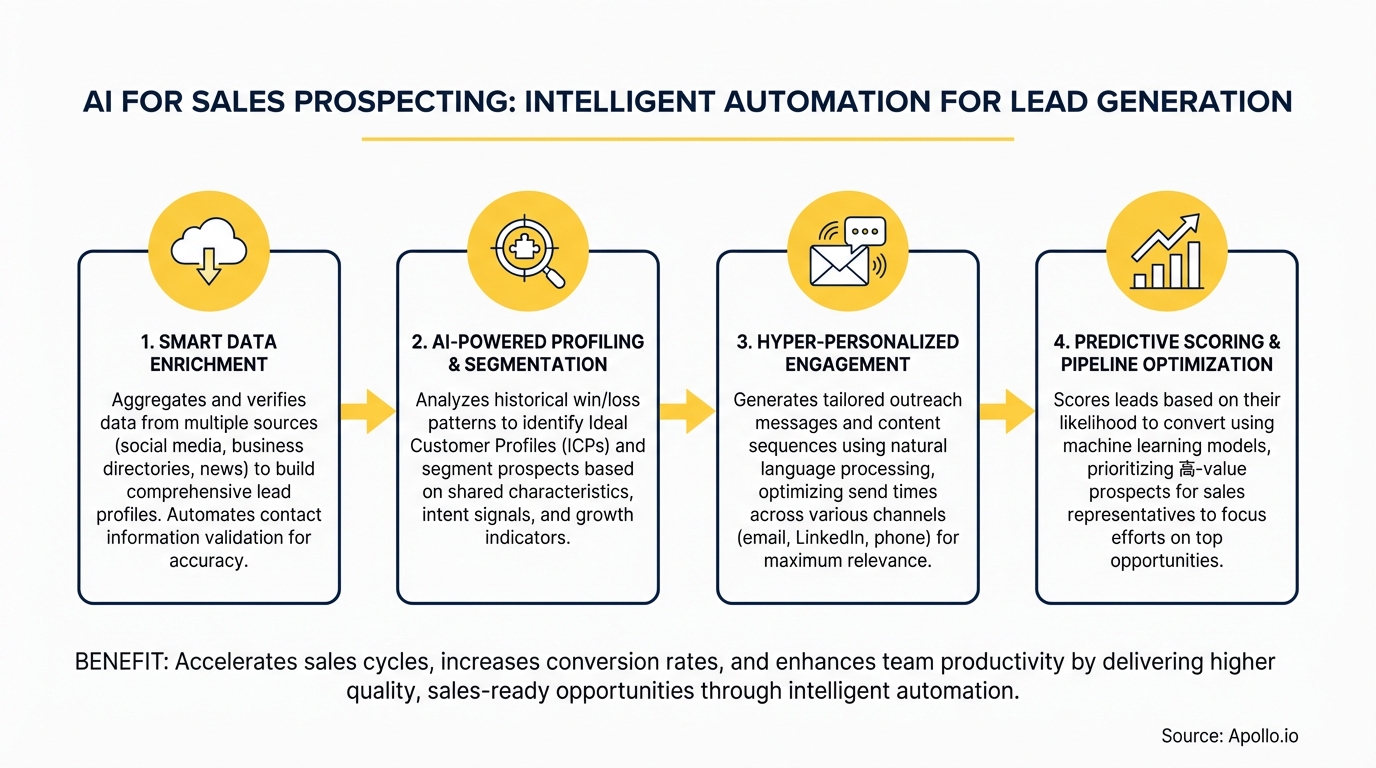
AI prospecting operates through three core functions: intelligent lead discovery, automated enrichment, and personalized engagement at scale.
Intelligent Lead Discovery: AI analyzes buyer intent signals (website visits, content downloads, job changes, funding announcements) to identify prospects actively researching solutions. Machine learning models score leads based on fit and timing, prioritizing accounts showing buying behavior over static ICP matches.
Automated Enrichment: AI continuously updates contact records with verified email addresses, phone numbers, job titles, and company data. Salaria Sales notes that the integration of AI with CRM platforms enables businesses to manage customer data more effectively through automated lead scoring, predictive customer needs, and actionable insights for sales teams.
Personalized Engagement: Natural language models generate customized emails, messages, and call scripts based on prospect context. The AI references recent company news, mutual connections, relevant case studies, and specific pain points to create relevant outreach that resonates with individual buyers.
Struggling to find qualified leads? Search Apollo's 224M+ contacts with 65+ filters and let AI surface your best-fit prospects automatically.
Why Are Sales Teams Adopting AI Prospecting?
The business case for AI prospecting centers on measurable time savings and revenue impact. Teams adopting AI report significant improvements across key prospecting metrics.
Time Efficiency: Manual prospect research consumes hours daily. AI handles list building, data enrichment, and initial outreach drafting in minutes, freeing sellers to focus on conversations. According to Rev Empire, 81% of sales leaders believe AI helps their teams spend less time on manual and administrative tasks.
Revenue Performance:Dring.ai reports that companies using generative AI have reported a 20% increase in customer satisfaction and a 15% boost in sales conversion rates. Better targeting and personalization translate directly to higher connect and conversion rates.
Scale Without Headcount: AI prospecting enables small teams to execute enterprise-level outreach programs. One SDR with AI tools can manage the same volume as three without automation, making it particularly valuable for startups and mid-market companies competing against larger competitors.
How Do SDRs Use AI to Book More Meetings?
SDRs leverage AI across the entire prospecting workflow, from initial research to meeting confirmation.
Research Automation: AI agents scan news, social media, earnings calls, and job postings to identify trigger events and talking points. Instead of spending 30 minutes researching each account, SDRs review AI-generated summaries highlighting relevant context and suggested angles.
Personalization at Scale: AI references specific details (recent funding, product launches, hiring patterns) in outreach templates. Modern prospecting tools generate unique first lines for hundreds of prospects while maintaining authentic, human tone.
Optimal Timing: Machine learning models predict the best send times based on prospect engagement patterns. AI sequences automatically pause when prospects show buying signals (visiting pricing pages, downloading resources) and trigger alerts for human follow-up.
Follow-Up Intelligence: AI analyzes email opens, clicks, and replies to recommend next steps. When prospects engage but don't respond, AI suggests alternative channels (phone, social) or revised messaging angles based on what's working across similar accounts.

What Should RevOps Teams Know About AI Prospecting Implementation?
RevOps leaders own the operational foundation that determines AI prospecting success or failure. Implementation requires more than buying tools.
Data Quality Gates: AI outputs reflect input quality. RevOps must establish CRM hygiene standards, deduplication processes, and enrichment workflows before scaling AI-generated outreach. Garbage data creates garbage personalization that damages brand reputation.
Governance Frameworks: Set approval workflows for AI-generated content, send volume limits to protect domain reputation, and compliance checks for regulated industries. B2B Fusion Group notes that AI in Revenue Operations refers to the use of AI to automate, optimize, and unify revenue-generating processes across sales, marketing, and customer success.
Measurement Infrastructure: Define KPIs before launch (reply rates, meeting conversion, pipeline contribution). Build holdout groups to isolate AI impact from other variables. Track leading indicators (personalization quality scores, send time optimization) alongside lagging outcomes.
Change Management: SDRs need training on prompting AI tools, reviewing outputs for accuracy, and adding human judgment to automated workflows. Create playbooks showing when to override AI recommendations and escalate edge cases.
Tired of managing multiple prospecting tools? Consolidate your tech stack with Apollo's AI sales automation and manage data, sequences, and analytics in one unified platform.
Turn Unreliable Forecasts Into Revenue Clarity
Forecasting a guessing game because deal data isn't real-time. Apollo gives you live pipeline visibility and accurate contact intelligence so you can predict revenue with confidence. Join 550K+ companies who eliminated forecast surprises.
Start Free with Apollo →How Should Sales Leaders Measure AI Prospecting ROI?
Measuring AI prospecting requires tracking both efficiency gains and revenue outcomes across the full funnel.
Activity Metrics:
- Time saved per rep (research, list building, email drafting)
- Prospects contacted per day (before vs after AI)
- Personalization quality scores (human review sampling)
Engagement Metrics:
- Email open rates, reply rates, positive reply rates
- Connect rates on calls (AI-prioritized leads vs random)
- Meeting booking rates from AI-assisted sequences
Revenue Metrics:
- Pipeline generated from AI-sourced leads
- Win rates by lead source (AI-scored vs manual)
- Customer acquisition cost reduction
According to The Future of Commerce, McKinsey forecasts that generative AI could unlock approximately $1 trillion worth of productivity gains across sales and marketing. Track these metrics in your sales analytics dashboard to quantify your AI investment returns.
What Are the Risks and How Do You Mitigate Them?
AI prospecting introduces new operational risks that require proactive governance.
Compliance Risks: AI-generated outreach must comply with CAN-SPAM, GDPR, and industry regulations.
Implement approval workflows for sensitive industries, maintain opt-out lists, and include required disclosures in templates.
Never let AI bypass compliance controls for speed.
Brand Risks: Generic or inaccurate AI personalization damages sender reputation. Set quality thresholds, require human review for executive outreach, and monitor unsubscribe rates as early warning signals. One badly personalized email to a key account costs more than the time saved.
Data Privacy: Ensure AI vendors meet security standards for customer data. Understand where prospect data is processed and stored. Implement data retention policies and document AI tool access in your security reviews.
Over-Reliance: AI should augment human judgment, not replace it. Train reps to add strategic context, override poor recommendations, and escalate edge cases. The best results come from human-AI collaboration, not full automation.
Start Scaling AI Prospecting in 2026
AI for sales prospecting has moved from experimental to essential. Teams using AI to identify high-intent prospects, personalize outreach, and automate research workflows are booking more meetings with less effort.
The implementation playbook is clear: start with data quality, establish governance frameworks, measure both efficiency and outcomes, and train teams on human-AI collaboration. Sales leaders who invest in AI prospecting infrastructure today will build sustainable competitive advantages as the technology continues advancing.
For SDRs and BDRs, AI eliminates hours of manual research and administrative work. For Account Executives, AI-qualified leads arrive with complete context and buying signals.
For RevOps, unified platforms reduce tool sprawl and improve data quality. As Collin Stewart from Predictable Revenue noted, "We reduced the complexity of three tools into one" when consolidating to an AI-powered prospecting platform.
Ready to transform your prospecting workflow? Try Apollo Free and experience AI-powered prospecting with 224M+ verified contacts, automated sequences, and built-in analytics in one unified platform.
Prove Apollo's ROI In Your First 30 Days
Budget approvals stuck on unclear metrics? Apollo tracks every touchpoint from prospect to closed deal so you can show leadership exactly what's working. Built-In increased win rates 10% and ACV 10% with Apollo's pipeline visibility.
Start Free with Apollo →Don't miss these
Sales
Inbound vs Outbound Marketing: Which Strategy Wins?
Sales
What Is a Sales Funnel? The Non-Linear Revenue Framework for 2026
Sales
What Is a Go-to-Market Strategy? The 2026 GTM Playbook
See Apollo in action
We'd love to show how Apollo can help you sell better.
By submitting this form, you will receive information, tips, and promotions from Apollo. To learn more, see our Privacy Statement.
4.7/5 based on 9,690 reviews
