The Problem 🥶
Apollo Workflows are designed to handle the heavy lifting in your sales process - think "scheduling tasks", "updating contact records", and "driving outreach". Helping teams reduce manual work and drive the pipeline more efficiently. While this end-to-end automation streamlines outreach and collaboration, it can feel overwhelming due to workflow options.
Most new users hit a wall when trying to set up powerful automations. Why? Generic starter templates just don’t cut it. They ignore the very things that make your company unique - your domain, ICP (Ideal Customer Profile), roles, locations, and pain points. This leads to confusion, frustration, and high drop-off rates during onboarding. And a broken onboarding experience has consequences for the long-term retention and renewals of a customer.

The Solution 🛠️
Enter AI-powered Workflow Recommendations. Built during Apollo’s hackathon, this feature turns your team’s specific details like industry, value proposition, target roles, and geographies into tailor-made automations. This is designed to solve the zero-to-one problem in workflows. Instead of starting from a blank builder, teams get a short list of relevant, ready-to-run starting points tailored to their context.
What are AI-powered Workflow Recommendations?
Static templates treat every team the same. Our AI workflow recommendations do the opposite: they’re custom-fit for your team’s
- Domain
- Pain points
- Value proposition
- ICP (Ideal Customer Profile of the company)
- Target roles, locations, and industries
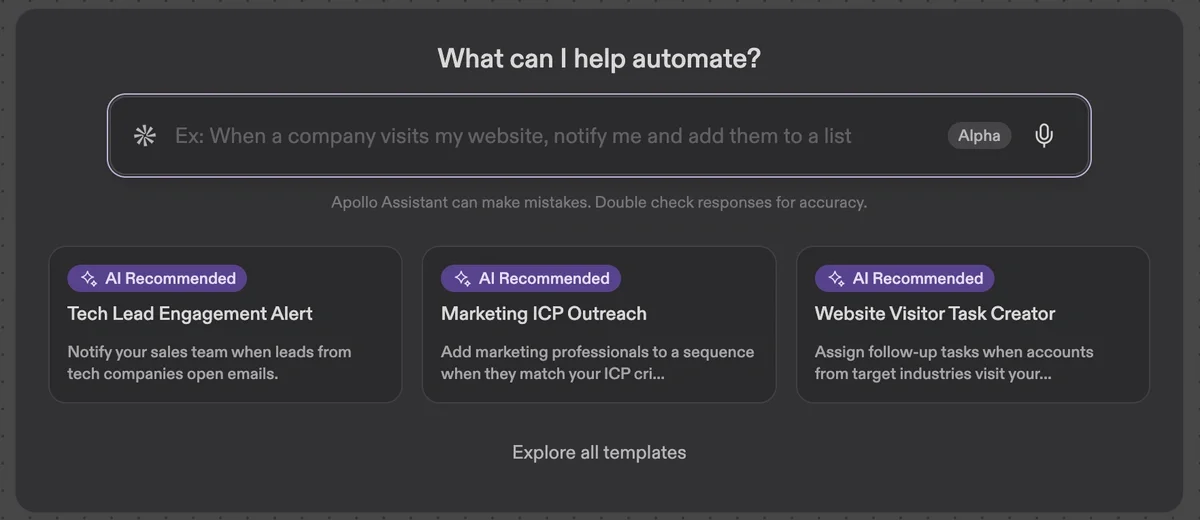
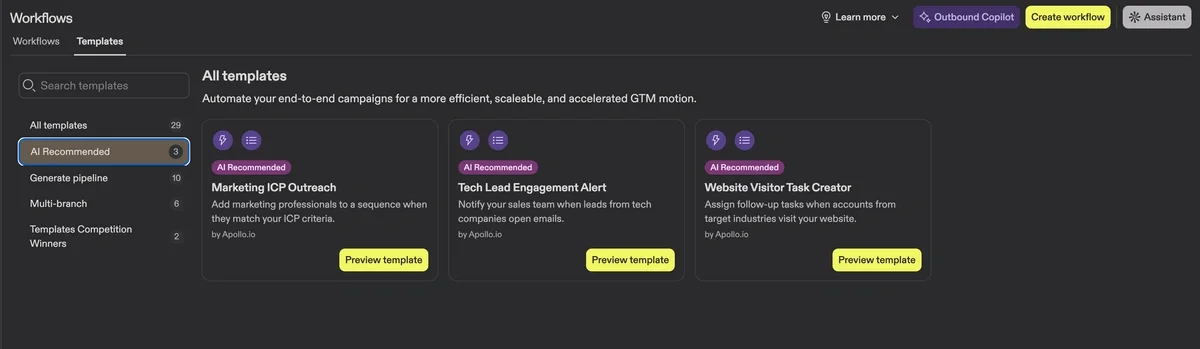
Each recommendation is generated by an LLM, turning your company's context into personalized workflows with relevant triggers, filters, and actions. As a user, you see these recommendations right in the workflow-builder starter screen and within the "Templates Library" - no searching required. Each recommendation is a starting point you can customize in the builder, so you get to the "first workflow" faster and then tailor it to your needs.
Examples:
- Tech Lead Engagement Alert: Notify your sales team when leads from tech companies open emails.
Prompt used: “Create a workflow that sends a Slack notification when contacts with Sales Development Manager, VP of Sales, or Marketing Operations Manager titles from computer software or IT companies open an email. Target companies in San Francisco, New York, Austin, Chicago, or Los Angeles.” - Marketing ICP Outreach: Add marketing professionals to a sequence when they match your ICP criteria.
Prompt used: “Create a workflow that runs every week to find new contacts in Marketing Operations Manager or Sales Enablement Specialist roles at companies in the marketing & advertising industry. Target companies in San Francisco, New York, Austin, Chicago, or Los Angeles. When matches are found, add them to a sequence.” - Website Visitor Task Creator: Assign follow-up tasks when accounts from target industries visit your website.
Prompt used: “Create a workflow that creates a manual task for the account owner when a company from the computer software, marketing & advertising, or information technology & services industries visits the Apollo.io website. Focus on companies in San Francisco, New York, Austin, Chicago, or Los Angeles.”
How do these AI workflow recommendations work? 🪄
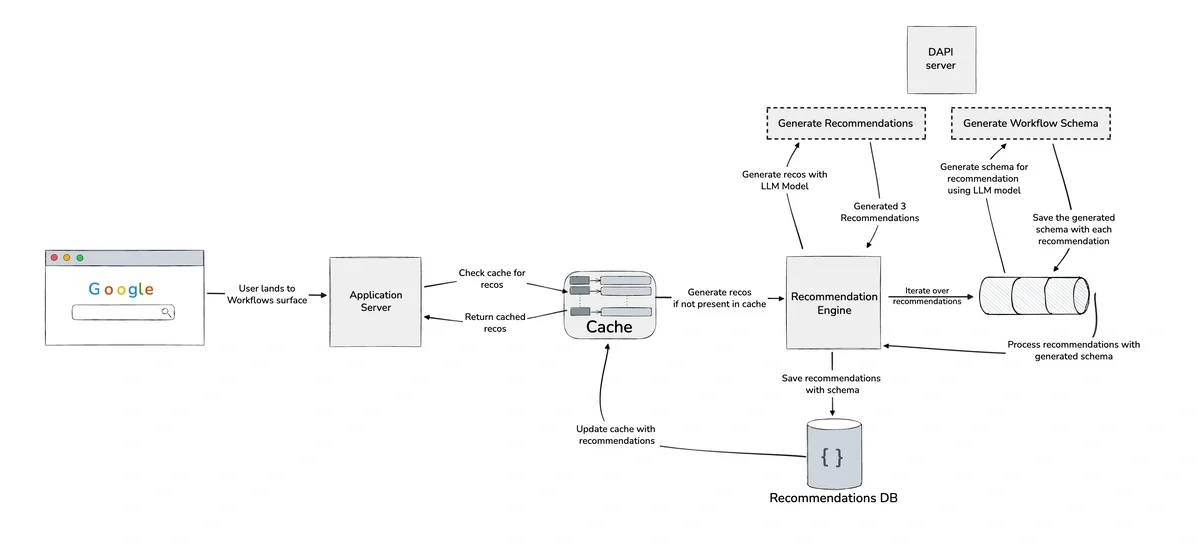
Here’s how the magic happens behind the scenes:
- Cache Check on Load: When you land on the workflows surface in Apollo's dashboard, the system checks for cached recommendations. A cache miss means that your team's data (pain points, ICP, etc.) is sent to our engine, which generates tailor-made suggestions.
- Recommendation Generation: If your team's data is missing or incomplete, an asynchronous job will start and process. It pulls these data points (pain points, ICP, etc.) and calls our data-platform server (we call it DAPI) to request custom recommendations.
- Workflow Schema Creation: Once the recommendations are generated, the engine translates each of those into ready-to-use workflow schemas. These schemas are the "actual" workflows, slashing your setup time.
- Persist and Cache for Fast Reuse: Each workflow recommendation (with its schema) is saved to the database, and the cache is updated for lightning-fast access next time.
Engineering Wins: More Speed, Less Cost 🚧
- Guard against non-deterministic behaviour: To keep filter generation safe and predictable, we inject the set of allowed filters and provide strict guidelines so the model doesn't assume unsupported filters. The recommendation engine generates a prompt, which another LLM then uses to convert text into filters and validate them against the allowed set. For hallucination risk, we rely on strict prompting and constrained inputs, and today we validate the response format (JSON extraction) so output stays machine-readable and deterministic even when wording varies.
- "Smart" Pre-generation for performance: Workflow generation time dropped dramatically from 30+ seconds to just 3 seconds. How so?
- Previously, recommendations and schemas were generated in one go, and LLM schema generation was a bottleneck. We stopped unnecessary or extra pre-generation with a CRON job and now generate recommendations only when a user lands on the workflow surface. The system moved from single-shot or blanket pre-generation to a hybrid model, narrowing pre-generation exclusively for paid teams while keeping on-demand generation for others. This optimization reduced cost projections by 99%, with the biggest driver being cutting the number of recommendations surfaced down to 3 (from 8 earlier) based on usage.
- We also adjusted the recommendation refresh cycle from monthly to quarterly, unlocking further efficiency.
Road to Production 🚄
The journey from concept to production involved key milestones that transformed AI workflow recommendations from a hackathon project into a platform-wide feature. This was a nice "win" that came from combining product and technical thinking ("Cold Start" problem), making good use of existing tools (LLM), and moving quickly, which is how teams usually operate at Apollo.
We started with an internal launch, testing personalized workflows based on each team's setup and ICP. This validated the core concept and gathered early feedback before customer release.
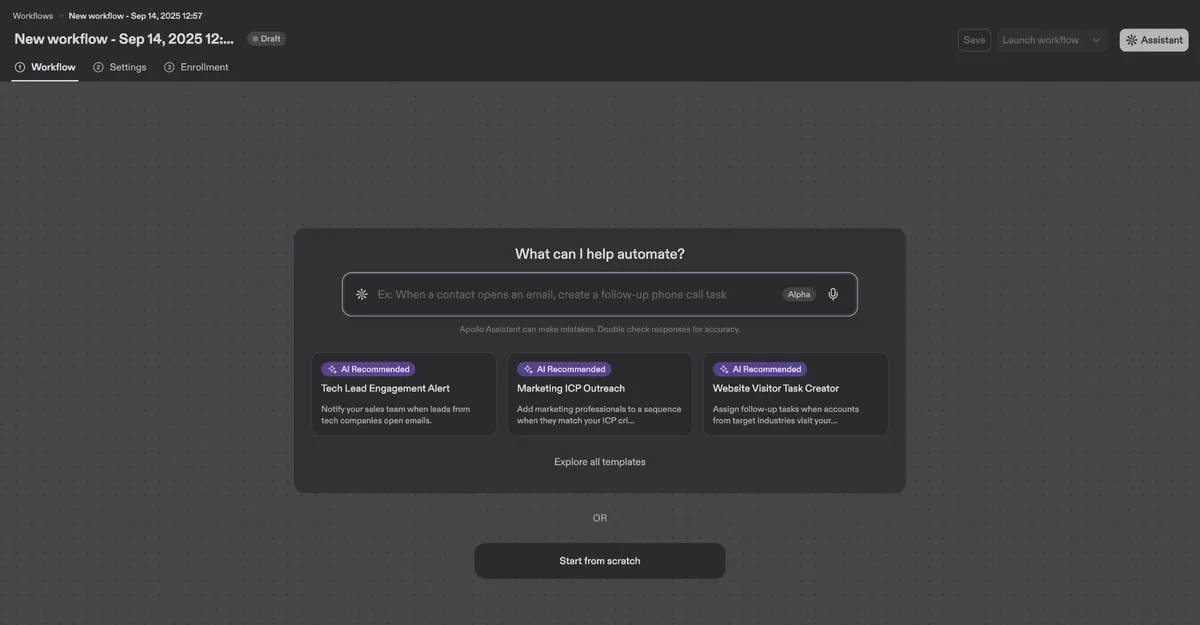
After internal validation, we rolled out externally, expanding to the "Templates Library" so all teams could access personalised workflow suggestions. This helped us understand how different customer segments used AI-generated recommendations.
A major breakthrough came when we optimised the generation process, reducing setup time to under 3 seconds as described above. This was crucial for a seamless user experience, as lengthy generation times had been a significant friction point.
To maximise reach and impact, we made recommendations embeddable throughout Apollo. We surfaced AI recommendations across multiple touch points, including the workflow builder starter screen and Templates Library, ensuring users encountered suggestions at the right moments.
Throughout rollout, we iterated based on quantitative signals (usage patterns, conversion rates, drop-off metrics) and qualitative user feedback. This data-driven approach allowed us to refine the feature and address pain points continuously.
Currently, AI workflow recommendations are live for 100% teams using Apollo.
Impact 📈
Users who tried AI recommendations saw huge wins across the board:
- Activation (new users): +115.8% relative lift
- Engagement (existing users): +83.1% relative lift
- Week 3 retention: +86.3% relative lift
- 1 in 3 users (33.6%) who see AI recommendations activate a workflow
Activation more than doubled for new users, engagement and retention soared, and every sales team gets a frictionless, custom-built start. This is what AI-driven personalisation and orchestration look like at Apollo.
✨ Join Us ...
Our engineering team at Apollo truly obsesses over making complex B2B software feel lucid, fast, and delightful to use. From building AI-powered Workflow Recommendations that solve the cold-start problem to tackling deep technical challenges in performance, scalability, and LLM optimisation, we turn complexity into clarity through thoughtful engineering.
If this excites you, come build the future of B2B software with us. We are a globally-distributed, fully-remote team of frontend, backend, and platform engineers who take pride in crafting intuitive, high-impact experiences at scale.
Explore our careers page!