
Why Is Email Deliverability a Growing Challenge for B2B Sales Teams in 2026?
Your sequences look healthy in the dashboard. Sends are processing. Open rates appear stable. But pipeline is flat, and reps are getting ghosted. The culprit is often invisible: your emails are being delivered but never reaching the inbox. According to SalesHive, only about 83–87% of marketing emails reach the inbox in 2025, meaning approximately 1 in 6 emails never makes it to prospects. For B2B sales teams, that gap is a direct tax on pipeline. Learning how to improve email deliverability is no longer optional — it's a revenue-critical discipline.

Research Less, Close More With Apollo
Tired of burning hours verifying contact info while your pipeline stalls? Apollo surfaces accurate, ready-to-contact leads so your reps spend time selling—not searching. Join 600K+ companies building predictable pipeline.
Start Free with Apollo →Key Takeaways
- Inbox placement and delivery rate are different metrics — a high delivery rate can mask serious inbox placement problems that kill pipeline.
- Google and Microsoft both tightened bulk-sender rules in 2024–2025, making authentication (SPF, DKIM, DMARC) and spam-complaint thresholds mandatory compliance floors, not best practices.
- Microsoft inboxes present a structurally harder deliverability environment for B2B teams, since most buyers operate in Outlook/M365 ecosystems.
- Spam complaint rate is now the most important outbound KPI — Google recommends keeping it below 0.1%, with 0.3% triggering enforcement penalties.
- List quality, ICP precision, and multi-channel sequencing are the primary levers to protect inbox placement while preserving pipeline volume.
Why Is Delivered Rate No Longer the Right Metric to Track?
Delivered rate measures whether the receiving server accepted your email — not whether a human saw it. Data from verified.email shows overall email delivery rates remain high (around 98.16%), but effective inbox placement is estimated at just 84.3% in some B2B datasets, with roughly one in six emails never reaching the inbox. That gap — accepted by the server but routed to spam or lost entirely — is where B2B pipeline quietly disappears.
The three metrics that matter for B2B outbound:
| Metric | What It Measures | Target for B2B Outbound |
|---|---|---|
| Delivery Rate | Server accepted the email | >98% (table stakes) |
| Inbox Placement Rate | Email landed in the primary inbox | >85% |
| Spam Complaint Rate | Recipients marked as spam | <0.1% (Google's recommendation) |
SDRs and RevOps leaders who only monitor delivery rate are operating blind. Inbox placement and complaint rate are the metrics that actually predict whether outbound sequences will generate replies.
What Changed With Google and Microsoft Sender Rules?
Both Google and Microsoft enforced major bulk-sender policy changes in 2024–2025, turning deliverability into a compliance problem rather than just a copywriting or list-hygiene issue.
Google (enforced since February 2024, with June 2024 escalations):
- Requires SPF, DKIM, and DMARC (minimum p=none) for all bulk senders
- Mandates one-click unsubscribe for marketing and subscribed mail
- Sets a hard spam-complaint ceiling: 0.3% triggers loss of mitigation eligibility; 0.1% is the recommended operating threshold
- Applies to senders of 5,000+ emails/day to Gmail addresses
Microsoft (enforcement began May 5, 2025):
- Requires SPF, DKIM, and DMARC for domains sending 5,000+ emails/day to Outlook, Hotmail, or Live addresses
- Mandates one-click unsubscribe compliance
- Microsoft inboxes already showed a 75.6% inbox placement rate in Validity's 2025 benchmark — the toughest major provider measured
For B2B sales teams, Microsoft's enforcement is particularly painful. Most B2B buyers operate inside Microsoft 365 environments, meaning a large share of your outbound is hitting the hardest-to-reach inbox provider.
Struggling to build sequences that stay compliant and convert? Apollo's multi-channel sales engagement platform helps B2B teams run outbound with built-in deliverability controls, so you reach prospects across email, phone, and social without burning your domain reputation.
Turn Funnel Guesswork Into Real Pipeline
Pipeline forecasting a guessing game because leads stall before they ever become opportunities? Apollo surfaces in-market buyers with precision so your team fills the top of the funnel with leads that actually convert. Nearly 100K paying customers stopped guessing and started closing.
Start Free with Apollo →Why Is B2B Deliverability Uniquely Harder Than B2C?
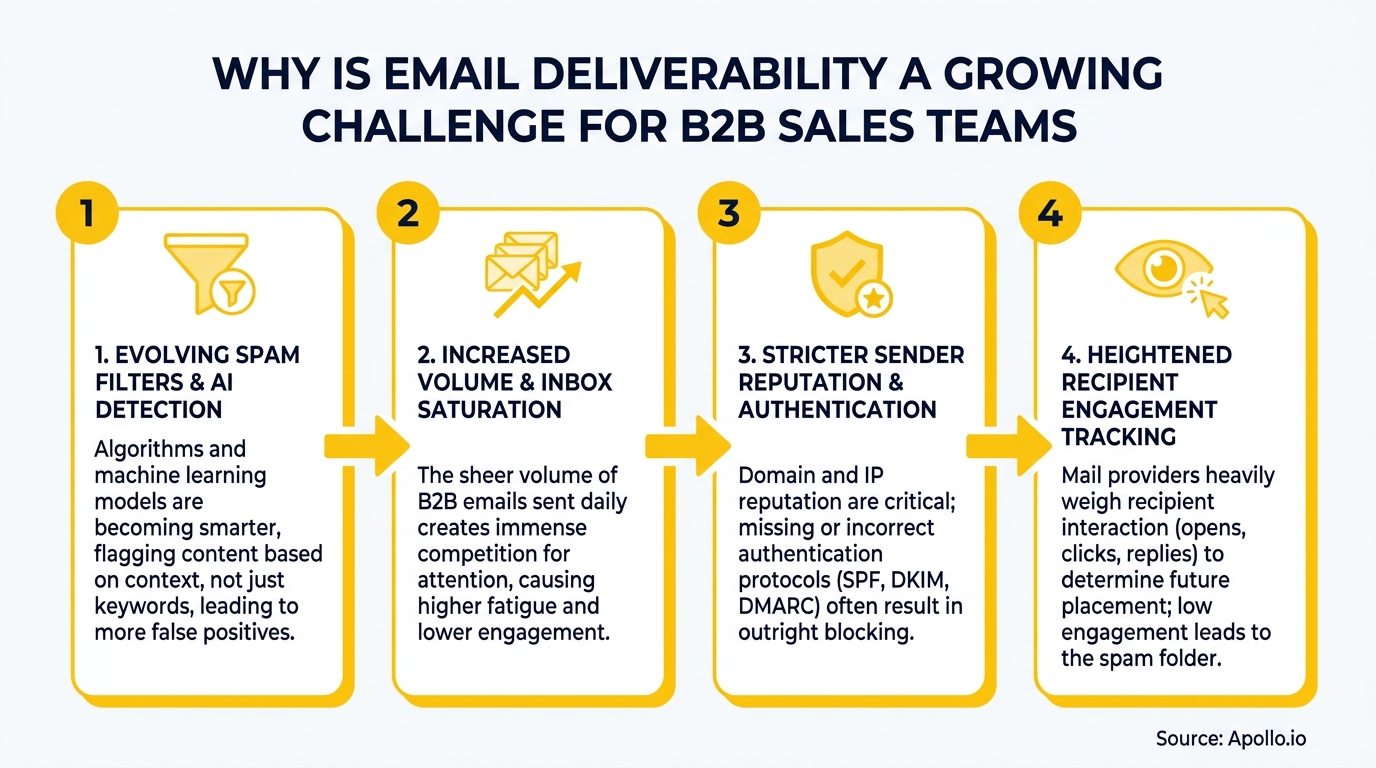
B2B email deliverability faces structural challenges that B2C senders don't encounter at the same scale. Corporate email gateways (Microsoft Defender, Proofpoint, Mimecast) apply additional filtering layers before mail even reaches the inbox provider's spam logic.
Outbound cold email sits in a regulatory and filtering gray zone — recipients didn't opt in, early engagement signals are weak, and providers treat low-engagement patterns as negative reputation signals.
The macro environment compounds the problem. Hornetsecurity's Cybersecurity Report analyzed 20.5 billion business emails in 2024 and found that 36.9% of all emails received by businesses were unwanted.
Corporate inboxes are on high alert, and B2B outbound that pattern-matches spam gets caught in that filter drag.
Additionally, Kickbox reports that 64.6% of businesses say email deliverability issues have directly impacted their revenue or customer retention — a figure that reflects how widely this problem has spread across B2B organizations of all sizes.

How Do SDRs and RevOps Teams Fix Deliverability Problems Operationally?
SDRs can't control inbox provider algorithms, but they can control the inputs that determine reputation. RevOps leaders should build the following into standard outbound operations:
Authentication and Domain Setup:
- Verify SPF, DKIM, and DMARC are configured and aligned across every sending domain and tool (CRM, sequencer, marketing ESP)
- Use separate sending domains for cold outbound vs. marketing vs. transactional mail — shared reputation across streams is a silent risk
- Warm new domains gradually before scaling send volume
List Hygiene as an Ongoing Operation:
- Verify email addresses before adding contacts to sequences — bounces and spam traps damage sender reputation
- Suppress unsubscribes and hard bounces immediately and universally across all tools
- Remove unengaged contacts from active sequences rather than continuing to send
Complaint Rate Management:
- Keep user-reported spam rates below Google's 0.1% recommendation at all times
- Reduce sequence frequency for cold lists — over-sending is the fastest path to complaint accumulation
- Tighten ICP targeting: irrelevant emails generate complaints; relevant ones generate replies
Sending to stale or unverified contacts is one of the fastest ways to blow past complaint thresholds. Worried your contact data is hurting deliverability? Apollo's data enrichment keeps your B2B contact database verified and current, so sequences reach real prospects — not invalid addresses that bounce and burn your domain.
What Should B2B Teams Measure Instead of Open Rate?
Open rate is increasingly unreliable as a performance signal. Privacy features and bot-triggered opens inflate the metric without reflecting genuine prospect interest.
B2B teams should shift reporting to engagement signals that reflect actual pipeline intent.
Recommended KPI framework for outbound email in 2026:
- Reply rate: The clearest signal of genuine engagement
- Positive reply rate: Separates interest from objections
- Meeting booked rate: The direct pipeline output of outbound sequences
- Spam complaint rate: The compliance floor — monitor daily, not weekly
- Domain-level inbox placement: Test with seed lists across Gmail and Outlook regularly
- Bounce rate: Hard bounces above 2% signal list quality issues requiring immediate action
AEs and sales leaders who build reporting around these metrics can identify deliverability degradation before it collapses pipeline. For guidance on crafting messages that drive replies rather than spam clicks, see how to write sales emails that get responses.
How Does Multi-Channel Outreach Protect Email Deliverability?
Multi-channel sequencing reduces deliverability risk by distributing outreach across email, phone, and social touchpoints — lowering per-channel send frequency and reducing the complaint signals that damage domain reputation. When a prospect receives fewer emails but also sees a relevant call or social interaction, reply rates improve and spam complaints drop.
Practical sequencing guidelines:
- Cap email touches at 4–6 per prospect per sequence; fill remaining touchpoints with calls and social outreach
- Space email steps at least 3–5 business days apart for cold contacts
- Use intent data to prioritize which prospects receive higher email frequency — warmer signals justify more touches
- Personalize subject lines and openers to reduce the probability of spam classification; see data-backed email subject lines for sales for proven approaches

How Can B2B Sales Teams Protect Pipeline Without Sacrificing Email Volume?
Deliverability and pipeline volume are not in opposition — they require operational discipline to run together. The teams that protect inbox placement at scale treat list quality, domain infrastructure, and complaint rate as revenue infrastructure, not marketing ops busywork.
The practical answer is consolidation: when prospecting, data enrichment, and sequencing live in separate tools, authentication misalignment and suppression gaps create silent deliverability leaks. Teams that unify those workflows reduce operational risk.
As Cyera noted after consolidating their sales stack, "Having everything in one system was a game changer."
Email remains a high-ROI channel when executed with proper infrastructure. Build your outbound on verified data, compliant authentication, and multi-channel sequences — and treat complaint rate as the single most important number in your outbound program.
Try Apollo Free — and run outbound sequences on verified contacts with built-in deliverability controls, all from one platform.
Prove Pipeline ROI From Day One
ROI pressure killing your tool budget before it even gets approved? Apollo delivers measurable pipeline impact fast—so justifying the spend is easy. Nearly 100K paying customers closed the loop between tool investment and revenue growth.
Start Free with Apollo →Don't miss these
Sales
Inbound vs Outbound Marketing: Which Strategy Wins?
Sales
What Is a Sales Funnel? The Non-Linear Revenue Framework for 2026
Sales
What Is a Go-to-Market Strategy? The 2026 GTM Playbook
See Apollo in action
We'd love to show how Apollo can help you sell better.
By submitting this form, you will receive information, tips, and promotions from Apollo. To learn more, see our Privacy Statement.
4.7/5 based on 9,690 reviews
