
What Is the Cost of Bad Contact Data on a 10-Person SDR Team's Quota Attainment?
Bad contact data is a quota killer that most revenue leaders underestimate. Every bounced email, disconnected phone number, and outdated job title represents a rep who worked hard and got nothing. For a 10-person SDR team operating under quota pressure, the cumulative effect is measurable, compounding, and entirely preventable. Understanding how contact data enrichment drives ROI starts with understanding exactly what bad data costs first.

Research Less, Pipeline More With Apollo
Tired of your reps burning hours verifying contact info instead of closing deals? Apollo delivers 97% email accuracy so your team hits the right people, fast. Join 600K+ companies building predictable pipeline from day one.
Start Free with Apollo →Key Takeaways
- Bad contact data creates a silent quota gap: SDRs lose productive selling time to bounces, wrong numbers, and stale records — not poor effort.
- The productivity drain is measurable per rep: research shows reps spend 27% of their time on bad data, costing approximately $32,000 per rep annually in lost productivity.
- Deliverability is now a quota metric: high bounce rates damage sender reputation, reduce inbox placement, and cut the number of meetings your entire team can book.
- Data decay is continuous, not annual: B2B contact data degrades at 22–30% per year, meaning a list that was clean at the start of a quarter may already be unreliable mid-quarter.
- Fixing the data foundation — not hiring more reps — is often the highest-leverage action a RevOps or sales leader can take to protect quota attainment.
How Much Does Bad Contact Data Actually Cost a 10-Person SDR Team?
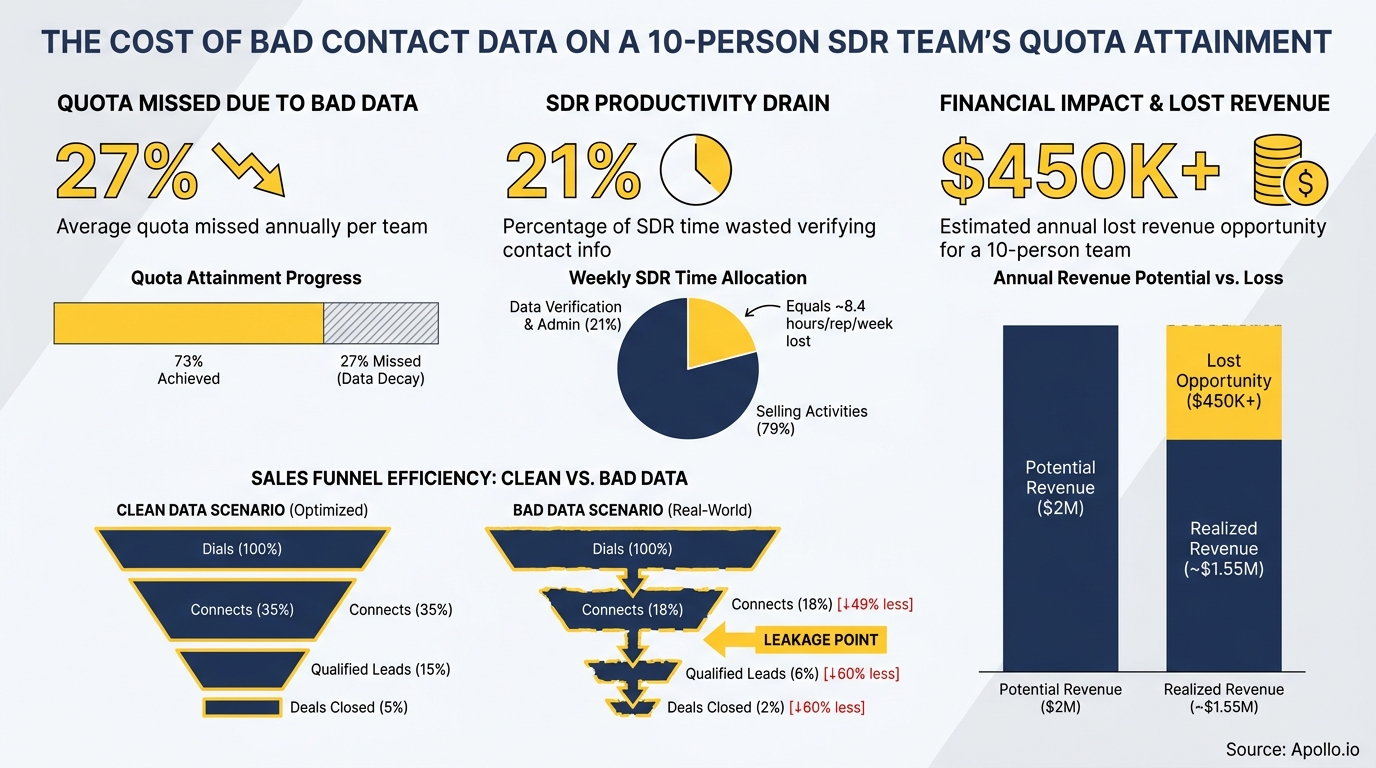
Bad contact data costs a 10-person SDR team through two compounding channels: direct productivity loss per rep and team-wide pipeline shortfall. According to SalesO, research indicates that sales reps spend 27% of their time on bad data, costing approximately $32,000 per rep annually in lost productivity. Across a 10-person team, that is a substantial drag on capacity before a single deal is worked.
The org-level picture is equally stark. Research cited by IndustrySelect shows poor data quality costs the average B2B company between $12.9 million and $15 million annually through wasted marketing spend, lost sales opportunities, and operational inefficiencies. Even a fraction of that figure, applied to a 10-rep team's territory and quota, translates into real missed attainment.
The practical quota impact follows this chain:
- Invalid emails increase bounce rate, damage domain reputation, and reduce inbox placement for every rep on the team.
- Wrong phone numbers waste call blocks and lower connect rates, reducing meetings booked per day.
- Outdated job titles or companies send reps into dead-end conversations with people who no longer hold purchasing authority.
- Duplicate or missing records create gaps in follow-up sequences, letting warm prospects go cold.
Struggling to find accurate contacts for your team? Search Apollo's 230M+ verified contacts with 65+ filters to build lists your SDRs can actually work.
How Does Bad Data Damage Deliverability and Reduce Meetings Booked?
Bad contact data reduces meetings booked by degrading email deliverability at the domain level, which punishes every SDR on a shared sending domain — not just the rep with the bad list. The causal chain is direct: invalid addresses generate hard bounces, bounces raise complaint rates, complaint rates lower sender reputation, and lower reputation means fewer emails reach the inbox across the entire team.
This is no longer a marginal risk. Mailbox providers, including Microsoft 365 (which many enterprise buyers use as their primary inbox), have tightened enforcement standards.
A bounce rate that was tolerable in 2023 can now trigger filtering that suppresses an SDR team's outbound reach into key accounts. When decision-makers live in Microsoft 365-heavy environments, bad data disproportionately blocks access to exactly the personas your reps need to reach.
The fix starts upstream: verify contacts before they enter a sequence, not after the damage is done. Tools that support waterfall enrichment run contacts through multiple verification sources sequentially, maximizing valid coverage before a single email is sent.

Why Do SDRs Lose So Much Time to Bad Data?
SDRs lose time to bad data because researching, verifying, and correcting contact information happens manually during selling hours rather than being solved systematically upstream. Data from Pintel.ai illustrates the scale: if a rep works 50 leads per day, improving data quality can reduce research time from 10 minutes to 2 minutes per lead, saving over 6 hours per week per rep in additional selling capacity. Multiply that across 10 reps for a full quarter and the recovered capacity is significant.
RevOps leaders who audit where SDR time actually goes consistently find the same pattern: reps are doing manual data work that should have been handled before the record reached the sequence. The solution is not better time management — it is better data infrastructure. Automating job change alerts and data enrichment ensures reps work records that are current before the outreach begins, not after a bounce reveals the problem.
What Causes Contact Data to Go Bad — and How Fast?
Contact data goes bad through natural workforce movement: people change jobs, get promoted, leave companies, and update their contact details continuously. B2B contact records decay at 22–30% annually, which means a list that was accurate at the start of a fiscal year is meaningfully degraded by mid-year.
For a 10-person SDR team running quarterly sequences, a static list imported once at the beginning of the quarter may already contain a significant share of stale records by week eight.
The root causes break into four categories:
| Data Source | Common Failure Mode | High-Leverage Fix |
|---|---|---|
| Vendor lists | Low refresh cadence, no re-verification | Evaluate providers by recency and verification method |
| CRM manual entry | Typos, missing fields, inconsistent formats | Enforce required fields; auto-enrich on record creation |
| Inbound forms | Fake or incomplete submissions | Real-time validation at point of capture |
| Existing CRM records | No re-verification after initial import | Continuous enrichment triggered before sequence enrollment |
Understanding the difference between data cleansing and enrichment matters here: cleansing removes or corrects existing errors, while enrichment adds missing or updated fields. Both are required, and neither is a one-time event.
Turn Funnel Guesswork Into Closed Deals
Quota stress mounting because leads stall before they ever reach your pipeline? Apollo surfaces high-intent prospects and keeps your forecast grounded in real data. Over 600K companies stopped guessing and started closing.
Start Free with Apollo →How Should RevOps Teams Build a Data Quality Operating Model?
RevOps teams should treat data quality as an ongoing operational process with defined ownership, cadence, and measurable SLAs — not a periodic cleanup project. The benchmark cited above makes clear that 76% of organizations have less than half their CRM data accurate and complete, according to Validity. That is a structural problem, not a one-quarter fix.
A lightweight governance model for a 10-rep SDR team includes:
- Weekly ritual: Review bounce rates and invalid contact flags from the prior week's sequences. Any domain-level deliverability signal should trigger immediate list audit.
- Pre-sequence check: No record enters a sequence without passing a recency check. Contacts not verified within 60–90 days are re-enriched before enrollment.
- Ownership: RevOps owns the data SLA; SDR managers own enforcement at the team level. Neither role can delegate the outcome to the other.
- ROI measurement: Track connect rate, reply rate, and meetings booked per 100 contacts before and after enrichment cycles to make the business case visible.
Solving data synchronization across multiple business systems is often the underlying blocker: when CRM, sequencing tool, and data provider are out of sync, records that appear current in one system are stale in another.
Tired of dirty data slowing your team down? Start free with Apollo's verified B2B contact enrichment and keep your CRM accurate automatically.

What Should SDR Teams Look for When Evaluating a Data Provider?
SDR teams should evaluate data providers on four criteria that directly connect to quota outcomes: email verification accuracy, contact recency, job-change monitoring, and coverage within their specific ICP. Volume of records is a secondary metric — a smaller, highly verified database produces better quota outcomes than a large, stale one.
Key evaluation criteria:
- Verification method: Does the provider verify emails in real time or rely on batch checks? Real-time verification at the point of export reduces bounce risk at the source.
- Recency and refresh rate: How frequently are records re-verified? Job changes happen continuously; providers that re-check on a fixed annual schedule leave gaps.
- ICP coverage: Does the provider have strong coverage in your target industries and geographies? Depth in your ICP matters more than breadth across all segments.
- CRM integration: Can enriched data flow directly into your CRM without manual export/import steps that introduce lag and error?
Apollo's database of 230M+ people and 30M+ companies supports 97% email accuracy with continuous enrichment, built around a structured data enrichment strategy that keeps records current as contacts change roles. For a 10-person SDR team, that means fewer bounces, more connects, and more meetings from the same number of outreach attempts.
How Can SDR Teams Start Recovering Quota Lost to Bad Data?
SDR teams recover quota lost to bad data by starting with an audit, not a tool purchase. Measure your current bounce rate, connect rate, and meetings booked per 100 contacts.
These three numbers establish your baseline and quantify how much of your quota gap is a data problem versus a messaging or activity problem.
From there, the recovery sequence is straightforward:
- Enrich your existing CRM records before the next sequence cycle begins.
- Implement a pre-enrollment verification check so no unverified contact enters a sequence.
- Set up job-change monitoring so reps are alerted when a key contact moves to a new role — one of the highest-converting outreach triggers in outbound sales.
- Measure the delta in connect rate and meetings booked after 30 days of clean data.
Apollo consolidates prospecting, enrichment, sequencing, and CRM sync into one platform — eliminating the data sync gaps that occur when these functions live in separate tools. As Cyera noted, "Having everything in one system was a game changer." For a 10-rep SDR team, that consolidation means one source of truth for contact data, no manual exports, and sequences that run on verified records from day one.
Bad contact data is a solvable problem, and the ROI of solving it shows up directly in quota attainment. Get Leads Now and give your SDR team the verified data foundation they need to hit quota consistently.
Prove Pipeline ROI With Apollo
Budget approval stuck on unclear metrics? Apollo surfaces measurable pipeline impact so you can justify every dollar spent. Over 600K+ companies turned ROI uncertainty into confident investment decisions.
Start Free with Apollo →Don't miss these
Sales
Inbound vs Outbound Marketing: Which Strategy Wins?
Sales
What Is a Sales Funnel? The Non-Linear Revenue Framework for 2026
Sales
What Is a Go-to-Market Strategy? The 2026 GTM Playbook
See Apollo in action
We'd love to show how Apollo can help you sell better.
By submitting this form, you will receive information, tips, and promotions from Apollo. To learn more, see our Privacy Statement.
4.7/5 based on 9,690 reviews
