
What's a Reasonable Benchmark for Email Bounce Rates When Using a Paid Data Provider?
If your paid data provider promises clean lists but your bounce rates tell a different story, you need clear benchmarks to evaluate what's acceptable and when to act. The short answer: target under 2% total bounce rate, with hard bounces ideally staying below 1%.
But bounce rate alone is no longer the full picture.
Before scaling outbound, understanding these thresholds protects your sender reputation, inbox placement, and ultimately your pipeline. Learn how to use a reliable B2B email database to set yourself up for deliverability success from day one.

Accurate Data, More Deals Closed
Tired of burning hours verifying contacts that bounce anyway? Apollo surfaces verified business emails and phone numbers so your team sells instead of researches. Nearly 100K paying customers stopped the data chase — start now.
Start Free with Apollo →Key Takeaways
- A healthy bounce rate from paid data should stay below 2%, with sub-1% hard bounces as the modern standard for well-maintained lists.
- Bounce rate is an incomplete signal: inbox placement and spam placement matter just as much for evaluating data quality.
- B2B lists decay faster than B2C, so a vendor's refresh cadence directly determines the bounce rate you'll actually see.
- SDRs and RevOps teams should pilot new data segments before scaling, using a seed-test protocol to validate provider claims.
- When bounces exceed 2%, a clear escalation playbook (pause, verify, suppress, re-source) limits reputation damage.
Why Is Bounce Rate Alone Not Enough to Evaluate a Paid Data Provider?
Bounce rate is just one layer of deliverability quality, and a low rate can mask serious inbox placement problems. A list can post acceptable bounce numbers while a significant share of messages land in spam or go missing entirely.
According to the Validity 2025 Email Deliverability Benchmark Report, global inbox placement in 2024 averaged 83.5%, with 6.7% of messages going to spam and 9.8% classified as missing. That means even a list producing low bounces could be failing on nearly 17% of sends.
The complete picture requires tracking three metrics together:
- Hard bounce rate: permanent delivery failures (invalid addresses)
- Inbox placement rate: percentage actually reaching the primary inbox
- Spam placement rate: percentage accepted but filtered out of the inbox
When evaluating a vendor, ask for all three. Any provider that only reports bounce rate is showing you an incomplete scorecard.
What Are the Accepted Benchmarks for Email Bounce Rates in 2026?
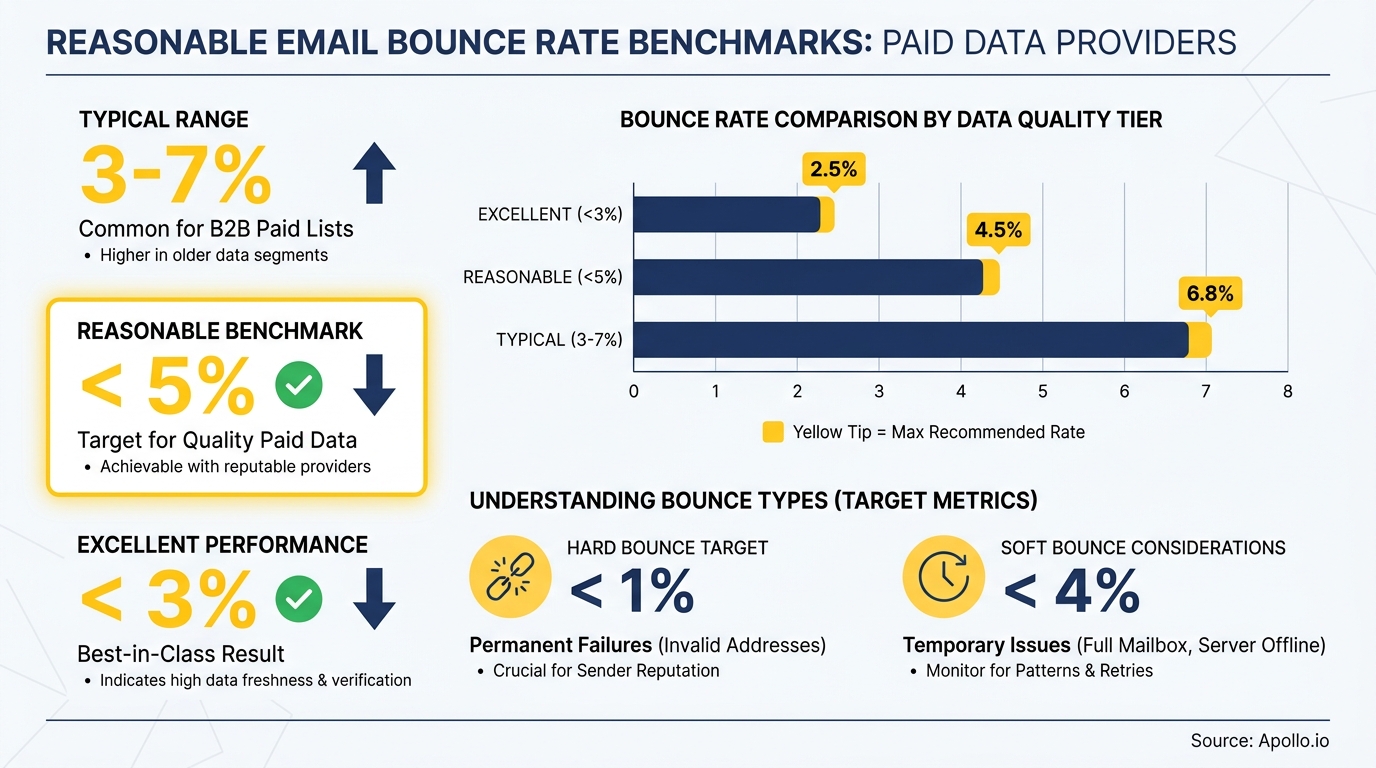
The widely accepted benchmark for a healthy email bounce rate is below 2% across all industries and sending contexts. Multiple independent sources align on this threshold as the dividing line between normal and problematic.
| Bounce Rate Range | Status | Action Required |
|---|---|---|
| Below 1% | Excellent | Maintain current hygiene practices |
| 1%–2% | Caution | Investigate segment quality, increase verification cadence |
| 2%–5% | Warning | Pause high-bounce segments, re-verify list |
| Above 5% | Critical | Stop sending, suppress contacts, re-source data |
Research from Folderly's 2025 benchmarks, based on 2024 data, shows an industry-wide average bounce rate of 0.89%, reflecting the standard achievable with consistent list hygiene. According to ActiveCampaign, a universally accepted benchmark for a healthy bounce rate across all industries is below 2%.
For B2B specifically, rates trend higher due to faster email churn from job changes. Data from Powered By Search shows some industry averages for B2B email marketing in 2025 placed the average bounce rate at 2.48%, making it even more critical to work with providers who refresh their data continuously.
How Should SDRs and RevOps Teams Evaluate a Paid Data Provider?
SDRs and RevOps leaders should evaluate paid data providers on four criteria before committing to a full deployment: verification method, refresh cadence, bounce guarantee or credit policy, and segment-level reporting.
Use this scorecard when assessing any provider:
- Verification method: Does the provider use real-time verification, periodic batch checks, or no stated method? Real-time or near-real-time is the current standard.
- Refresh cadence: How often are contacts re-verified? A list verified six months ago carries meaningful decay risk for B2B contacts.
- Credit/replacement policy: Does the provider replace or credit hard-bounced contacts? What is the threshold that triggers a replacement?
- Segment-level bounce reporting: Can you see bounce rates by industry, job function, or geography? A low overall rate can hide high-bounce pockets in specific segments.
- Email accuracy claim: Is the provider's accuracy claim based on verified delivery outcomes, or just pattern matching?
Tired of bouncy lists burning your sender reputation? Start free with Apollo's 230M+ verified business contacts and 97% email accuracy.

How Does Data Decay Affect Your Bounce Rate Benchmark?
Data decay is the primary reason a list that looked clean at purchase can produce elevated bounces within months. B2B contacts churn faster than B2C because people change jobs, companies restructure, and domains expire.
A sound data enrichment strategy accounts for decay by scheduling re-verification at regular intervals, not just at the point of purchase. The fresher the data, the closer your bounce rate will stay to the sub-1% target that signals healthy list quality.
Key decay management practices:
- Re-verify segments older than 90 days before sending at scale
- Suppress contacts who have not engaged after a defined number of sends
- Flag catch-all and role-based addresses (info@, support@) for separate handling
- Remove contacts from departed employees using job-change signals where available
Research from The Digital Bloom found that organizations sending over 1 million emails monthly faced a decline of 22.35 percentage points in inbox placement when they did not verify email lists, underscoring the operational cost of skipping verification.
Turn Funnel Guesswork Into Pipeline Wins
Forecasts feel unreliable because your pipeline data isn't. Apollo surfaces in-market buyers before they go cold, turning weak lead flow into predictable revenue. Nearly 100K paying customers stopped guessing and started closing.
Start Free with Apollo →What Is a Seed Testing Protocol for Validating Paid Data Before Scale?
A seed test is a controlled pilot send to a small sample of provider-sourced contacts, used to measure actual bounce and placement performance before committing to a large-scale send. Run a seed test any time you onboard a new provider or a new data segment.
Step-by-step pilot protocol:
- Pull a representative sample: Select 200–500 contacts spanning the industries, geographies, and job functions you intend to target.
- Send a single-touch email: Use your standard outbound template. Keep it short. Do not use link-heavy content that could inflate spam signals.
- Measure within 48 hours: Record hard bounces, soft bounces, and any spam complaint signals from your sending platform.
- Apply the benchmark ladder: If hard bounces exceed 2%, do not proceed to full send. If they're under 1%, you're clear to scale with normal hygiene in place.
- Check placement: Use a seed inbox tool to verify whether messages are landing in the primary inbox or being filtered.
This process protects your sending domain and gives you real-world data to validate the provider's accuracy claims before they affect your deliverability at scale. Pairing this with ongoing contact data enrichment keeps your list fresh between pilot rounds.
What Is the Escalation Playbook When Bounce Rates Exceed Safe Thresholds?
When bounce rates cross the 2% threshold, the escalation response should follow four steps: pause, verify, suppress, and re-source. Acting quickly at each stage limits damage to your sender reputation and domain health.
| Trigger | Action | Owner | Timeline |
|---|---|---|---|
| Bounce rate 2%–5% | Pause sends to affected segment | SDR / Email ops | Immediately |
| Bounce rate 2%–5% | Re-verify segment with a third-party tool | RevOps | Within 24 hours |
| Post-verification | Suppress undeliverable contacts | RevOps / Marketing ops | Before next send |
| Bounce rate above 5% | Stop all sends, escalate to vendor for replacement data | RevOps / Vendor manager | Same day |
For RevOps leaders managing multi-seat outbound teams, building this escalation logic into your data cleansing and enrichment workflow means bounce spikes get caught before they compound into domain-level reputation damage.

How Does Apollo Help Keep Bounce Rates Under Control?
Apollo maintains 97% email accuracy across its 230M+ person database, with contacts continuously re-verified to minimize the decay risk that drives bounce spikes in static purchased lists. SDRs and RevOps teams using Apollo operate from a single platform covering prospecting, enrichment, and sequencing, eliminating the handoff errors that occur when data moves between disconnected tools.
"Having everything in one system was a game changer," noted a team at Cyera. That consolidation removes the manual re-verification step that most teams skip, keeping bounce rates predictably low without adding process overhead.
Apollo's data enrichment tools let you enrich and re-verify existing CRM records using 65+ data attributes, so your pipeline stays clean even as contacts change roles and companies evolve.
Conclusion: Set Your Benchmark, Then Build the Process Around It
A reasonable benchmark for email bounce rates from a paid data provider is under 2% total, with hard bounces ideally below 1%. That target requires more than just choosing the right vendor.
It depends on their refresh cadence, your verification process at send time, and a clear escalation plan when numbers drift upward.
Bounce rate is only one signal. Inbox placement and spam rates complete the picture.
Build your evaluation scorecard around all three, run seed tests before scaling any new segment, and treat 2% as a fire-drill threshold rather than an acceptable steady state.
Ready to build outbound on data you can trust? Get Leads Now and see how Apollo's verified contact database keeps bounce rates in check from the first send.
Glossary: Key Deliverability Terms
- Hard bounce: A permanent delivery failure caused by an invalid, non-existent, or blocked email address.
- Soft bounce: A temporary delivery failure, often due to a full inbox or server issue. Repeated soft bounces on the same address may indicate a deeper problem.
- Inbox placement rate: The percentage of delivered emails that land in the recipient's primary inbox, as opposed to spam or other folders.
- Seed test: A controlled pilot send to a small list sample used to measure real-world bounce and placement performance before a full campaign.
- DMARC/SPF/DKIM: Email authentication protocols that verify a message's origin and protect your sending domain from spoofing. Properly configured, they improve inbox placement and reduce the likelihood of being filtered as spam.
- Data decay: The degradation of contact accuracy over time as professionals change jobs, companies close, and email addresses become inactive.
Prove Pipeline ROI With Apollo
ROI pressure killing your tool budget? Apollo delivers measurable pipeline impact so you can walk into every budget review with hard numbers. Leadium 3x'd annual revenue — see what Apollo does for your team.
Start Free with Apollo →Don't miss these
Sales
Inbound vs Outbound Marketing: Which Strategy Wins?
Sales
What Is a Sales Funnel? The Non-Linear Revenue Framework for 2026
Sales
What Is a Go-to-Market Strategy? The 2026 GTM Playbook
See Apollo in action
We'd love to show how Apollo can help you sell better.
By submitting this form, you will receive information, tips, and promotions from Apollo. To learn more, see our Privacy Statement.
4.7/5 based on 9,690 reviews
