
What Is a Sales Lead? Definition, Types, and Qualification Methods
A sales lead is a business contact who has shown interest in your product or service and fits your ideal customer profile. In 2026, with 80% of B2B sales interactions happening digitally, understanding what makes a quality lead matters more than ever. This guide covers AI-powered lead identification, scoring frameworks, and alignment strategies that turn prospects into pipeline.

Eliminate 4+ Hours Of Daily Research With Apollo
Tired of spending 4+ hours daily hunting for contact info? Apollo delivers 224M verified contacts with 96% email accuracy instantly. Join 550K+ companies closing more deals.
Start Free with Apollo →Key Takeaways
- A sales lead is a business contact matching your ICP who has shown purchase intent through specific actions
- AI-driven lead scoring analyzes 50+ data points to prioritize leads with 3-5x higher conversion rates
- Companies with aligned sales and marketing teams achieve 24% faster revenue growth
- Only 4% of leads are ready to buy immediately, requiring strategic nurturing for the other 96%
- Modern lead management platforms consolidate prospecting, scoring, and engagement in one workspace
What Is A Sales Lead?
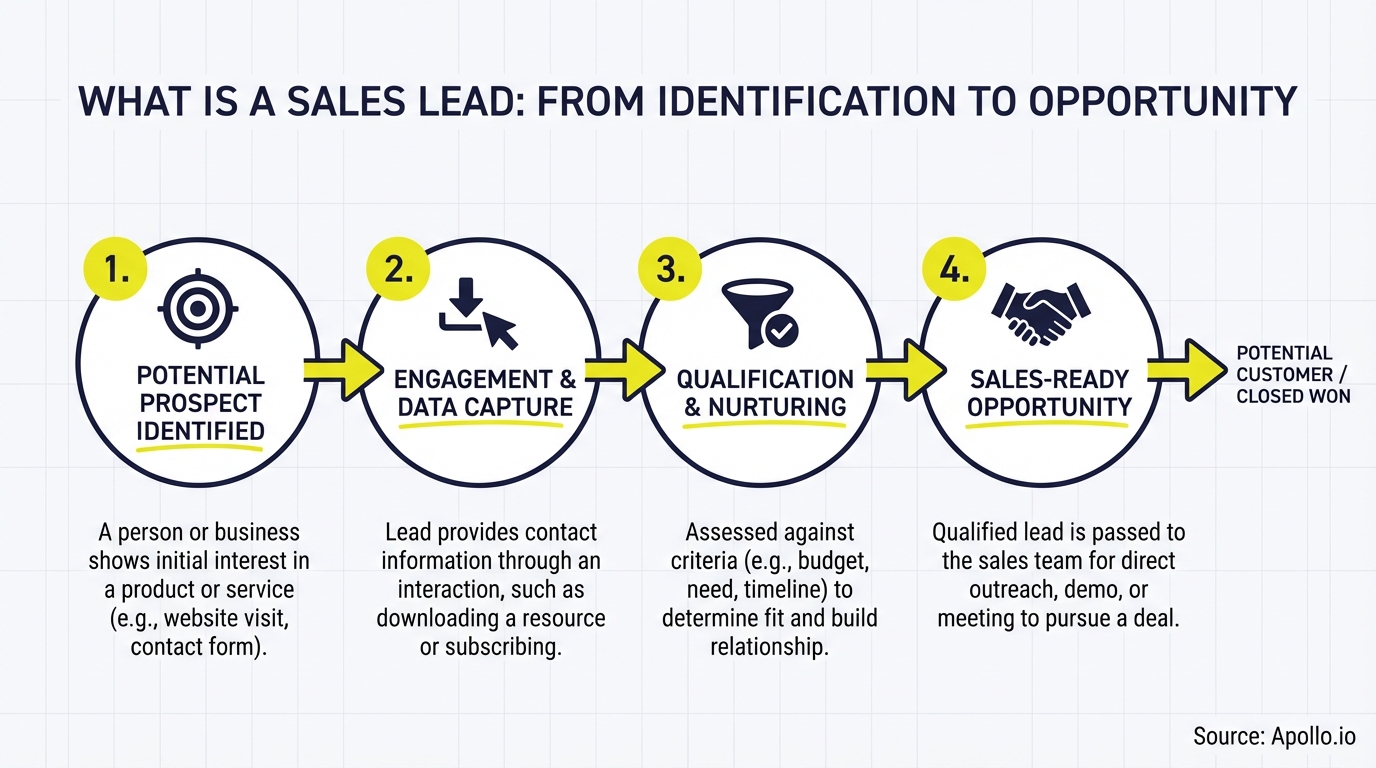
A sales lead is a business contact who matches your ideal customer profile and has demonstrated interest in your solution through specific actions like downloading content, attending webinars, or requesting demos. Unlike cold prospects, leads have raised their hand in some way. They represent potential revenue opportunities worth pursuing through strategic prospecting and outreach.
Leads fall into categories based on qualification level. Marketing Qualified Leads (MQLs) have engaged with marketing content but need further nurturing.
Sales Qualified Leads (SQLs) have been vetted by sales and are ready for direct outreach. Product Qualified Leads (PQLs) have used your product through trials or freemium models and show usage signals indicating purchase intent.
The lead generation market is projected to reach $29.51 billion by 2034, reflecting an 11.33% CAGR driven by digital transformation and AI adoption. This growth underscores why modern teams need sophisticated systems to identify, score, and convert leads efficiently.
How Does AI-Powered Lead Scoring Work?
AI-powered lead scoring assigns numerical values to leads based on demographic data, behavioral signals, and engagement patterns. Machine learning algorithms analyze historical conversion data to identify which characteristics predict deal closure.
Scores typically range from 0-100, with higher scores indicating stronger purchase intent and better fit.
Modern scoring models evaluate 50+ data points including job title, company size, industry, website visits, email opens, content downloads, and social media engagement. AI continuously refines scoring criteria based on actual outcomes, learning which signals matter most for your specific business. For SDRs managing hundreds of prospects, AI-powered lead scoring platforms surface the 10-15% of leads most likely to convert.
Struggling to prioritize which leads to contact first? Search Apollo's 224M+ contacts with AI scoring that identifies your best-fit prospects.
What Data Inputs Drive Effective Lead Scoring?
Effective lead scoring combines three data categories. Demographic data includes job title, seniority, company size, industry, location, and technologies used. Behavioral data tracks website visits, page views, time on site, content downloads, email engagement, and social interactions. Contextual data captures buying stage signals like demo requests, pricing page visits, competitor comparison research, and RFP submissions.
| Data Category | Key Signals | Scoring Weight |
|---|---|---|
| Demographic Fit | Job title, company size, industry match | 30-40% |
| Behavioral Engagement | Website visits, content downloads, email opens | 30-40% |
| Intent Signals | Pricing views, demo requests, competitor research | 30-40% |
How Do SDRs Qualify And Convert Leads?
SDRs qualify leads by verifying fit and intent through discovery questions and research. The BANT framework (Budget, Authority, Need, Timeline) remains foundational, but modern SDRs also evaluate pain severity, competitive landscape, and buying committee structure. Research from Gitnux shows only 4% of website visitors are ready to buy, so SDRs must identify where each lead sits in their buying journey.
Top-performing SDRs use multi-touch qualification sequences that combine email, phone, LinkedIn, and video outreach.
They personalize messaging based on lead behavior and firmographic data.
For example, if a lead downloaded a pricing guide, the SDR references that specific action and offers a custom ROI calculation.
This relevance-driven approach converts 3-5x better than generic templates.
SDRs working with Apollo report booking 46% more meetings by leveraging AI research agents that surface account intelligence, recent company news, hiring signals, and technology stack data. This context enables conversations that demonstrate understanding rather than pitching blindly.
Turn Forecast Guesswork Into Revenue Certainty
Pipeline forecasting a guessing game? Apollo's real-time deal tracking gives you accurate visibility across every stage. Built-In increased win rates 10% with Apollo's scoring and signals.
Start Free with Apollo →Why Is Sales And Marketing Alignment Critical?
Sales and marketing alignment ensures both teams work from the same definitions, goals, and handoff processes. Data from Gitnux reveals companies with aligned teams achieve 24% faster revenue growth. Misalignment creates friction where marketing generates leads sales considers unqualified, or sales ignores leads marketing invested resources to nurture.
Alignment requires three foundational elements. First, shared lead definitions that specify exactly what constitutes an MQL versus SQL.
Second, documented Service Level Agreements (SLAs) defining how quickly sales will follow up on marketing leads and what feedback marketing receives on lead quality. Third, unified reporting that tracks leads through the entire funnel, revealing where conversions happen and where leads drop off.
For RevOps teams building alignment frameworks, Apollo provides a single source of truth where both sales and marketing access the same contact data, engagement history, and scoring models. As one RevOps leader noted, "Having everything in one system was a game changer" (Cyera).
What Should A Lead Handoff SLA Include?
An effective SLA specifies response times, qualification criteria, and feedback loops. Marketing commits to delivering a minimum number of qualified leads monthly based on agreed-upon scoring thresholds.
Sales commits to contacting MQLs within 24-48 hours and providing disposition feedback within one week. The SLA also defines what happens to leads sales deems unqualified, whether they return to marketing nurture streams or get archived.
- Response Times: SQLs contacted within 24 hours, MQLs within 48 hours
- Qualification Standards: Minimum lead score of 70, specific firmographic requirements met
- Feedback Cadence: Weekly lead quality review meetings, monthly SLA performance reports
- Recycling Process: Unqualified leads returned to nurture with reason codes documented
What Lead Management Tools Do Teams Actually Need?
Modern lead management requires tools for prospecting, enrichment, scoring, engagement, and pipeline tracking. The challenge is that cobbling together ZoomInfo for data, Outreach for sequences, Gong for call intelligence, and Salesforce for CRM creates integration headaches and inflated costs.
Sales leaders report spending $15,000-$30,000 annually per rep on disconnected tools.
Tired of managing multiple tools that don't talk to each other? Apollo consolidates prospecting, enrichment, engagement, and analytics in one platform, cutting your tech stack costs in half while giving teams a unified workspace. As one customer shared, "We reduced the complexity of three tools into one" (Predictable Revenue).

Essential capabilities include a verified contact database with 200M+ records, AI-powered lead scoring and enrichment, multi-channel sequencing for email and LinkedIn, conversation intelligence for call coaching, and pipeline tracking that shows exactly where deals stand. For Account Executives managing complex deals, having prospect research, engagement history, and next-step recommendations in one view accelerates deal velocity by 30-40%.

How Are Healthcare And AI Sectors Changing Lead Generation?
Healthcare tech and AI solutions represent the fastest-growing B2B sectors for lead demand in 2026. According to CapLeads research, healthcare tech driven by hospital automation, digital billing, and compliance solutions shows 40%+ YoY lead volume growth. AI and automation solutions see even higher demand as every department seeks AI assistants and workflow automation.
These sectors require specialized lead generation approaches. Healthcare buyers prioritize HIPAA compliance, integration with existing EMR systems, and clinical validation data.
Lead nurture cycles run 6-12 months with multiple stakeholders. AI solution buyers want proof of ROI, integration complexity assessments, and data security guarantees.
They research extensively before engaging sales, consuming 5-7 pieces of content before requesting demos.
Sales teams targeting these sectors need industry-specific prospecting strategies and content that addresses technical requirements. Apollo's database includes detailed technographic data showing which healthcare systems use specific EMR platforms or which companies already deploy AI infrastructure, enabling precise targeting.
Start Converting Better Leads Into Revenue
A sales lead represents potential revenue, but only when you have systems to identify, score, and engage the right contacts at the right time. The teams winning in 2026 leverage AI to surface high-intent prospects, align sales and marketing around shared definitions and processes, and consolidate their tech stack to eliminate data silos and tool bloat.
Companies with blogs generate 67% more leads monthly, but volume means nothing without quality. Focus on lead intelligence, scoring accuracy, and strategic nurturing for the 96% researching rather than chasing the 4% ready to buy today.
Ready to transform how your team identifies and converts leads? Try Apollo Free and access 224M+ verified business contacts, AI-powered lead scoring, and multi-channel engagement tools in one workspace. See why 2M+ users consolidated their sales tech stack with Apollo.
Prove Apollo's ROI In Your First 30 Days
Budget approval stuck on unclear metrics? Apollo tracks every touchpoint from first contact to closed deal. Built-In increased win rates 10% and ACV 10% with Apollo's scoring and signals.
Start Free with Apollo →Don't miss these
Sales
Inbound vs Outbound Marketing: Which Strategy Wins?
Sales
What Is a Sales Funnel? The Non-Linear Revenue Framework for 2026
Sales
What Is a Go-to-Market Strategy? The 2026 GTM Playbook
See Apollo in action
We'd love to show how Apollo can help you sell better.
By submitting this form, you will receive information, tips, and promotions from Apollo. To learn more, see our Privacy Statement.
4.7/5 based on 9,690 reviews
