
Why Do Outbound Emails Go to Spam? The Most Common Reasons in 2026
Your SDRs are sending sequences, but meetings aren't booking. The copy looks fine. The targeting seems right. The real problem is often invisible: your emails never reached the inbox. Spam filters have grown significantly more aggressive, and in 2026, even well-crafted outbound can disappear before a prospect ever sees it. Understanding why emails land in spam is now a revenue-critical skill for every B2B GTM team.
The stakes are direct. Deliverability failures don't just lower open rates — they kill pipeline. If your sequence has a spam placement problem, every A/B test, subject line optimization, and email subject line strategy is built on a broken foundation.

Research Less, Pipeline More With Apollo
Tired of burning hours verifying contact info while your pipeline stalls? Apollo delivers 230M+ accurate business contacts so your team spends time selling, not searching. Start building pipeline today.
Start Free with Apollo →Key Takeaways
- Poor sender reputation is the leading cause of email non-delivery, responsible for the overwhelming majority of missed inboxes.
- Authentication gaps (SPF, DKIM, DMARC) are now a hard requirement from Google, Yahoo, and Microsoft — not a best practice.
- Spam complaint rates must stay below 0.1% to maintain inbox placement; hitting 0.3% triggers filtering penalties.
- Stale or purchased contact lists generate bounces and complaints that compound into long-term domain reputation damage.
- Most teams lack visibility into inbox placement, making it impossible to diagnose or fix the root cause before pipeline drops.
What Are the Most Common Reasons Outbound Emails Go to Spam?
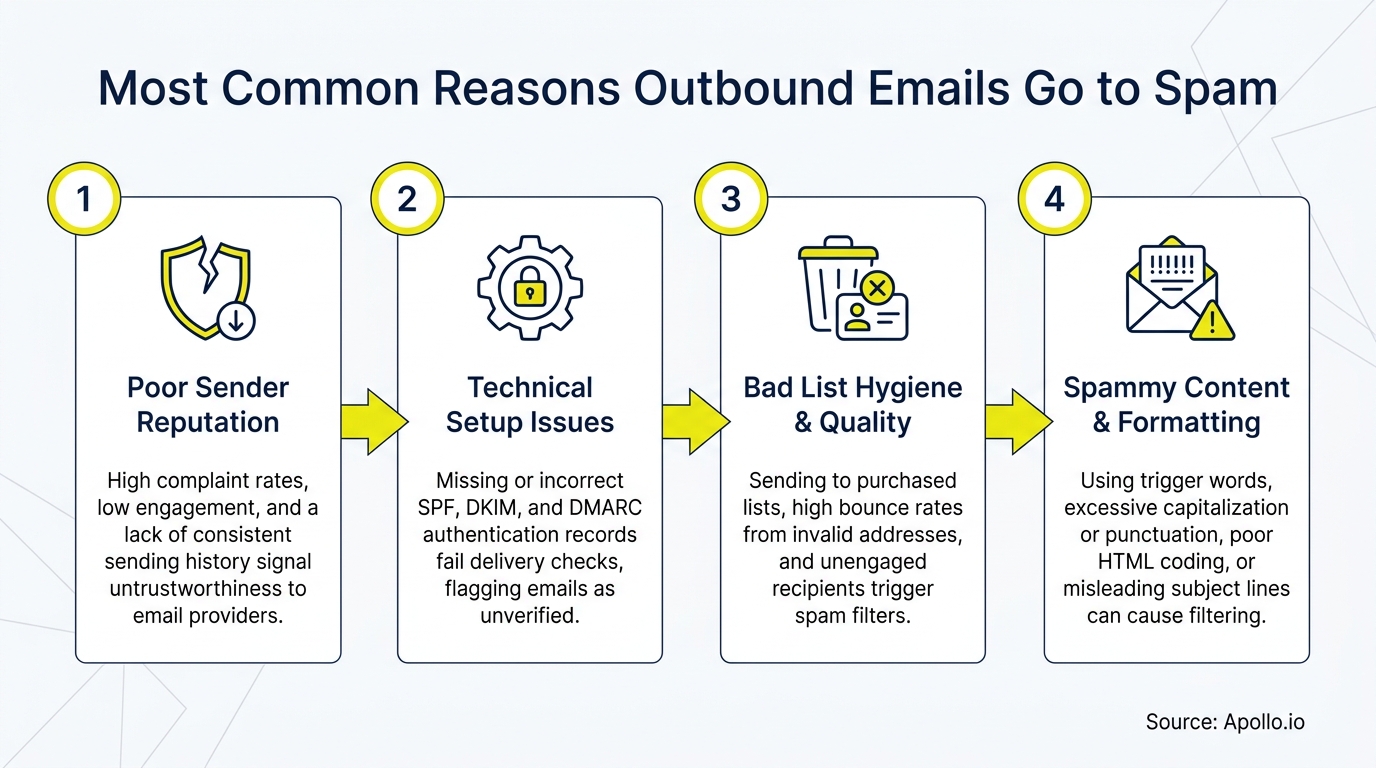
Outbound emails go to spam primarily due to poor sender reputation, missing email authentication, high complaint rates, low-quality contact lists, and engagement patterns that trigger algorithmic filters. These causes interact: a bad list raises bounces, bounces hurt reputation, and degraded reputation causes future sends to filter — regardless of content quality.
According to Mailmend, a staggering 83% of email non-delivery is attributed to poor sender reputation. That figure reframes the problem entirely: most spam placement issues are not content problems. They are infrastructure and data quality problems.
| Root Cause | Specific Signal | Threshold / Target |
|---|---|---|
| Poor sender reputation | Sender score | Keep above 90 |
| High spam complaint rate | User-reported spam rate | Under 0.1%; never reach 0.3% |
| Hard bounce rate | Invalid / non-existent addresses | At or below 2–2.5% |
| Authentication failure | SPF / DKIM / DMARC misalignment | 100% pass rate required |
| List quality issues | Purchased lists, spam traps, stale data | Zero tolerance for spam traps |
| Volume spikes | Sudden send-rate increases | Ramp gradually; no sudden spikes |
Why Is Email Authentication Non-Negotiable in 2026?
Email authentication (SPF, DKIM, and DMARC) is now a hard requirement enforced by every major mailbox provider. Missing or misconfigured authentication causes emails to be filtered or outright rejected before any content evaluation occurs.
As noted by The Digital Bloom, Google and Yahoo mandated SPF, DKIM, and DMARC for bulk senders (those sending 5,000+ emails per day to Gmail addresses) as of early 2024, with Microsoft implementing DMARC requirements by May 2025. For outbound teams sending sequences at scale, this means authentication failures now translate directly into spam placement or rejection — not just lower deliverability scores.
- SPF: Authorizes which servers can send on behalf of your domain.
- DKIM: Adds a cryptographic signature to verify the message wasn't altered in transit.
- DMARC: Tells receiving servers what to do when SPF or DKIM fails (none / quarantine / reject).
- One-click unsubscribe: Required by Google for bulk senders; absence increases complaint rates.
RevOps leaders managing outbound infrastructure should audit DMARC alignment first. A misconfigured subdomain used for sequences is one of the most common silent killers of B2B outbound performance.
Turn Funnel Guesswork Into Closed Deals
Pipeline forecasting a guessing game? Apollo surfaces in-market buyers before they stall, turning weak top-of-funnel leads into real opportunities. Join 600K+ companies building pipeline they can actually count on.
Start Free with Apollo →How Does List Quality Affect Spam Placement?
Sending to stale, purchased, or unverified contact lists generates the bounces and spam complaints that destroy domain reputation over time. Research from KVN Mail confirms that sending to inactive or purchased email lists and sudden spikes in email volume are both detrimental to sender reputation.
Industry best practices, cited by Insight Mark Research, recommend maintaining bounce rates at or below 2–2.5%. Exceeding this threshold signals to mailbox providers that your list hygiene is poor — and filters respond accordingly.
For SDRs and BDRs building outbound sequences, the data going into those sequences is as important as the copy. Reaching verified, accurate contacts protects deliverability. Struggling with stale prospect data? Apollo's 230M+ verified business contacts with 97% email accuracy help SDRs and BDRs protect their sender reputation from the start.
What Spam Complaint Rate Triggers Filtering Penalties?
A spam complaint rate at or above 0.3% triggers filtering penalties from Google and Yahoo, and the recommended safe threshold is under 0.1%. These are hard gates, not guidelines.
Data from Mailmend shows that in 2024, the average spam complaint rate reached 0.07% — a doubling from previous years — indicating tightening scrutiny from both mailbox providers and recipients. The bar is rising while the margin for error is shrinking.
Complaint rates spike when outbound emails reach the wrong people. Targeting irrelevant prospects, sending too frequently, or lacking a clear unsubscribe path all increase the probability that recipients mark your message as spam instead of simply ignoring it. Tighter ICP targeting is the most direct lever for reducing complaint rates in outbound sequences. Explore lead generation approaches that prioritize precision over volume.

How Do SDRs and RevOps Teams Diagnose Deliverability Problems?
SDRs and RevOps leaders diagnose deliverability problems by monitoring five core metrics weekly: spam complaint rate, hard bounce rate, DMARC pass rate, blocklist status, and inbox placement rate. Most teams skip this monitoring and only discover issues when pipeline volume drops unexpectedly.
A practical weekly observability checklist:
- Spam complaint rate: Check Google Postmaster Tools; target under 0.1%.
- Hard bounce rate: Pull from your sending platform; flag anything above 2%.
- DMARC alignment: Review DMARC aggregate reports for SPF/DKIM failures.
- Blocklist status: Check MXToolbox or similar for domain/IP listings weekly.
- Inbox placement testing: Use seed list testing to confirm actual inbox vs. spam routing.
- Engagement signals: Track replies and clicks — not just opens, which Apple's Mail Privacy Protection has made unreliable as a primary metric.
For B2B sales teams running multi-step sequences, adding this weekly review into the RevOps cadence prevents compounding damage. A deliverability problem caught in week one costs far less than one discovered after a month of degraded domain reputation.
What Other Factors Push Outbound Emails into Spam?
Beyond authentication and list quality, engagement patterns, sending behavior, and content signals all contribute to spam placement. Mailbox providers use AI-driven filtering that evaluates the cumulative pattern of your sends — not just individual messages.
- Sudden volume spikes: Scaling from 50 to 500 emails per day overnight triggers spam filters. Warm up sending volume gradually over weeks.
- Templated, low-variation content: AI-driven filters increasingly detect high-volume sequences with repetitive patterns. Personalization and variation reduce this risk.
- Spam trigger words: Phrases like "guaranteed," "free offer," or excessive use of caps and exclamation marks raise content-level flags.
- Missing plain-text version: HTML-only emails with no plain-text alternative are a common filter trigger.
- Broken or suspicious links: Links to domains with poor reputation or redirects through flagged domains damage deliverability.
- No physical address or unsubscribe mechanism: Required by CAN-SPAM; absence increases spam classification probability.
For teams running outbound sales sequences, a unified platform that manages verified data, personalization, and sequence throttling in one place reduces the operational risk of triggering these filters through fragmented tooling.
How Do You Fix Outbound Deliverability and Stay Out of Spam?
Fixing outbound deliverability requires addressing root causes in a specific order: authentication first, then list hygiene, then sending behavior, then content. Skipping to content fixes while authentication is broken wastes effort.
Priority fix sequence:
- Audit and confirm SPF, DKIM, and DMARC are correctly configured and aligned for every sending domain and subdomain.
- Verify your contact list with a reputable tool before launching any new sequence. Remove role addresses, catch-alls, and contacts inactive for 6+ months.
- Implement a sending ramp: start new domains at low volume and increase by no more than 20–30% per week.
- Add one-click unsubscribe to all outbound sequences to reduce complaint rates.
- Monitor Google Postmaster Tools weekly for domain reputation and spam rate signals.
- Shift engagement measurement to replies, clicks, and meeting bookings rather than open rate (which Apple's Mail Privacy Protection inflates artificially).
Teams using outbound-heavy go-to-market strategies who treat deliverability as an ops function — not a one-time setup task — consistently outperform those who optimize copy while ignoring infrastructure. As noted, "Having everything in one system was a game changer" (Cyera) — consolidating prospecting, verified data, and sequence execution into one platform removes the gaps where deliverability problems typically hide.

Start Sending Outbound That Actually Reaches the Inbox
The most common reasons outbound emails go to spam — poor sender reputation, authentication failures, bad list data, and high complaint rates — are all fixable. But they require systematic attention, not one-off tweaks.
SDRs, RevOps leaders, and sales managers who treat deliverability as a core performance metric will book more meetings from the same sending volume.
Apollo gives B2B GTM teams verified contact data, built-in sequence management, and sales engagement tools in one unified platform — reducing the fragmented tooling that creates deliverability blind spots. "We reduced the complexity of three tools into one" (Predictable Revenue). Ready to build outbound that lands? Start a free trial with Apollo and protect your sender reputation from day one.
Prove Pipeline ROI Before Next QBR
ROI pressure killing your next budget approval? Apollo delivers measurable pipeline impact from day one — 46% more meetings, trackable deal velocity, and results leadership can't argue with. Start free today.
Start Free with Apollo →Don't miss these
Sales
Inbound vs Outbound Marketing: Which Strategy Wins?
Sales
What Is a Sales Funnel? The Non-Linear Revenue Framework for 2026
Sales
What Is a Go-to-Market Strategy? The 2026 GTM Playbook
See Apollo in action
We'd love to show how Apollo can help you sell better.
By submitting this form, you will receive information, tips, and promotions from Apollo. To learn more, see our Privacy Statement.
4.7/5 based on 9,690 reviews
