
Sales Report Template: Build Data-Driven Reports That Drive Revenue
Sales leaders waste hours copying data into spreadsheets while deals slip through the cracks.
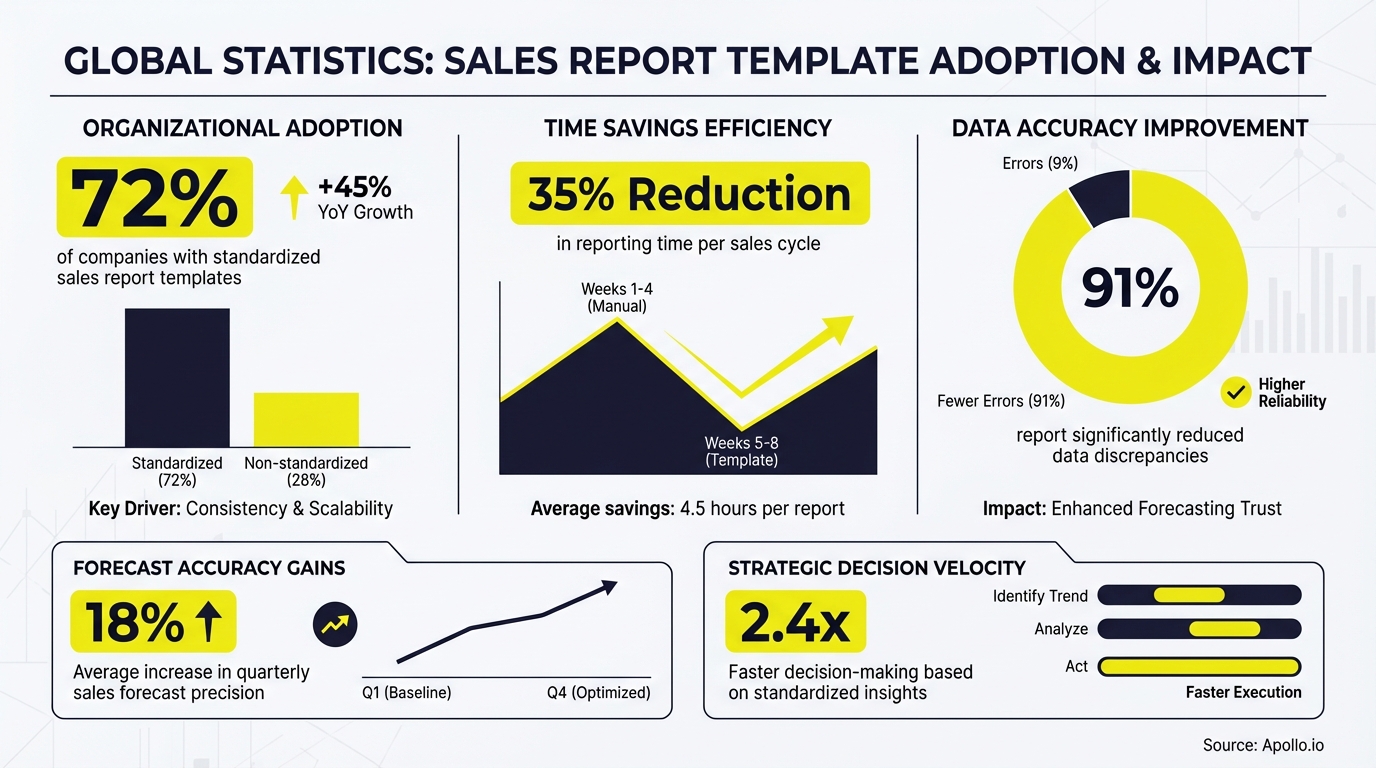
A sales report template transforms this chaos into clarity by automating data collection and standardizing metrics across your team.
The right template gives you instant visibility into pipeline health, rep performance, and revenue forecasts without manual busywork.
Modern sales reporting has evolved beyond static spreadsheets.
Research by Gartner shows sellers who effectively partner with AI tools are 3.7 times more likely to meet their quotas.
Today's templates integrate with your CRM, surface AI-driven insights, and adapt to hybrid B2B selling across email, phone, and social channels.

Apollo Finds Verified Contacts In Seconds
Tired of spending 4+ hours daily hunting for contact info? Apollo delivers 224M+ verified contacts with 96% email accuracy. Join 550K+ companies closing more deals.
Start Free with Apollo →Key Takeaways
- Sales report templates standardize metrics and automate data collection, saving sales leaders hours of manual work each week
- AI-enabled templates deliver predictive insights and quota attainment forecasts that static spreadsheets cannot match
- Modern templates track multi-channel activity across email, phone, and social outreach in unified dashboards
- Revenue operations teams use templates to maintain data governance and ensure consistency across sales channels
- The best templates integrate with your existing tech stack to eliminate tool sprawl and reduce platform costs
What Is a Sales Report Template?
A sales report template is a pre-built framework that organizes sales data into standardized formats for tracking performance, pipeline health, and revenue metrics.
It eliminates manual data entry by pulling information directly from your CRM and sales engagement platforms into consistent, repeatable reports.
Templates range from simple weekly activity trackers to complex forecasting dashboards.
The core components include pipeline stages, conversion rates, deal velocity, rep performance metrics, and revenue forecasts.
Modern templates also incorporate AI-driven insights that highlight risks and opportunities automatically.
According to Gartner, 60% of B2B sales organizations have transitioned to data-driven selling approaches that integrate sales processes, applications, data, and analytics.
Templates serve as the foundation for this transformation by standardizing how teams collect and analyze performance data.
Why Do Sales Leaders Need Report Templates in 2026?
Sales leaders need report templates because manual reporting consumes time that should go toward coaching and strategy.
Templates automate data aggregation across multiple systems, providing real-time visibility into team performance without spreadsheet maintenance.
The shift to hybrid selling has made reporting more complex. Teams now manage activity across email sequences, phone calls, social outreach, and in-person meetings.
Templates unify these disparate channels into single dashboards that show complete customer engagement patterns.
For RevOps leaders, templates ensure data governance and consistency.
When every sales leader builds custom reports, metrics definitions diverge and comparisons become meaningless.
Standardized templates maintain uniform KPIs across regions, products, and teams.
Struggling with pipeline visibility across channels? Track every deal stage in one unified dashboard with Apollo's deal management.
What Metrics Should SDRs Track in Sales Reports?
SDRs should track activity metrics, conversion rates, and pipeline contribution in their sales reports. Core metrics include calls made, emails sent, meetings booked, and conversion rates from prospect to qualified opportunity.
| Metric Category | Key Metrics | Why It Matters |
|---|---|---|
| Activity Volume | Calls, emails, social touches | Shows daily productivity and outreach consistency |
| Response Rates | Email open, reply, call connect rates | Indicates message quality and targeting accuracy |
| Conversion Metrics | Prospect to meeting, meeting to opportunity | Reveals qualification skills and pipeline impact |
| Pipeline Value | Total dollar value of opportunities created | Connects SDR activity to revenue outcomes |
SDRs using AI-powered platforms report faster prospecting and higher booking rates.
Modern templates automatically calculate these metrics from platform data, eliminating manual tracking.
The best templates also benchmark individual performance against team averages to identify coaching opportunities.
Templates should segment metrics by channel to show which outreach methods drive the best results.
An SDR might discover their phone calls convert at 12% while emails convert at 3%, suggesting where to focus effort.
This granular visibility helps reps optimize their daily workflows.
Turn Forecast Guesswork Into Revenue Certainty
Pipeline forecasting a guessing game? Apollo's real-time visibility shows exactly where every deal stands. Built-In boosted win rates 10% with Apollo's signals and scoring.
Start Free with Apollo →How Do Account Executives Use Report Templates?
Account Executives use report templates to track deal progression, forecast accuracy, and close rates.
AE templates focus on pipeline stages, deal velocity, win/loss analysis, and quota attainment rather than top-of-funnel activity metrics.
The most valuable AE templates show deal health scores that combine engagement frequency, stakeholder involvement, and timeline adherence.
These predictive indicators help AEs identify at-risk deals before they stall.
Templates also track average deal size, sales cycle length, and competitive win rates by segment.
For AEs managing complex enterprise deals, templates should include buying committee tracking and multi-threading metrics.
Research shows 74% of B2B buyer teams experience unhealthy conflict during decision processes.
Templates that map stakeholder engagement help AEs navigate internal buyer politics and maintain deal momentum.
AEs benefit from templates that compare their performance across different deal sizes, industries, and product lines.
This analysis reveals where each rep has natural strengths and where coaching could improve outcomes.
Many enterprise sales solutions now include these breakdowns automatically.
What Features Make Sales Report Templates Effective?
Effective sales report templates combine automation, customization, and actionable insights.
The template should pull data automatically from your CRM and sales engagement platforms without manual exports or data entry.
Key features include:
- Real-time data refresh: Templates sync with source systems continuously, not just at report generation time
- Role-based views: SDRs, AEs, and managers see metrics relevant to their responsibilities
- Drill-down capability: Click from summary metrics into individual activities and deal details
- Exception highlighting: Automatic flags for deals behind schedule or reps missing targets
- Trend visualization: Charts showing performance trajectories, not just point-in-time snapshots
- Export flexibility: One-click exports to presentations, spreadsheets, or PDF formats
The best templates also include benchmarking against historical performance and peer comparisons.
An AE seeing their close rate dropped from 28% to 19% can investigate what changed in their approach or territory.
Spending hours building reports manually? Automate your reporting workflows with Apollo's AI GTM system.
How Should Sales Leaders Implement Report Templates?
Sales leaders should implement report templates by starting with core metrics, ensuring data quality, and training teams on consistent usage.
Begin with three to five essential reports rather than building a comprehensive library immediately.

Implementation steps:
- Define metric standards: Document exactly how each KPI is calculated and what activities count toward it
- Audit data sources: Verify your CRM and sales tools contain accurate, complete information
- Pilot with one team: Test templates with a single team before rolling out organization-wide
- Schedule regular reviews: Set weekly or bi-weekly cadences for teams to review reports together
- Iterate based on feedback: Adjust templates as teams identify missing metrics or confusing formats
RevOps leaders should establish governance around template modifications.
When individual managers customize templates excessively, consistency breaks down and cross-team comparisons become impossible.
Create a process for requesting template changes that balances flexibility with standardization.
The most successful implementations integrate templates into existing workflows rather than adding new meetings.
For example, paste template outputs directly into weekly forecast calls or one-on-one coaching sessions.
This ensures templates drive action rather than becoming unused dashboards.
Start Building Better Sales Reports Today
Sales report templates transform raw data into actionable insights that drive quota attainment and revenue growth.
The best templates automate data collection, standardize metrics across teams, and surface AI-driven predictions that help you coach more effectively and forecast more accurately.
Modern sales organizations need unified reporting across email, phone, social, and in-person channels.
Templates that integrate with your existing tech stack eliminate the tool sprawl that creates reporting gaps and inflates costs.
As one Apollo customer noted, "Having everything in one system was a game changer" (Cyera).
Start by implementing core templates for SDR activity, AE pipeline management, and forecast accuracy.
Focus on metrics that directly connect to revenue outcomes rather than vanity metrics that don't influence buyer decisions.
With proper implementation and governance, templates become the foundation for truly data-driven sales operations.
Ready to consolidate your sales tech stack and automate reporting? Start free with Apollo and access deal management, pipeline tracking, and AI-powered insights in one unified platform.
Prove Apollo's Value In Your First Week
Budget approval stuck on unclear metrics? Apollo tracks every touchpoint to pipeline dollar—showing exact ROI from day one. Built-In increased win rates 10% and ACV 10% with Apollo's signals.
Start Free with Apollo →Don't miss these
Sales
Inbound vs Outbound Marketing: Which Strategy Wins?
Sales
What Is a Sales Funnel? The Non-Linear Revenue Framework for 2026
Sales
What Is a Go-to-Market Strategy? The 2026 GTM Playbook
See Apollo in action
We'd love to show how Apollo can help you sell better.
By submitting this form, you will receive information, tips, and promotions from Apollo. To learn more, see our Privacy Statement.
4.7/5 based on 9,690 reviews
