
Sales Portal: Definition, Benefits, and Implementation Guide
B2B sales portals are no longer just digital storefronts. They're hybrid ecosystems where AI automation meets human expertise, self-service meets consultative selling, and omnichannel strategies converge. Research by Gartner shows 61% of B2B buyers now prefer rep-free experiences, yet Gartner predicts 75% will prioritize human interaction over AI by 2030. The winning sales portal strategy balances both.

Apollo Eliminates 4+ Hours Of Daily Research
Tired of spending 4+ hours daily hunting for contact info? Apollo delivers 224M verified contacts with 96% email accuracy—so your team sells instead of searches. Join 550K+ companies closing more deals.
Start Free with Apollo →Key Takeaways
- Modern sales portals combine AI-powered self-service with human-led selling for complex deals, reducing costs while maintaining relationship quality.
- Omnichannel architecture synchronizes data across 10+ buyer touchpoints, delivering consistent experiences whether prospects engage via portal, rep, or mobile.
- Flexible payment terms and optimized checkout UX directly impact conversion, with 93% of B2B buyers now choosing eCommerce platforms for procurement.
- SDRs and AEs using integrated sales portals save 12+ hours weekly on admin tasks, redirecting time to high-value prospect conversations.
- ROI-driven portal implementations deliver measurable gains: 35% faster deal cycles, 46% more meetings booked, and 50% reduction in tool costs through consolidation.
What Is a Sales Portal in 2026?
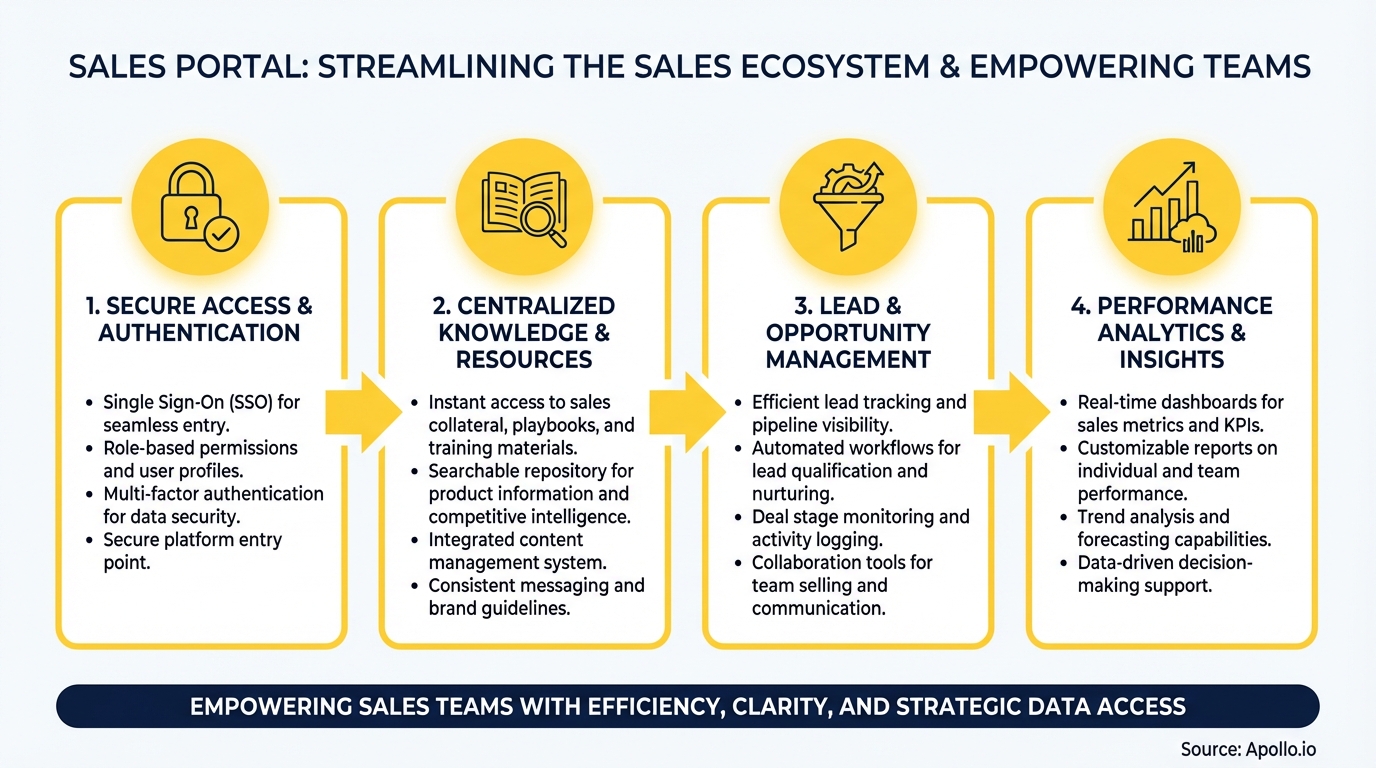
A sales portal is a unified digital platform where buyers research products, configure solutions, request quotes, and complete purchases while sales teams manage leads, automate outreach, and close deals. Unlike traditional eCommerce sites, B2B sales portals integrate CRM data, pricing engines, inventory systems, and communication tools into one workspace.
Modern portals serve dual purposes: empowering buyers with self-service capabilities while equipping B2B sales teams with intelligence to intervene at critical moments. According to Gartner, 80% of B2B sales interactions now occur in digital channels, making portals the primary revenue engine for most organizations.
Leading portals in 2026 feature AI research agents, conversation intelligence, automated workflows, and real-time data enrichment. They replace fragmented tech stacks with consolidated platforms that handle prospecting, engagement, meetings, and deal management in one system.
Why Do Sales Teams Need Portal Technology?
Sales portals eliminate the chaos of managing multiple tools, spreadsheets, and disconnected systems. For SDRs prospecting hundreds of accounts weekly, portals provide instant access to verified contact data, buying signals, and engagement history without switching between platforms.
Account Executives closing enterprise deals gain pre-meeting intelligence, automated follow-ups, and pipeline visibility that shortens sales cycles by 35%.
RevOps teams benefit from single-source-of-truth data architecture, reducing integration maintenance and data quality issues. Sales leaders get real-time dashboards showing team performance, conversion metrics, and revenue forecasts.
As one customer noted, "We reduced the complexity of three tools into one" (Predictable Revenue), cutting costs while improving outcomes.
Data from McKinsey shows B2B buyers now use up to 10 channels during their purchasing journey, doubling from five channels five years ago. Portals orchestrate these touchpoints, ensuring consistent messaging whether prospects engage via email, phone, chat, or self-service.
How Does AI-Human Balance Work in Sales Portals?
The most effective 2026 sales portals use AI for research, data enrichment, and routine tasks while preserving human touchpoints for relationship-building and complex problem-solving. AI handles lead scoring, contact discovery, email sequencing, and meeting scheduling.
Sales reps focus on consultative conversations, objection handling, and strategic account planning.
Implementation follows a decision framework:

| Task Type | AI Automation | Human-Led |
|---|---|---|
| Prospect Research | AI discovers contacts, enriches data, identifies signals | Rep reviews insights, selects priority accounts |
| Initial Outreach | AI generates personalized emails, schedules sequences | Rep customizes messaging for VIP prospects |
| Meeting Coordination | AI books appointments, sends reminders, updates CRM | Rep conducts discovery calls, builds relationships |
| Deal Management | AI tracks pipeline, flags stalled deals, suggests next steps | Rep negotiates terms, addresses concerns, closes |
Struggling to balance automation with personalization? Apollo's AI platform automates research and outreach while keeping reps in control.
What Features Define Modern Omnichannel Portals?
Omnichannel sales portals synchronize data across web, mobile, email, phone, and in-person channels. Core architecture includes:
- Unified Data Layer: Single customer record updated in real-time across all touchpoints, eliminating duplicate entries and conflicting information.
- API-First Integration: Connects CRM, marketing automation, billing, support, and analytics tools through standardized APIs, not brittle custom code.
- Channel Orchestration Engine: Routes prospects to appropriate channels based on intent signals, deal size, and buyer preferences automatically.
- Mobile-Responsive Interface: Full portal functionality on smartphones and tablets, supporting field sales teams and on-the-go buyers.
- Security & Compliance: Role-based access controls, audit logs, and encryption protecting sensitive business contact information.
For teams managing enterprise sales, omnichannel portals ensure consistent experiences whether prospects engage with SDRs, AEs, customer success, or self-service resources. Data enrichment happens automatically, maintaining 96% accuracy across 224M+ contacts.
Turn Forecast Guesswork Into Quota Certainty
Pipeline forecasting a guessing game? Apollo reveals which leads convert with real-time intent signals and verified contacts. Built-In boosted win rates 10% using Apollo's scoring.
Start Free with Apollo →How Do SDRs Use Sales Portals to Book More Meetings?
SDRs using modern sales portals report booking 46% more meetings by leveraging AI research agents and automated sequences. The workflow starts with advanced search filters identifying ideal customer profile matches across 30M+ companies.
AI enriches contact records with phone numbers, email addresses, job changes, and buying signals.

SDRs then launch multi-channel sequences combining email, LinkedIn, and phone outreach. Automated meeting scheduling eliminates back-and-forth, with calendar links embedded in outreach messages. AI call assistants transcribe conversations, generate summaries, and suggest follow-up actions, saving 12+ hours weekly on administrative tasks.
Portal analytics show which messages, subject lines, and send times drive highest response rates. SDRs iterate based on data, not guesswork.
Real-time notifications alert reps when prospects open emails, visit pricing pages, or download resources, enabling timely follow-up that converts interest into booked meetings.
What Payment and Checkout Features Drive Conversions?
B2B checkout UX directly impacts revenue. A study from B2B eCommerce Association found 93% of buyers now choose eCommerce platforms for procurement, yet most face poor checkout experiences.
High-converting portals offer:
- Flexible Payment Terms: Net-30, Net-60, installment plans, and credit options tailored to buyer cash flow needs, not rigid upfront payment requirements.
- Dynamic Pricing: Volume discounts, contract-based pricing, and custom quotes generated automatically based on deal size and customer segment.
- One-Click Reordering: Saved payment methods, shipping addresses, and purchase histories enabling repeat buyers to complete transactions in seconds.
- Multi-Currency Support: Automatic conversion and localized pricing for global buyers, reducing friction in international deals.
- Approval Workflows: Multi-step authorization for purchases exceeding budget thresholds, integrating with procurement systems buyers already use.
For Account Executives managing complex deals, portals with deal management capabilities track contract negotiations, approval stages, and payment milestones in real-time. This visibility prevents deals from stalling in procurement and accelerates time-to-revenue.
How Can Sales Leaders Measure Portal ROI?
ROI measurement tracks efficiency gains, revenue impact, and cost savings from portal consolidation. Key metrics include:
| Metric Category | Specific KPIs | Target Improvement |
|---|---|---|
| Efficiency | Time saved on admin tasks, meetings booked per rep, outreach velocity | 12+ hours weekly saved, 46% more meetings |
| Revenue | Deal cycle length, win rates, average contract value, pipeline velocity | 35% faster cycles, 25% higher win rates |
| Cost Savings | Tools consolidated, subscription costs eliminated, integration maintenance reduced | 50% lower tech stack costs |
| Data Quality | Contact accuracy, duplicate records, enrichment coverage, CRM adoption | 96% accuracy, 90% enrichment rate |
Sales leaders at companies like Census report, "We cut our costs in half" by consolidating prospecting, engagement, and analytics tools into unified portals. Cyera noted, "Having everything in one system was a game changer" for team productivity and forecast accuracy.
Dashboard tracking should monitor leading indicators (outreach volume, response rates, meetings booked) and lagging indicators (closed-won revenue, customer acquisition cost, lifetime value). RevOps teams use these insights to optimize workflows, reallocate resources, and demonstrate clear ROI to executive stakeholders.
Turn Your Sales Portal Into a Revenue Engine
The most successful 2026 sales portals balance AI efficiency with human expertise, deliver seamless omnichannel experiences, and provide flexible buying options that match modern B2B procurement needs. For SDRs, they automate prospecting and outreach.
For AEs, they shorten deal cycles with intelligence and automation. For sales leaders, they consolidate tech stacks and provide visibility into every stage of the revenue process.
Implementation starts with defining your AI-human balance, mapping omnichannel touchpoints, and designing checkout experiences that convert. Focus on consolidation over complexity. As modern sales teams discover, replacing 3-5 separate tools with one unified platform cuts costs, improves data quality, and accelerates revenue growth.
Ready to consolidate your sales tech stack? Schedule a Demo to see how Apollo's all-in-one GTM platform replaces prospecting, engagement, and pipeline tools with one workspace that helps teams book 46% more meetings and close deals 35% faster.
Prove Apollo's Value In Your First 30 Days
Budget approvals stuck on unclear metrics? Apollo delivers measurable pipeline impact from day one—track every dollar from prospect to close. Built-In increased win rates 10% and ACV 10% using Apollo's scoring and signals.
Start Free with Apollo →Don't miss these
Sales
Inbound vs Outbound Marketing: Which Strategy Wins?
Sales
What Is a Sales Funnel? The Non-Linear Revenue Framework for 2026
Sales
What Is a Go-to-Market Strategy? The 2026 GTM Playbook
See Apollo in action
We'd love to show how Apollo can help you sell better.
By submitting this form, you will receive information, tips, and promotions from Apollo. To learn more, see our Privacy Statement.
4.7/5 based on 9,690 reviews
