
How to Conduct Sales Pipeline Analysis That Drives Revenue Growth
Sales pipeline analysis is the systematic process of examining your sales pipeline to identify bottlenecks, forecast revenue, and optimize conversion rates. In 2026, Gartner reports that 65% of B2B sales organizations have transitioned from intuition-based to data-driven decision making. For Sales Leaders and RevOps teams, this shift means pipeline analysis is no longer optional. It's the foundation for predictable revenue and team coaching at scale.

Reclaim 4+ Hours Daily With Apollo's Automation
Tired of reps spending hours hunting for contact info? Apollo delivers 224M verified contacts instantly, eliminating manual research. Join 550K+ companies who've turned data entry into deal closing.
Start Free with Apollo →Key Takeaways
- Sales pipeline analysis reveals where deals stall, helping SDRs and AEs focus on high-impact activities that move deals forward
- Data-driven pipeline metrics cut guesswork, giving Sales Leaders clear visibility into team performance and revenue forecasts
- Balancing AI automation with human touchpoints creates healthier pipelines that convert 35% more prospects into closed deals
- RevOps teams using consolidated platforms report 50% cost savings versus managing multiple disconnected tools
What Is Sales Pipeline Analysis?
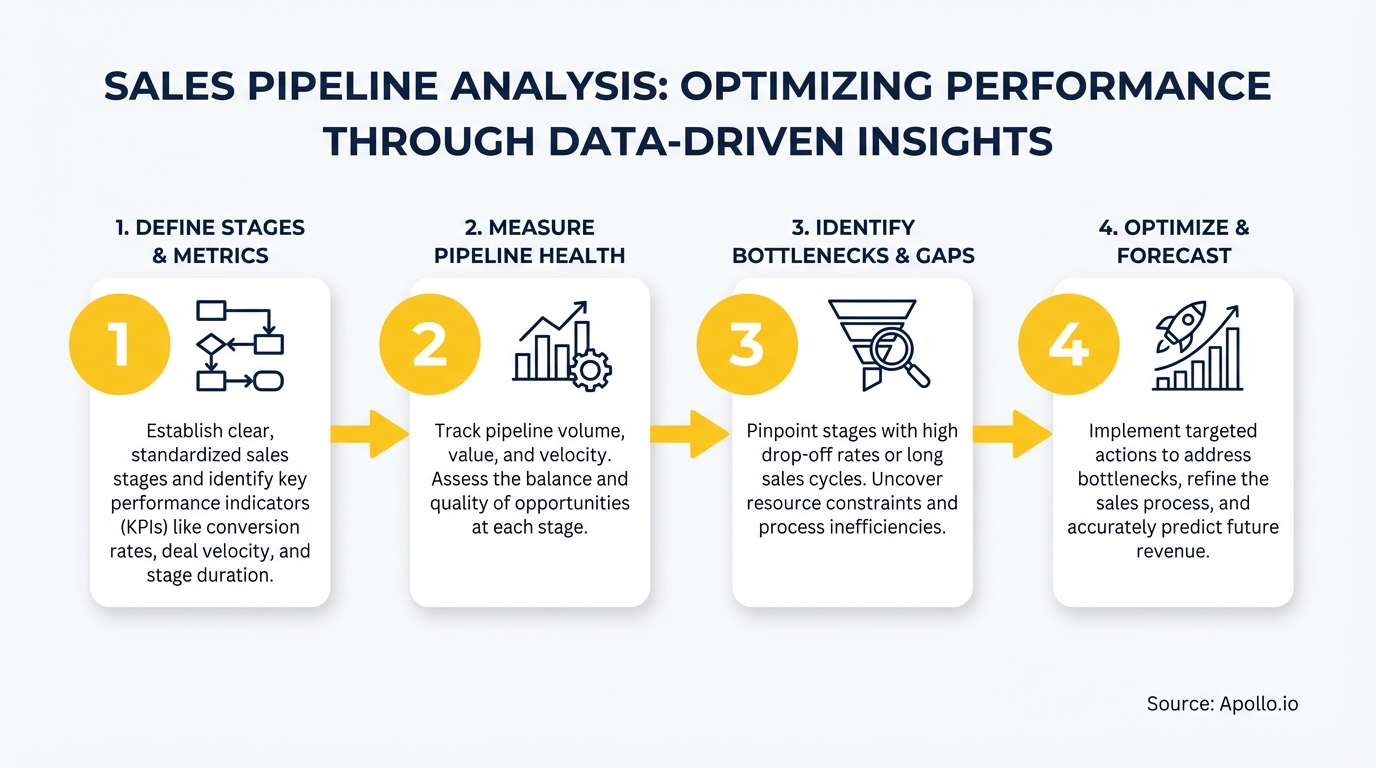
Sales pipeline analysis is the practice of evaluating your pipeline's health by tracking metrics like stage conversion rates, deal velocity, and pipeline coverage. It answers critical questions: Are deals moving forward?
Where do prospects drop off? Is your team hitting quota?
The process involves three core elements. First, you measure stage-by-stage conversion rates to identify bottlenecks.
Second, you calculate deal velocity to understand how long deals take to close. Third, you assess pipeline coverage to ensure you have enough opportunities to hit revenue targets.
According to Gartner, 61% of B2B buyers now prefer a rep-free buying experience. This means your pipeline analysis must account for both self-service digital touchpoints and strategic human engagement at key decision moments.
Why Is Sales Pipeline Analysis Critical in 2026?
Sales pipeline analysis directly impacts revenue predictability and team performance. Without it, Sales Leaders operate blind, unable to coach effectively or forecast accurately.
RevOps teams struggle to allocate resources, and AEs waste time on deals that will never close.
The business impact is measurable. Teams using data-driven pipeline analysis report 30-40% higher forecast accuracy.
They identify at-risk deals earlier, allowing AEs to course-correct before opportunities die. They also spot high-performing patterns, enabling Sales Leaders to replicate what works across the entire team.

Research by McKinsey shows AI integration in sales processes enhances efficiency and customer engagement. But technology alone isn't enough. The most successful teams balance automation with deliberate human interaction, creating pipelines that feel personal while scaling efficiently.
How Do Sales Leaders Build a Pipeline Health Framework?
A pipeline health framework tracks specific metrics that reveal whether your pipeline will hit revenue targets. Sales Leaders need a dashboard showing pipeline coverage ratio, average deal size, win rate by stage, and sales velocity.
Start with these core metrics:
| Metric | Definition | Healthy Benchmark |
|---|---|---|
| Pipeline Coverage | Total pipeline value ÷ Quota | 3-4x quota |
| Stage Conversion Rate | % of deals moving to next stage | 20-30% per stage |
| Average Deal Velocity | Days from first touch to close | 30-90 days (varies by ACV) |
| Win Rate | Closed-won deals ÷ Total opportunities | 20-30% |
Spot In-Market Buyers Before Competitors Do
Missing prospects who are ready to buy right now? Apollo's intent signals reveal which accounts are actively researching solutions. Built-In increased win rates 10% by reaching buyers at the perfect moment.
Start Free with Apollo →For RevOps teams managing pipeline health, deal management platforms provide real-time visibility into these metrics. Track them weekly, not monthly. Early detection of pipeline gaps gives your team time to course-correct before quarter-end panic sets in.
Struggling to track deals effectively? Get complete pipeline visibility with Apollo's deal management platform.
How Do AEs Improve Pipeline Conversion Rates?
AEs improve conversion rates by focusing on three high-impact activities: qualifying harder early, personalizing outreach with research, and creating urgency through business value. The goal is moving the right deals forward, not pushing everything through the funnel.
Start with qualification. Use frameworks like BANT (Budget, Authority, Need, Timeline) or MEDDIC to disqualify poor-fit prospects early.
This frees up time for deals that will actually close. AEs using rigorous qualification report 25-35% higher win rates because they focus energy where it matters.
Next, personalize every interaction. Generic outreach dies in 2026. Sales analytics platforms help AEs identify which messaging resonates with specific buyer personas. Use data on past wins to replicate successful patterns across your pipeline.
Finally, create urgency by tying your solution to business outcomes with specific timelines. Instead of "This will help your team," say "This will reduce your customer churn by 15% in Q2, preventing $200K in lost revenue." Specificity converts.
What Tools Help RevOps Teams Consolidate Their Tech Stack?
RevOps teams in 2026 are cutting bloated tech stacks by consolidating onto all-in-one platforms. The average sales team uses 5-8 separate tools for prospecting, engagement, enrichment, and pipeline management.
This creates data silos, integration headaches, and inflated costs.
The consolidation trend is driven by real customer results. "We reduced the complexity of three tools into one," says Predictable Revenue. "We cut our costs in half," reports Census. "Having everything in one system was a game changer," notes Cyera. These aren't marketing claims.
They're operational realities from RevOps leaders who eliminated redundant subscriptions.

Modern platforms combine contact databases, sales development workflows, engagement sequences, and funnel analytics in one workspace. This gives SDRs, AEs, and Sales Leaders a single source of truth. No more toggling between tools or syncing data manually.
Tired of managing multiple disconnected tools? Consolidate your entire GTM stack with Apollo's unified platform.
How Should Teams Balance AI Automation With Human Engagement?
The future of sales isn't fully automated or fully manual. It's strategic automation paired with high-value human touchpoints. Data from Gartner predicts that by 2030, 75% of B2B buyers will prefer sales experiences prioritizing human interaction over AI. This doesn't mean abandoning automation. It means using it wisely.
Automate low-value tasks: data entry, meeting scheduling, initial outreach sequences, and follow-up reminders. This frees SDRs and AEs to focus on relationship-building conversations that require empathy, problem-solving, and strategic thinking. AI sales tools handle the busywork so your team can focus on closing deals.
Reserve human engagement for high-stakes moments: discovery calls, objection handling, contract negotiations, and executive relationship-building. These interactions benefit from emotional intelligence and adaptability that AI can't replicate.
The most successful teams use automation to create capacity for more meaningful human conversations, not to replace them entirely.
What Implementation Steps Drive Immediate Pipeline Improvements?
Start with a pipeline audit. Export your current pipeline and calculate stage conversion rates, average deal velocity, and win rate by source.
Identify your biggest bottleneck. Is it top-of-funnel volume?
Mid-stage conversion? Closing efficiency?
Next, implement weekly pipeline reviews with your team. Sales Leaders should review individual rep pipelines, coaching on deal strategy and qualification rigor. Use proven playbooks from high-performing teams to structure these reviews for maximum impact.
Then, clean your data. Remove stale opportunities that haven't moved in 60+ days.
Update contact information using enrichment tools. Accurate data is the foundation of reliable pipeline analysis.
Finally, set up automated alerts for at-risk deals based on inactivity or stage duration thresholds. This ensures no opportunity falls through the cracks.
Ready to Transform Your Sales Pipeline Analysis?
Sales pipeline analysis in 2026 requires more than spreadsheets and gut instinct. It demands real-time data, AI-powered insights, and a unified platform that eliminates tool sprawl.
The teams winning today use data-driven frameworks to identify bottlenecks, coach effectively, and forecast with confidence.
Apollo gives Sales Leaders, RevOps teams, and AEs complete pipeline visibility in one workspace. Our customers report 46% more meetings with AI research agents and 35% higher booking rates with intelligent messaging.
We've helped over 550,000 companies consolidate their tech stack, cutting costs while improving performance.
Try Apollo Free and see how the right platform transforms your pipeline analysis from guesswork to precision.
Prove ROI In Days, Not Quarters With Apollo
Budget approval stuck on unclear metrics? Apollo delivers measurable pipeline impact from day one—track every dollar spent to revenue generated. Built-In increased win rates 10% and ACV 10% with clear attribution.
Start Free with Apollo →Don't miss these
Sales
Inbound vs Outbound Marketing: Which Strategy Wins?
Sales
What Is a Sales Funnel? The Non-Linear Revenue Framework for 2026
Sales
What Is a Go-to-Market Strategy? The 2026 GTM Playbook
See Apollo in action
We'd love to show how Apollo can help you sell better.
By submitting this form, you will receive information, tips, and promotions from Apollo. To learn more, see our Privacy Statement.
4.7/5 based on 9,690 reviews
