
Sales Operations Analyst: Role, Skills, and Career Path
Sales operations analysts sit at the intersection of data, technology, and revenue strategy. As companies consolidate their tech stacks and shift toward unified revenue operations (RevOps) frameworks, this role has evolved from spreadsheet wrangler to strategic architect. In 2026, sales operations analysts drive pipeline predictability, optimize AI-powered workflows, and turn fragmented sales data into actionable intelligence that closes deals faster.
According to Gartner, sales operations teams now dedicate 73% of their time to non-sales functions, up from 39% in 2019. This shift reflects the expanding scope of the role: analysts now own forecasting models, tech stack governance, AI implementation, and cross-functional alignment between sales, marketing, and customer success.

Apollo Eliminates 4+ Hours Of Daily Research
Tired of reps spending half their day hunting for contact info? Apollo delivers 224M+ verified contacts instantly—no more manual research or data entry. Join 550K+ companies who turned wasted hours into closed deals.
Start Free with Apollo →Key Takeaways
- Sales operations analysts build the data infrastructure, workflows, and reporting systems that enable sales teams to hit quota consistently.
- The role requires a blend of analytical rigor, technical fluency with CRM and BI tools, and business acumen to translate metrics into strategic recommendations.
- AI adoption is reshaping daily workflows, with analysts now managing automated data enrichment, predictive scoring, and AI-assisted pipeline forecasting.
- Career advancement often leads to senior SalesOps roles, RevOps leadership, or strategic GTM positions with compensation ranging from $70K to $140K+ depending on experience and company size.
- Companies adopting unified platforms like Apollo cut costs by consolidating 3-5 tools into one workspace, giving analysts cleaner data and faster insights.
What Is a Sales Operations Analyst?
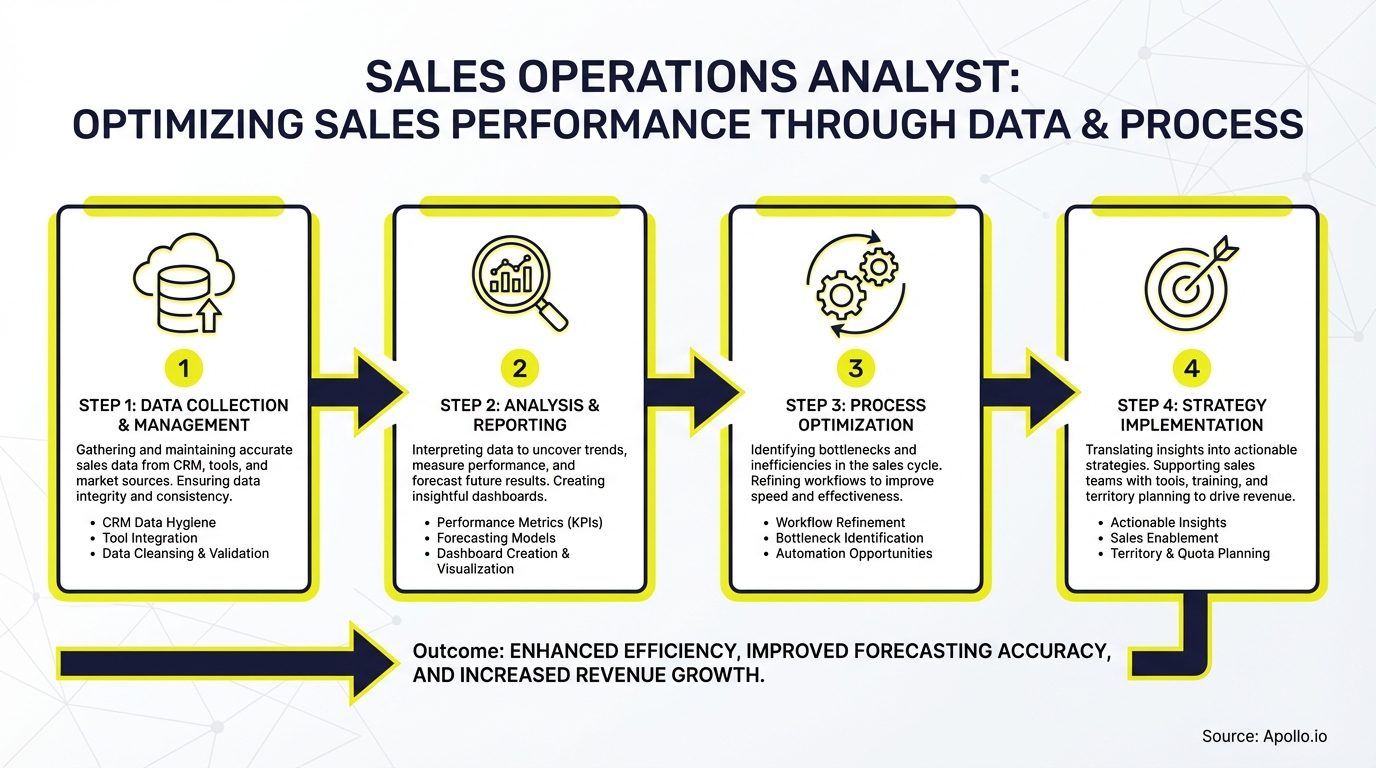
A sales operations analyst is a strategic enabler who optimizes sales processes, manages data integrity, and provides actionable insights that drive revenue growth. Unlike sales reps who close deals or sales managers who coach teams, analysts focus on the systems, workflows, and metrics that make the entire sales organization more efficient and predictable.
The role bridges multiple functions. Analysts collaborate with sales leadership to define KPIs and forecasting models, work with marketing to track lead conversion rates, partner with finance on quota planning, and support RevOps teams in implementing technology that scales.
They're the architects behind pipeline dashboards, territory planning models, compensation structures, and the tech stack integrations that keep data flowing smoothly across systems.
In practical terms, a sales operations analyst might spend their morning auditing CRM data quality, their afternoon building a Tableau dashboard that visualizes win rates by region, and their evening configuring automated workflows in the sales engagement platform. The role requires comfort with ambiguity, strong problem-solving skills, and the ability to communicate complex findings to non-technical stakeholders.
What Is the Difference Between a Sales Analyst and a Sales Operations Analyst?
While the titles overlap, sales analysts typically focus narrowly on reporting and descriptive analytics (what happened last quarter), whereas sales operations analysts take a broader, forward-looking approach that includes process optimization, systems administration, and prescriptive recommendations (what should we change to improve results).
Sales operations analysts own the tech stack, design workflows, and implement changes. Sales analysts produce reports.
Think of it this way: a sales analyst tells you conversion rates dropped 12% last month. A sales operations analyst diagnoses why (poor lead quality from a specific campaign), proposes a solution (tighter MQL criteria and automated lead scoring), and implements the fix in the CRM.
Why Are Sales Operations Analysts Important in 2026?
Revenue teams face unprecedented complexity in 2026. B2B buyers now use an average of ten channels during their purchasing journey, according to McKinsey, and sales organizations respond by deploying more tools, more touchpoints, and more data than ever before. Without skilled analysts to organize this chaos, sales teams drown in noise.
Sales operations analysts provide three critical capabilities:
Data Infrastructure and Integrity: They ensure CRM data is accurate, complete, and actionable. Clean data powers everything from territory assignments to AI-driven lead scoring. Analysts build validation rules, run deduplication scripts, and establish governance policies that prevent garbage data from sabotaging forecasts.
Tired of dirty data slowing down your sales team? Start free with Apollo's 224M+ verified business contacts and automated enrichment workflows.
Process Optimization and Workflow Design: Analysts identify bottlenecks in the sales cycle and implement solutions. If deals stall in the proposal stage, they might automate contract generation.
If SDRs waste time on unqualified leads, they build scoring models that prioritize high-intent prospects. Every improvement compounds across the team.
Strategic Insights and Forecasting: Leadership needs reliable projections to allocate resources, plan hiring, and set investor expectations. Sales operations analysts build forecasting models that account for seasonality, pipeline velocity, and historical win rates. They surface trends early so leaders can course-correct before missing targets.
Research by Gartner indicates that by 2025, 75% of the highest-growth companies will adopt the RevOps model, which relies heavily on skilled operations analysts to unify sales, marketing, and customer success metrics under one framework.
What Does a Sales Operations Analyst Do? Core Responsibilities
The day-to-day work varies by company stage and industry, but most sales operations analysts own a core set of responsibilities that fall into five categories:
What Are the Key Responsibilities of Sales Operations Analysts?
| Responsibility Area | Typical Tasks | Tools Used |
|---|---|---|
| Data Management | CRM hygiene, deduplication, field mapping, data enrichment, validation rules | Salesforce, HubSpot, Apollo, ZoomInfo |
| Reporting & Analytics | Dashboard creation, pipeline analysis, win/loss reporting, quota attainment tracking | Tableau, Looker, Power BI, Google Sheets |
| Process Optimization | Workflow automation, territory planning, lead routing, commission structure design | Salesforce Flows, Zapier, Outreach, Apollo Workflows |
| Systems Administration | Tech stack management, integration maintenance, user training, tool evaluation | Salesforce Admin, API integrations, SSO platforms |
| Forecasting & Planning | Pipeline forecasting, capacity modeling, quota setting, territory carving | Excel, Clari, Anaplan, custom models |
A typical week might include running a pipeline review for the VP of Sales, troubleshooting why certain leads aren't syncing from marketing automation to the CRM, building a new dashboard to track demo-to-close conversion rates, and evaluating whether to renew a prospecting tool based on ROI analysis.
How Do Sales Operations Analysts Support SDRs and AEs?
Sales operations analysts act as force multipliers for front-line sellers. For SDRs, analysts provide clean prospect lists, build automated sequences, and create dashboards that show which activities drive the most meetings. They eliminate manual research by integrating AI-powered prospecting tools that surface intent signals and contact information automatically.
For AEs managing complex deals, analysts build deal desk processes, configure CPQ (configure-price-quote) systems, and provide competitive intelligence dashboards. They ensure AEs spend time selling, not wrestling with administrative tasks or hunting for the latest pricing sheet.
Sales leaders managing teams rely on analysts to provide visibility into team performance, identify coaching opportunities, and forecast accurately. The analyst becomes the trusted advisor who translates raw data into strategic recommendations about where to invest, what to change, and which reps need support.
What Skills Do Sales Operations Analysts Need?
Success in this role requires a unique combination of hard and soft skills. The best analysts blend technical proficiency with business acumen and communication skills that translate complexity into clarity.
What Technical Skills Are Essential for Sales Operations Analysts?
| Skill Category | Specific Capabilities | Proficiency Level |
|---|---|---|
| CRM Platforms | Salesforce administration, HubSpot workflows, custom object creation, reporting | Advanced |
| Data Analysis | SQL queries, Excel pivot tables, statistical analysis, data visualization | Intermediate to Advanced |
| Business Intelligence | Tableau, Looker, Power BI dashboard design and maintenance | Intermediate |
| Sales Technology | Outreach, SalesLoft, Apollo, Gong, Clari, LinkedIn Sales Navigator | Intermediate |
| Automation Tools | Zapier, Salesforce Flows, API integrations, workflow engines | Intermediate |
| Spreadsheet Mastery | Complex formulas, VLOOKUP, INDEX-MATCH, macros, scenario modeling | Advanced |
Beyond technical skills, analysts need strong business acumen to understand how sales processes drive revenue. They should grasp concepts like CAC (customer acquisition cost), LTV (lifetime value), pipeline velocity, and conversion rate optimization.
Financial literacy helps when building compensation plans or ROI models for new technology investments.
What Soft Skills Matter Most for Sales Operations Analysts?
Technical skills get you in the door, but soft skills determine your impact and career trajectory:
Communication: You'll translate complex data findings into recommendations for executives who don't speak SQL. The ability to tell a story with numbers, create executive-ready presentations, and explain technical concepts to non-technical audiences separates good analysts from great ones.
Problem-Solving: Sales leaders bring messy, ambiguous problems. "Pipeline feels weak but I don't know why" or "Deals are taking too long to close lately." You need structured thinking to break down vague concerns into testable hypotheses and concrete solutions.
Stakeholder Management: You'll work with sales reps who resist new processes, executives who want contradictory metrics, and IT teams with different priorities. Success requires diplomacy, influence without authority, and the patience to build consensus across competing interests.
Attention to Detail: A single misplaced decimal in a commission formula can cost thousands of dollars and erode trust. Analysts must obsess over accuracy while moving quickly to meet tight deadlines.
How Do Sales Operations Analysts Use AI in 2026?
AI has fundamentally changed what sales operations analysts do daily. Rather than spending hours on manual data entry or building reports from scratch, analysts now orchestrate AI-powered systems that handle routine tasks automatically.
What AI Tools Do Sales Operations Analysts Manage?
According to Gartner, by 2028, 10% of sales associates are projected to use AI to manage multiple jobs simultaneously. This shift means sales operations analysts increasingly manage AI systems rather than performing manual analysis.
Key AI applications include:
Automated Data Enrichment: AI systems continuously update contact records with fresh phone numbers, email addresses, job titles, and company information. Analysts configure enrichment rules and monitor data quality rather than manually researching prospects.
Predictive Lead Scoring: Machine learning models analyze historical win/loss patterns to score new leads based on likelihood to convert. Analysts train these models, tune scoring thresholds, and validate predictions against actual outcomes.
AI-Powered Forecasting: Instead of building static Excel models, analysts leverage AI platforms that ingest real-time pipeline data, historical trends, and external signals to generate dynamic forecasts that update as conditions change.
Conversation Intelligence: AI analyzes recorded sales calls to identify objections, track competitor mentions, and surface coaching opportunities. Analysts build dashboards that aggregate these insights across the entire team.
Workflow Automation: AI determines optimal times to send emails, suggests next-best actions for reps, and automatically routes leads based on complex criteria. Analysts design the logic and monitor performance.
Struggling to keep prospect data current and accurate? Apollo's AI-powered enrichment keeps 224M+ contacts fresh automatically.
How Do Sales Operations Analysts Implement AI Responsibly?
With great AI power comes great responsibility. Analysts must ensure AI systems don't perpetuate biases, compromise data privacy, or make decisions without human oversight.
Best practices include establishing clear governance frameworks that define when AI can act autonomously versus when human review is required, regularly auditing AI outputs for bias or errors, maintaining transparency about how AI-driven decisions are made, and ensuring compliance with data privacy regulations when AI processes customer information.

Analysts also manage change management as AI tools reshape workflows. They train sales teams on new AI capabilities, address concerns about job displacement, and demonstrate how AI augments rather than replaces human judgment.
What Is the Career Path for Sales Operations Analysts?
Sales operations offers clear progression from analyst to leadership roles, with multiple paths depending on your interests and strengths.
How Do You Become a Sales Operations Analyst?
Most sales operations analysts enter the field through one of three paths:
Internal Transition: Many start as SDRs or AEs, then move into operations after demonstrating strong analytical skills and systems knowledge. This path provides deep sales process understanding but may require building technical skills through self-study or certifications.
Analytics Background: Others come from business analyst, data analyst, or finance roles. They bring strong technical and analytical skills but need to learn sales-specific knowledge and build relationships with go-to-market teams.
Direct Entry: Recent graduates with business, analytics, or information systems degrees increasingly land entry-level sales operations roles. They benefit from formal training but must develop both technical skills and sales acumen quickly.
Regardless of entry path, successful analysts invest in continuous learning. Salesforce certifications (Administrator, Advanced Administrator, Sales Cloud Consultant) signal CRM expertise. SQL courses and BI tool training build analytical capabilities. Reading sales methodology books and following RevOps thought leaders develops strategic thinking.
What Career Progression Opportunities Exist for Sales Operations Analysts?
| Career Stage | Typical Title | Salary Range (2026) | Key Responsibilities |
|---|---|---|---|
| Entry Level | Sales Operations Analyst, Junior SalesOps Analyst | $60K - $80K | Reporting, data hygiene, basic analysis, tool administration |
| Mid Level | Senior Sales Operations Analyst, SalesOps Specialist | $80K - $110K | Process optimization, forecasting, complex analysis, project leadership |
| Senior Level | Sales Operations Manager, Lead Sales Operations Analyst | $110K - $140K | Team management, strategy development, exec partnership, tech stack ownership |
| Leadership | Director of Sales Operations, VP of RevOps, Head of GTM Operations | $140K - $220K+ | Multi-team leadership, budget ownership, cross-functional strategy, board reporting |
Career advancement requires expanding from tactical execution to strategic thinking. Senior analysts identify problems proactively rather than waiting for assignments, build relationships across functions to drive adoption of new processes, and develop the communication skills to present to executives confidently.
Find Your Exact Buyers With Apollo Intelligence
ICP targeting off and leads never convert. Apollo's intent signals identify prospects actively researching solutions like yours. Built-In increased win rates 10% with buyer intelligence.
Start Free with Apollo →Alternative paths include pivoting to specialized roles like Revenue Operations Analyst (broader scope across sales, marketing, and CS), Sales Strategy Manager (focus on GTM planning and market analysis), or Sales Enablement Manager (training and content development).
How Do Sales Operations Analysts Drive Revenue Growth?
The best sales operations analysts directly impact revenue through initiatives that increase productivity, improve conversion rates, and accelerate pipeline velocity.
What Metrics Do Sales Operations Analysts Track?
Effective analysts focus on metrics that drive action rather than vanity metrics that look impressive but don't inform decisions:
| Metric Category | Key Metrics | Why It Matters |
|---|---|---|
| Pipeline Health | Pipeline coverage ratio, pipeline velocity, stage conversion rates | Predicts future revenue and identifies bottlenecks |
| Sales Productivity | Activities per rep, meetings booked, quota attainment, time to ramp | Shows where reps need support or processes need improvement |
| Conversion Metrics | Lead-to-opp, opp-to-close, win rate by segment, average deal size | Reveals which stages leak revenue and where to focus optimization |
| Forecast Accuracy | Forecast vs. actuals variance, pipeline linearity, deal slippage rate | Builds leadership trust and enables better resource planning |
| Efficiency Metrics | CAC, sales cycle length, rep capacity, tool utilization, ROI per channel | Identifies where to invest for maximum return |
Analysts don't just report these metrics. They dig deeper to understand causation.
If conversion rates drop, they segment by rep, region, product, and lead source to pinpoint the root cause. If pipeline coverage looks weak, they analyze leading indicators like outbound activity levels and meeting quality to forecast problems weeks in advance.
How Do Sales Operations Analysts Optimize the Tech Stack?
According to Gartner, 61% of organizations plan to increase technology spending in 2026, but more tools don't automatically equal better results. Sales operations analysts evaluate whether each tool delivers ROI and eliminate redundancy.
The best analysts champion tool consolidation. Rather than maintaining separate systems for prospecting, engagement, enrichment, calling, and pipeline management, they advocate for unified platforms that reduce context-switching and data fragmentation.
Companies using Apollo report cutting their tech stack from 3-5 tools down to one integrated workspace. As one RevOps leader at Predictable Revenue noted, "We reduced the complexity of three tools into one."
When evaluating new tools, analysts build business cases that quantify expected benefits: "This AI-powered research tool will save each SDR 5 hours per week on manual prospecting, allowing them to book 20% more meetings, which should generate $X in pipeline based on our conversion rates." They also plan implementation carefully, including data migration, integration setup, user training, and success metrics to track post-launch.
What Challenges Do Sales Operations Analysts Face?
The role comes with distinct challenges that require resilience, creativity, and strong stakeholder management.
How Do Sales Operations Analysts Handle Competing Priorities?
Analysts constantly juggle urgent requests from sales leaders, long-term strategic projects, and reactive troubleshooting. The VP of Sales needs a custom report for tomorrow's board meeting.
Marketing wants to redesign the lead routing logic. Three reps can't access the dialer.
A forecast model needs rebuilding before month-end.
Successful analysts develop frameworks for prioritization. They categorize requests by impact (revenue effect) and effort (time required), focusing on high-impact, low-effort wins first.
They set boundaries by establishing regular office hours for ad hoc questions rather than becoming the go-to person for every minor issue. They communicate tradeoffs clearly when stakeholders request conflicting priorities.
How Do Sales Operations Analysts Drive Adoption of New Processes?
Building a perfect process means nothing if sales teams don't follow it. Reps resist changes that add perceived friction to their workflow, even when those changes benefit them long-term.
Effective analysts involve reps early in process design, soliciting feedback and addressing concerns before rollout. They frame changes in terms of benefits to reps, not just to leadership.
Instead of "We need better data hygiene," they say "Clean data means you'll spend less time researching accounts and more time selling."
They also design processes that feel easy. Rather than requiring reps to manually update ten fields, they build automation that captures information automatically.
They gamify adoption through leaderboards and incentives. They provide excellent training and support during transitions.
And they measure adoption rates rigorously, addressing resistance quickly before bad habits solidify.
How Do RevOps Teams Differ from Traditional Sales Operations?
Revenue Operations (RevOps) represents the evolution of sales operations from a sales-only function to an integrated go-to-market function that spans sales, marketing, and customer success.
What Is the RevOps Model and Why Does It Matter?
Traditional sales operations focuses narrowly on sales efficiency: CRM management, quota planning, sales reporting. RevOps takes a holistic view of the entire customer journey, aligning processes, data, and metrics across all revenue-generating teams.
In a RevOps model, operations analysts work on cross-functional initiatives. They might analyze how marketing-generated leads convert compared to sales-sourced opportunities, optimize the handoff process between SDRs and AEs, or build unified reporting that shows customer health scores alongside renewal forecasts.
The goal is eliminating silos that create friction in the buyer journey.
Research by Gartner shows that by 2025, 75% of the highest-growth companies will adopt the RevOps model. Companies making this transition report better forecast accuracy, higher win rates, and improved customer retention because all teams work from the same playbook and data foundation.
How Do Sales Operations Analysts Transition to RevOps Roles?
Moving from sales operations to RevOps requires expanding your scope and building relationships beyond the sales organization. Start by learning marketing automation platforms like HubSpot or Marketo and customer success tools like Gainsight.
Understand how marketing measures campaign ROI, how customer success defines churn risk, and how finance calculates customer lifetime value.
Volunteer for cross-functional projects that require collaboration. Build dashboards that combine sales and marketing data.
Participate in customer lifecycle discussions. Demonstrate that you think about the full customer journey, not just the sales cycle.
This broader perspective positions you for RevOps roles that command higher compensation and strategic influence.
What Tools Do Sales Operations Analysts Use in 2026?
The sales operations tech stack has consolidated significantly as platforms offer more integrated capabilities and companies seek to reduce tool sprawl.
What Are the Essential Tool Categories for Sales Operations Analysts?
| Tool Category | Purpose | Leading Platforms (2026) |
|---|---|---|
| CRM Platform | Central database for customer data, pipeline management, reporting foundation | Salesforce, HubSpot, Microsoft Dynamics |
| Sales Engagement | Multi-channel outreach, sequence automation, activity tracking | Outreach, SalesLoft, Apollo |
| Business Intelligence | Advanced analytics, custom dashboards, data visualization | Tableau, Looker, Power BI, Mode |
| Data & Enrichment | Contact data, company intelligence, automated enrichment | Apollo, ZoomInfo, Clearbit, Cognism |
| Conversation Intelligence | Call recording, AI-powered analysis, coaching insights | Gong, Chorus, Apollo AI Call Assistant |
| Forecasting & Planning | Pipeline forecasting, capacity planning, quota management | Clari, BoostUp, Anaplan, native CRM tools |
| Revenue Operations Platforms | Unified workspace for prospecting, engagement, enrichment, calling, pipeline management | Apollo (all-in-one GTM platform) |
The trend toward platform consolidation accelerated in 2025-2026 as companies realized that managing integrations between 8-12 different tools created more problems than it solved. Data sync issues, user friction from context-switching, and compounding subscription costs drove adoption of unified platforms.
Companies using Apollo as their central GTM platform report significant benefits. Census, a data infrastructure company, noted "We cut our costs in half" by consolidating tools.
Cyera, a data security firm, said "Having everything in one system was a game changer" for their sales team's productivity.
How Do Sales Operations Analysts Build Effective Dashboards?
Dashboard design separates mediocre analysts from exceptional ones. Poor dashboards overwhelm users with irrelevant metrics or fail to surface insights that drive action.
Great dashboards tell a story and guide decision-making.
What Are the Principles of Effective Dashboard Design?
Audience-Specific Design: A dashboard for SDRs should emphasize different metrics than one for the CRO. SDRs need activity tracking and meeting metrics. AEs need pipeline coverage and close rates. Executives need forecast accuracy and revenue trends. Build different views for different roles rather than forcing everyone to use the same generic dashboard.
Actionable Insights: Every metric should answer a question or inform a decision. "Conversion rate dropped 15% this month" is useful. "Total opportunities created: 347" without context is not. Include comparisons to targets, previous periods, or team benchmarks to make metrics meaningful.
Visual Hierarchy: Place the most important metrics prominently at the top. Use color strategically to highlight problems (red for below-target) or successes (green for exceeding goals). Avoid cluttered designs that bury insights in visual noise.
Drill-Down Capability: High-level summaries should link to detailed views. If overall win rate declined, users should be able to drill into win rate by region, product, or rep to identify where the problem originated.
Real-Time or Near-Real-Time Data: Stale dashboards erode trust. Automate data refreshes so users see current information, not last week's snapshot. Document refresh schedules clearly so users know data currency.

What Are the Biggest Opportunities for Sales Operations Analysts in 2026?
Several emerging trends create significant opportunities for ambitious sales operations analysts to drive strategic impact and accelerate their careers.
How Can Sales Operations Analysts Lead AI Transformation?
AI adoption in sales is still early enough that analysts who develop deep AI expertise can become invaluable strategic advisors. Most sales leaders understand AI is important but don't know how to implement it effectively.
Analysts who can evaluate AI vendors, design AI-assisted workflows, and measure AI ROI position themselves as transformation leaders.
Start by identifying high-impact, low-risk AI use cases. Automated data enrichment and email personalization carry minimal downside and clear benefits.
Build proof-of-concept projects that demonstrate value, then expand to more complex applications like predictive forecasting or conversation analysis. Document wins carefully and share learnings across the organization.
How Can Sales Operations Analysts Champion Diversity and Inclusion?
According to Gartner, women represent only 31% of senior-level B2B sales employees despite comprising nearly half of the global workforce. Sales operations analysts can drive change through data-driven initiatives.
Analyze hiring, promotion, and compensation data to identify disparities. Build dashboards that track diversity metrics across the sales organization.
Work with talent acquisition to ensure job descriptions use inclusive language and interview processes minimize bias. Design mentorship programs that connect underrepresented reps with senior leaders.
Create transparency around promotion criteria so advancement opportunities are clear to everyone.
These initiatives improve business outcomes, not just optics. Diverse teams bring different perspectives that lead to better problem-solving and stronger customer relationships.
Companies with inclusive cultures also attract better talent in competitive hiring markets.
How Do Sales Operations Analysts Prepare for the Future?
The role will continue evolving rapidly as AI capabilities expand, buying behaviors shift, and companies demand more sophisticated analytics. Analysts who invest in continuous learning and adaptability will thrive.
What Skills Should Sales Operations Analysts Develop for Long-Term Success?
Advanced Analytics and Data Science: Basic SQL and Excel proficiency will become table stakes. Analysts who master Python or R for statistical analysis, learn machine learning fundamentals, and understand predictive modeling will command premium compensation and strategic influence.
Change Management and Organizational Design: Technical skills alone aren't enough. Analysts who study how organizations adopt new technologies, build change management frameworks, and develop influence skills will drive more successful transformations than those who focus only on systems.
Cross-Functional Business Acumen: Expand beyond sales to understand marketing attribution, customer success metrics, product analytics, and financial modeling. The most valuable analysts think holistically about the entire customer journey and speak the language of every function.
Strategic Communication: Practice translating technical concepts for executive audiences. Learn to build compelling presentations that tell stories with data. Develop executive presence through practice, feedback, and observation of skilled communicators.
AI Literacy: Stay current on AI developments relevant to sales. Understand not just how to use AI tools, but how they work, their limitations, and their ethical implications. Read research, attend conferences, and experiment with new technologies constantly.
Frequently Asked Questions About Sales Operations Analysts
What Is the Average Salary for a Sales Operations Analyst in 2026?
Entry-level sales operations analysts typically earn $60K-$80K base salary, with total compensation reaching $70K-$90K when including bonuses. Mid-level analysts earn $80K-$110K base ($90K-$125K total comp), while senior analysts command $110K-$140K base ($125K-$160K total comp).
Geography, company size, and industry significantly impact compensation, with tech hubs and enterprise software companies paying premium rates.
Do Sales Operations Analysts Need Sales Experience?
Sales experience helps but isn't mandatory. Many successful analysts come from analytics, finance, or operations backgrounds and learn sales concepts on the job.
However, understanding sales processes, buyer psychology, and the daily challenges reps face makes you more effective. If you lack sales experience, shadow reps, listen to recorded calls, and immerse yourself in sales methodology to build credibility.
What Certifications Help Sales Operations Analysts Advance Their Careers?
Salesforce Administrator and Advanced Administrator certifications demonstrate CRM expertise and command respect in most B2B organizations. For analysts focused on data, Google Analytics certification or SQL certifications signal analytical rigor.
Tableau or Power BI certifications showcase BI skills. RevOps-specific certifications from vendors like Clari or courses from organizations like the Revenue Collective provide specialized knowledge.
How Do Sales Operations Analysts Measure Their Own Success?
Track initiatives you launch and their business impact. If you implement a new lead scoring model, measure how it improved conversion rates or sales productivity.
If you redesign territory assignments, track whether quota attainment improved. Document time saved through automation projects.
Build a portfolio of wins with quantified results to reference during performance reviews and job searches.
What Is the Difference Between Sales Operations and Sales Enablement?
Sales operations focuses on systems, processes, data, and analytics that optimize sales efficiency. Sales enablement focuses on training, content, and coaching that improve sales effectiveness.
Operations builds the dashboards; enablement teaches reps how to use them. Operations designs the territory model; enablement trains reps on their new territories.
The roles collaborate closely but serve different functions.
How Do Sales Operations Analysts Work with Revenue Operations Teams?
In companies with dedicated RevOps teams, sales operations analysts typically report into RevOps leadership rather than directly to the VP of Sales. This structure ensures alignment across sales, marketing, and customer success. Analysts may work on projects spanning multiple functions, such as unified lead-to-revenue reporting or integrated GTM tech stack optimization. The relationship requires strong collaboration and shared metrics.
Start Building the Future of Sales Operations
Sales operations analysts shape how modern revenue teams operate, combining analytical rigor with strategic thinking to drive measurable business impact. The role has never been more important or more dynamic, with AI transformation, RevOps adoption, and tool consolidation creating opportunities for analysts to lead change rather than just react to it.
Success requires mastering both technical skills like CRM administration and data analysis, and soft skills like stakeholder management and strategic communication. The best analysts think holistically about the entire revenue engine, advocate for process improvements backed by data, and continuously invest in learning as the landscape evolves.
Whether you're considering a career in sales operations, looking to advance from analyst to leadership, or seeking to maximize your impact in your current role, focus on initiatives that drive revenue, build cross-functional relationships, and develop both your technical and strategic capabilities. The organizations that invest in strong sales operations talent and unified GTM platforms consistently outperform those that don't.
Prove Apollo's ROI In Your First Quarter
Budget approval stuck on unclear metrics? Apollo delivers measurable impact: 46% more meetings, 10% higher win rates, 50% YoY growth. Customer. io and Built-In justify spend with hard numbers.
Start Free with Apollo →Ready to consolidate your sales tech stack and give your operations team cleaner data and better insights? Start Your Free Trial of Apollo's all-in-one GTM platform and see how 550K+ companies are cutting costs while accelerating revenue.
Don't miss these
Sales
Inbound vs Outbound Marketing: Which Strategy Wins?
Sales
What Is a Sales Funnel? The Non-Linear Revenue Framework for 2026
Sales
What Is a Go-to-Market Strategy? The 2026 GTM Playbook
See Apollo in action
We'd love to show how Apollo can help you sell better.
By submitting this form, you will receive information, tips, and promotions from Apollo. To learn more, see our Privacy Statement.
4.7/5 based on 9,690 reviews
