
What Is Sales Funnel Optimization? Strategy, Implementation, ROI (2026)
Sales funnel optimization transforms how revenue teams convert prospects into customers. In 2026, optimizing your funnel means creating self-serve buyer experiences, unblocking deal stalls with targeted content, and maintaining data consistency across every touchpoint. Modern B2B sales funnels require more than lead generation tactics—they need systematic approaches that address why deals stall and how buyers actually research solutions.

Stop Manual Research - Apollo Finds Buyers Fast
Tired of spending 4+ hours daily hunting for contact info? Apollo delivers 224M verified contacts with 96% email accuracy. Join 550K+ companies closing more deals.
Start Free with Apollo →Key Takeaways
- Sales funnel optimization focuses on conversion rates at each stage, not just top-of-funnel volume
- According to SERPSculpt, average B2B funnels convert 2.3% of website visitors to leads
- Marketing and sales alignment leads to 38% higher sales win rates per Brainstorm Club
- RevOps teams in 2026 prioritize data hygiene and lifecycle orchestration over adding more tools
- Self-serve content and AI-ready resources accelerate deals through mid-funnel stages
What Is Sales Funnel Optimization?
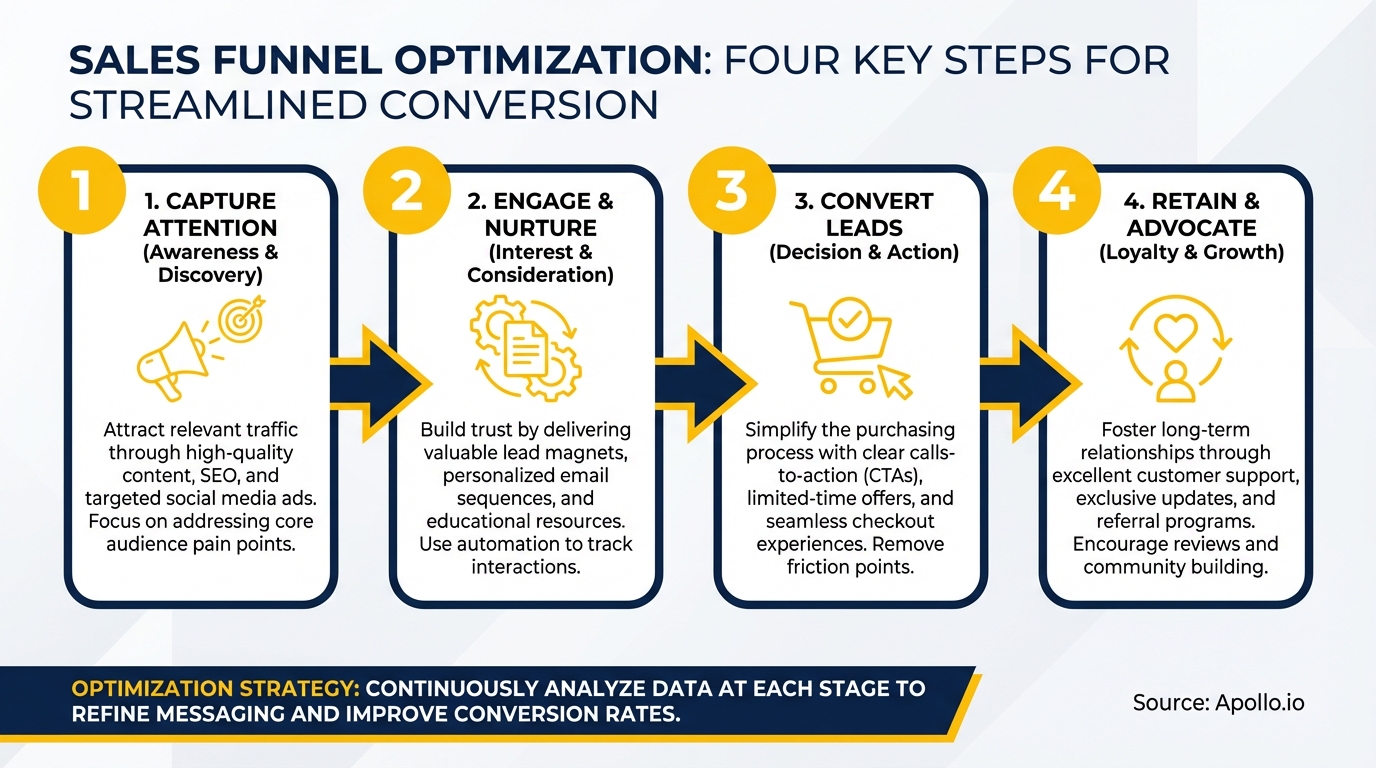
Sales funnel optimization is the systematic process of improving conversion rates, velocity, and revenue at each stage of your sales pipeline. It identifies where prospects drop off, why deals stall, and which interventions move buyers forward.
Unlike traditional lead generation that focuses solely on volume, optimization targets stage-specific bottlenecks with data-driven improvements.
For SDRs and AEs in 2026, this means creating content and workflows that support how buyers actually research—61% now prefer self-educating without sales reps. Optimization requires aligning messaging across your website, outreach sequences, and sales conversations to eliminate the inconsistencies that 69% of B2B buyers report encountering.
Modern funnel optimization also addresses the reality that 86% of B2B purchases stall during the buying process. The goal shifts from generating more leads to unblocking decisions with ROI calculators, implementation roadmaps, and comparison frameworks that buyers can access on-demand.
Why Does Sales Funnel Optimization Matter in 2026?
Funnel optimization directly impacts revenue growth and team efficiency. Research from Salesgenie shows highly aligned companies grow 19% faster and are 15% more profitable. When RevOps leaders optimize their funnel, they reduce cost per acquisition, shorten sales cycles, and improve win rates simultaneously.
The shift to AI-mediated buyer journeys makes optimization even more critical. Buyers now encounter AI Overviews during research, with 72% using these summaries and 90% clicking through to verify sources.
Your funnel content must be citation-worthy and easily extractable by AI systems to remain discoverable.
For Sales Leaders managing quota-carrying teams, optimization delivers predictable pipeline. Instead of hoping more activity generates results, you engineer specific conversion improvements.
A 5-point lift in your mid-funnel conversion rate often delivers more revenue than doubling top-of-funnel leads.
How Do RevOps Teams Optimize Funnel Performance?
RevOps teams start with data hygiene and lifecycle orchestration. Clean, connected records enable accurate attribution, personalization, and automated workflows.
Teams standardize lifecycle stage definitions so marketing and sales share a single source of truth about what qualifies as a Marketing Qualified Lead (MQL) or Sales Qualified Lead (SQL).
Stage-specific optimization follows a diagnostic approach:
- Awareness: Audit content relevance (73% of buyers avoid irrelevant outreach), ensure messaging consistency across channels
- Consideration: Deploy deal-stall content addressing requirements, ROI validation, security reviews
- Decision: Provide vendor comparison frameworks, implementation roadmaps, procurement templates
- Close: Track conversion rates (average sales call conversion is 13-25% per SalesMotion)
Struggling to maintain clean pipeline data across your team? Apollo's deal management platform provides a single source of truth for your entire revenue team.

What Self-Serve Assets Accelerate Funnel Velocity?
Self-serve assets let buyers progress without sales interaction. In 2026, rep-free buying experiences are the default preference for 61% of B2B buyers.
Your funnel must support this behavior with tools that answer questions, validate decisions, and provide implementation clarity.
High-impact self-serve assets include:
| Asset Type | Funnel Stage | Buyer Question Answered |
|---|---|---|
| ROI Calculator | Consideration | What's the financial impact? |
| Implementation Roadmap | Decision | How long until we see value? |
| Vendor Comparison Matrix | Consideration | How do solutions differ? |
| Security Documentation | Decision | Does this meet our requirements? |
| Use Case Library | Awareness | Who else solves this problem? |
For Founders and CEOs building repeatable sales motions, self-serve content reduces dependency on senior sellers for every deal. Companies that excel at nurturing generate 50% more sales-ready leads at 33% lower cost according to MarketingLTB.
Turn Forecast Chaos Into Revenue Clarity
Pipeline forecasting a guessing game? Apollo delivers real-time deal visibility and lead scoring that makes revenue planning predictable. Built-In improved win rates 10% with Apollo's intelligence.
Start Free with Apollo →How Do AEs Unblock Stalled Deals With Content?
AEs face a reality where 86% of B2B purchases stall.
Deal-stall content targets specific blocking moments with templates, checklists, and frameworks that move buyers forward.
This content differs from awareness-stage materials because it addresses procurement, legal review, internal alignment, and budget approval.
Effective stall-unblocking content includes:
- Business Case Templates: Pre-formatted ROI justification with editable assumptions
- Procurement Questionnaires: Answered vendor questions reducing back-and-forth
- Implementation Timelines: Week-by-week rollout plans with resource requirements
- Executive Briefings: One-page summaries for C-level sign-off
- Comparison Guides: Side-by-side feature analysis for evaluation committees
Account Executives managing complex B2B SaaS sales funnels report these assets reduce sales cycles by weeks. The key is making content accessible in your CRM so reps can send the right resource at the right moment without searching or customizing.
What Role Does Data Quality Play in Funnel Optimization?
Data quality determines whether optimization efforts succeed or fail. Dirty data creates false signals—you might think a campaign underperforms when duplicate records split attribution.
RevOps teams treating data hygiene as their highest-priority work see better results from every downstream optimization.
Critical data quality standards include:
- Deduplication: Merge duplicate person and company records to unify engagement history
- Enrichment: Fill missing fields (title, company size, industry) to enable segmentation
- Lifecycle Definitions: Standardize what qualifies as MQL, SQL, Opportunity across systems
- Source Attribution: Track original lead source and all influencing touchpoints
- SLA Timestamps: Record when leads enter each stage to measure velocity
Tired of duplicate records and incomplete contact data? Apollo enriches your database with 224M+ verified business contacts and maintains data accuracy automatically.
For Sales Leaders implementing sales performance management systems, clean data enables accurate forecasting, territory optimization, and rep coaching. You can't optimize what you can't measure accurately.

How Should Teams Measure Funnel Optimization Success?
Measurement connects optimization work to revenue impact. Instead of tracking vanity metrics, focus on conversion rates, velocity, and deal value at each stage. According to Predictable Profits, the overall average B2B conversion rate is 2.9%, giving you a baseline to benchmark against.
Key funnel optimization metrics include:
| Metric | What It Measures | Optimization Goal |
|---|---|---|
| Stage Conversion Rate | % moving to next stage | Increase by identifying drop-off causes |
| Stage Velocity | Days spent in each stage | Reduce time with targeted content |
| Win Rate | % of opportunities closed-won | Improve with better qualification |
| Average Deal Size | Revenue per closed deal | Grow through upsell content |
| Cost Per Acquisition | Total cost to acquire customer | Lower through efficiency gains |
SDRs and BDRs benefit from tracking activity-to-outcome ratios (emails sent to meetings booked, calls made to opportunities created). This reveals which prospecting motions drive pipeline most efficiently, allowing you to double down on what works.
What Tools Consolidate Your Funnel Optimization Stack?
Modern teams consolidate tools to reduce complexity and improve data flow. Managing separate platforms for prospecting, engagement, enrichment, and analytics creates integration headaches and data silos.
An all-in-one approach simplifies workflows while maintaining the single source of truth required for accurate optimization.
Apollo provides sales teams with a unified platform that handles prospecting, engagement, enrichment, and analytics in one workspace. "We reduced the complexity of three tools into one," reports Collin Stewart at Predictable Revenue. This consolidation delivers both cost savings and operational efficiency.
For RevOps teams managing sales productivity across growing teams, tool consolidation reduces training time, eliminates data sync issues, and provides complete visibility into pipeline health. "We cut our costs in half" by moving to a unified platform, notes the team at Census.
Conclusion
Sales funnel optimization in 2026 requires systematic approaches that address self-serve buying, deal stalls, and data quality. RevOps teams focusing on stage-specific conversion improvements and content that unblocks decisions see measurable revenue impact.
The shift to AI-mediated buyer journeys makes citation-rich, easily extractable content essential for discoverability.
Start by auditing your current funnel for the biggest conversion bottleneck. Is it top-of-funnel lead quality?
Mid-funnel stalls? Close-stage win rates?
Focus optimization efforts where a small improvement delivers the largest revenue delta. Implement self-serve assets that let buyers progress independently, and ensure your messaging stays consistent across every touchpoint.
Ready to optimize your sales funnel with an all-in-one platform? Schedule a Demo to see how Apollo consolidates your prospecting, engagement, and pipeline management into one workspace—helping teams book more meetings, close deals faster, and cut their tech stack costs.
Prove Apollo's Value In Your First Week
Budget approval stuck on unclear metrics? Apollo tracks every touchpoint from prospect to close, delivering measurable pipeline impact. Built-In boosted win rates 10% and ACV 10% with Apollo's intelligence.
Start Free with Apollo →Don't miss these
Sales
Inbound vs Outbound Marketing: Which Strategy Wins?
Sales
What Is a Sales Funnel? The Non-Linear Revenue Framework for 2026
Sales
What Is a Go-to-Market Strategy? The 2026 GTM Playbook
See Apollo in action
We'd love to show how Apollo can help you sell better.
By submitting this form, you will receive information, tips, and promotions from Apollo. To learn more, see our Privacy Statement.
4.7/5 based on 9,690 reviews
