
Sales Engagement Software: Definition, Benefits, and Best Practices
Sales teams in 2026 face a paradox: buyers want personalized engagement but prefer self-service experiences. Gartner research shows 61% of B2B buyers now prefer rep-free buying, yet the same buyers expect tailored outreach when reps do reach out. Sales engagement software solves this by automating repetitive tasks while preserving human touchpoints where they matter most.

Apollo Finds Qualified Leads In Minutes
Tired of slow lead generation killing your pipeline? Apollo identifies high-quality prospects with 96% email accuracy and AI-powered targeting. Join 550K+ companies building predictable revenue.
Start Free with Apollo →Key Takeaways
- Sales engagement software automates multi-channel outreach while preserving personalized human interaction at critical touchpoints
- Modern platforms combine prospecting, sequencing, and analytics in one workspace, replacing 3-5 separate tools and cutting costs significantly
- AI-driven features enhance personalization at scale, but 75% of buyers will prefer human-centric experiences by 2030
- Successful implementation requires balancing automation with strategic human engagement across email, phone, and social channels
- ROI comes from tool consolidation, faster ramp times, and measurable improvements in meeting bookings and pipeline velocity
What Is Sales Engagement Software?
Sales engagement software is a platform that automates and orchestrates multi-channel outreach across email, phone, and social channels while tracking every interaction. It combines contact databases, sequencing engines, and analytics into one system that helps sales teams scale personalized communication.
Unlike CRM systems that store data, sales engagement platforms actively drive outreach workflows. They automate follow-ups, prioritize high-intent prospects, and surface insights that guide rep behavior in real-time.
Modern platforms integrate AI to craft personalized messages, identify optimal send times, and predict which prospects are most likely to convert. This technology shift allows SDRs and AEs to focus on conversations rather than administrative tasks.
How Does Sales Engagement Software Work?
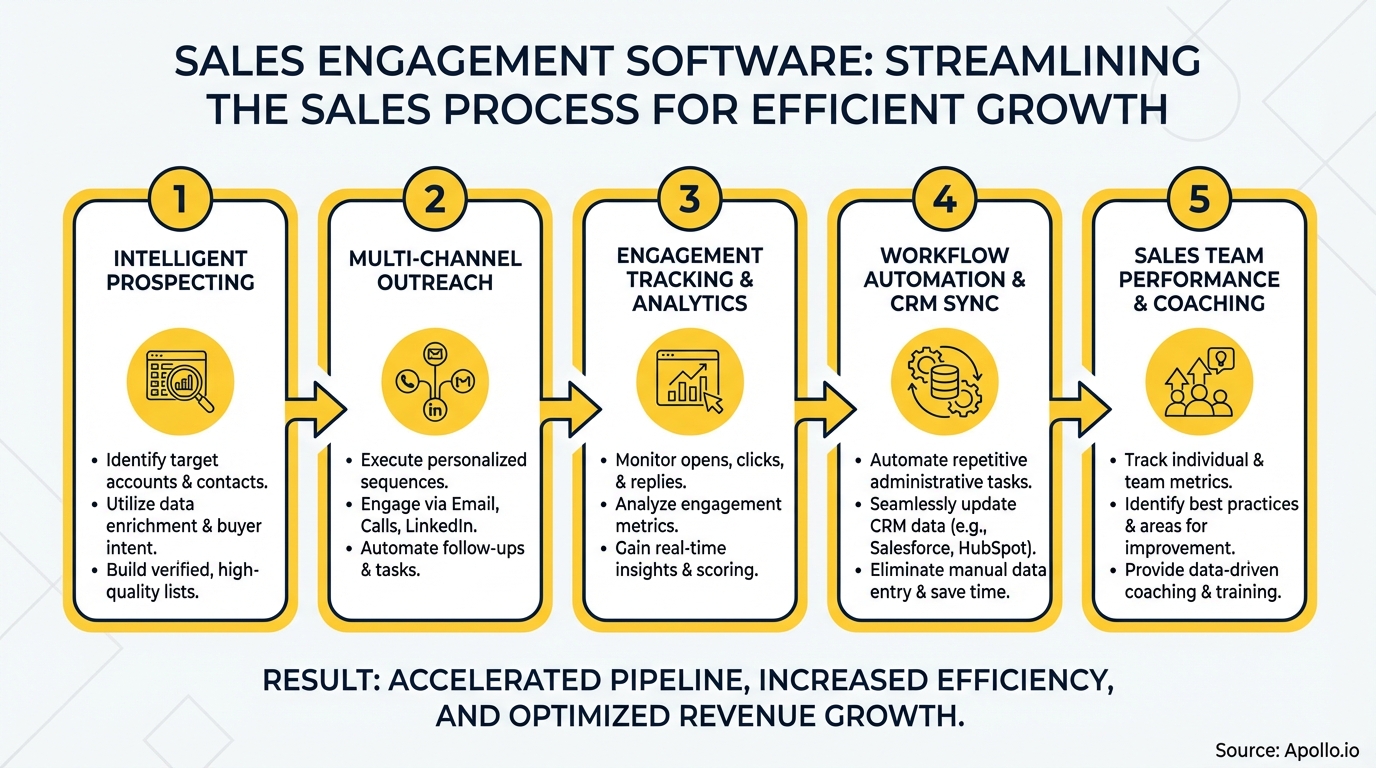
Sales engagement software operates through automated sequences that execute multi-touch campaigns across channels. Reps build workflows with specific touchpoints (emails, calls, social messages) spaced over days or weeks, then enroll prospects who move through each step automatically.
The platform tracks engagement signals like email opens, link clicks, and reply sentiment. When prospects show interest, the system alerts reps to jump in with personalized outreach.
When prospects don't engage, the sequence continues nurturing until they respond or exit the workflow.
Core workflow components:

- Prospecting databases with filters for ICP targeting
- Sequence builders for multi-channel campaigns
- Email templates with personalization variables
- Call scripts and local presence dialing
- Analytics dashboards tracking opens, replies, and bookings
- CRM sync to maintain single source of truth
Struggling to coordinate outreach across channels? Automate your sequences with Apollo's unified engagement platform.
Why Do Sales Teams Need Engagement Software in 2026?
Buyer behavior has fundamentally changed. Research from Northwestern University's Spiegel Research Center found that doubling digital engagements leads to a twofold increase in sales opportunities. Yet manual outreach can't scale to meet this demand.
Sales engagement software bridges this gap by enabling personalization at scale. Teams can maintain human authenticity while reaching 10x more prospects through automated workflows that feel individually crafted.
Business drivers for adoption:
- Tool consolidation: Replace prospecting, sequencing, and dialing tools with one platform
- Cost reduction: Cut software spend versus buying ZoomInfo, Outreach, and Gong separately
- Faster ramp: New SDRs become productive in weeks instead of months
- Pipeline predictability: Track leading indicators like email reply rates and call connection rates
- Data accuracy: Maintain clean contact information with automated enrichment
Census, a data platform company, cut their costs in half by consolidating their tech stack into one engagement platform. Cyera's sales team found that having everything in one system was a game changer for productivity.
Turn Forecast Guesswork Into Revenue Certainty
Missing quota because your pipeline visibility is a black box? Apollo gives you real-time deal intelligence and buyer intent signals so you can forecast with confidence. Built-In increased win rates 10% with Apollo's scoring.
Start Free with Apollo →How Do SDRs Use Engagement Software to Book More Meetings?
SDRs use engagement software to automate repetitive prospecting tasks while preserving time for high-value activities like research and live conversations. The platform handles sequence execution, follow-up timing, and activity logging automatically.
Modern SDRs build sequences that blend automated touches with manual personalization. They might send 3-4 automated emails, then add a personalized video or voice note when a prospect opens multiple messages.
This hybrid approach maintains authenticity while scaling outreach volume.
Daily SDR workflow with engagement software:
| Time | Activity | Platform Feature |
|---|---|---|
| 9:00 AM | Review engagement alerts | Dashboard shows hot prospects who replied or clicked |
| 9:30 AM | Respond to inbound interest | Email sync pulls conversations into one inbox |
| 10:00 AM | Enroll new prospects | Search database with ICP filters, add to sequences |
| 11:00 AM | Make calls from sequence | Click-to-dial with local presence and call recording |
| 2:00 PM | Personalize high-priority outreach | AI research agent surfaces prospect intel |
| 3:00 PM | Review performance metrics | Analytics show reply rates, meeting bookings, best sequences |
Teams using optimized sequences report measurable improvements in meeting bookings by focusing rep time on personalization instead of manual tasks.
What Features Should You Look for in 2026?
The sales engagement category has matured beyond basic email automation. Leading platforms in 2026 combine prospecting databases, AI-powered personalization, conversation intelligence, and deal management in one workspace.
Essential platform capabilities:
- Unified database: Built-in contact data eliminates need for separate prospecting tools
- Multi-channel sequences: Coordinate email, phone, and social touches in one workflow
- AI message generation: Create personalized emails based on prospect context and intent signals
- Conversation intelligence: Record calls, generate summaries, surface coaching opportunities
- Revenue analytics: Track metrics from first touch to closed deal
- Native integrations: Sync with CRM, calendar, and communication tools
Predictable Revenue reduced the complexity of three separate tools into one unified platform, streamlining their entire sales workflow. This consolidation eliminates integration headaches and reduces training time for new reps.
Spending too much on disconnected tools? Consolidate your tech stack with Apollo's all-in-one GTM platform.
How Do You Balance AI Automation with Human Personalization?
The most effective sales strategies in 2026 use AI for research and drafting while preserving human judgment for relationship building. Gartner predicts that by 2030, 75% of B2B buyers will prefer sales experiences prioritizing human interaction over AI.
Smart teams use AI to handle time-consuming tasks like contact research, initial message drafting, and follow-up scheduling. Reps then add personal touches, contextual insights, and authentic voice before sending.
Framework for AI-human balance:
- AI handles: Prospect research, company intelligence, email drafts, send-time optimization, sequence execution
- Humans handle: Message review and editing, voice notes, live calls, objection handling, relationship nurturing
- Hybrid approach: AI generates first draft, rep personalizes with specific insights, platform automates delivery and follow-up
For Account Executives managing complex deals, AI surfaces pre-meeting intelligence while reps focus on strategic positioning and executive relationship building. This division of labor maximizes both efficiency and authenticity.
RevOps leaders implementing AI sales tools report that governance frameworks ensure quality control while allowing reps to move faster on high-intent opportunities.
Conclusion
Sales engagement software has evolved from simple email automation into comprehensive platforms that orchestrate entire go-to-market motions. The winning approach in 2026 combines AI-powered efficiency with human-centric personalization, meeting buyers where they are while respecting their preference for both self-service and authentic interaction.

Teams that consolidate prospecting, engagement, and analytics into one platform eliminate tool sprawl, reduce costs, and accelerate rep productivity. The result is predictable pipeline generation backed by data-driven insights and measurable ROI.
Ready to modernize your sales engagement strategy? Request a Demo to see how Apollo's all-in-one platform helps teams book more meetings, close more deals, and cut their tech stack in half.
Prove Apollo's ROI In Days, Not Quarters
Budget approval stuck on unclear metrics? Apollo tracks pipeline impact from day one—quantifiable meetings booked, deal velocity, and revenue attribution. Built-In increased win rates 10% and ACV 10% with Apollo's scoring.
Start Free with Apollo →Don't miss these
Sales
Inbound vs Outbound Marketing: Which Strategy Wins?
Sales
What Is a Sales Funnel? The Non-Linear Revenue Framework for 2026
Sales
What Is a Go-to-Market Strategy? The 2026 GTM Playbook
See Apollo in action
We'd love to show how Apollo can help you sell better.
By submitting this form, you will receive information, tips, and promotions from Apollo. To learn more, see our Privacy Statement.
4.7/5 based on 9,690 reviews
