
Sales Classes That Drive Real Pipeline Growth in 2026
Sales classes in 2026 are evolving beyond traditional lecture-based training into ROI-driven, AI-enhanced learning experiences that deliver measurable pipeline growth. Modern sales professionals need practical skills that translate directly into booked meetings, closed deals, and revenue impact. Whether you're an SDR looking to double your outreach efficiency or a sales leader building a high-performing team, the right training approach combines proven methodologies with cutting-edge technology. Today's most effective sales development strategies integrate AI-powered tools, data-driven insights, and hands-on practice that mirrors real-world selling scenarios.

Skip Research - Apollo Finds Contacts Instantly
Tired of spending 4+ hours daily hunting for contact info? Apollo delivers 224M verified contacts with 96% email accuracy so your team sells instead of searches. Join 550K+ companies closing more deals.
Start Free with Apollo →Key Takeaways
- Sales classes in 2026 combine AI-enabled tools, data integration, and practical exercises to deliver measurable revenue outcomes
- Modern training focuses on LinkedIn-centric prospecting, automated workflows, and tech stack consolidation to maximize efficiency
- ROI-focused curricula help SDRs book 46% more meetings and AEs increase bookings by 35% using AI research and messaging
- Effective programs include downloadable templates, scenario-based learning, and real-time performance tracking
- The best sales training integrates directly with your CRM and sales engagement platforms for seamless skill application
What Are Sales Classes?
Sales classes are structured training programs designed to develop prospecting, relationship-building, and closing skills for revenue teams. They combine theoretical frameworks with actionable techniques that sales professionals can implement immediately.
Unlike generic professional development, modern sales classes focus specifically on B2B selling methodologies, digital engagement strategies, and technology-enabled workflows.
The landscape shifted dramatically as B2B buying behaviors evolved. Research by Statista shows that digital channels now drive a substantial portion of B2B sales, requiring sales teams to master online prospecting, virtual selling, and data-driven personalization. Today's training programs address these digital-first realities with curriculum covering LinkedIn social selling, AI-powered research, and automated outreach sequences.
Modern sales classes serve multiple roles across organizations:
- New hire onboarding: Accelerate ramp time from 6 months to 8-12 weeks with structured skill development
- Skill enhancement: Keep experienced reps updated on emerging techniques like AI-assisted personalization
- Team alignment: Standardize methodologies across SDRs, AEs, and account managers for consistent execution
- Technology adoption: Train teams to maximize ROI from sales platforms and automation tools

How Do Sales Classes Improve Revenue Performance?
Effective sales classes drive measurable improvements in pipeline generation, conversion rates, and deal velocity by teaching systematic approaches to prospecting and closing. The key differentiator in 2026 is integration between training content and the actual tools teams use daily.
When SDRs learn prospecting techniques directly within their sales engagement platform, adoption rates increase and skills translate immediately into booked meetings.
According to data from Gitnux, 89% of B2B marketers use content marketing to generate leads for SaaS products, with case studies proving most effective. Sales classes that incorporate real customer success stories and documented methodologies from top performers create replicable frameworks for entire teams. For Account Executives managing complex deals, training on structured deal management approaches helps shorten sales cycles and improve forecast accuracy.
The most impactful programs focus on three core competencies:
- Targeted prospecting: Using intent signals, technographic data, and buying committee mapping to identify high-fit accounts
- Multi-channel engagement: Coordinating email, LinkedIn, phone, and video outreach for maximum response rates
- Data-driven personalization: Leveraging company research and trigger events to craft relevant messaging
Struggling to find qualified leads at scale? Search Apollo's 224M+ contacts with 65+ filters to build targeted prospect lists in minutes.
What Topics Should Modern Sales Classes Cover?
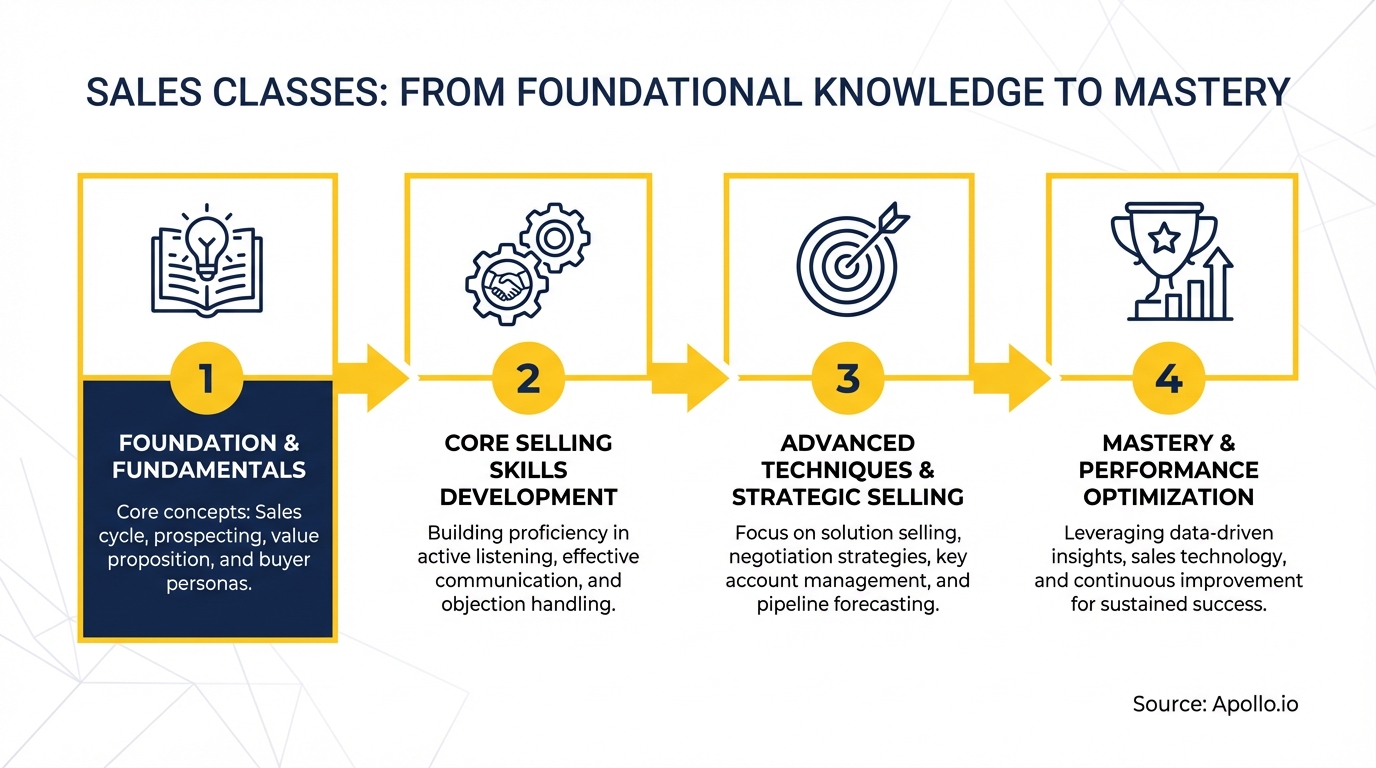
The most effective sales training curricula in 2026 balance foundational selling principles with emerging AI-powered techniques and technology workflows. Rather than generic soft skills, programs should address specific capabilities that directly impact revenue metrics.
For SDRs and BDRs, this means mastering outbound prospecting at scale while maintaining personalization that resonates with buyers.
| Training Module | Key Skills Covered | Target Audience |
|---|---|---|
| AI-Powered Research | Using AI to analyze accounts, identify pain points, generate talking points | SDRs, BDRs, AEs |
| LinkedIn Prospecting | Building connections, engaging with content, booking meetings through social | SDRs, Sales Leaders |
| Sequence Optimization | Multi-touch cadence design, A/B testing, response rate improvement | SDRs, RevOps |
| Discovery Methodology | Uncovering business problems, qualification frameworks, pain amplification | AEs, Sales Leaders |
| Tech Stack Mastery | CRM hygiene, sales engagement platforms, conversation intelligence tools | All revenue roles |
Sales classes should also address the tool consolidation opportunity that defines modern revenue operations. Teams using 5-7 separate tools for prospecting, engagement, enrichment, and analytics face integration headaches and inflated costs.
Training that demonstrates unified platforms helps organizations realize significant savings. As one customer noted, "We reduced the complexity of three tools into one" (Predictable Revenue), while another reported "We cut our costs in half" (Census).
Turn Forecast Guesswork Into Revenue Certainty
Pipeline forecasting a guessing game? Apollo's real-time visibility shows exactly where every deal stands so you can predict revenue with confidence. Built-In increased win rates 10% with Apollo's scoring and signals.
Start Free with Apollo →How Do SDRs Book More Meetings With Sales Training?
SDRs booking more meetings consistently master three critical skills: rapid account research, compelling first-touch messaging, and persistent multi-channel follow-up. The challenge facing SDRs in 2026 is volume versus quality.
Teams must contact enough prospects to hit meeting quotas while personalizing outreach sufficiently to earn responses. AI-powered research tools solve this equation by automating the time-intensive work of company analysis and pain point identification.
SDRs using AI research agents report 46% more meetings booked compared to manual prospecting approaches. The efficiency gain comes from eliminating 30-45 minutes of pre-call research per prospect.
Instead of manually reviewing websites, LinkedIn profiles, and news mentions, SDRs receive AI-generated summaries highlighting relevant business initiatives, technology usage, and potential pain points.
This intelligence feeds directly into personalized email templates and phone conversation guides.
Practical training for SDRs should include:
- Ideal customer profile development: Defining firmographic and technographic criteria for high-converting prospects
- Value proposition crafting: Translating product features into business outcomes specific to each buyer persona
- Objection handling frameworks: Responding to common pushback on timing, budget, and competitive alternatives
- Meeting setting techniques: Using assumptive closes, offering specific time slots, and reducing friction in booking process
The most successful SDR training incorporates live practice with real prospects using proven pitch techniques and immediate coaching feedback. Role-playing exercises where SDRs handle discovery questions, navigate gatekeepers, and overcome objections build confidence before actual prospect conversations.
What Technology Should Sales Classes Teach?
Sales classes in 2026 must address the technology stack that powers modern revenue teams, with emphasis on platforms that consolidate multiple functions into unified workflows. The reality facing sales organizations is tool sprawl: separate systems for contact data, email sequencing, call recording, meeting scheduling, and pipeline tracking.
This fragmentation creates data silos, integration maintenance, and inflated software costs.
Training should focus on all-in-one platforms that handle prospecting through closing in a single workspace. For RevOps teams managing tech stack decisions, understanding consolidation opportunities delivers immediate ROI.
One customer found that "Having everything in one system was a game changer" (Cyera), eliminating the friction of context-switching between tools and maintaining data consistency across systems.
Essential technology capabilities to cover:
- Contact database access: Searching and filtering 224M+ business contacts with accurate email and phone data
- Sales engagement automation: Building multi-channel sequences with email, LinkedIn, and phone touchpoints
- AI-powered personalization: Generating customized messaging based on account research and buyer signals
- Conversation intelligence: Recording calls, transcribing conversations, and extracting action items automatically
- Pipeline visualization: Tracking deal progress, forecasting revenue, and identifying at-risk opportunities
Spending hours jumping between tools to research prospects and log activities? Consolidate your tech stack with Apollo's all-in-one sales platform.

How Should Sales Leaders Measure Training ROI?
Sales leaders measuring training effectiveness should track leading indicators like activity volume and message quality alongside lagging metrics such as pipeline generated and revenue closed. The challenge with traditional sales training is the gap between classroom learning and on-the-job application.
Sales managers need visibility into whether new skills translate into changed behaviors and improved outcomes.
For Founders and CEOs evaluating training investments, ROI comes down to cost per meeting booked and customer acquisition cost reduction. If training accelerates rep ramp time from 6 months to 3 months, the organization gains an additional quarter of productive selling from each new hire.
When training improves conversion rates at each funnel stage, fewer leads are required to hit revenue targets.
Key performance indicators to monitor:
| Metric Category | Specific KPIs | Target Improvement |
|---|---|---|
| Activity Metrics | Emails sent, calls made, LinkedIn messages, meetings requested | 20-30% increase in quality outreach volume |
| Engagement Metrics | Email open rates, reply rates, meeting acceptance rates | 15-25% improvement in response rates |
| Pipeline Metrics | Qualified opportunities created, average deal size, win rate | 25-40% increase in pipeline generated |
| Efficiency Metrics | Time to first meeting, sales cycle length, quota attainment | 30-50% faster ramp to full productivity |
The most sophisticated sales organizations integrate training platforms directly with their CRM and sales engagement systems. This integration enables real-time skill assessment based on actual selling behaviors rather than quiz scores.
Sales Leaders can identify which techniques drive results and which require additional coaching or refinement.
Start Implementing Sales Training That Drives Results
Sales classes deliver maximum ROI when they combine proven methodologies with the technology tools your team uses daily. The future of sales training is practical, AI-enhanced, and measurable.
Rather than generic soft skills workshops, invest in programs that teach your SDRs how to leverage data for personalized outreach, your AEs how to navigate complex deals with intelligence, and your entire team how to consolidate fragmented workflows into unified platforms.
The organizations winning in 2026 recognize that sales training is not a one-time event but an ongoing capability-building process. By integrating learning directly into daily workflows and measuring improvements in pipeline metrics, you create a culture of continuous improvement.
For teams looking to scale revenue efficiently, the right combination of skills training and technology enablement makes the difference between hitting quota and consistently exceeding targets.
Ready to equip your team with the tools and training they need to succeed? Start prospecting with Apollo's all-in-one platform and see how consolidating your tech stack accelerates results across your entire revenue organization.
Prove Apollo's ROI In 30 Days, Not 6 Months
Budget approval stuck on unclear metrics? Apollo tracks every dollar spent to pipeline generated—quantify time saved, meetings booked, and deals closed in real-time. Built-In increased win rates 10% and ACV 10% with Apollo's ROI dashboard.
Start Free with Apollo →Don't miss these
Sales
Inbound vs Outbound Marketing: Which Strategy Wins?
Sales
What Is a Sales Funnel? The Non-Linear Revenue Framework for 2026
Sales
What Is a Go-to-Market Strategy? The 2026 GTM Playbook
See Apollo in action
We'd love to show how Apollo can help you sell better.
By submitting this form, you will receive information, tips, and promotions from Apollo. To learn more, see our Privacy Statement.
4.7/5 based on 9,690 reviews
